How to Attract Cardinals to Your Yard
As an Amazon Associate we earn from qualifying purchases.
How to attract cardinals starts with three basic needs: food, cover and water. Northern cardinals do not migrate, so a yard that meets those needs can hold the same birds through the year. The sources we opened agree on sunflower seed, dense shrubs and clean water as the practical steps, and they advise placing feeders near cover. This guide takes each need in turn and shows which source supports each step.
Quick answer
- Offer black oil sunflower seed in a platform or hopper feeder placed near shrubs or trees.
- Plant dense shrubs, especially those that bear fruit, for nesting cover and food.
- Keep clean water available, and check birdbaths during extreme cold.
- Clean feeders regularly, because moldy seed and hulls can build up.
Plan for a bird that stays all year
Cardinals are year-round residents, and that changes how you plan. The University of Florida’s IFAS fact sheet says: “Cardinals are non-migratory, remaining in or near their territories year-round.” The Pennsylvania Game Commission agrees: “They are year round residents throughout their range.” Mississippi State University Extension makes the same point in its bird-of-the-month note: “However, cardinals are resident species and do not migrate.”
A yard that serves cardinals in winter also serves them in spring and summer. The UF/IFAS sheet covers the breeding season, when the bird’s territorial behavior is strongest. The same plantings and feeders therefore work across the year, and the window advice later in this guide follows the same calendar.
Offer black oil sunflower seed
Seed is the core of a cardinal feeding plan. The UF/IFAS fact sheet says: “The cardinal’s beak morphology reflects its primary dietary niche: seeds.” Its list of seed foods includes sunflower, grasses, weeds and commercial birdseed. Sunflower is the seed that several of the sources name, and Mississippi State’s winter guide gives the reason in its own words: “Black oil sunflower seeds are ideal for winter, since they provide the highest calories per ounce!”
Sunflower also has a range story. The UF/IFAS fact sheet lists feeders among the reasons the bird has moved north, and states that “Widespread use of feeders stocked with sunflower seeds supports winter survival in colder regions.” Its other explanations are human-altered landscapes and milder winters, so feeders are one part of the picture rather than the whole of it.
Cardinals are not only seed-eaters. The UF/IFAS sheet says they are “largely gleaners, plucking items from branches or the ground, though they occasionally engage in short flights to capture insects.” During the breeding season the sheet says adults eat more insects, so the diet shifts with the season.
Choose a feeder that suits a larger seed-eater
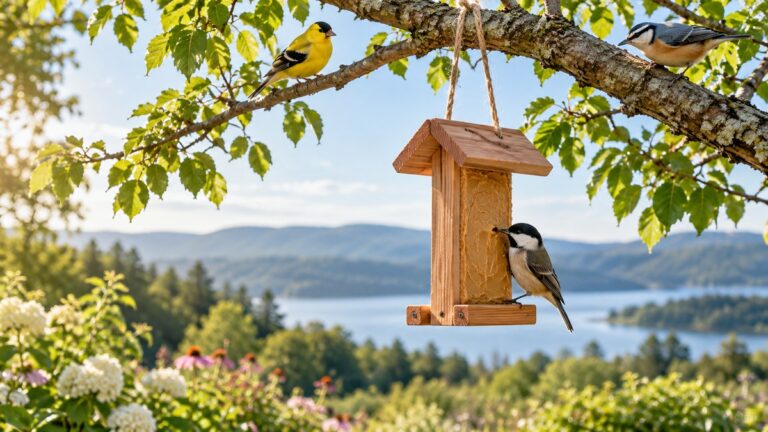
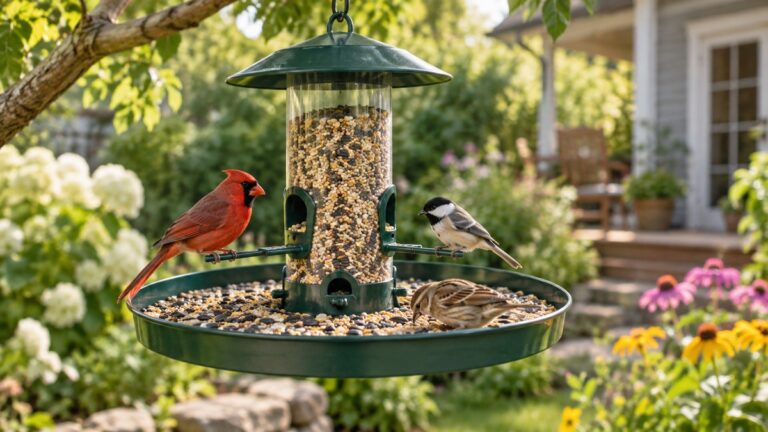
Feeder style decides which birds can use the seed. Washington State University’s bird guide says: “Platform feeders with a screened tray for drainage and hopper feeders are good for larger birds”. It contrasts that with tube feeders: “Tube feeders with shorter metal perching stations may attract smaller birds such as chickadees and finches, while excluding larger birds like jays.” The sources we opened do not name cardinals for one feeder type, so a platform or hopper feeder is the style to try first, and you can watch which birds use it.
Washington State also advises matching the amount to the birds’ appetite: put out “seed the birds will eat in a day or two and clean feeders often.” The cleaning routine below covers what happens when seed is left to sit.
Put feeders near trees and shrubs
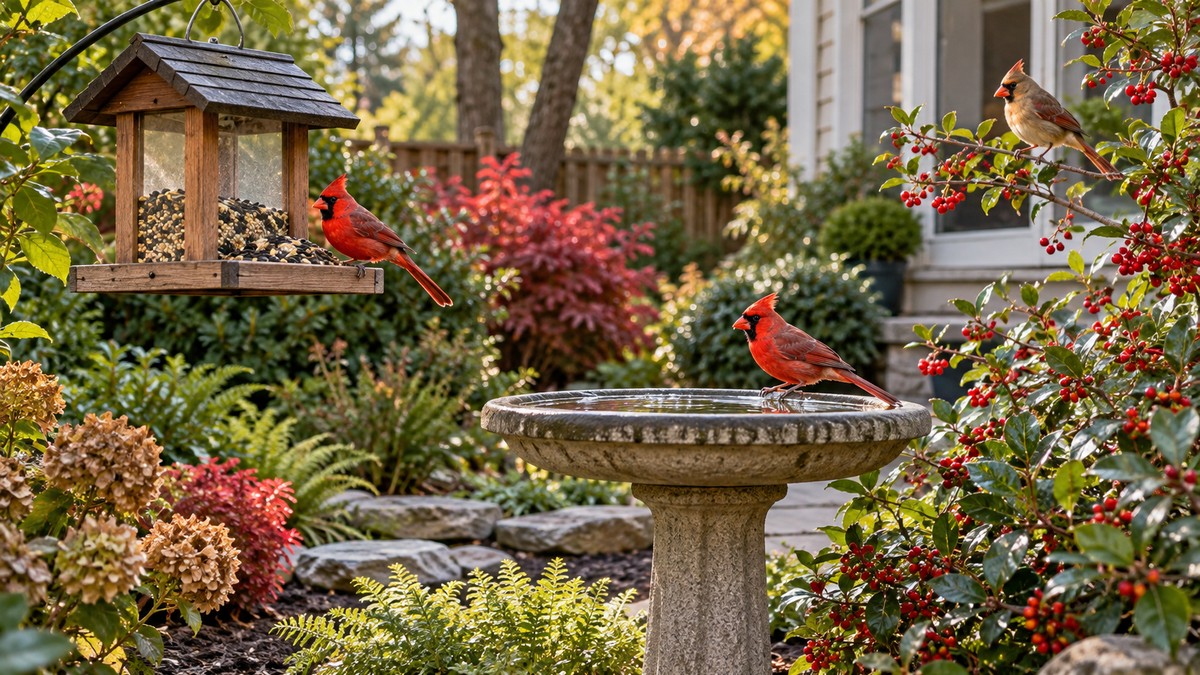
Placement is the second decision. Mississippi State’s winter guide says: “Be sure to always have bird feeders and water stations filled, and try to place them near trees and shrubs for easy access.” The reason is cover. The UF/IFAS sheet describes cardinal habitat as “understory and mid-story vegetation”, and says this is “where they place nests, avoid predators, and feed on fruiting shrubs.”
Washington State’s guide adds a rule for the feeder’s own spot: “All feeders should be located out of the wind”, with some type of cover nearby. Together, the two rules point to a spot that is sheltered from the wind and close to a shrub or tree. If you need to deter squirrels too, see keeping squirrels off feeders for the next step.
Plant the dense shrubs cardinals use
Cover is where cardinals nest, and the Pennsylvania Game Commission says plainly: “They need dense shrubs for nesting”. The same page describes the birds’ homes: “Cardinals live in thickets, hedgerows, brushy fields, swamps, gardens, and towns and cities.” Its advice for a yard is direct: “People who enjoy cardinals can help their fate by promoting the growth of shrubs and brambles on their property.”
The UF/IFAS sheet says that “Northern Cardinals thrive in dense, shrubby vegetation.” It also lists food plants that a yard can supply: “Fruit: Hackberry, beautyberry, blackberry, sumac, mulberry, and many ornamental shrubs”. Mississippi State’s bird-of-the-month note gives a planting rule: “Consider planting shrubs with fruits or berries to provide birds with a food source.” Its winter guide names specific choices: “Plants like wax myrtles, hollies, and American red cedars are great options!”
Native plants also feature in the winter guide. It says that “Other items to plant include native grasses like bluestem and broomsedge, which are also great for shelter.” It also recommends “planting native trees and shrubs in your landscape”, because “This creates a year-round source of shelter and food for birds.” Many shrubs look bare in cold months, when the guide says they lose “their primary sources of shelter and food.” A mix of evergreen cover and fruiting shrubs covers that gap, and the sources do not suggest a single plant for every region.
Brush is the quickest form of cover. The winter guide says: “For instant impact, you can create brush piles that will provide a safe haven and attract food sources to the area.” It presents brush piles as a quick step for a yard that has no room for a hedge, and it pairs them with the planted cover described above.
Fruit matters in winter too. The Pennsylvania Game Commission notes that “In winter, cardinals forage on a variety of wild fruits and berries as well as seeds.” The fruiting shrubs above therefore serve the bird’s food list as well as its cover. The sources do not give a yield or a timing schedule for any shrub, so pick plants that suit your region and soil.
Provide clean, reliable water
Water is the third need. The Mississippi State winter guide asks for “food, water, and shelter” together, and its bird-of-the-month note suggests that you can “set out bird feeders and a birdbath to encourage them to make themselves at home.” The winter guide also says that freezing is less of a concern in its region: “Since temperatures in our region do not remain below freezing often, there’s not much concern for frozen water.”
That regional point matters, because colder places meet the advice more often. In those yards, the guide’s cold-weather rule applies: “Still, check on any birdbaths or fountains during extreme cold weather to make sure there is clean, flowing water available for them.” Clean and flowing are the two words to keep in mind. The sources we opened do not give a heater rule or a water depth, so check product labels and your local extension office for those details.
Clean feeders on a schedule
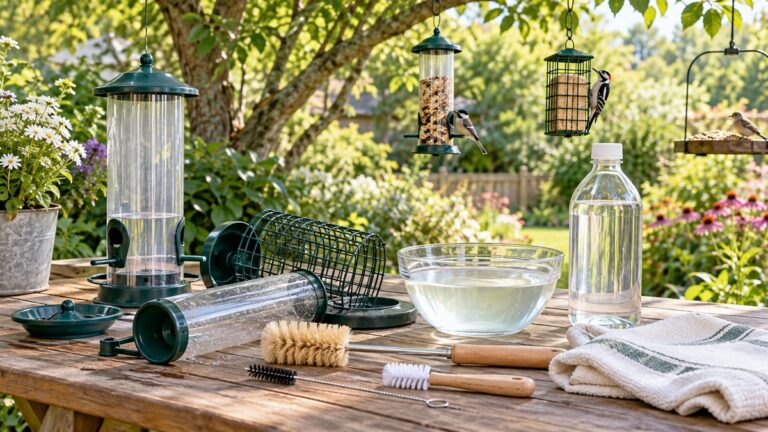
Cleaning is the step many yards skip. Washington State’s guide says that “All feeders should be cleaned on a regular basis”, because moldy and decomposing seeds and hulls build up. Its routine is short: “Start by removing old seeds, take the feeder apart and handwash in hot, soapy water”. Then comes the drying step: “Rinse thoroughly, dry and refill.” The same guide adds that you should “Clean the area under your feeders”, since spilled seed collects there.
Mississippi State’s winter guide explains why the routine matters: “Regular cleaning reduces the opportunity for disease spread among backyard birds, especially during winter when birds congregate at these features in high numbers.” In cold months more birds crowd into the same spots, so a clean feeder matters more then. For a separate cleaning method, see how to clean bird feeders with vinegar.
Expect territorial behavior at windows
Cardinals defend their space, and that can show up on your windows. The UF/IFAS sheet explains: “A well-known behavior in cardinals is window fighting, where individuals attack their own reflection during the breeding season, perceiving it as a territorial intruder.” The sheet also notes that “Males show this behavior most, though females occasionally participate.”
The fix the sheet offers is simple. “You can reduce the reflection of the problematic window with soapy water.” It adds that “You only need to do this during the summer breeding season as territorial aggression decreases in fall and winter.” The sheet describes cardinals as “territorial throughout much of the year,” so the window fix is tied to the season rather than to the bird’s presence.
Mistakes to avoid
- Relying only on tube feeders, which Washington State says tend to exclude larger birds such as jays.
- Placing feeders in open ground, far from the shrubs and trees the bird uses for cover.
- Letting moldy seed and hulls build up between fills.
- Forgetting water during extreme cold, when the sources ask you to check birdbaths.
- Leaving the yard bare of shrubs, when the sources name dense shrubs for nesting.
- Ignoring window fighting during the breeding season.
How we chose
We chose five university, extension and state-agency pages that cover cardinal habitat, food, water or feeder care, and that we could open and read. Two other pages returned errors when opened, so they are not cited. We kept a statement only when a page states it in plain words. Some pages focus on winter feeding and others on the bird’s year-round habits, so we say which season each point applies to. The Pennsylvania Game Commission page and the UF/IFAS fact sheet supply most of the habitat and behavior detail, and the two Mississippi State pages and the Washington State guide supply the feeding, water and cleaning steps.
What we could not verify
What the sources do not say
The sources we opened do not name a feeder brand or a model, and they do not give a daily amount of seed. They do not say how quickly a cardinal will find a new feeder. They do not give a shrub list for every region, so check your state extension office for native choices near you. Mississippi State says freezing is not often an issue in its region, so its freezing advice may not fit colder yards. The Pennsylvania Game Commission page is written for Pennsylvania, and its region may differ from yours.
Frequently asked questions
Do cardinals migrate?
No. The UF/IFAS fact sheet says cardinals are non-migratory and remain in or near their territories year-round. Mississippi State University Extension says the same: “However, cardinals are resident species and do not migrate.”
What food should you put out for cardinals?
Black oil sunflower seed is the food the sources name most often. Mississippi State says it provides the highest calories per ounce, and the UF/IFAS sheet lists sunflower among the seeds cardinals eat. Offer it in a platform or hopper feeder near cover.
Do cardinals need water in winter?
The Mississippi State winter guide lists water with food and shelter as the three things a backyard habitat should provide. It says freezing is not often a concern in its region, but it advises checking birdbaths and fountains during extreme cold so the water stays clean and flowing. The sources we opened do not give a heater rule.
Why is a cardinal attacking a window?
The UF/IFAS sheet describes window fighting, where birds attack their reflection during the breeding season. Males show the behavior most. The sheet says you can reduce the reflection with soapy water, and that the behavior decreases in fall and winter.
Can cardinals be attracted without a feeder?
Yes, the sources point to shrubs, fruit and cover. Mississippi State advises planting shrubs with fruits or berries, and the Pennsylvania Game Commission says cardinals forage on wild fruits and berries in winter as well as seeds. Native shrubs, native grasses and brush piles also give cover, as the Mississippi State winter guide notes.
Bottom line
Give cardinals black oil sunflower in an open feeder near shrubs, plant dense cover that bears fruit, and keep the water clean all year.
Sources
- https://ask.ifas.ufl.edu/publication/UW551/pdf (opened 2026-10-22)
- https://pgc.pa.gov/Education/WildlifeNotesIndex/Pages/Northern-Cardinal.aspx (opened 2026-10-22)
- https://extension.msstate.edu/blogs/extension-for-real-life/bird-the-month-northern-cardinal (opened 2026-10-22)
- https://extension.msstate.edu/blogs/extension-for-real-life/how-create-winter-habitat-for-birds (opened 2026-10-22)
- https://wpcdn.web.wsu.edu/extension/uploads/sites/57/2023/04/Birds-in-Winter.pdf (opened 2026-10-22)