How Long to Run a Drip Irrigation Timer
As an Amazon Associate we earn from qualifying purchases.
Readers asking how long to set timer for drip irrigation usually want a single number, and the extension sources do not give one. They give a method instead: set a weekly water target, convert it into run time using the flow rate, cap each run for your soil, and then choose the days. Each step below comes from a named guide, with the arithmetic shown where it is ours.
A number from one table or one soil applies only to that case. Treat the examples as a check on your own math, not as a setting to copy.
Quick answer
- Start from the weekly target. The Arkansas guide puts most fruit and vegetable crops at about 1 to 2 inches of water per week.
- Convert the target using your flow rate. Utah State gives an inline drip formula that turns emitter flow and spacing into an application rate.
- Cap each run for your soil. The Florida guide sets a limit of under 60 minutes per run for Florida’s sandy soils, which is a regional rule, not a general one.
Step 1: Set the weekly target
The Arkansas guide gives the planning range of about 1 to 2 inches per week for most fruit and vegetable crops, while noting that every crop has its own needs. That range is a starting point. The UC Master Gardener guide shows why the number moves with the season. It notes that reference evapotranspiration, the water need of a standard reference crop, has been calculated for every month of the year for locations in California. It also calls working out how much and when to water the biggest challenge in drip irrigation. The weekly target is therefore a seasonal number, and it is worth revisiting each month.
Stay inside the range for your crop and climate. The sources do not give one target for every garden, so pick a number between one and two inches, then adjust it once you see how the soil behaves through the season.
Step 2: Turn the target into run time
Run time depends on the application rate, which comes from the flow rate and the spacing. Utah State points out that it is hard to know how many inches a system delivers each hour from a flow rate listed in gallons per hour, which is why the conversion matters. Its formula for inline drip is: drip rate equals the flow per emitter times 231, divided by the emitter spacing in inches times the lateral spacing in inches. The Arkansas guide says that if the label omits the flow rate, it can be calculated with its formulas. Read the label first, and calculate only if it is missing.
The Utah State table gives a worked row. For 5/8-inch tape at 8-inch spacing on a 100-foot row with 2-foot row spacing, the table lists an application rate of 0.16 inches per hour, and 3.15 hours to apply half an inch. The last column is hours for half an inch, so the row shows 3.15 hours for half an inch. At that rate a full inch takes about 6.3 hours. That doubling is our arithmetic from the table, not a figure the guide states, and it holds only if the rate and the row layout match your system.
Penn State reaches the same kind of answer with its own assumptions. Its example uses a drip tube rated at 0.45 gallons per minute per 100 feet and a 30-inch width of bed. It concludes that events should be repeated until a week’s run totals 5.8 hours, which delivers one inch of water. The figure depends on the flow rate and the bed width, so it is an example to learn from, not a number to copy.
Step 3: Split the weekly total into events
Penn State’s worked example shows how one weekly total becomes several runs. Its soil has a water-holding capacity of 0.12 inch of water per inch of soil. For that case it gives a run of 110 minutes per irrigation event, typically within a 24-hour period, chosen to avoid leaching and runoff. The weekly total is then reached by repeating events, not by running one long event.
The UC Master Gardener guide shows the same logic from the flow side. Its example design delivers 40 gallons per hour. Running that design for 75 minutes puts out about 50 gallons per watering cycle, and the guide ties that to its monthly target. You can check the arithmetic yourself: gallons per hour, times minutes, divided by 60. For the UC example, 40 times 75 divided by 60 is 50 gallons, which matches the guide’s figure.
Step 4: Cap each run for your soil
The cap is the most time a single event should run. The Arkansas guide provides a Table 3 that sets it, giving the maximum recommended run time in minutes for a single irrigation event, based on the soil’s water-holding capacity and the drip tape’s flow rate. Penn State uses the same logic, reading the maximum minutes it can run at one time from a table using water-holding capacity and the tube’s flow rate.
The cap depends on the soil’s water-holding capacity, and Penn State’s table lists that capacity by texture in inches of water per inch of soil. Coarse sand and compacted sands fall at 0.02 to 0.06, and sandy loam at 0.11 to 0.15. The Arkansas guide works through a sandy loam example, using a water-holding capacity of 0.10 to 0.12 inches of water per inch of soil together with a tube flow rate of 0.5 gallons per minute per 100 feet, and then reads the cap from its Table 3. Because the cap depends on that capacity, one number does not fit every bed.
Penn State ties its 110-minute limit to avoiding leaching and runoff, so do not copy that number, which belongs to its own soil and flow rate. The University of Florida gives a simpler regional rule: under 60 minutes per run for Florida’s sandy soils. Outside Florida, use the cap table for your own soil rather than that number.
Step 5: Set the days and start times
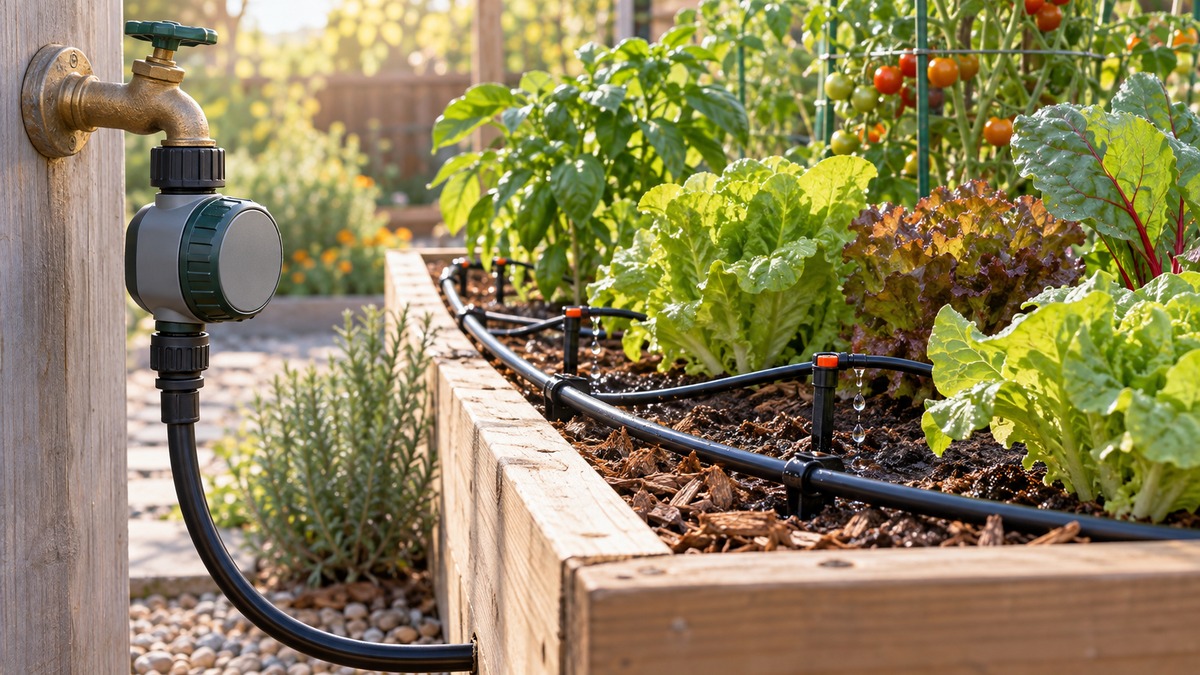
Once you have the run time and the number of events, set the timer. The Florida guide describes the scheduling options: a timer can run every day, every second day or every third day, or on custom days such as particular weekdays. Those options let you spread the events across the week. The same guide says to follow local water restrictions when programming a timer. Check local rules before you choose a daily or multi-day pattern.
The guide admits that setup is not obvious, since it is not always clear how to program a timer to apply the amount of water you want. It also says each zone’s run time can be set from several minutes to several hours. That range tells you whether a timer can deliver your run time, not whether it will do so correctly. Check the output in your own bed after the first few runs.
The UC Master Gardener guide also treats scheduling as its own step, which covers determining the watering days and times of your system. Its method sizes the emitters first and then sets the days and times, which is the order this article follows. The guide’s own schedule example is a useful model for the arithmetic, not a template for your garden.
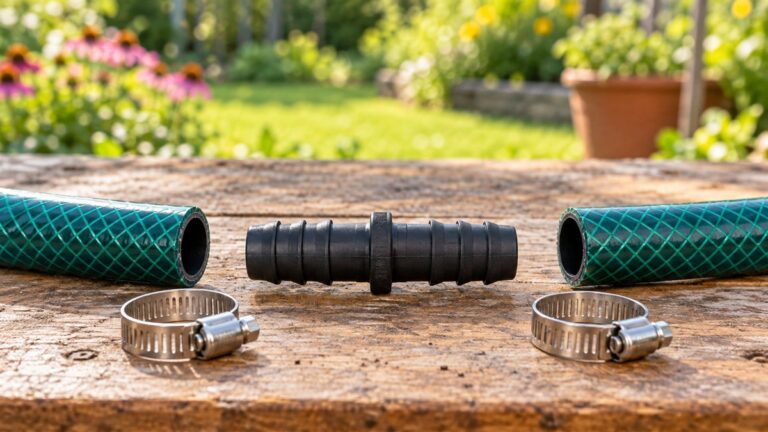
If the timer sits on a hose line, the post on garden hose quick connects with shut-off is a related read. If you are joining tape to the hose, the post on garden hose to drip irrigation adapters covers that step.
Smart controllers and weather
Smart timers add a layer of automation. The EPA’s WaterSense minireport on weather-based controllers says these controllers use current weather data to adapt their irrigation schedules. The Florida guide adds that smart irrigation timers also have to be programmed properly to run efficiently. The sources do not say that a smart timer sets the right drip run time without your input. Enter the flow rate and the cap yourself, then let the controller adjust from there.
A worked example from the sources
Here is one path, using only figures from the sources above. Take the Utah State row for 5/8-inch tape at 8-inch spacing, which takes 3.15 hours for half an inch, or about 6.3 hours for a full inch at the same rate. Now apply the Florida cap of 60 minutes per run. Six hours and 18 minutes is 378 minutes, and 378 divided by 60 is 6.3, so the week needs seven runs of at most 60 minutes. The cap sets the number of runs, not the weekly target. This is arithmetic, not a recommendation. It assumes the table’s rate matches your tape, and it uses a cap that Florida’s guide gives for its own sandy soils.
Common mistakes
- Running one long event on sandy soil. The Florida guide sets a limit of under 60 minutes for its sandy soils, and Penn State ties its per-event limit to avoiding leaching and runoff.
- Using a timer default without knowing the flow rate. The Arkansas guide starts with the label, and the flow rate decides every later number.
- Ignoring local water restrictions. The Florida guide says to follow them when programming the timer.
- Forgetting the weekly total when you split the run into events. Penn State’s example works from the weekly total, then repeats events to reach it.
- Assuming the Utah State table fits your row spacing. The table is built on 2-foot row spacing.
How we chose
We used the University of Florida timer guide, the Arkansas and Penn State run-time guides, the Utah State table and the UC Master Gardener example. The EPA minireport covers weather-based controllers, so we used it only for what those controllers do, not for a drip run time. Each source was opened with curl and kept when it returned HTTP 200. The Florida link is the EDIS AE220 PDF, which opened as the timer publication CIR1421. Search summaries that gave run times without naming an extension source were not used.
What we could not verify
The sources give a method and a few worked examples. They do not give one run time that fits every garden, and the arithmetic in this article is ours, labelled where it appears.
What the sources do not say
The sources do not give a universal run time. The Penn State example depends on a tube rated at 0.45 gallons per minute per 100 feet and a 30-inch width. The Utah State table is built on 2-foot row spacing. The Florida 60-minute limit applies to Florida’s sandy soils, not to soils elsewhere. The EPA minireport gives no drip run time, so it is not a source for a setting. The sources do not say how a timer should handle rain, beyond following local water restrictions. The 6.3-hour figure and the seven-run count come from one table row and are our arithmetic.
Frequently asked questions
How long should a drip irrigation timer run?
Calculate it from your weekly target and your flow rate, then cap each event for your soil. The example figures in this article show the method, and they are not settings to copy.
How many times a week should drip irrigation run?
The timer can run every day, every second day or every third day, according to the Florida guide. Penn State’s example repeats events until the weekly total is reached, and the per-event cap sets how many events you need.
Why cap the run time?
Penn State ties its per-event limit to avoiding leaching and runoff. The Arkansas guide provides a table of maximum minutes per event based on soil, and the Florida guide sets 60 minutes for its sandy soils.
Do smart timers set the run time for me?
The EPA minireport says weather-based controllers use current weather data to adapt schedules. It does not give a drip run time, and the Florida guide says smart timers still need proper programming.
Does rain change the timer setting?
The sources here give no drip rule for rain. The EPA minireport describes weather-based controllers, which adapt to weather, and the Florida guide asks you to follow local water restrictions.
Sources
- https://edis.ifas.ufl.edu/publication/AE220/pdf (opened 2026-10-22)
- https://uaex.uada.edu/publications/pdf/FSA6174.pdf (opened 2026-10-22)
- https://extension.psu.edu/determining-how-long-to-run-drip-irrigation-systems-for-vegetables (opened 2026-10-22)
- https://extension.usu.edu/yardandgarden/research/water-recommendations-for-vegetables.php (opened 2026-10-22)
- https://ucanr.edu/sites/default/files/2021-02/30917.pdf (opened 2026-10-22)
- https://www.epa.gov/sites/production/files/2017-01/documents/ws-products-minireport-irrigation-controllers.pdf (opened 2026-10-22)