How to Water Newly Planted Trees
As an Amazon Associate we earn from qualifying purchases.
Learning how to water new trees is really a question about the first two or three growing seasons, not just the first week. Penn State Extension says a newly planted tree can take a year for each inch of trunk diameter to become established in USDA Hardiness Zones 2 to 6. The extension guidance from Penn State and Colorado State University gives a schedule that tapers from daily watering to weekly watering, along with an amount tied to trunk size. This article sets out that schedule and shows where the sources differ.
Rain, soil type and the kind of tree all change the plan. Those factors are covered below, along with what the sources do not settle.
Quick answer
- Water every day for the first one to two weeks, every two to three days from about week three to week twelve, then weekly until the first frost. That is the Penn State schedule.
- Apply at least 1 to 1.5 gallons per inch of trunk diameter each time, across the whole root zone. Colorado State’s Watering Trees table lists 2 to 3 gallons per application for a 2-inch tree, and its PlantTalk page gives a larger weekly figure.
- Do not count on rain alone. Penn State advises against assuming rainfall is enough to skip a session.
Why new trees need a steady routine
Penn State describes the root zone as the soil that stores water for the plant, and it asks you to water the whole root zone consistently to protect fragile roots. Consistency is the theme of the whole schedule. A tree that goes weeks without a soak and then gets one large drink is not on the routine the guide describes.
Colorado State’s guide makes the same point from another angle. It says that regular irrigation after planting encourages root development and helps the tree establish. It also explains the timeline: establishment generally takes one growing season per inch of caliper. That is why watering continues for seasons rather than weeks. A thin, young tree needs help until its roots have spread into the soil around it.
The schedule, week by week
Penn State gives the most specific timeline. Water when you plant, then follow these intervals: daily for one to two weeks after planting, every two to three days from about week three through week twelve, and weekly after week twelve until the first frost. After the first year, the guide says to keep watering weekly until the tree is established. Fall planting follows a slightly different path: keep the same schedule through the first frost, then resume weekly watering in spring and continue through the end of the growing season.
The Colorado State table for trees under two inches in caliper follows the same shape. It lists daily watering for two weeks after planting, then every two to three days for the next two months, then weekly until the tree is established, which takes one to two growing seasons. Both guides move from daily to every few days to weekly, which gives you a pattern that holds across the sources even though the amounts differ. The next section covers the amounts.
How much water each time
Penn State sets a minimum of 1 to 1.5 gallons per inch of trunk diameter per watering, applied across the whole root zone rather than just at the trunk. For measuring trunk size, the guide says that for trunks under four inches across you should measure six inches above ground level and the root flare, and for larger trees you should measure at 12 inches. Using the guide’s own rate, a 2-inch trunk works out to 2 to 3 gallons per session.
The Colorado State Watering Trees table gives the same result for a 2-inch tree. It lists 2 to 3 gallons per application for a 2-inch caliper tree, and 1 to 1.5 gallons for a 1-inch caliper tree. The Penn State minimum and the Colorado State table agree on those figures.
The PlantTalk page takes a different route. Its general rule is to apply as much water as the size of the pot or root ball each week. For balled-and-burlapped trees it suggests 10 gallons per inch of trunk diameter, and it illustrates that with 20 gallons for a 2-inch tree. That is far more water than the 2 to 3 gallons per session in the table. The gap is worth noting. The table and the Penn State minimum both point to a few gallons per session, while PlantTalk points to a much larger weekly figure. The sources do not settle which is right for your tree, so the soil check in the next section is the way to decide.
Where to put the water
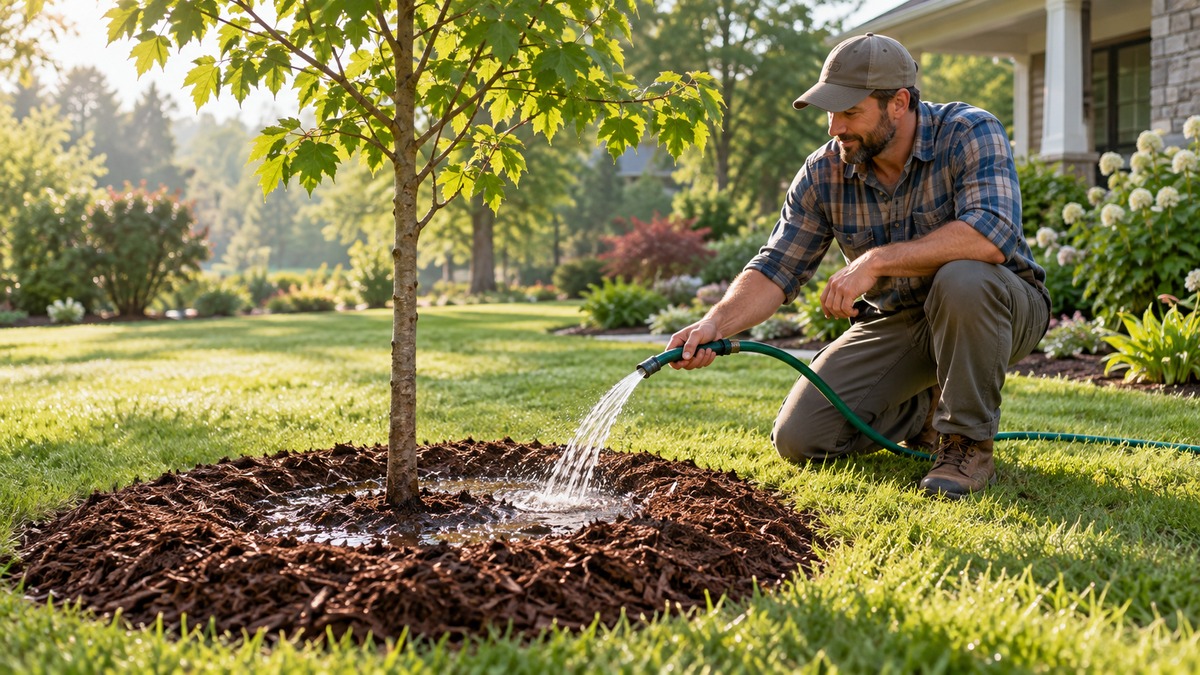
Penn State asks you to water the whole root zone, not just the trunk, and it warns against shallow watering. Deep watering, it says, builds strong roots and improves heat and drought resilience. Colorado State makes the same point about depth in a different way: for mature trees, frequent shallow watering does not supply enough water to the roots, and frequent deeper watering may supply too much. That point is written for established trees, but it shows the logic of deep, less frequent soaking.
Penn State lists several ways to apply the water, including buckets, watering bags, soaker hoses and sprinklers, and it suggests using whichever method you have the tools for. It cautions that soaker hoses can clog or water unevenly. Whatever you use, the goal is the same: water spread across the root zone instead of a splash at the trunk. If you water by hose, the post on hose attachments for watering plants is a related read.
Check the soil at the root zone
Penn State’s monitoring advice is concrete. It suggests checking soil moisture at a depth of 6 to 9 inches with a probe. It also notes that when the soil is hard to probe or dig, the delicate roots struggle to absorb water. The probe is the reference, and the schedule above is a plan to check against it. Check before each session rather than watering on a fixed day.
PlantTalk warns that too much water can kill a new plant as quickly as too little. That is a reason to check before every session rather than assuming more is safer. Soil type raises the stakes. Colorado State names the common mistake on compacted, clay soils with poor drainage: applying too much water in one session, which can waterlog the planting hole. On heavy soil, a smaller amount per session with a check before the next one is the safer habit.
Rain, heat and winter
Rain does not replace the schedule. Penn State says not to assume rainfall is enough to skip a session. It suggests skipping only after substantial rain, such as one inch or more over 24 hours. It also explains that a fast storm wastes much of its water: a storm that drops an inch or more in less than an hour mostly runs off the surface and does little for the tree. A heavy downpour in an hour is not the same as a steady soaking rain.
Winter matters in dry climates. Colorado State says that in its dry climate, watering continues through the winter as well as the rest of the year. Its table adds occasional winter watering, once or twice a month, when moisture has been short and the ground is not frozen. Because those rules come from a dry climate, a wetter region may need less. The sources do not say how to adapt the winter rule to a wetter area.
Shrubs and pots
The PlantTalk page covers more than trees. It says that all newly planted trees and shrubs need supplemental water, and that sprinkler watering is usually enough for newly planted shrubs. For a container, the rule is to match the water to the size of the pot or root ball each week. That is a different setup from a tree in the ground, so the schedule in this article is for trees planted in soil. For container plantings, the post on bottom-watering planters is a related read on container watering.
How long watering lasts
Penn State gives an establishment timeline of about a year for each inch of trunk diameter in USDA Zones 2 to 6. It works through a common example: a standard balled-and-burlapped tree with a 2-inch trunk takes about two growing seasons to become fully established. Colorado State is close, saying a two-inch caliper tree should be established in two to three growing seasons. The two timelines overlap. For a two-inch tree, plan on at least two growing seasons of watering, and check the soil before you stop.
Mistakes to avoid
- Stopping too early. Penn State continues weekly watering until the tree is established, not just through the first summer.
- Shallow sprinkles. Penn State asks you to avoid shallow watering and to water the whole root zone.
- Skipping water after light rain. The Penn State threshold for skipping is substantial rain over many hours.
- Too much water in one session on compacted or clay soil. Colorado State ties that to waterlogging the planting hole.
- Watering on a fixed day without checking. Penn State recommends a soil probe at 6 to 9 inches.
How we chose
We used the Penn State extension page and the two Colorado State publications because each gives a full schedule for newly planted trees, with an amount and an establishment timeline. Each source was opened with curl, and we kept only pages that returned HTTP 200. A Minnesota extension page and a Massachusetts fact sheet returned 403 and were left out. We did not use general tree care blogs, because their figures varied and were not tied to a named extension program.
What we could not verify
The sources agree on the schedule and on the idea of a soil check, but they do not agree on every amount. This article shows both figures for balled-and-burlapped stock instead of choosing one. Where the sources are silent, the article says so.
What the sources do not say
The sources do not settle the difference between the Watering Trees table and the PlantTalk figure for balled-and-burlapped trees. The PlantTalk pot rule is general and does not give a figure per container size for a tree. The Colorado State winter advice is written for a dry climate, so it does not translate directly to wetter regions. The sources do not give a rule for a tree planted in heavy clay beyond the warning about waterlogging. The Penn State establishment figure is given for USDA Hardiness Zones 2 to 6, so a tree in another zone may establish on a different timeline.
Frequently asked questions
How long should a newly planted tree be watered?
Penn State’s schedule runs daily for the first one to two weeks, every two to three days through about week twelve, and weekly until the first frost. After the first year, watering continues weekly until the tree is established. For a two-inch tree, plan on at least two growing seasons.
How many gallons does a new tree need?
Penn State gives at least 1 to 1.5 gallons per inch of trunk diameter each time. For a 2-inch tree, that is 2 to 3 gallons per session, which matches the Colorado State table. PlantTalk gives a larger figure for balled-and-burlapped stock, so check which one applies to your tree before you choose.
Does a new tree still need water after rain?
Usually, yes. Penn State says not to assume rainfall is enough, and it names about one inch or more over 24 hours as the threshold for skipping a session. A fast storm can run off before the roots get much of it.
Does a new tree need water in winter?
In a dry climate, Colorado State says watering continues in winter. It also suggests watering once or twice a month in winter if moisture has been short and the ground is not frozen. The guide was written for that dry climate, so adjust for your own region.
Does the schedule change for shrubs?
PlantTalk says newly planted trees and shrubs both need supplemental water, and that regular sprinkler watering is usually sufficient for newly planted shrubs. The schedule above is written for trees, so use it for shrubs with care and check the soil either way.
Sources
- https://extension.psu.edu/meeting-the-watering-needs-of-a-newly-planted-tree (opened 2026-10-22)
- https://tra.extension.colostate.edu/wp-content/uploads/sites/9/2026/07/Watering-Trees.pdf (opened 2026-10-22)
- https://planttalk.colostate.edu/topics/trees-shrubs-vines/1719-watering/ (opened 2026-10-22)