How to Make a Rain Garden in Your Backyard
As an Amazon Associate we earn from qualifying purchases.
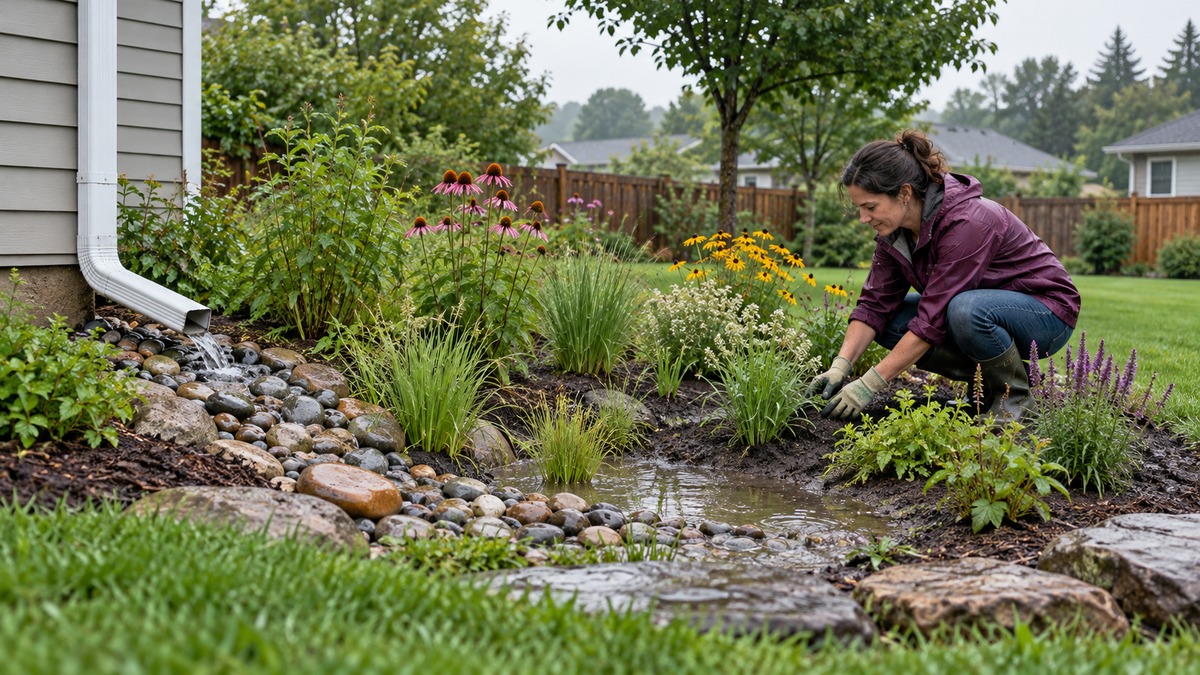
Knowing how to make a rain garden in your backyard starts with one idea. A rain garden is a shallow basin that catches water from a roof, driveway or other hard surface and lets it soak into the ground. The EPA defines it as “a depressed area in the landscape that collects rain water from a roof, driveway or street and allows it to soak into the ground.”
The steps below draw on an EPA page, a Purdue Extension guide and two Penn State Extension pages. They cover where to dig, how to test the soil, how to size the basin, how to plant it and how to care for it. Where the sources differ, we say so.
Quick answer
- Pick a low spot that collects runoff from a roof or driveway, and keep the basin at least 10 feet from the foundation.
- Test the soil first. If water takes more than 24 hours to drain from a test hole, consider another site.
- Size the basin from the hard surface it drains, and keep it no deeper than 18 inches.
- Plant native species, add 2 to 3 inches of shredded hardwood mulch, and water about one inch a week during the first season.
Choose a spot that catches the runoff
Start by watching the yard in the rain. Penn State Extension advises that you “walk the property in the rain to observe storm water flow” and look for “low, flat areas that collect storm water but are not permanently waterlogged.” Purdue Extension describes the right spot as one where the rain garden “will intercept runoff from impervious surfaces (rooftops, driveways, sidewalks)”.
Keep the basin away from buildings and septic systems. Purdue says the garden “should be at least 10 feet from any foundations or sublevels and 20 feet from basements”, and that it should be at least 25 feet from a septic drain field. Penn State’s list of places to avoid is longer: “Do not construct a rain garden near a septic tank, leach field, drinking water well, tree roots, waterlogged areas, or utilities.” The Penn State pages we opened do not give the 20-foot basement figure.
Slope matters as well. Penn State says that “Steep slopes greater than 10% are not ideal sites for a rain garden.” Check your municipality’s storm water rules before you finalize the plan, because local ordinances can limit the design.
Call before you dig
Both guides put the utility check near the start of the job. Purdue says to “Avoid underground utilities by calling the local Call Before You Dig number”, because private lines such as water service lines “will not be marked on private property.” Penn State’s instruction is to “always call Pennsylvania 811, PA One Call” before any digging, which is a Pennsylvania service.
Test the soil before you dig
Soil decides how fast the basin drains. Purdue notes that “Water will infiltrate more quickly through sandy soils, whereas clay soils have slower infiltration rates.” Penn State gives rough rates: “Rain will soak into a sandy soil at a quick rate of 2.5 inches per hour, while rain soaks into a silty soil at a rate of one-half inch per hour.” It adds that “And in clay soil, the rate is only a third of an inch per hour.”
The test holes differ between the guides. Penn State says to “Dig several one-foot deep by one-foot wide holes”, then to “Fill the holes with water and monitor the time it takes for the water to drain.” Purdue uses 8-inch holes and asks you to “allow it to soak for two hours to saturate the ground” before timing the drop. For a fuller picture of soil, see our roundup of garden soil testers.
The pass mark also differs. Penn State says that “If it takes more than 24 hours for the water to drain, you should consider another site.” Purdue sets a goal for the finished basin instead: “Water should drain from a rain garden basin within 24 to 48 hours.” Purdue ties that window to plant health, since it “prevents plants from being submerged in saturated soil for extended periods of time”. Use the Penn State line as a stop sign for the test hole, and the Purdue range as the goal for the built garden.
Work out the size with simple arithmetic
Size comes from two numbers: the hard surface that drains into the garden, and the depth the basin can hold. Purdue’s design goal is “to hold about 1 inch of rainfall during heavy rain events”. Its formula is “Area of impervious surface in square feet / depth of rain garden calculated from infiltration test”. The guide’s example uses a 500 square foot roof and a 10-inch depth, which gives a 50 square foot garden.
Penn State starts from a percentage instead. It says the garden should be “10 to 20% of the impervious surface area draining into the garden”. Its worked example uses a roof that is “50 feet long and 12.5 feet wide”, or 625 square feet. For a one-inch storm, “We multiply 625 square feet by 0.083, since one inch of rain equals 0.083 feet, and get 52 cubic feet of storm water.” With a six-inch depth, the result is 104 square feet.
The table applies both methods to two roof sizes. The arithmetic is ours and uses only the formulas and depths printed in the guides. The 400 square foot row is an example, not a measurement of any yard.
| Hard surface draining to the garden | Purdue formula at 6-inch depth | Purdue formula at 10-inch depth | Penn State 10 to 20 percent range |
|---|---|---|---|
| 400 sq ft | 400 ÷ 6 = 66.7 sq ft | 400 ÷ 10 = 40 sq ft | 40 to 80 sq ft |
| 625 sq ft | 625 ÷ 6 = 104.2 sq ft | 625 ÷ 10 = 62.5 sq ft | 62.5 to 125 sq ft |
At six inches, the two methods agree on the 625 square foot roof, both giving about 104 square feet. They diverge at other depths. Purdue warns that “It is best not to have a rain garden over 18 inches deep regardless of infiltration rates.” Penn State’s percentage range is a starting point, since it says the area “can vary greatly” with soil and depth.
Dig, shape and plant the basin
Dig to the design depth and keep the basin level. Purdue asks for a basin that is “flat-bottomed and has gently sloping sides.” Penn State describes the finished parts, including “an erosion-resistant outlet for overflow, often lined with rock.” Where downspout water enters, rock or gravel helps, since “placement of rock or gravel will help protect this area from erosion.”
Soil may need help. Purdue says that “Some soil types with heavy amounts of clay or sand may require amendments to the soil, such as additional compost or another source of organic matter.” It also warns that “Infiltration rates may have changed,” so test again before planting. Build the berm and the outlet from the soil you dug out: “Using the soil from the basin, construct the berm to retain water; create an outlet to direct any overflow.” Purdue adds that “Outlets should be lined with rocks or gravel to minimize erosion of the berm and maintain mulch levels.”
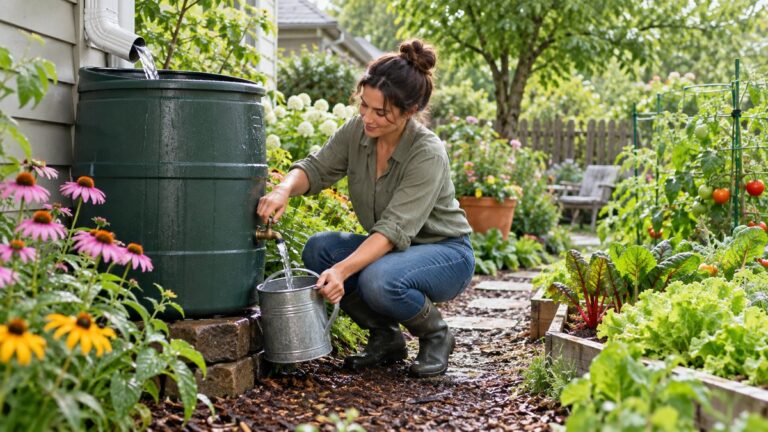
For plants, Purdue explains that native species “will help create soil conditions that increase infiltration of stormwater”. The EPA says rain gardens “can be a cost effective and beautiful way to reduce runoff from your property”, and Penn State adds that native plants “provide important food and habitat for wildlife, especially insects and birds.” Purdue advises that you “Dig a hole approximately twice the size of the root ball” for each plant, and notes that “Planting plugs up to gallon size will provide a faster established rain garden.” If you also want to collect roof water for the garden, see our notes on rain barrels for the garden.
Mulch goes on last. Purdue calls for “a 3-inch layer of hardwood shredded mulch”, and Penn State recommends “Apply approximately 2-3 inches of shredded hardwood mulch after planting.” Then check the basin with a real rain. Penn State suggests that you “observe the new area after a rain” and “Note the areas that hold water the longest.” Purdue’s test is that “water should infiltrate within 24 to 48 hours.” If it does not, “if water is not infiltrating fast enough you may want to lower your discharge point”, and that change should be temporary.
Care for the garden in its first two years
Penn State says “The establishment phase is the most important period in the life of a rain garden.” Purdue notes that “During the first growing season, plants typically need to be watered weekly to an equivalent of about one inch of water.” After that, “the plants will need to be watered only during extremely dry periods.”
When you water, go deep and not often. Penn State says to “Water deeply during prolonged dry spells to encourage deeper root growth”, and warns that “Shallow, frequent watering can promote weak root systems and reduce drought tolerance.” Weeding is the other regular job. “Inspect the rain garden every few weeks during the growing season and remove weeds before they produce seeds.” “Hand pulling is often the most effective method” for a small garden, and “Avoid excessive soil disturbance, which can expose additional weed seeds.”
Mulch needs a light touch over time. Penn State advises to “Avoid excessive mulch depths because too much mulch can float during storms, clog inlets, reduce infiltration, and smother plants.” Purdue gives a depth check: “Heavy storms can wash mulch away, and if it is less than 3 inches deep, add more mulch.” Penn State also says that “In most cases, rain gardens do not require annual mulch applications after establishment.” Top up when the layer thins, and skip the new layer every spring.
After major storms, walk the basin and look for trouble. Penn State lists the signs: “exposed soil, small channels or gullies, sediment deposits, washed-out mulch, or undercut edges near inlets.” Its longer view is encouraging: “Properly maintained rain gardens can remain functional and attractive for decades.”
Leave some seed heads for the birds. Purdue suggests you “may want to leave flower heads through the winter to provide architecture, habitat, and food sources for wildlife.” When you cut the plants back, its guidance is “Do not cut below 4 to 6 inches”, and it prefers late fall or early winter, so the plants “have all spring to regrow and flower again.”
Common mistakes to avoid
- Building too close to the house. Both guides set a 10-foot minimum from the foundation, and Purdue adds 20 feet from basements.
- Skipping the drain test. A basin that drains too slowly leaves plant roots sitting in water, which is the risk Purdue describes.
- Leaving the outlet unlined. Purdue says outlets should be lined with rock or gravel so the berm does not erode.
- Adding mulch every spring. Penn State names yearly mulching as one of the most common errors in maintenance.
- Digging on a steep slope. Penn State says slopes above 10 percent are not ideal, and steep ground pushes runoff toward erosion.
Frequently asked questions
How big should a backyard rain garden be?
Penn State suggests 10 to 20 percent of the hard surface draining into it. Purdue divides that surface area by the basin depth from your own infiltration test. The two methods match at a six-inch depth, so the roof or driveway you drain and the depth your soil allows decide the answer.
How deep should a rain garden be?
Purdue ties depth to your infiltration test and advises staying under 18 inches, even when the soil drains quickly. Penn State’s worked example uses a six-inch ponding depth. A shallower basin needs more floor area to hold the same water.
Can a rain garden sit next to the house?
Not right against it. Penn State and Purdue both use 10 feet from the foundation as the minimum. Purdue adds 20 feet from basements and 25 feet from a septic drain field.
Should you call before digging a rain garden?
Yes. Purdue advises calling the local Call Before You Dig number, and private water service lines may not be marked on your property. Penn State names Pennsylvania 811 for its own state.
How long should water take to drain from the basin?
Penn State treats more than 24 hours in a test hole as a reason to look elsewhere. Purdue expects the finished basin to drain within 24 to 48 hours. If it drains slower after planting, Purdue suggests lowering the discharge point for a while until the roots establish.
What we could not verify
The EPA page states that “This website is no longer being updated, and content may not be current.” We drew on its definition and its list of benefits only, and not on its links or local resources.
What the sources do not say
The four pages do not give a cost for building a rain garden, and they name no plants for a particular state beyond general native-plant advice. Purdue’s plant list points to Indiana resources, so readers elsewhere need a local list. The sources also disagree on several figures. The test hole is 8 inches square in one guide and 12 inches square in the other. The pass limit is 24 hours in one guide and a 24 to 48 hour target in the other. The mulch depth is 2 to 3 inches in one place and 3 inches in another. Our table uses the example depths printed in the guides, not measurements of any yard. We did not check any state or municipal rule.
How we chose
We chose four pages that we could open and read on 2026-10-22: the EPA rain garden page, Purdue Extension guide ID-533-W, and two Penn State Extension pages, one on how to make a rain garden and one on best practices for rain gardens. We picked government and university sources, and we kept only statements that appear word for word in the fetched text. Other search results were not opened and are not cited.
Sources
- https://www.epa.gov/soakuptherain/soak-rain-rain-gardens (opened 2026-10-22)
- https://extension.purdue.edu/extmedia/ID/ID-533-w.pdf (opened 2026-10-22)
- https://extension.psu.edu/how-to-make-a-rain-garden (opened 2026-10-22)
- https://extension.psu.edu/best-practices-for-rain-gardens (opened 2026-10-22)