How to Plan a Native Plant Garden
As an Amazon Associate we earn from qualifying purchases.
Learning how to plant a native garden starts with a plan, not a plant tag. The pages in this guide follow the same order: check the site, test the soil, choose plants native to your area, then install in phases. Each step below names its source.
The University of New Hampshire Extension says native insects coevolved with native plants and rely on these plants for food and to complete their lifecycles.
Quick answer
- Assess the site first: sun, soil moisture and drainage, soil type and deer pressure.
- Perform a soil test before planting, and address any soil problems first.
- Choose plants native to your region, and ask about local origin, since labels can be vague.
- Plant the area closest to structures first, and mix plant heights for food and cover.
Why native plants matter for wildlife
The University of New Hampshire Extension article says native plants do more than beautify a landscape: they also provide much needed habitat for wildlife species. It notes that many exotic plants commonly used in home gardens do not support insects and larger wildlife in the same way that native plants would.
The same article points out a trade-off among shrubs. Most shrubs considered great for wildlife produce fruit that is attractive to songbirds, but some of those species also host certain insects, which the article says is important to note.
The University of Maryland landscape page adds that native plants support pollinators and native wildlife as well. The Illinois release says that for the greatest wildlife benefit, you should seek out straight species, not cultivars.
Start with a site assessment
The University of Maryland Extension Home and Garden Information Center answer says a site assessment is a good first step for a gardener or hired consultant. It determines the conditions of the planting area, including summer sun exposure, soil moisture and drainage, overall soil type and whether browsing deer will be an issue.
The Illinois Extension release gives the same starting point. Decide where the new bed will go, and note whether the location gets full sun, partial sun or shade. Its advice is to pay close attention to the sun and soil.
The Maryland answer also gives two examples that are easy to miss. A roof downspout that empties into the planting area keeps it wetter in rain, while a spot under mature shade trees can stay drier because the canopy and roots compete for water. Both examples change what will grow, so both belong in the assessment.
The same answer asks whether overhead utility lines or tree branches will limit the eventual height of shrubs or small trees. That question is about mature size, and it is worth asking before a plant is chosen for a spot with limited height. If you already have a design plan or plant list, the same answer offers feedback on plant selection, placement and substitution, and that feedback can include photos of the site.
Check the soil before you buy
The University of Maryland Extension landscape design page says to perform a soil test before planting. That step matches the Illinois advice to determine the condition of the soil first. The Illinois release also says problems with soil will need to be addressed.
The Maryland Ask Extension answer treats learning the soil conditions as an early step in the planning process. It says that, for this kind of planting, soil acidity, measured as pH, matters more than nutrient content.
The Mississippi State publication adds a point about fertilizer. It says native plants are better adapted to local soil types and in general do not require fertilizing for good growth.
Choose plants native to your region
The Illinois release says the idea is to include plants, trees and shrubs that already call Illinois home. The regional question is the one to answer for your own yard, since a plant can be native to North America and still not be native to your area.
The Howard County answer on Ask Extension explains why labels can mislead. The genetic source of a propagated plant is called provenance, and it’s best to choose plants with as local a provenance as possible. It notes that some nurseries sell locally sourced native plants and some do not, and that plant labeling can be vague about what counts as native.
That answer gives an example. Oakleaf hydrangea is native to the southeastern United States but not to the Maryland area the answer covers. A plant can carry a native label and still come from somewhere else, so asking the nursery where the plant was grown is a practical check.
Native plant lists for a single state can differ, but the Howard County answer says that for the most part they include the same plants. The University of Maryland landscape page gives a practical rule: always ask for alternatives that are native plants, and ask local garden centers or nurseries to recommend similar plants that suit your site’s conditions.
The Maryland Ask Extension answer also notes that its native gardening pages focus on concepts and a handful of native species, rather than on designing spaces, though some pages link to sample garden designs. A list of native plants is not a layout, so the layout needs its own planning.
Not every native plant will suit every spot. The University of Maryland landscape page says some plants may not be appropriate for all situations. The same page adds that while some plants will grow in less than ideal conditions, their growth and health are best when their needs are met. The same page says its plant recommendations and design plans are suggestions based on an average townhouse plot and an average single-family home.
Plan the layout for food and cover
The University of New Hampshire Extension says to try planting a variety of species of differing heights, because not all wildlife species forage or find shelter at the same level. The same article says to take the next step by choosing plants that provide food throughout the year.
Penn State Extension’s guide to trees, shrubs and vines says to select plants that provide cover and nest sites. It also says evergreen trees and shrubs make some of the best shelters, especially those that keep their branches close to the ground.
The same guide adds that many excellent native trees, shrubs and vines offer four seasons of interest, with fragrant flowers, eye-catching fruit, brilliant fall color and sculptural forms in winter. It says the same plants can attract a diversity of wildlife with the food, cover and nest sites they supply.
The University of New Hampshire article names other shrubs that make good screens and provide wildlife value, including dogwood, highbush blueberry, viburnum, winterberry, bayberry and inkberry.
The UNH article says that mimicking nature is the best way to ensure that wildlife will use a backyard habitat. That is a goal for the whole layout, not a single plant choice.
The Illinois release notes that native trees such as oak, willow, cherry, plum and birch can support many different caterpillar species. It says herbs and native perennials, such as butterfly weed, violets and dill, are host plants too, and that several native shrub varieties provide berries.
The University of Maryland landscape designs can be used for sun, shade and all light exposures in between. The quantity of each species to plant depends on the amount of space you have and your budget.
Install in phases, with the area near the house first
The University of Maryland landscape page says to begin by removing or relocating existing plants that are showing signs of stress or have outgrown the space.
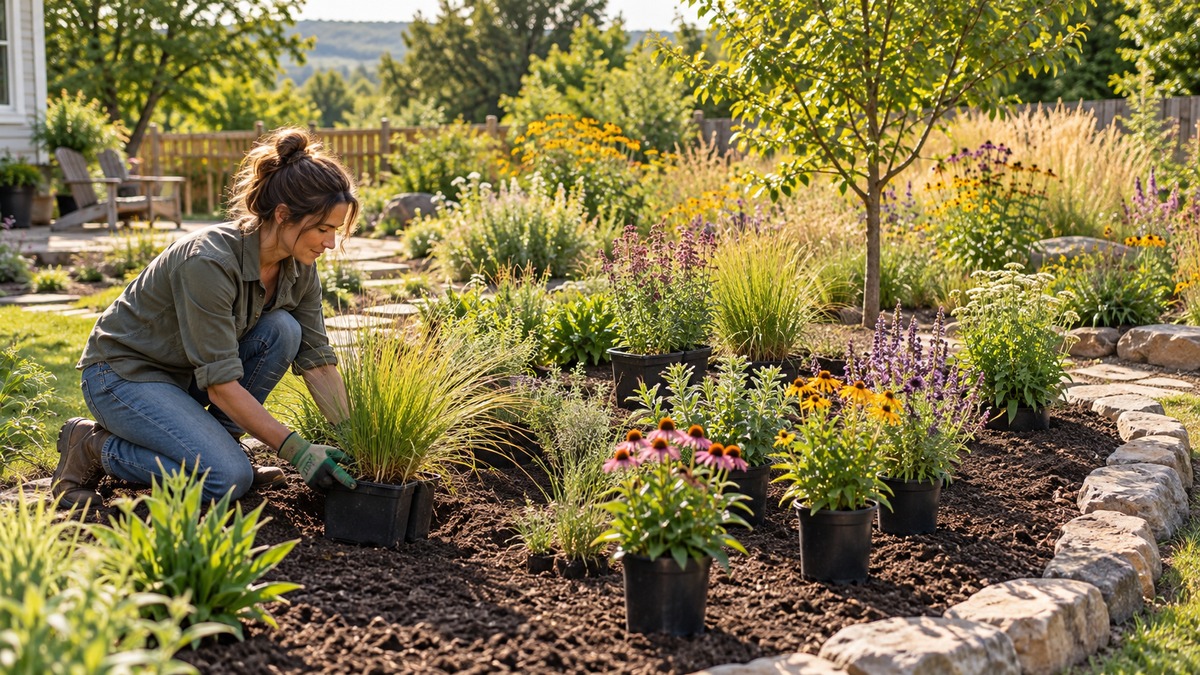
The same page says the area closest to structures should be planted in the first phase. It gives the reason: this reduces the trampling of smaller plants and the compaction of the soil.
The UMD page sets a goal rather than a rule: aim to have at least 70 percent native plants, to help support native beneficial insects and birds.
After planting: water, fertilizer and learning the plant
Penn State Extension says that if a native plant is set in its preferred site, watering and fertilizing beyond the first year may not be necessary.
Penn State also suggests observing the environment where the plant grows in the wild, or consulting a native plant book for cultural information. Mississippi State Extension adds that, once established, native plants typically require less water and maintenance than nonnative species, and that they should be used where and when possible.
The same publication includes a table of selected native and nonnative plant species that provide food in fall and winter. For year-round food, that table is the place to check a plant list against the seasons.
For the layout side of a planting, the raised bed companion planting layout guide covers how plants can share a bed. If your native planting goes into raised beds rather than the ground, the raised bed soil mix guide covers the soil side.
How we chose
This guide uses seven public pages: two Ask Extension answers, one from the University of Maryland Extension Home and Garden Information Center and one from a Howard County, Maryland expert; an Illinois Extension release; a University of Maryland Extension landscape design page; a University of New Hampshire Extension article; a Penn State Extension guide to trees, shrubs and vines; and a Mississippi State Extension publication. Each is an extension page that could be opened and read during this check, and each covers part of the planning sequence.
Some pages were left out. The Native Plant Society of Texas, a University of Georgia Master Gardener article and a University of Minnesota course page returned errors when opened, and the Wisconsin DNR page could not be reached. Nonextension garden sites that came up in search were not used.
What we could not verify
The seven pages were written for different places, including Maryland, Illinois, New Hampshire, Pennsylvania and Mississippi. The Maryland and Illinois pages are the closest to a regional plan, and the others are general. This guide shows each recommendation with its own source rather than merging them into one list.
What the sources do not say
The pages do not give a spacing table for each species, a planting date for your region or a cost for a native garden. They do not set a number of plants for a given bed size. The Howard County answer says Extension personnel do not perform one-on-one residential site visits, though Master Gardener volunteers can help with local presentations and demonstration gardens. The sources read here do not give a fertilizer rate, and this guide does not supply one.
Frequently asked questions
Do you need a soil test before planting natives?
Yes, according to the University of Maryland landscape page, which says to perform a soil test before planting. The Illinois release advises determining the condition of the soil first and addressing any problems before planting.
How can you tell whether a plant is local?
Ask the nursery where the plant was grown, and use the provenance idea from the Howard County answer, which says to choose plants with as local a provenance as possible. Plant labels can be vague, and the Oakleaf hydrangea example shows that a native label can still point to a plant from another region.
Does a native garden need a lot of space?
No. The Illinois release says many native gardens can be incorporated into any existing landscape, even if space is limited.
How many native plants should a garden include?
The University of Maryland landscape page aims for at least 70 percent native plants, to support native beneficial insects and birds. The page presents that as a goal rather than a fixed rule.
Which part of the bed should be planted first?
The area closest to structures should be planted in the first phase, according to the University of Maryland landscape page. The page says this reduces trampling of smaller plants and compaction of the soil.
Sources
- https://ask.extension.org/kb/faq.php?id=890762 (opened 2026-10-22)
- https://ask.extension.org/kb/faq.php?id=881281 (opened 2026-10-22)
- https://extension.illinois.edu/news-releases/planning-designing-native-garden (opened 2026-10-22)
- https://extension.umd.edu/resource/landscape-designs-native-plants (opened 2026-10-22)
- https://extension.unh.edu/blog/2018/06/planting-native-shrubs-privacy-wildlife (opened 2026-10-22)
- https://extension.psu.edu/landscaping-for-wildlife-trees-shrubs-and-vines (opened 2026-10-22)
- https://extension.msstate.edu/publications/establishing-backyard-wildlife-habitat (opened 2026-10-22)