How to Keep Compost Working Through Winter
As an Amazon Associate we earn from qualifying purchases.
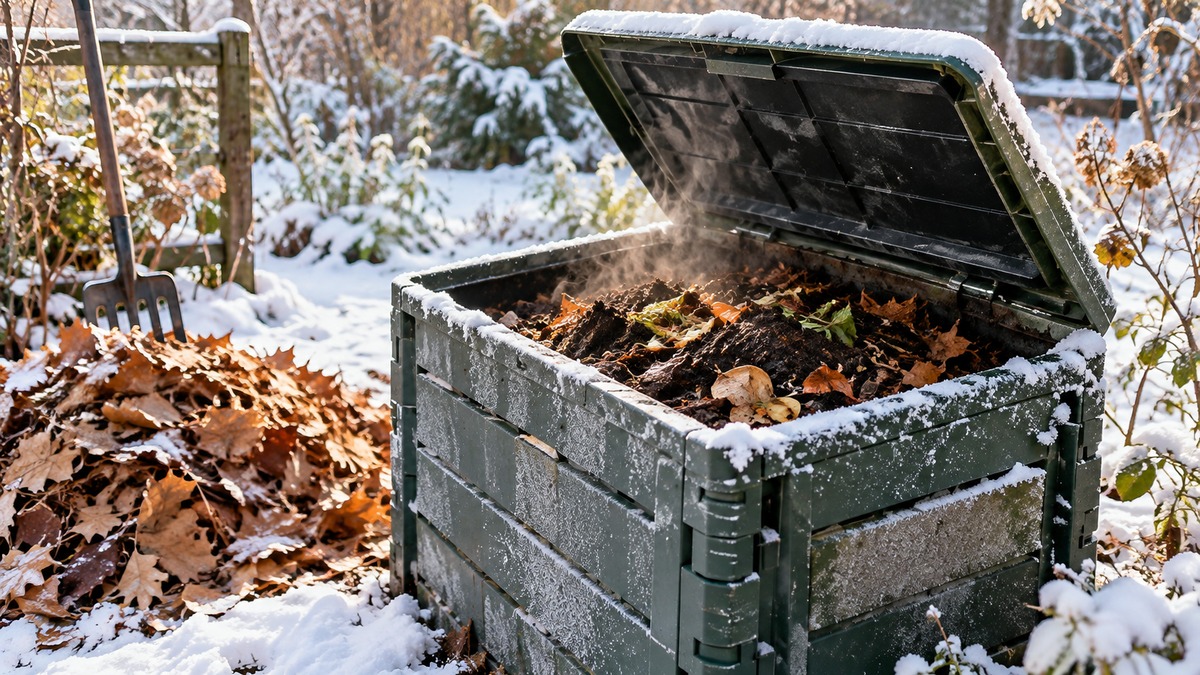
If you are asking how to compost in winter months, the short answer is that the pile slows down without stopping. Cold weather is a real limit, but the sources we opened agree that a well-built pile keeps working through the coldest stretch. The practical job is to make the pile big enough, insulate it, keep it covered and turn it less.
Two points from the sources shape everything below. First, the size and insulation of the pile matter more than the calendar. Second, winter turning is a judgment call, and the sources do not agree on it, so this guide shows where they differ.
Quick answer
- Cold slows composting rather than stopping it. Expect a slower pile, not a dead one.
- Build the pile large enough to hold heat, then add insulation and a cover that keeps out excess water.
- Turn less when temperatures stay below freezing, and wait for a day above freezing before you turn the pile.
Decide whether an outdoor pile fits the winter
Before you keep a pile going through the cold, the Illinois Extension winter sheet asks three questions. Can you still reach the pile to manage it? Will you have enough browns and greens? Can you keep the pile protected from rain and snowmelt? If the answer to those questions is no, the sheet says you should “possibly consider halting outdoor composting operations during the coldest parts of the year.”
The sheet’s alternative is “indoor worm bins, Bokashi buckets, or a public or private food scrap pickup or drop off service during the winter months.” The Oregon State Ask Extension answer takes a similar view. A winter pause is acceptable when the goal is only to handle household waste on site, while other goals call for optimizing the pile before it freezes. If you also protect garden beds through the cold months, see our guide to preparing raised beds for the cold months.
Build the pile large enough to hold heat
Size is the first lever. The Illinois sheet says: “The larger the pile the more heat is generated and retained.” It adds: “Smaller piles are prone to freezing, which halts active composting.” For a pile you start now, the sheet recommends that you “Increase pile size when starting a pile at the beginning of the cold season.” The NC State county extension says the same thing in other words: “The smaller the pile the more likely it can stop completely and/or freeze.”
The Oregon State farm bulletin on keeping compost cooking in winter gives a minimum, but it is written for manure piles on a farm. It says “A pile needs to have at least 1 cubic yard of material.” The same bulletin adds: “Larger piles help insulate themselves, as the inside of the pile will be creating heat.” The Oregon State Ask answer uses the same idea and lists “large enough piles to be self-insulating” among the conditions a pile needs. The sources do not turn the cubic-yard figure into a backyard size, so treat it as a farm reference, not a home-pile target. For the basic layout of a pile before the cold arrives, see our guide to building a compost pile from the start.
Insulate the pile before the freeze
Insulation works best when it goes on early. The Oregon State Ask answer is direct about timing: “Note that this has to be done before freezing conditions occur – while the pile is still hot.” Its method is simple: “You can insulate your compost pile with bales of hay or straw.”
The Illinois sheet lists what a top layer can be: “This could include finished compost, compost covers, woodchips, or other dry feedstock like straw.” Its general advice is to “Add a layer of insulation on top of the compost pile.” The NC State county extension suggests a lighter layer for a pile you are still feeding: “consider providing extra insulation using organic materials like a layer of pine needles or leaves to protect the pile and maintain warmth when not turning the pile.”
Placement matters too. The New Mexico column says: “Gardeners can provide this extra insulation by placing straw bales around the compost pile, or at least on the north and east sides of the compost.” It treats extra insulation as needed only in the coldest parts of its state, saying “additional insulation may help.” The Oregon State farm bulletin gives the same advice for exposed sites: “At higher elevations or in areas with cold prevailing winds, straw or hay bales placed around the pile will help insulate and protect the compost.”
Cover the pile and keep the water in range
A cover keeps out water, and it helps hold heat. The Oregon State farm bulletin says “Compost piles must be covered in winter to exclude excess rain or snow,” and it names an easy option: “A tarp is an easy and inexpensive way to cover the pile.” It adds that “A cover will also help insulate the pile by excluding cold air.” The Oregon State fall bulletin lists tarp, plywood or burlap and gives the reason: “Cover the pile with a tarp, plywood or burlap to retain heat and prevent water saturation.”
The Illinois sheet gives the balance a cover has to strike: “Thus in the winter it’s important to make sure the bin or pile is covered to protect it from excess moisture while also allowing for air flow.” The reason is clear in the same sheet: “With an active pile excess moisture can lead to anaerobic conditions.”
The moisture target itself differs between sources. The Alabama guide says: “Ideally, the moisture content of the compost pile should be between 40 and 60 percent.” The Oregon State farm bulletin gives a narrower range: “Ideal moisture content for composting materials is approximately 50%–60%.” The two ranges disagree at the low end, so this guide shows both rather than picking one. The Oregon State fall bulletin adds a winter habit: “Check moisture regularly, especially during rainy winter months.”
Feed the pile with material that still breaks down
In winter, feeding is about water and nitrogen as much as scraps. The Oregon State Ask answer says that optimal conditions need enough water, piles large enough to insulate themselves, and enough nitrogen. It notes that “food scraps, which also have high water content” can supply some of the water, and it names alfalfa pellets as a nitrogen source. It also says fresh grass clippings are “not an option at this time of year.”
The New Mexico column makes the same point from a warmer site. Its key to winter composting is to “provide a proper ratio of carbon to nitrogen in the compost feed-stock,” so the microbes stay busy and keep generating heat. For the browns and greens, the NC State county extension suggests shredding or chopping both into pieces “ideally 1/2 to 1 inch.” Small pieces give the microbes more surface to work on, and that matters more when the pile is cold.
Turn less, and time the turn
The sources disagree on turning, so the right choice depends on the pile and the weather. The Illinois sheet is the most cautious: “Reduce turning frequency or stop turning when temperatures dip below freezing for sustained periods of time.” The Oregon State Ask answer makes the timing concrete: wait until conditions are reliably above freezing, at least during the daytime, and then turn the pile.
The Oregon State farm bulletin takes a different view and says “Turning the pile will help to keep the compost cooking.” Its fall bulletin says to “Turn the pile weekly to introduce oxygen,” but that advice is for active fall piles, not the deep cold. This guide does not settle the disagreement. It does not give a winter turning schedule, and it does not claim that either approach is right for every pile.
What a cold pile looks like
Expect slower work, not a dead pile. The Illinois sheet says: “Extremely cold temperatures slow down rather than completely halt the composting process.” The Oregon State fall bulletin puts it this way: the process “will slow in winter but will continue — especially if the pile is well maintained.” The New Mexico column says composting “should continue even if at a reduced rate for a time.”
Finished compost behaves differently. The Illinois sheet says: “While a finished compost pile may not be impacted by freezing and thawing, exposure to excessive moisture can leach nutrients.” That means the cover matters for finished compost too, not only for an active pile.
Mistakes that slow a winter pile down
- Waiting until the first hard freeze to insulate. The Oregon State Ask answer says insulation has to go on before freezing, while the pile is still hot.
- Building a small pile. The Illinois sheet and the NC State county extension both say smaller piles are more likely to freeze.
- Letting rain and snowmelt soak the pile. The Illinois sheet ties excess moisture to anaerobic conditions.
- Counting on fresh grass clippings in winter. The Oregon State Ask answer says they are not an option at this time of year.
- Turning the pile in a deep freeze. The Illinois sheet advises reducing turning when cold lasts.
How we chose
This guide draws on seven pages: the Illinois Extension winter composting sheet, two Oregon State Extension pages on winter piles (a farm bulletin first published in 2007 and reviewed in 2026, and an Ask Extension answer), an Oregon State fall bulletin, the NC State county extension winter tips, a New Mexico State Southwest Yard and Garden column from December 2015, and the Alabama backyard composting guide for the moisture range. We kept statements that a page makes directly, and we show where pages disagree. Where a figure comes from a farm source, the text says so.
What we could not verify
The pages cover the cold-season basics well, but they leave several practical questions open. This section lists them so you can plan around the gaps.
What the sources do not say
The sources do not give a home-pile size that is guaranteed to keep working. The only minimum is the farm figure of one cubic yard. They give no insulation depth, so this guide gives none. Their turning advice conflicts, and none of them sets a winter turning schedule. The moisture ranges also differ at the low end, 40 to 60 percent in the Alabama guide and 50 to 60 percent in the Oregon State farm bulletin. None gives a start or stop date for a region, so the sources cannot say when your local winter will stop a pile. The New Mexico column describes winters that are cold but often warm enough for composting to continue, so its advice may not match a colder site.
Frequently asked questions
Does composting stop in winter?
Not according to these sources. The Illinois sheet says cold slows composting rather than halting it, and the Oregon State fall bulletin says the process “will slow in winter but will continue.” A small, uncovered pile is the one most likely to freeze and stop, so size and cover decide how far the pile slows.
How big should a winter compost pile be?
The sources agree that a bigger pile holds more heat. The Illinois sheet says the larger the pile, the more heat it generates and keeps. The only specific figure is the Oregon State farm minimum of one cubic yard, which is written for manure piles on a farm. The sources do not give a home-pile target, so this guide does not give one either.
Should a winter pile be turned?
The sources disagree. The Illinois sheet says to reduce turning or stop when temperatures stay below freezing for sustained periods. The Oregon State Ask answer says to wait until conditions are reliably above freezing, at least during the daytime, before turning. The Oregon State farm bulletin says turning helps the compost keep cooking, so the answer depends on your weather and your pile.
Do kitchen scraps still belong in a winter pile?
The New Mexico column says yes, because a pile in a cold but workable climate can keep decomposing when it is managed well. The Oregon State Ask answer notes that food scraps carry high water content, which helps the moisture side. Keep the pile balanced and bury the scraps. If the pile cannot be reached through the cold, the Illinois sheet suggests indoor worm bins, Bokashi buckets or a food scrap pickup service.
Can a winter pile wait until spring to restart?
Yes, if your goal is only to handle household waste on site. The Oregon State Ask answer says a pause fits that goal, while other goals call for optimizing the pile before it freezes. The pages do not give a spring date, so this guide does not give one either.
Sources
- https://extension.illinois.edu/sites/default/files/winter_composting_infosheet_2024.pdf (opened 2026-10-22)
- https://extension.oregonstate.edu/es/catalog/em-9660-keep-compost-cooking-farm-winter (opened 2026-10-22)
- https://extension.oregonstate.edu/ask-extension/featured/can-i-compost-freezing-temperatures (opened 2026-10-22)
- https://extension.oregonstate.edu/es/node/80766/printable/print (opened 2026-10-22)
- https://lee.ces.ncsu.edu/news/winterizing-your-compost-essential-tips-for-hot-cold-and-vermicomposting/ (opened 2026-10-22)
- https://swyg.nmsu.edu/2015/121915.html (opened 2026-10-22)
- https://www.aces.edu/wp-content/uploads/2018/11/ANR-0638.REV_.pdf (opened 2026-10-22)