Planting a Pollinator Garden for Butterflies
As an Amazon Associate we earn from qualifying purchases.
If you want to know how to create a pollinator garden for butterflies, start with two groups of plants: host plants that caterpillars can eat, and nectar plants that adult butterflies drink from. The sources agree on that split. They also agree that native plants and a sunny, sheltered spot matter, and that a garden with only nectar flowers leaves out the caterpillars’ food.
A butterfly garden does not have to be big. The Wisconsin Extension article says, “Butterfly gardens do not need to be large.” A few pots, a small bed or a corner of the yard can all work. This guide covers plants, layout, shelter and timing, and it names the gaps the sources leave open.
Quick answer
- Plant host plants for the caterpillars. The NWF says monarch caterpillars can only eat milkweed, so milkweed is the core host plant for that species.
- Add nectar plants for adults. Penn State Extension says adult butterflies feed on nectar, the sweet liquid in flowers.
- Prefer native flowers where you can. Illinois Extension says many of its nectar plants are native.
- Choose a sunny, protected spot. Wisconsin Extension recommends sunny, protected sites and says the garden does not need to be large.
Know the life cycle first
Butterflies pass through four stages, and each one needs something different from the garden. Penn State Extension also notes that “There are about 750 butterfly and skipper species in North America and about ten times that number of moths.” Penn State Extension says, “The life of a butterfly is marked by four vastly different stages: egg, caterpillar, pupa, and adult.” The same page explains why the garden matters beyond looks: “Butterflies pollinate flowering plants and serve as food for other organisms, thus forming an important link in the food chain.”
The caterpillar stage is the one that needs the most planning. Penn State says the egg “hatches into a caterpillar, which immediately feeds on the leaf of the plant where it has hatched.” Oregon State Extension adds that caterpillars “emerge ravenous and equipped with chewing mouthparts.” A garden that feeds only the adults therefore leaves the caterpillars without food, which is the reason the sources keep returning to host plants.
After the caterpillar stage, the insect forms a pupa. Penn State notes that “Adult butterflies of most species emerge from the chrysalis 10 to 15 days later.” The adult then needs nectar, so the garden has to supply food across the whole cycle, not just the flowering season.
Start with host plants
Host plants come first because caterpillars feed on leaves, and a garden that feeds only the adults leaves out the caterpillars. The University of Maryland Extension guide puts the point directly: “In addition to nectar plants; however, a butterfly garden should include host plants: plants that serve as food sources for the butterflies in the caterpillar stage.”
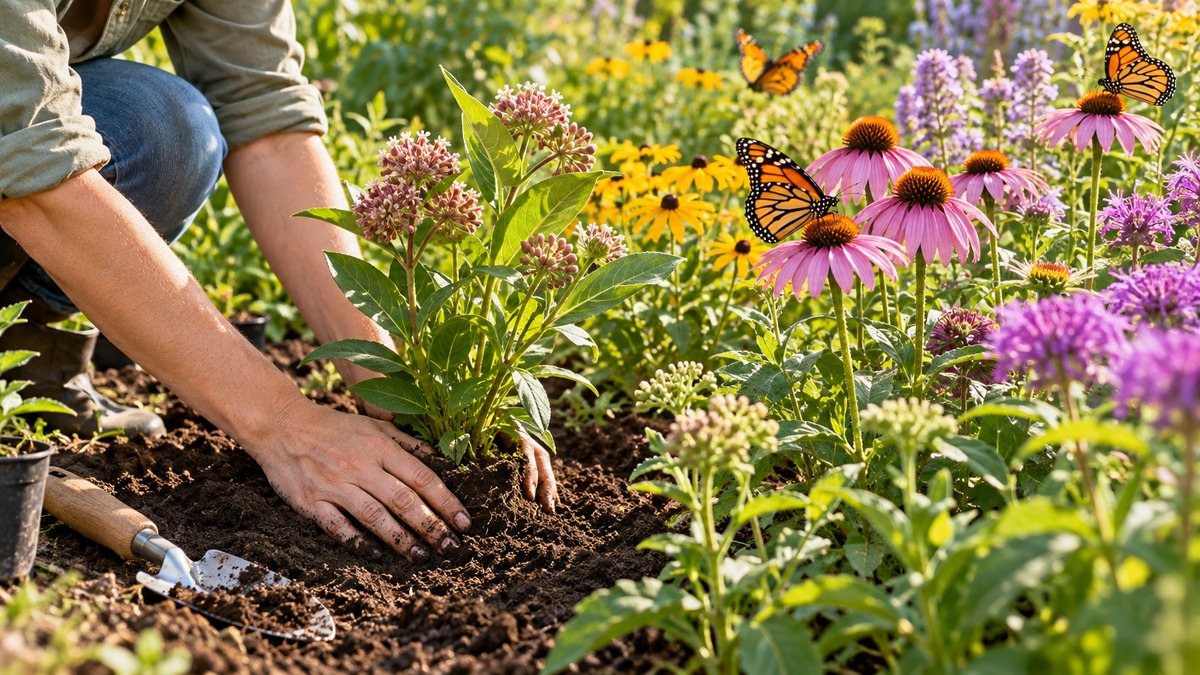
Milkweed is the clearest example. The NWF explains that the monarch caterpillar “depends on it as a food source and cannot survive without it.” Penn State Extension’s York County page makes the same point from a different angle: “Milkweed attracts the Monarch and other butterflies, and dill and parsley are both excellent food sources for the Eastern Black Swallowtail young.” The page pairs milkweed with parsley and dill for different butterflies, so a single border can feed more than one species.
The same page calls the common milkweed “a perennial native American plant named for the milky white sap”, and it says, “Monarchs and milkweed have evolved together.” That history is one reason the sources treat milkweed as a native plant to build around. The NWF also notes that housing development and agriculture have removed milkweed from many places, which is why gardens are part of the answer.
Illinois Extension’s host-plant list gives monarchs milkweeds and butterfly weed, and it pairs other species with other plants, such as native asters for the pearl crescent. Each butterfly species needs its own food plant, so a single flowering border will not cover every species you see.
Caterpillar damage is part of the deal. Oregon State Extension says, “That means gardeners who want butterflies must tolerate some plant damage.” It explains why: “Only a small number of plants — sometimes just one — provide the nutrition each species of caterpillar needs.” Plan on some chewed leaves wherever you grow host plants.
Choosing the right milkweed depends on where you live. The NWF says, “The best choice for monarchs is milkweed that is native to your region!” It adds, “There are over 100 species of milkweed that naturally occur throughout North and Central America, but not all of these will be native to where you live in the country.” The sources do not give one milkweed to buy for every yard, so the regional check comes first.
Add nectar plants for adults
Adult butterflies need a steady supply of nectar, and Penn State Extension’s page says so plainly: “Adult butterflies feed on nectar, the sweet liquid in flowers.” Because the egg, caterpillar and adult stages each need something different, a garden that works for butterflies usually has both kinds of plant.
The University of Maryland guide names native nectar plants that suit a butterfly garden. Its list includes bee balm and wild bergamot, black-eyed Susan, coneflowers and goldenrods. The guide also describes mountain mints as blooming all summer into fall and as outstanding for attracting butterflies and pollinators, which makes them a useful bridge into autumn.
Illinois Extension’s perennial nectar list includes asters, black-eyed Susan, purple coneflower, Joe-Pye weed, bee balm, butterfly weed, goldenrod and milkweeds. Its page says, “Many of these are native plants.” It adds a caution that matters when you shop: “However, cultivars or related non-native species are often also available and may not be as useful as a nectar source.”
Butterfly bush needs a note of caution. The University of Maryland guide says butterfly bushes “excel as butterfly and bee magnets” but adds that “the nectar they produce is high in sucrose and does not provide other nutrients essential to the health of the pollinators.” That is a reason to pair any butterfly bush with the native plants above rather than let it stand alone.
Choose native perennials that come back
Perennials return each year, which makes them a steady base for a butterfly garden. Most of the nectar plants named above are perennials in the Illinois and Maryland lists, and the Illinois list names several of them as native. Those two facts together are why the sources favor them over annual bedding.
Growing conditions matter as well. The University of Maryland guide says that swamp milkweed “likes sun and moist-wet soil” and that butterfly weed “grows in poor dry soil in sun”. Read the light and soil needs of each plant before you commit a spot to it, and match the plant to the site rather than the other way around.
The NWF’s native-plant guidance points the same way. It notes that “Four milkweed species are native to much of the United States making them a good choice for many regions.” It also says that a milkweed species may not be native where you live, which is why the regional check matters more than any single recommendation.
The sources do not give one native list for every region. To check your own area, ask your state extension office which plants are native where you live. The sources that name native species do so for their own regions, so a plant that is native in one state may not be native in another.
Layout, size and shelter
Size is less important than placement. The Wisconsin Extension article says, “Butterfly gardens do not need to be large.” It also explains a layout point: “In fact, it has been found that butterflies prefer scattered groupings of butterfly plants rather than one large butterfly garden.” Several small groups of the same plant can work better than one big bed, according to that guide.
Sun and shelter go together. Wisconsin Extension says, “Site butterfly gardens in sunny, protected spots.” Illinois Extension lists the shelter butterflies use: “Butterflies seek shelter under leaves, in tree crevices, under bark, or in brush or log piles.” It suggests setting aside part of the yard and letting it grow a little wild. A log pile or a loose corner of brush can supply that shelter, though the sources do not give a size for it.
Oregon State Extension’s guide on keeping butterflies in the garden longer says that, “like all wildlife,” butterflies need shelter, water and food. That guide treats shelter as part of the garden, not an extra. The sources do not give a spacing rule, so judge the spacing by how the plants grow in your own bed.
If you are starting from bare ground, our guide to creating a flower bed from scratch covers the groundwork. For arrangements inside a raised bed, see our raised bed companion planting garden layout guide.
Timing and bloom
Bloom through the season, not just in midsummer. Illinois Extension says, “Adults will use a variety of nectar sources, but something should always be available throughout the growing season.” The University of Maryland guide lists asters for late summer to fall, which fills the gap that summer bloomers leave.
Planting time depends on the plant and the place. Oregon State Extension says, “The best planting time depends on the plant and where you live.” That guide suggests planting warm-season annuals such as zinnias and cosmos in spring after the last frost. The sources do not give dates for your zone, so use the local extension calendar before you plant.
How we chose
We chose sources that are extension services or a national wildlife nonprofit: University of Maryland Extension, Illinois Extension, Wisconsin Extension, Penn State Extension, Oregon State Extension and the National Wildlife Federation. We opened each page on 2026-10-22 and kept only sentences that appear in the text we fetched. Where the sources differ, we say so instead of choosing one. We left out retail pages and content-farm pages, even when they came up in searches. No product is recommended in this article.
What we could not verify
What the sources do not say
The sources we opened do not give plant spacing, bed dimensions or a planting calendar for any particular zone. They do not give a native plant list for every region, and they do not say which plants are invasive in every state. They do not rank the host plants against one another for each species, beyond the examples named above. The milkweed and native-status advice depends on your location, so check your local extension office before you buy. The guides were written for their own regions, so treat their timing and plant lists as examples.
Frequently asked questions
Do you need milkweed for monarch butterflies?
Yes, according to the NWF. It says monarch caterpillars can only eat milkweed and that the caterpillar depends on it and cannot survive without it. Choose milkweed that is native to your region, because the NWF says not all species are native to every place.
Does a butterfly garden have to be large?
No. The Wisconsin Extension article says butterfly gardens do not need to be large, and that butterflies prefer scattered groupings of butterfly plants rather than one large garden. A few pots or a small bed can be enough to start.
Do butterfly gardens need native plants?
The sources favor native plants, and Illinois Extension says many of its nectar plants are native. It also warns that cultivars or related non-native species may not be as useful as a nectar source. The sources do not give a percentage of native plants that a garden needs.
Will caterpillars damage the plants?
Yes, some damage is expected. Oregon State Extension says gardeners who want butterflies must tolerate some plant damage, because caterpillars need specific food plants and only a few plants provide that nutrition.
What do butterflies need besides flowers?
Shelter. Illinois Extension says butterflies seek shelter under leaves, in tree crevices, under bark, or in brush or log piles. Sunny, protected spots also help, according to the Wisconsin Extension article.
Sources
- https://extension.umd.edu/sites/extension.umd.edu/files/2021-03/PLANNING%20A%20BUTTERFLY%20GARDEN.pdf (opened 2026-10-22, HTTP 200)
- https://extension.illinois.edu/sites/default/files/hkmw-butterflygardens.pdf (opened 2026-10-22, HTTP 200)
- https://hort.extension.wisc.edu/articles/create-a-butterfly-garden/ (opened 2026-10-22, HTTP 200)
- https://extension.psu.edu/gardening-for-butterflies (opened 2026-10-22, HTTP 200)
- https://extension.psu.edu/programs/master-gardener/counties/york/york-master-gardener-articles/native-plants-wildlife/help-the-butterflies-with-milkweed-parsley-and-dill (opened 2026-10-22, HTTP 200)
- https://extension.oregonstate.edu/news/how-keep-butterflies-your-garden-longer (opened 2026-10-22, HTTP 200)
- https://www.nwf.org/Native-Plant-Habitats/Plant-Native/Why-Native/Milkweed-for-Monarchs (opened 2026-10-22, HTTP 200)