How to Turn a Compost Pile and How Often
As an Amazon Associate we earn from qualifying purchases.
Learning how to turn a compost pile comes down to two decisions: how often to turn it, and whether the weather allows it. Turning mixes the outer material into the middle and brings in air, which the microbes need. The sources we opened do not agree on one schedule. Virginia Tech suggests a turn once a month, Arizona and Oregon State describe weekly turns, and an Oregon State farm guide says about every two weeks. Most of them tie the timing to moisture, temperature or the weather, and the sections below explain each point.
Quick answer
- Turn the pile to add oxygen. The Alabama Cooperative Extension guide says that aeration by turning “provides oxygen to the microbes doing the work.”
- The schedules differ: monthly in Virginia Tech’s publication, weekly in the Arizona handout and an Oregon State printable page, and about every two weeks in an Oregon State farm guide. Pick one that fits your pile and check it between turns.
- In freezing weather, wait for days that are reliably above freezing, as one Oregon State Ask Extension answer advises.
Why turning adds air
The Alabama guide opens its method with a simple idea: “The key to composting in the home landscape is to regulate the conditions under which microbial decomposition takes place for greater efficiency.” Air is one of those conditions. The guide defines the step plainly: “Aeration–contact with air by turning–provides oxygen to the microbes doing the work.” It also explains that a pile gets oxygen in two ways, by turning and by building the pile so surface air can diffuse into the center. Turning is the direct route.
The same guide also describes what happens without enough air. In its words, “When a pile gets too little oxygen, it will become anaerobic, and offensive odors can result.” That is one reason turning matters for smell as well as for speed. A pile that smells may need air, and the sections below cover how to check.
How often: the schedules the sources give
The sources disagree on frequency, so the table lists each one as it states it. Use the table to compare, not to pick a single winner.
| Source | Turning schedule it states | Context the source gives |
|---|---|---|
| Virginia Tech extension publication SPES-393 | Monthly: “Once a month, turn the pile, moving the top and outside materials to the inside and vice versa.” | “The plant materials should decompose into compost within four or five months in warm weather, longer under cool or dry conditions.” |
| University of Arizona and Yavapai County Extension, Backyard Composting handout (2021) | Weekly or monthly: “Weekly will finish in 1-2 months; Monthly 4-6 months” | Listed under Step 4, Aerate the Pile |
| Oregon State Extension printable page 80766 | Weekly: “Turn the pile weekly to introduce oxygen” | The page covers turning fall yard debris into compost. The text we read gives no finish time. |
| Oregon State Extension EM 9660, a farm guide | About every two weeks: “you should be able to turn the pile about every two weeks” | The guide is written for manure and bedding on livestock farms, so its schedule may not match a backyard pile. |
The gap between monthly and weekly is large, and the sources do not explain it in one place. The Arizona handout gives the trade-off in its own figures: weekly turns finish in one to two months, and monthly turns take four to six months.
Steps for turning the pile
Check the moisture first
Start with water, not the fork. The Alabama guide says that “A handful of compost should feel like a wrung-out sponge.” It describes the target as compost that “should be moist when squeezed but not dripping wet.” The guide’s range for the whole pile is “Ideally, the moisture content of the compost pile should be between 40 and 60 percent.”
If the pile looks dry as you turn it, water it while you work. The Alabama guide says to “Add water if the pile dries out.” A pile that is too wet has the opposite problem, and the guide notes that “If too wet, the decomposition process will slow down.” Check moisture at each turn, so you catch either problem before the next one.
Move the outside material to the middle
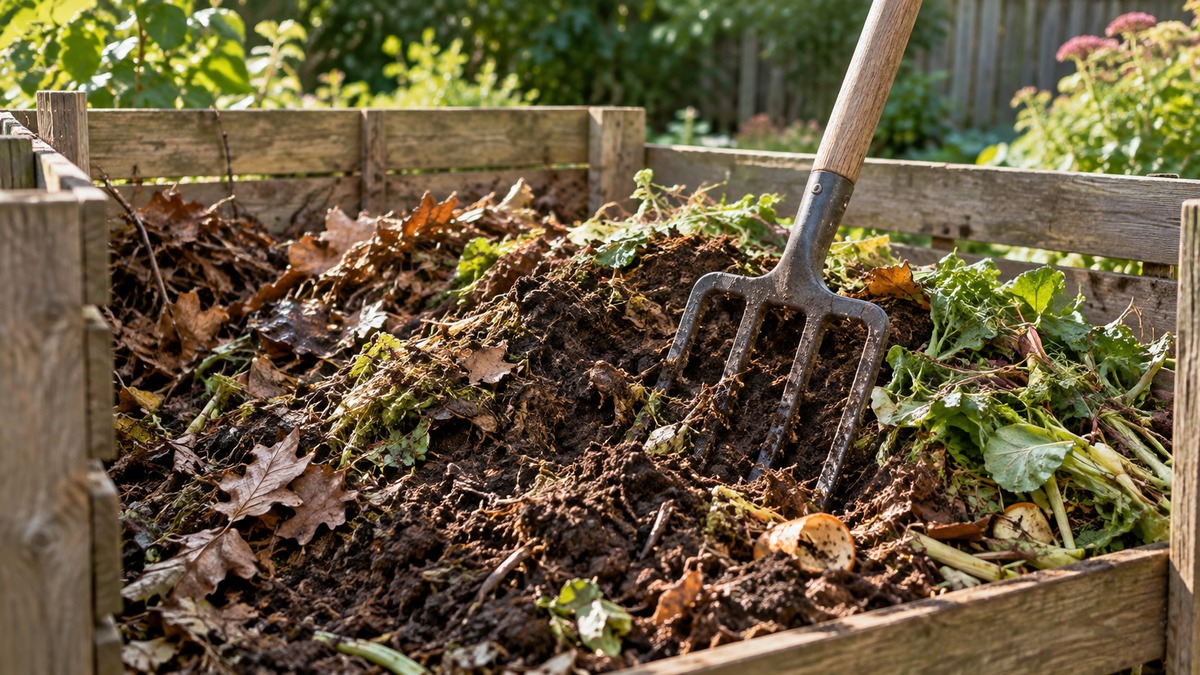
The Virginia Tech publication describes the purpose of a turn as moving “the top and outside materials to the inside and vice versa.” In practice, loosen the pile with a turning tool, pull the outer layer toward the center, and move the center material to the outside. The source does not give a specific method, so the steps here are our reading of its wording, not a step-by-step from the source.
The Alabama guide explains why a tool matters: “Composting tools are designed to penetrate the pile and open up a passage for air and moisture when withdrawn.” The guide does not name a tool, and this article does not recommend one. If you already use a tumbler, the steps are different, and you can read the guide to using a rotating compost bin before you start.
Watch the middle temperature
Heat is part of the process. Virginia Tech says that “The center of the pile should reach 140 degrees Fahrenheit for over 3-5 days to kill most weed seeds, insects and eggs, and disease organisms.” That sentence is the source’s own statement about the center of a pile, and this article does not add to it.
The Alabama guide gives a different reason to turn: after the middle of the pile has heated up, turning encourages uniform aeration of the pile. In other words, turn once the heat has built, so the whole pile gets air and not just the outside.
Timing: how long until the pile is ready
Turning speeds the process, but the sources give a range, not a fixed day. Virginia Tech says: “Composting may be completed in one to two months if the materials are shredded, kept moist, and turned several times to provide good aeration.” That sentence names three things together: shredding, moisture and turning. Its earlier estimate is longer: “The plant materials should decompose into compost within four or five months in warm weather, longer under cool or dry conditions.”
The Alabama guide gives an even wider range. It says compost can be ready to use anywhere from about a month to about a year, depending on the materials and how the pile is managed. The Arizona handout treats the end of the process as a separate step. Its Step 7 is “Cure the Compost,” and it says to “Allow the finished pile to sit UNDISTURBED for 1 month”. So turning can stop before the compost is ready to use.
Turning in cold weather
Cold changes the schedule. The Oregon State farm guide says that “Turning the pile will help to keep the compost cooking.” It also gives a timing rule for the first turn: “The ideal time to turn it is about three days after the internal temperature has reached 150°F.” Those figures come from a livestock-farm setting, so treat them as the source’s numbers rather than a rule for every backyard pile.
The same guide recommends cover in winter: “A tarp is an easy and inexpensive way to cover the pile.” It also says the pile needs enough material to hold heat, with “A pile needs to have at least 1 cubic yard of material.” If you are deciding on pile size before winter, see the guide to building or choosing a compost bin.
The Oregon State Ask Extension answer is more cautious about turning in deep cold. Its writer says that “it would be an uphill battle to get a home garden-sized compost pile to heat up in weather like this.” The advice is to “wait until conditions are reliably above freezing, at least during the daytime, turn the pile”. The same answer says a pause in the process can be acceptable depending on your goals.
If turning is not practical in winter, the farm guide describes another option: “Perforated PVC pipes inserted into the piles may also help circulate air, especially if actively turning the piles isn’t an option.” That is a farm practice, and the source does not give a size or spacing for pipes, so this article does not either.
Common mistakes
- Letting the pile dry out between turns. The Alabama guide’s fix is to add water.
- Turning a pile that is already too wet. The guide notes that a wet pile slows decomposition.
- Letting the pile go short of air. The Alabama guide links a pile with too little oxygen to offensive odors.
- Turning a frozen pile on a cold day, when the Oregon State answer advises waiting for days that are reliably above freezing.
Checks after each turn
- Squeeze a handful and compare it with the wrung-out sponge test in the Alabama guide.
- Smell the pile. If it smells offensive, the guide links that to too little oxygen, so the pile may need more turns or more air.
- Look at the material. Finished compost should look like a uniform potting soil, and the Alabama guide describes it as having little left that is recognizable from the original materials.
Where turning fits in the Arizona steps
The Arizona handout lists seven steps for a successful pile. Turning is step four, and the heading reads “Step 4. Aerate the Pile”. The steps run from selecting a site and choosing a container, through raw materials, moisture and temperature, to curing the finished compost. Turning sits in the middle of that sequence, and the handout also says to start there when a pile has problems.
The handout’s troubleshooting section makes that point directly: “Always start with turn the pile”. It is a simple first fix. If the pile still struggles after a turn, the same handout points to moisture and temperature as the next things to check, and the Alabama guide adds the carbon-to-nitrogen balance as a common cause of slow or smelly piles.
Tools and pile size before you start
The Oregon State farm guide gives a minimum for a pile of material. It also says that larger piles help insulate themselves, because the inside of the pile creates heat. The sources do not give one size that suits every yard, so measure the material you have before you decide how often to turn.
The Alabama guide’s point about tools is the job they do: a tool that penetrates the pile opens a passage for air and moisture. The sources do not name a tool, so judge any tool by that job. This article does not recommend a brand either.
How we chose
Every schedule and cold-weather rule in this article comes from an extension page we opened on 2026-10-21. We used six pages: Virginia Tech’s publication SPES-393, the Arizona and Yavapai County handout, two Oregon State Extension pages (a printable article and the EM 9660 farm guide), an Oregon State Ask Extension answer, and the Alabama Cooperative Extension ANR-0638 guide. We kept statements that the page states in plain words, and we quoted only sentences we confirmed in the saved text of each page. Where pages disagree, we show each figure and say so. This post recommends no products and names no brands.
What we could not verify
We could not confirm one turning schedule that works for every pile, bin or climate. The sources give ranges and conflicting intervals. We also could not confirm how much a tumbler should be turned, because the sources we opened do not cover tumblers.
What the sources do not say
The sources we opened do not give a single correct number of turns per season, and they do not state the best turning frequency for a given pile size. The Oregon State printable page gives no finish time in the text we read. The sources do not give a rule for turning a tumbler, and they do not give a height for a pile that needs turning. For those questions, check the maker’s manual for a bin and your local extension office for climate-specific guidance.
Frequently asked questions
How often should you turn a compost pile?
The sources differ. Virginia Tech suggests a monthly turn, the Arizona handout gives weekly turns for a finish in one to two months, and an Oregon State printable page says weekly. The Oregon State farm guide says about every two weeks. Choose the rhythm that matches your timing, and check moisture at each turn. For more on setups, see tools and setups for a compost pile.
Do you have to turn a compost pile at all?
The sources treat turning as the usual way to add air. The Alabama guide also lists building the pile so surface air can diffuse into the center. When turning is not practical, the Oregon State farm guide describes perforated pipes as one way to help air move, although it is written for farms.
What should you do if the pile smells when you turn it?
Start by turning the pile, as the Arizona handout advises for problems. The Alabama guide ties offensive odors to too little oxygen. Then check moisture, because the Alabama guide notes that a pile that is too wet slows decomposition. If the odor persists, ask your local extension office for guidance.
Should you turn a compost pile in winter?
Turn it only on days when temperatures are reliably above freezing during the day. The Oregon State Ask Extension answer gives that advice, and the farm guide recommends a tarp for cover. Keep the pile large enough to hold heat, and remember that the same answer says a pause in the process can be acceptable depending on your goals.
How long should a pile rest after the last turn?
The Arizona handout says to let the finished pile sit undisturbed for one month. Virginia Tech says compost may be completed in one to two months when materials are shredded, kept moist and turned several times. The sources do not give one number that fits every pile.
Sources
- https://www.pubs.ext.vt.edu/content/dam/pubs_ext_vt_edu/426/426-703/SPES-393.pdf (opened 2026-10-21)
- https://www.extension.arizona.edu/sites/default/files/attachment/BackyardCompostingHandout2021.pdf (opened 2026-10-21)
- https://extension.oregonstate.edu/es/node/80766/printable/print (opened 2026-10-21)
- https://extension.oregonstate.edu/es/catalog/em-9660-keep-compost-cooking-farm-winter (opened 2026-10-21)
- https://extension.oregonstate.edu/ask-extension/featured/can-i-compost-freezing-temperatures (opened 2026-10-21)
- https://www.aces.edu/wp-content/uploads/2018/11/ANR-0638.REV_.pdf (opened 2026-10-21)