How to Make a Bird Bath at Home
As an Amazon Associate we earn from qualifying purchases.
Learning how to make a bird bath at home comes down to one job: give birds a shallow, stable spot to drink and bathe. A plant saucer or ceramic bowl can do the job if the water stays shallow, the surface gives birds a grip, and the water stays fresh. This guide draws on university extension pages and National Wildlife Federation material to show the main points.
Some sources agree closely, and some do not. Where they disagree, especially on water depth and how often to change the water, this article shows each figure and says where the difference lies.
Quick answer
- Keep the water shallow. The NWF says a bath should be no more than three inches deep for small birds, and NC State Extension says two to three inches for songbirds.
- Give the bottom some grip. A textured surface helps birds stand while they bathe, and gravel or stones help when the basin is too deep or too slick.
- Change the water every two to three days and scrub the bath once a week, as Illinois Extension advises. Oregon State says shallow dishes should be refreshed daily, and the NWF’s summer advice is to replace still water daily.
- If you add an electric heater for winter, follow the manual and your local rules. The sources we opened give no wattage or cord length.
Start with a shallow basin
Depth is the detail that most often goes wrong. The NWF’s 2003 magazine article says, “One of the most common mistakes made with bird baths is providing water that is too deep.” It also explains the reason: “Though birds may be able to drink from the edges, they will not bathe in water that is more than a couple of inches deep.”
The figures differ by source, and this guide does not pick a single winner. NC State Extension’s songbird page says, “A bathing area should be no more than 2 to 3 inches deep with a relatively hard bottom.” The NWF’s bird bath page says, “To entice small birds to jump in, a bath should be no more than three inches deep.” Oregon State’s winter guidance sits at the shallow end: “Use a shallow, flat-bottomed dish with 1/2 to 1 inch of water.” The safe reading is to keep the water at the shallow end of the range the sources give: under the three-inch ceiling, and at about one inch if you want to follow the strictest figure listed.
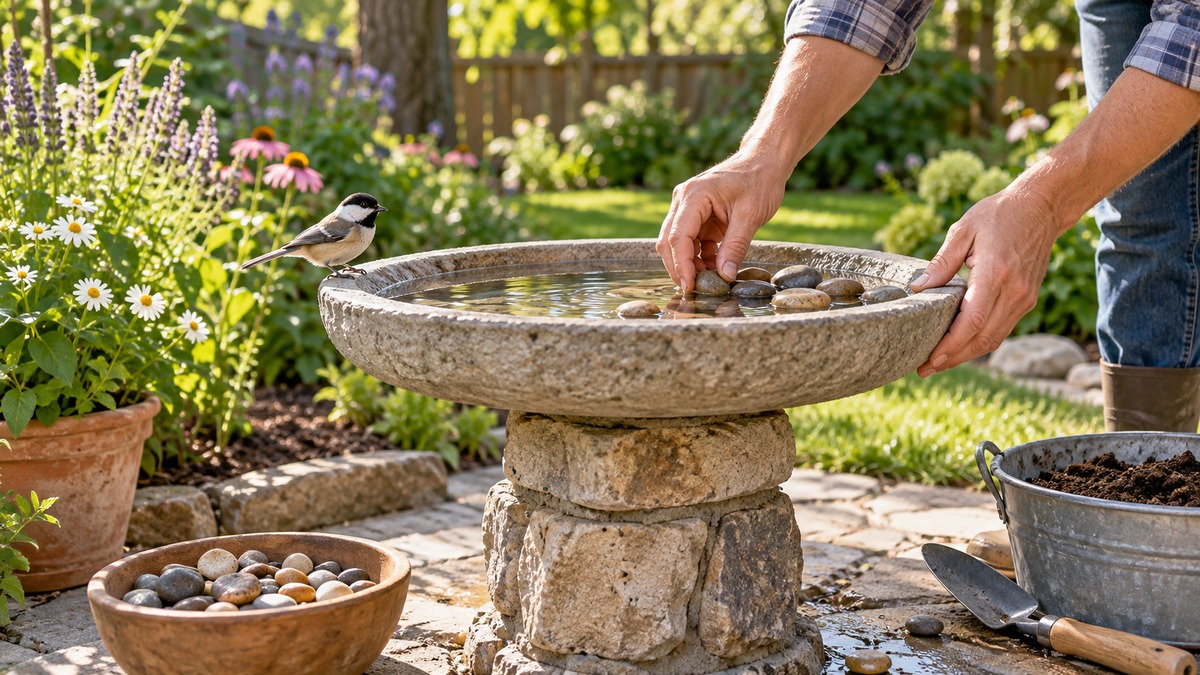
A basin that is a little too deep can still be fixed. The NWF’s bird bath page says, “If the container is a little too deep or too slippery, line the bottom with gravel or stones.” The NWF’s 2003 article describes the same idea with a rock: “This problem can be easily solved when a rock is placed in the water to create an island of shallow water.” The rock gives birds a shallow spot to reach while the rest of the basin stays deeper.
Pick a base and make it grippy
The NWF’s bird bath page describes the homemade route in plain terms: “You can purchase a premade birdbath or make your own.” It also lists low-effort bases: “You can also place large plant saucers or ceramic bowls on tree stumps, logs, or on large plant pots (filled with soil for more stability).” The page notes that a plant pot should be filled with soil for more stability.
Check three things before you set the base down. The base should sit steady, the water should stay shallow, and the inside should give birds grip. The NWF says, “To allow birds to get a foothold while bathing, the interior surface should be textured.” NC State Extension’s gardener handbook says birdbaths should be shallow and have nonslippery sides and bottoms. If a container is too slippery, the NWF suggests lining the bottom with gravel or stones.
Choose the container with that list in mind. A shallow dish with a textured interior fits the guidance better than a deep, smooth bowl. That comparison is a reading of the sources, not a direct statement from any of them.
Choose the spot
Placement changes how birds use a bath. NC State Extension’s songbird page says, “The bath should be gently sloping, free of vegetation, and frequently replenished with fresh water.” Penn State Extension’s winter guide adds a placement tip: “Ideally, your birdbath should be placed near a tree with overhanging branches so that the birds have a place to sit and preen after bathing.”
Cats are a real concern for birds at a bath. The same Penn State passage says, “If cats are present, place the bath away from dense shrubbery where cats can hide and surprise the birds.” The sources do not give a set distance from cover, so judge the spot by the cats and shrubs in your own yard.
Open water works, but it is not the only option. The NWF’s 2003 article says, “Though still water works, water that moves will be more attractive to birds, because they can hear the water moving from some distance.” That is a reason to consider moving water, though the sources do not describe how to build one at home.
Keep the water fresh
Fresh water is the main job, and the schedules differ. Illinois Extension says, “Change the water every two to three days and clean the bath with a scrub brush once a week to keep the water clean, healthy, and mosquito-free.” Oregon State’s guidance on shallow dishes says, “Birds also need clean, fresh water in shallow dishes refreshed daily.” The NWF’s summer article goes further and says, “In summer, that means replacing still water daily, and recirculating water every week or two.”
The reasons for frequent changes are practical. The NWF’s bird bath page says, “It’s important to change standing water regularly to avoid providing habitat for mosquito breeding.” NC State Extension asks that the bath be frequently replenished with fresh water, which points the same way. The sources agree that water left sitting for long stretches is the problem to avoid.
Summer deserves the closest attention. The NWF’s 2003 article says, “AT NO OTHER TIME of the year are backyard ponds and bird baths more important, or more active, than during summer days.” It adds that a bath in summer can draw birds that rarely visit a feeder: “Summer bird baths can attract birds that do not eat from feeders, such as warblers, vireos and flycatchers.”
Clean the bath on a schedule
Cleaning has two parts: a routine scrub and a periodic disinfection. Illinois Extension sets the routine at one scrub a week. The NWF’s bird bath page describes what that scrub removes: “This involves scrubbing out any bird droppings and algae.” The same page also says the NWF calls for cleaning birdbaths regularly in summer.
The NC State handbook adds a disinfection step on top of the routine: “Every two weeks after cleaning the bath, sanitize it by filling it with a solution of one part bleach to ten parts water solution and letting it stand for 3 minutes. Then empty the bath down the sink and rinse well.” The NC State steps end with emptying the bath and rinsing it well.
Oregon State’s winter article keeps the rule short: “Clean it often.” Pair the weekly scrub with a fresh-water change every few days and the routine covers both the algae and the water quality. After any disinfection, empty the bath, rinse it well, and refill it with fresh water.
Winter water and heaters
Winter is when water matters most. Penn State Extension says, “Cold winter temperatures can mean a time of drought for birds. Thus, water becomes particularly attractive to birds in winter.” The same guide notes that heaters to keep the water from freezing are sold for this purpose: “Heaters to keep the water from freezing are available at stores that sell bird feeding supplies.”
If you add a heater, treat it as electrical equipment outdoors. Follow the manufacturer’s manual, use an outdoor setup if the manual calls for one, and follow your local rules for outdoor electrical use. None of the sources we opened gives heater wattage, cord length or an installation method, so do not rely on this article for those details.
The NWF’s bird bath page also covers ice. It says, “If you have time to check your birdbaths in the morning, you can move them into your garage until the ice melts and rotate them with baths filled with water.” That schedule suits someone who can check the bath each morning. It does not describe a heated setup.
Mistakes to avoid
Three mistakes come up across the sources.
- Water that is too deep. The NWF’s 2003 article says birds will not bathe in water more than a couple of inches deep. A deep bowl may still give birds a drink from the edges, but they will not bathe in it.
- Slick sides with no grip. If a container is too slippery, the NWF suggests lining the bottom with gravel or stones, and NC State Extension calls for nonslippery sides and bottoms.
- Stagnant water. The NWF says standing water should be changed regularly to avoid mosquito breeding, and Illinois Extension calls for a change every two to three days.
A fourth mistake is skipping the periodic disinfection. The NC State handbook sets that step at every two weeks.
Buying instead of building
A homemade bath is not the only route. Penn State Extension says, “Birdbaths come in a variety of sizes, shapes, and prices.” If you would rather buy one, see our guide to the best bird bath options. The depth and cleaning points in this article apply to a store-bought bath as well.
For another homemade water option, see our DIY water dispenser for birds guide.
How we chose
We chose sources that are extension services or a national wildlife nonprofit: NC State Extension, Penn State Extension, Oregon State Extension, Illinois Extension and the National Wildlife Federation. We opened each page on 2026-10-22 and kept only sentences that appear in the text we fetched. Where sources gave different depths, water changes or cleaning schedules, we show each figure instead of choosing one. We left out retail pages and content-farm pages, even when they came up in searches, because they do not give verifiable rules for wildlife. No product is recommended in this article.
What we could not verify
What the sources do not say
None of the pages we opened says which container materials are suitable for birds to drink from. This article therefore does not make that claim for ceramic, plastic, concrete or other bases. The sources also do not give a build plan with dimensions, a parts list for a stand, or a rule for how long a homemade basin lasts. The depth figures differ, and so do the change schedules. The heater advice stops at general guidance, with no wattage or cord length. The pages were written for their own regions, so your local weather and wildlife rules may change the schedule.
Frequently asked questions
How deep should a homemade bird bath be?
The sources give different limits. The NWF says no more than three inches for small birds, NC State Extension says two to three inches for songbirds, and Oregon State suggests half an inch to one inch. Choose the shallow end of that range and add gravel or stones if the water runs deeper than you want.
How often should you change the water in a bird bath?
Illinois Extension recommends every two to three days. Oregon State advises daily refreshing of shallow dishes, and the NWF’s 2003 article says to replace still water daily in summer. The sources do not give a separate cool-weather schedule, so check the water each time you visit.
Does a bird bath help if birds already visit a feeder?
Yes, according to Penn State Extension. Its guide says, “Along with providing food for birds, it is a good idea to supply a source of water that birds can use for drinking and bathing.” The same guide adds, “Water also attracts species that do not normally visit your feeder.”
How do you keep mosquitoes from breeding in a bird bath?
Change the water on a regular schedule. The NWF’s bird bath page says, “It’s important to change standing water regularly to avoid providing habitat for mosquito breeding.” Illinois Extension pairs the water change with a weekly scrub so the bath stays “clean, healthy, and mosquito-free.”
Can you use an electric heater in a bird bath?
Penn State Extension says heaters to keep water from freezing are sold for this purpose. Follow the manufacturer’s manual and your local rules for outdoor electrical equipment. The sources do not give wattage, cord length or placement details, so check the manual before you plug anything in.
Sources
- https://content.ces.ncsu.edu/extension-gardener-handbook/20-wildlife (opened 2026-10-22, HTTP 200)
- https://content.ces.ncsu.edu/songbirds (opened 2026-10-22, HTTP 200)
- https://www.nwf.org/Native-Plant-Habitats/Plant-Native/Habitat-Essentials/Birdbaths (opened 2026-10-22, HTTP 200)
- https://www.nwf.org/Magazines/National-Wildlife/2003/Baths-for-Birds (opened 2026-10-22, HTTP 200)
- https://extension.illinois.edu/blogs/ilriverhort/2021-10-04-create-bird-friendly-yard (opened 2026-10-22, HTTP 200)
- https://extension.oregonstate.edu/news/feed-winter-birds-right-seed-shelter-water (opened 2026-10-22, HTTP 200)
- https://extension.oregonstate.edu/news/experts-its-ok-leave-bird-feeders-avian-flu-outbreak-reaches-state (opened 2026-10-22, HTTP 200)
- https://extension.psu.edu/winter-bird-feeding-the-basics (opened 2026-10-22, HTTP 200)