How to Compost at Home: A Beginner’s Walkthrough
As an Amazon Associate we earn from qualifying purchases.
How to compost at home for beginners comes down to a few steps: pick a spot that drains well, build the pile in layers of brown and green material with a little soil, keep it damp like a wrung-out sponge, and turn it so air reaches the middle. The four extension guides we opened cover these steps. They differ on how often to turn the pile and on whether a soil layer is needed, and this walkthrough notes where they disagree.
Quick answer
- Oregon State describes a one-third method: brown material, green material and soil in equal parts.
- Virginia Tech and Oregon State both describe the ideal moisture as a wrung-out sponge.
- Turning schedules differ: monthly in Virginia Tech, weekly in Oregon State and the Arizona handout.
- Alabama says to keep meat scraps, bones and fats out of the pile because they attract pests.
What you need before you start
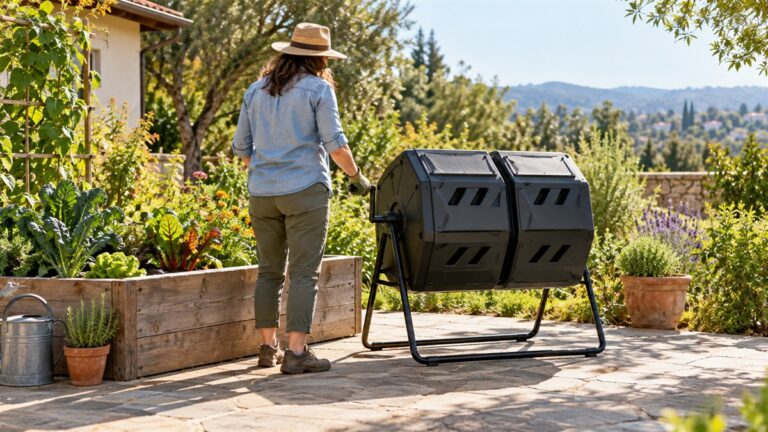
A bin is optional. Virginia Tech says you do not even need one to make compost, though a permanent bin makes sense if you compost regularly. Oregon State lists pallets, cinder blocks or chicken wire as bin materials, and it also describes a freestanding pile. Before you build or buy a bin, look up homeowner association and local ordinance limits, since Virginia Tech notes these can restrict the kind, size and location of bins in your neighborhood. For setups you can compare, see options for setting up a compost bin.
Choose the site with care. Oregon State says to build the pile on well-drained soil in sun or shade, and to lay a plastic barrier underneath if pests are a concern. Arizona’s site checklist covers sunlight, critters, view and water, so each of those is worth a look before you pick a corner.
Gather brown material, green material and a little soil. Brown material includes dry leaves, straw, woody prunings and sawdust, though Virginia Tech lists sawdust only when it is not from treated wood. Green material includes grass clippings, fresh plant material and kitchen scraps. Alabama notes that sawdust decomposes very slowly unless nitrogen is added, and suggests adding grass clippings or manure at the same time.
The guides do not give the same figures, so the table below sets each one beside its source. Where a guide gives no figure, the table says not stated.
| Source | Pile size or container | Layers | Turning |
|---|---|---|---|
| Alabama, ANR-0638 | Not stated | 6-inch coarse base, then 6 to 8 inches of finer material, then 1 to 2 inches of soil or finished compost | Periodically, to mix and aerate |
| Virginia Tech, SPES-393 | At least 27 cubic feet (3 by 3 by 3 feet); usually avoid over 125 cubic feet (5 by 5 by 5 feet) | 3-inch coarse base, about 9 inches of dry leaves, then 3 to 9 inches of fresh material | Once a month |
| Oregon State, fall yard debris guide | Total height under 3 feet | Alternating 2-inch layers of brown, green and soil | Weekly |
| Arizona, Yavapai County handout | Ideally 1 cubic yard | Repeated layers of brown, green, manure and native soil | Weekly finishes in 1 to 2 months; monthly takes 4 to 6 months |
The arithmetic links two of these figures. One cubic yard is 27 cubic feet (3 × 3 × 3), which is the same as the smallest pile Virginia Tech says will hold enough heat. A pile of about that size fits both the Arizona and Virginia Tech figures.
Build the pile in layers
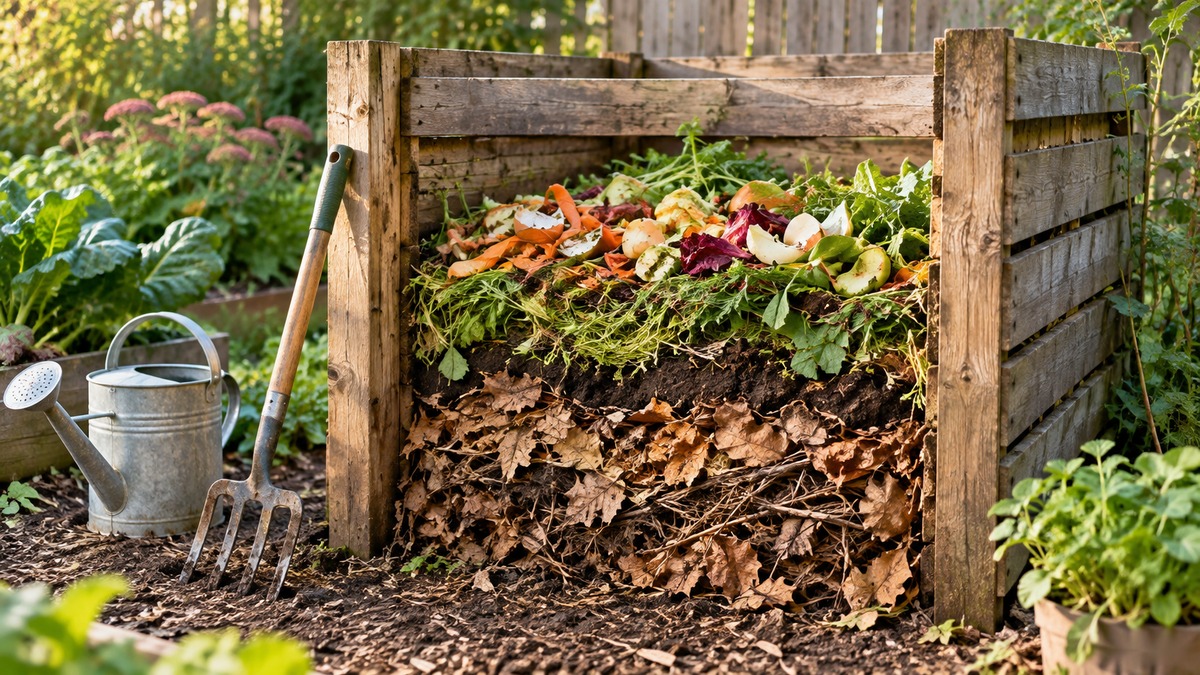
Each guide builds the pile in layers, though the depths differ. Start with a coarse base. Virginia Tech suggests a 3-inch layer of twigs, chopped corn stalks or a wooden pallet, and Oregon State suggests twigs or small branches to improve drainage and airflow. Alabama starts with a 6-inch layer of coarse material, which it says adds air. For a pile layout that suits a yard, see tools and setups for a compost pile.
Add the brown and green layers
Virginia Tech suggests about 9 inches of dry leaves or other old plant material, then 3 to 9 inches of fresh plant material, kitchen waste or fresh manure. Oregon State alternates 2-inch layers of brown, green and soil, and advises keeping the total height under 3 feet. Alabama places 6 to 8 inches of finer material above the base, then 1 to 2 inches of soil or finished compost on top. Chop or shred the materials before adding them, since Virginia Tech says this speeds composting.
Bury the kitchen scraps
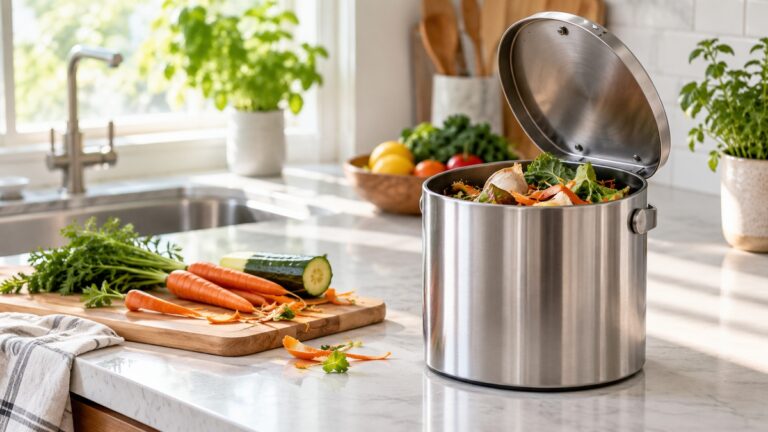
Alabama says vegetable and fruit scraps, eggshells and coffee grounds can go in, as long as they are buried to avoid odor. Oregon State warns that items such as coffee grounds, tea leaves and eggshells can draw rats, raccoons and opossums, so it advises caution with them. Its list of items to leave out includes meat or dairy, fats or oils, pet waste, and diseased or poisonous plants.
Layer in soil, or skip it
Oregon State and Alabama both call for a layer of soil or finished compost, which supplies microbes. Virginia Tech disagrees: it says added starters, activators or garden soil are not needed, because microorganisms are already present in sufficient numbers on the plant material. The sources do not settle this point, so the steps here mark the soil layer as a disagreement.
Keep the pile damp and turned
Moisture
Virginia Tech says the pile should have the moisture of a wrung-out sponge and stay moist but not soaking wet. Alabama gives a moisture range of 40 to 60 percent, and warns that a pile which is too wet will decompose more slowly. Add water if the pile dries out, as Alabama advises. Oregon State describes the goal as a balance of air and moisture.
Turning
Turning adds oxygen. Virginia Tech says the more you turn a pile, the faster it breaks down, and Alabama says turning once the pile gets hot prevents overheating and speeds the process. How often to turn is one of the points where the guides disagree. Oregon State says to turn the pile weekly, Arizona says weekly turning finishes in one to two months, and Virginia Tech says to turn it once a month, moving the outside material to the inside.
Cover and shape
Oregon State suggests covering the pile with a tarp, plywood or burlap to hold heat and keep water from saturating it. Virginia Tech says to shape the pile so the center sits lower than the sides, which helps water flow in during dry weather. If you build your own bin, Virginia Tech says to leave spaces between the boards or blocks, because air is essential to rapid composting. If you want to build a bin yourself, see building or choosing a compost bin.
Check the pile after you build it
A pile should start to heat up within a few days. Virginia Tech says a pile that does not heat may lack nitrogen or moisture, or it may be too small. Oregon State says to add more green material and aerate, and Arizona says a damp pile that will not heat needs more nitrogen.
Smell is the other early check. Virginia Tech lists three causes: the pile may be too tightly packed for oxygen to move through, it may have too much nitrogen-containing material, or it may be too wet. Arizona says to turn the pile for unpleasant odors, and to add carbon if the smell is ammonia. Alabama explains the mechanism: when a pile gets too little oxygen, it becomes anaerobic, and offensive odors can result.
Arizona also warns about spontaneous combustion in hot piles. The sources we opened do not describe how to prevent it, so check local rules and fire guidance for your area.
Common mistakes to avoid
- Adding meat, bones or fats. Alabama says these attract unwanted animal and insect pests.
- Letting the pile get too wet. Alabama says decomposition slows, and Arizona says a waterlogged pile needs turning and a look at its drainage.
- Packing the pile too tightly. Virginia Tech says this can leave too little oxygen moving through the material.
- Building a pile under 27 cubic feet. Virginia Tech says a pile that small does not hold enough heat.
- Adding milk, cheese or yogurt. Alabama’s list of items not to compost includes these dairy foods.
How long it takes
Timing depends on the materials, moisture and how often the pile is turned. The four guides give these figures.
| Source | Time figure stated |
|---|---|
| Alabama | As soon as a month, or as long as a year, depending on materials and management |
| Virginia Tech | Four or five months in warm weather, longer in cool or dry conditions; one to two months if shredded, kept moist and turned several times |
| Oregon State | Two to three months with good balance and regular attention |
| Arizona | Weekly turning finishes in 1 to 2 months; monthly turning takes 4 to 6 months |
Alabama ties its wide range to the kinds of materials and how the pile is managed. Virginia Tech and Arizona tie their shorter figures to frequent turning.
When the compost is ready
Alabama says finished compost should look like uniform potting soil, with little sign of the materials that went in. Oregon State describes it as dark, crumbly, earthy-smelling and mostly unrecognizable. Arizona says the finished pile should feel only slightly warmer than the air, that it can reduce in size by up to half, and that it should then sit undisturbed for one month to cure.
How we chose
This walkthrough covers the beginner steps given in the four extension guides we opened, plus the figures each guide states. We kept a step when at least one guide gave it, and we noted where the guides disagree on a figure or a method. The sources were the Alabama Cooperative Extension publication ANR-0638, the Virginia Tech publication SPES-393, the Oregon State Extension article on turning fall yard debris into compost, and the University of Arizona Yavapai County handout on backyard composting. We read the saved text of each on 2026-10-21. The post recommends no products and names no bins, tools or brands.
What we could not verify
The four sources are extension guides about home composting. They do not compare products, so this post makes no product comparison and makes no claim about any bin, tool or brand.
What the sources do not say
- The sources we opened disagree on turning frequency. Virginia Tech says monthly, while Oregon State and Arizona say weekly.
- They disagree on whether soil or starters must be added. Virginia Tech says they are not needed.
- They give no figure for the spacing between bin boards or blocks.
- They do not state the local rules that apply to your yard.
- They do not explain how to prevent spontaneous combustion in a hot pile.
- They do not cover indoor composting or worm bins.
Frequently asked questions
How big should a first compost pile be?
Virginia Tech says piles smaller than 27 cubic feet do not hold enough heat, and that piles larger than 125 cubic feet are usually best avoided for backyard use. Arizona gives an ideal size of one cubic yard, which is the same 27 cubic feet. Oregon State advises keeping the total height under 3 feet.
Is a compost bin required to start?
No. Virginia Tech says you do not need a bin at all, and Oregon State describes a freestanding pile as an option. Virginia Tech suggests a permanent bin if you plan to compost regularly, and it asks readers to check homeowner association and local ordinance limits before buying or building one.
Are kitchen scraps allowed in a compost pile?
Some kinds, yes. Alabama lists vegetable and fruit scraps, eggshells and coffee grounds as acceptable when they are buried. Its do-not list also covers dairy such as milk, cheese and yogurt, along with meat, fish, chicken, butter and vegetable oil. Oregon State adds pet waste and diseased or poisonous plants to the items to leave out.
How often should a compost pile be turned?
The guides do not agree. Oregon State and Arizona say weekly, and Virginia Tech says monthly. Each figure is given as its guide states it, and this walkthrough does not choose between them. Virginia Tech and Arizona both link more frequent turning to faster finishing.
How can you tell when compost is ready?
Look for dark, crumbly material with an earthy smell, which are the signs Oregon State gives. Alabama describes a uniform look like potting soil, and Arizona adds a feel check and a month of undisturbed curing. The sources do not give a measurement for the finished product.
Sources
- Alabama Cooperative Extension, ANR-0638, Backyard Composting: https://www.aces.edu/wp-content/uploads/2018/11/ANR-0638.REV_.pdf (opened 2026-10-21)
- Virginia Tech Extension, SPES-393, Making Compost From Yard Waste: https://www.pubs.ext.vt.edu/content/dam/pubs_ext_vt_edu/426/426-703/SPES-393.pdf (opened 2026-10-21)
- Oregon State University Extension, Turn fall yard debris into compost for a healthier garden: https://extension.oregonstate.edu/es/node/80766/printable/print (opened 2026-10-21)
- University of Arizona Yavapai County Cooperative Extension, Backyard Composting: https://www.extension.arizona.edu/sites/default/files/attachment/BackyardCompostingHandout2021.pdf (opened 2026-10-21)