Can You Put Food Scraps in Compost? A Guide
As an Amazon Associate we earn from qualifying purchases.
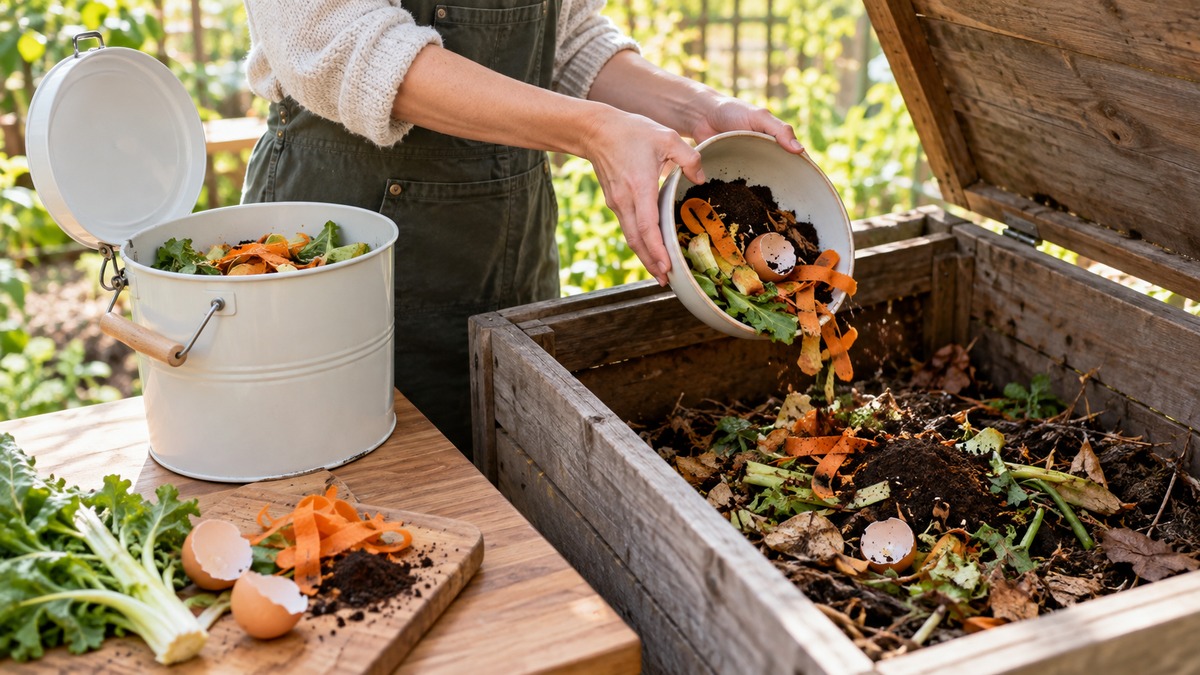
Can you put food scraps in compost? Yes, most plant-based kitchen scraps can go into a backyard pile. The sources we opened list fruit, vegetable, coffee and eggshell scraps as things to compost. They say to keep out meat, bones, dairy, fats and oils, and some of them ask you to check local program rules before adding animal-based items. Composting also keeps food waste out of landfills, which the EPA page gives as one reason to compost.
Quick answer
- The Arizona handout lists kitchen scraps and eggshells among acceptable materials.
- Oregon State says to avoid meat or dairy, fats or oils, pet waste, and diseased or poisonous plants.
- The Alabama handout says to keep meat scraps, bones and fats out because they attract animal and insect pests.
- EPA asks readers to check with the local composting or recycling coordinator before adding dairy, eggs, meat or fish bones, fats or pet waste.
Scraps the sources say you can compost
The Alabama handout gives the longest list. It names apples, carrots, pineapple, potatoes and turnips, along with coffee grounds and egg shells, and it ends by saying that just about any vegetable waste works. Its broader point is that just about any plant waste can be added to the pile. The Arizona handout agrees, listing kitchen scraps, coffee grounds and eggshells as acceptable materials.
The EPA page groups its items by what they do in the pile. Its list of things to compost includes fruits and vegetables, eggshells, coffee grounds and filters, tea bags and nut shells. Its greens group includes vegetable waste, fruit scraps and coffee grounds. The page explains that the green materials provide nitrogen, while the brown materials provide carbon, and it says the pile should have an equal amount of browns to greens.
The Alabama handout explains why these scraps matter. Microbes need protein, and the handout says they make it from materials high in nitrogen, which it lists as manures, kitchen scraps, green leaves and fertilizer nitrogen. The Oregon State article uses a simpler method: one-third carbon material such as dried leaves, one-third nitrogen material such as grass clippings, and one-third soil. It then adds that you can also include items like coffee grounds, tea leaves, eggshells and certain vegetable kitchen scraps.
Scraps the sources say to keep out
The sources do not all cover the same items. Where they do address an item, they point the same way: keep it out, or check local rules before adding it.
Meat, fish and bones are the clearest case. The Alabama handout is direct: “Do not add meat scraps, bones, or fats to the compost pile because they will attract unwanted animal and insect pests.” Its do-not list also names chicken, fish and lard. EPA places meat or fish bones and scraps in its check-local group and says they create odor problems and attract pests such as rodents and flies. Oregon State lists meat on its avoid list.
Dairy and eggs need a closer look. The Alabama do-not list names butter, cheese, milk, sour cream and yogurt. EPA groups dairy products and eggs with the check-local items and gives the same odor and pest reason. Oregon State puts dairy on the same avoid list as meat. Eggshells are different: the Alabama and Arizona handouts both accept them, and EPA lists eggshells as compostable.
Fats and oils get the same treatment in every source that covers them. The Alabama do-not list includes fats, lard, mayonnaise, peanut butter, salad dressing and vegetable oil. EPA places fats, grease, lard or oils in the check-local group. Oregon State says to avoid fats or oils.
Pet waste is where the sources are most cautious. Oregon State lists pet waste on its avoid list. EPA names dog or cat feces and soiled cat litter as check-local items and warns that they might carry parasites, bacteria, germs, pathogens and viruses harmful to humans. Diseased plants come up too. Oregon State says to avoid diseased or poisonous plants, and EPA notes that diseases or insects might survive and be transferred back to other plants.
Comparing the four sources
The table lines up each item with what each source says. “Not stated” means the source we opened does not cover that item. It does not mean the item is allowed.
| Item | Alabama | Arizona | Oregon State | EPA (archived 2021) |
|---|---|---|---|---|
| Vegetable and fruit scraps | Listed | Listed as acceptable | Certain vegetable scraps, with caution | Listed |
| Coffee grounds | Listed | Listed as acceptable | Included, with caution | Listed, with filters |
| Eggshells | Listed | Listed as acceptable | Included, with caution | Listed |
| Meat, fish and bones | Keep out | Not stated | Avoid | Check local rules |
| Dairy | Keep out | Not stated | Avoid | Check local rules (dairy and eggs) |
| Fats and oils | Keep out | Not stated | Avoid | Check local rules |
| Pet waste | Not stated | Not stated | Avoid | Check local rules |
| Diseased plants | Not stated | Not stated | Avoid | Listed as keep out |
Two points need attention. The sources differ on eggs in a way that is easy to miss: the handouts accept eggshells, but EPA puts eggs themselves in the check-local group. Also, a source that is silent on pet waste has not cleared it, so a silent cell calls for a local check, not a yes.
How to add scraps so they break down
If you are still deciding on a container, see options for setting up a compost bin.
Bury the scraps
The Alabama handout says to make sure kitchen scraps are buried in the pile to avoid odor. EPA gives a number: bury fruit and vegetable waste under 10 inches of compost material. Its steps also say to mix grass clippings and green waste into the pile once it is established. The page does not say how to gauge that depth in practice.
Chop larger pieces and add moisture
EPA says to add brown and green materials as they are collected, making sure larger pieces are chopped or shredded. It also says to moisten dry materials as they are added. The page does not give a maximum piece size, so this post does not set one.
Balance scraps with browns
EPA says the pile should have an equal amount of browns to greens. Oregon State suggests alternating 2-inch layers of brown, green and soil materials, and keeping the total pile height under 3 feet. Arizona gives a build order of brown, green, manure and native soil. The Alabama handout asks gardeners to build in layers, alternating yard waste with a nitrogen source and a sprinkling of soil or finished compost, and its nitrogen group includes kitchen scraps.
Keep the pile moist and turned
The Alabama handout gives a moisture target of 40 to 60 percent and says a pile that is too wet decomposes more slowly. Oregon State says to turn the pile weekly to introduce oxygen, and to cover it with a tarp, plywood or burlap to retain heat and prevent water saturation. Arizona says to turn the pile to re-introduce oxygen and to keep it moist like a damp sponge. For more on pile setups, see tools and setups for a compost pile.
If you have no room for a pile
EPA says that when there is no room for an outdoor pile, you can compost materials indoors in a special type of bin. Its indoor section includes a worm composting bin. For a closer look at worms, see worms for a compost bin.
Odors, pests and local rules
Smell and animals are the two problems the sources raise most often. The Alabama handout says that when a pile gets too little oxygen, it becomes anaerobic and offensive odors can result. It adds that too much nitrogen compared with carbon can deplete oxygen and produce odors as ammonia gas. Arizona’s problem-solving list gives the fixes: turn the pile for unpleasant odors, and add carbon if the smell is ammonia.
Pests are the other concern. Oregon State gives a direct warning: “However, be cautious — these can attract pests such as rats, raccoons and opossums.” The “these” in that sentence refers to the coffee grounds, tea leaves, eggshells and vegetable scraps the article had just listed as ones you can include, so the caution applies to scraps you might otherwise add. Oregon State also suggests placing a plastic barrier underneath the pile if pests are a concern.
Local rules are the last check. EPA says: “Check with your local composting or recycling coordinator to see if these organics are accepted by your community curbside or drop-off composting program.” That check applies to dairy, eggs, fats, meat or fish bones and pet waste. The sources we opened do not name any city, county or program, so the rule for your area is yours to find.
How long the process takes
Timing belongs to the whole pile rather than to one scrap, and the sources give different figures for different conditions. Arizona’s aeration step says: “Weekly will finish in 1-2 months; Monthly 4-6 months.” Oregon State says a pile with good balance and regular attention will break down in two to three months. The Alabama handout says compost can be ready as soon as a month or as long as a year, depending on the materials and how the pile is managed. EPA says the process usually takes anywhere between two months to two years.
The Alabama handout describes the end point: finished compost should look like uniform potting soil, with little evidence left of what went into the pile. Oregon State describes it as dark, crumbly, earthy-smelling and mostly unrecognizable. Arizona gives the same signs.
Common mistakes
- Leaving scraps on top of the pile. The Alabama handout says to bury them to avoid odor, and EPA gives a depth of 10 inches.
- Adding meat, bones or fats to an open pile, since the sources name animal and insect pests as the risk.
- Skipping the local check for dairy, eggs, fats, pet waste or fish bones, which EPA asks readers to make.
- Adding a lot of scraps with few browns, which cuts against EPA’s equal-parts advice.
- Letting the pile dry out or stay soaked. Oregon State says too much water stops the microbes and too little stalls the process.
How we chose
This post answers one question: which kitchen scraps the sources say to compost, which they say to keep out, and where local rules come in. We picked four pages against three criteria. Each page had to come from an extension service or a government agency. Each had to name kitchen scraps or specific food items, not only general composting. And every quotation had to match the text of the page we opened on 2026-10-21.
The four pages are the Alabama Cooperative Extension handout ANR-0638, the University of Arizona and Yavapai County Cooperative Extension handout, the Oregon State University Extension article on fall yard debris, and the EPA composting page. The EPA page is an archived January 2021 snapshot and says so at the top, so it is cited as archived. We kept it because it gives the fullest keep-out list and a reason for each item. We did not use any other page for this question. This post recommends no products and names none.
What we could not verify
The limits below come from the pages we opened, or from the way they were written.
What the sources do not say
- The sources do not list every food item, so an item missing from all four pages has not been cleared.
- No source gives a maximum size for a scrap or an amount of scraps a household can add in a week.
- No source names a city, county or program rule, so the check is left to the reader.
- The EPA page is an archived January 2021 snapshot, and the pages we opened do not confirm whether its details are current.
- The Alabama handout is marked as revised in September 2013.
- The sources do not say whether a closed bin changes the list of items to keep out.
- The timing figures depend on materials and management, and the sources do not say how climate or pile size changes them.
Frequently asked questions
Can you compost fruit and vegetable scraps?
Yes, according to the sources. The Alabama handout names apples, carrots, lettuce, potatoes, tomatoes and many others, and the Arizona handout counts kitchen scraps as acceptable. Oregon State adds a caution that certain vegetable scraps can draw rats, raccoons and opossums.
Can you compost meat, bones or fish?
Meat and bones are on the keep-out list in the Alabama handout, and Oregon State says to avoid meat. EPA asks you to check local rules first and gives odor and pest reasons for these items.
Can you put dairy, eggs or oil in compost?
Each source that covers dairy, fats or oils puts them on a keep-out or check-first list. The Alabama do-not list names milk, butter, cheese, yogurt and vegetable oil, and EPA groups dairy and eggs with the items to check with a local program.
Can you compost pet waste or cat litter?
None of the sources we opened recommends composting pet waste. Oregon State lists it on the avoid list. EPA names dog or cat feces and soiled cat litter as items to check with a local program, and it warns that these materials might carry parasites, bacteria, germs, pathogens and viruses harmful to humans. The pages do not describe a home method for handling pet waste, so this post does not give one.
Can you compost food scraps indoors?
EPA says materials can be composted indoors in a special type of bin when there is no room for an outdoor pile. It says a properly managed bin will not attract pests or rodents and will not smell bad, and that compost should be ready in two to five weeks. The page does not walk through the setup, and the pages we opened do not compare indoor results with outdoor piles for food scraps.
Sources
- Alabama Cooperative Extension, Backyard Composting, ANR-0638: https://www.aces.edu/wp-content/uploads/2018/11/ANR-0638.REV_.pdf (opened 2026-10-21)
- University of Arizona and Yavapai County Cooperative Extension, Backyard Composting handout: https://www.extension.arizona.edu/sites/default/files/attachment/BackyardCompostingHandout2021.pdf (opened 2026-10-21)
- Oregon State University Extension, Turn fall yard debris into compost for a healthier garden: https://extension.oregonstate.edu/es/node/80766/printable/print (opened 2026-10-21)
- US EPA, Composting At Home (archived January 2021 snapshot): https://19january2021snapshot.epa.gov/recycle/composting-home_.html (opened 2026-10-21)