Best Lawn Edger Manual
As an Amazon Associate we earn from qualifying purchases. Details
If you are looking for the best lawn edger manual, start with the type, because a rotary wheel edger and a half moon edger cut in different ways and suit different edges. A manual lawn edger is a hand tool with a blade or a pair of blades that you push along a walk or bed line, with no motor and no cord. We read seven manual edger listings on Amazon.com from seven different brands. Five are rotary wheel edgers with long handles, and two are half moon edgers with a short T-grip. This guide compares them by type, adjustable height, blade steel, listed weight and what each listing says about setup.
Quick answer
- For long, straight sidewalk and driveway edges, a rotary wheel edger suits the job. The five rotary listings here run from 63 to 75 inches in their titles and have adjustable handles.
- For shorter bed edges and a tighter cut at the turf line, a half moon edger suits the job. The CKLT listing is 41 inches and the Orcela listing is 37 inches.
- For a handle that fits your height, check the adjustment before you buy. Most of the rotary listings offer three or four height settings.
- For a blade you can sharpen by hand, check the blade steel. The CKLT listing gives a tempered spring steel blade, and the Orcela listing gives manganese steel.
- If you are edging a bed rather than a lawn, our best flower bed edging guide covers edging materials. For a hand tool to clear the cut line, see our best hand trowel guide.
Two kinds of manual edger
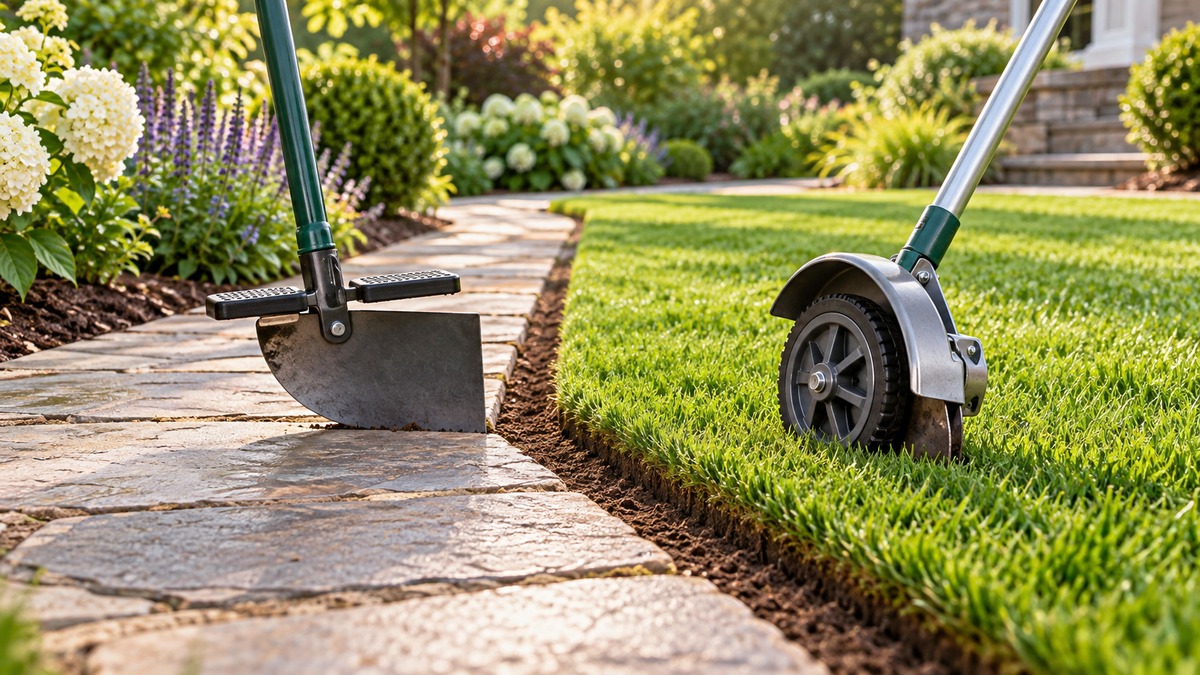
A rotary wheel edger has a wheel that rolls along the edge of the walk, with a set of blades on the wheel that cut the grass at the line. You push it along the edge while the wheel keeps the cut straight. A half moon edger has a flat, curved blade with a foot plate, and you step on the plate to drive the blade into the soil at the edge of a bed. Both are manual, and both are hand tools in the sense that matters here: you push or step, and you do the work yourself.
Penn State Extension’s general advice about tools applies to both types. It says “Use the wrong tool or the wrong form of the right tool, and you are more likely to become discouraged, exhausted, or injured.” For an edger, the right form is the one that matches the edge you are cutting. A long rotary edger suits a long walk, and a short half moon blade suits a curved bed line.
The seven edgers side by side
| Listing (brand) | Type and adjustment | Blade and build as listed | Weight (spec table) |
|---|---|---|---|
| BlumeTrec, 75 inch | Rotary wheel, 75 inch overall | Serrated and scissor blades, alloy steel, 2.6 inch wheel | 4.95 pounds |
| Walensee, 69.7 inch | Rotary wheel, three height settings | Chrome-plated blades per bullets, 2.4 inch roller | 4.55 pounds |
| Klarg, 66.9 inch | Rotary wheel, three height settings | Anti-rust plated blades per bullets | 1 pound |
| BlumWay, 67 inch | Rotary wheel, four height settings from 23.6 to 67 inches | Stainless steel blades, 6 inch wheel | 3.47 pounds |
| YAKUHY, 63 inch | Rotary wheel, four height settings | Stainless steel and carbon steel | 2.76 pounds |
| CKLT, 41 inch | Half moon, 8 inch footplate | Tempered spring steel, serrated, manganese steel per spec | 5.92 pounds |
| Orcela, 37 inch | Half moon, T-grip handle | Manganese steel, serrated, powder coated | 2.86 pounds |
Read the weight column with the type in mind. The Klarg spec table gives 1 pound for a 66.9 inch tool with a 5.5 inch cutting width, which looks light for that length, and we report the figure as listed. The CKLT half moon is the heaviest in the set at 5.92 pounds, which is in line with a heavier head and a wide footplate.
Height, reach and setup
Height matters on a rotary edger, because you walk the line holding the handle. The sources we opened give a clear principle here. Penn State Extension says “Good posture prevents injuries, so full-sized tools need to be correct for your height, normally your height or greater.” A rotary edger with three or four height settings lets you match the handle to your height, and that is the feature to check first.
The BlumWay listing gives four heights, from 23.6 inches to 67 inches. The YAKUHY bullets give four heights, 30.7, 44.5, 58.3 and 63 inches, but its spec table gives a minimum adjustable height of 5.9 inches, which does not match the bullets. The Walensee bullets list three handle heights, starting at 40.2 and 54.7 inches. Use the bullet figures for the height you will actually work at, and check the setting on the product page before you order.
Assembly is part of the buying decision too. The Walensee and BlumeTrec bullets describe aligning holes, inserting screws and twisting a threaded pipe to lock the handle. The Orcela listing includes four nuts, four bolts and two helper wrenches, and the bullets say the parts are all in the package. The BlumWay package includes a pair of gloves, a mounting kit and a user manual, and its spec table notes that the manual’s English language is not guaranteed.
Blades, steel and sharpening
Blade steel is the second thing to check. The CKLT listing describes a tempered spring steel blade with a serrated edge, and its spec table lists manganese steel. The Orcela bullets describe heavy duty manganese steel with serrated edges, and its powder-coated surface resists rust. The BlumeTrec bullets describe rust-resistant alloy steel blades with serrated edges and scissor-style action. The YAKUHY and BlumWay listings describe stainless steel blades, and the YAKUHY spec table also lists carbon steel.
The sources we opened do not compare these steels for edge life or rust resistance in lawn work, so treat the steel claims as the sellers’ own. Serrated and scissor-style blades are a listing feature rather than a verified cutting result.
Sharpening a serrated blade needs care. The Illinois Extension guide says “Sharp garden tools are more efficient at digging or pruning.” It also warns: “Do not use power grinders. Heat generated by the friction can make the metal brittle.” Hand sharpening with a file keeps the edge and the temper of the metal intact. Penn State Extension adds that “For all tools, any part that is meant to be sharp should be sharpened regularly.” For a dedicated sharpening tool, see our best pruner sharpener guide.
Bending, lifting and the work itself
Edging is repetitive work. Penn State Extension’s advice on garden work is direct: “Avoid prolonged bending over because it fatigues the lower back muscles.” The long handles on the rotary designs let you stand while you work, which is what the listings describe. The half moon edgers in this set use a foot plate, so you drive the blade with a step rather than a push.
Penn State’s lifting advice matters if you carry the edger or lift it over a curb. It says “To lift safely, hinge at your hips, bend your knees, and lean forward, keeping the lower back straight.” The same page notes that “Lifting a 10-pound load incorrectly can actually put 100 pounds of pressure on your lower back.” An edger is not a 10-pound load, but the same lifting principle applies when you lift a long tool off a truck bed or a shelf.
The Klarg bullets tell the user to slide the edger forward forcefully. This guide does not repeat that instruction, because the sources we opened do not support forceful use.
Which edger for which edge
| Edge you are cutting | Type to consider | Listings in this guide that state a length in that range |
|---|---|---|
| Long sidewalk or driveway line | Rotary wheel | BlumeTrec at 75 inches, BlumWay at 67 inches, Klarg at 66.9 inches, Walensee at 69.7 inches, YAKUHY at 63 inches |
| Shorter, curved bed line | Half moon | CKLT at 41 inches, Orcela at 37 inches |
| A handle set for more than one height | Rotary wheel with three or four settings | BlumWay (four), YAKUHY (four in its bullets), Walensee (three), Klarg (three) |
The table shows where each listing belongs. A rotary edger is the better match for a long line that you walk with the handle upright, and a half moon edger is the better match for a short bed line where the footplate drives the blade. Both are manual, so the choice is about the line, not about power.
Conflicts to check in the edger listings
| Listing | What the bullets say | What the spec table says | What to check |
|---|---|---|---|
| YAKUHY | Height settings of 30.7, 44.5, 58.3 and 63 inches | Minimum Adjustable Cutting Height: 5.9 inches | Confirm the lowest setting |
| YAKUHY | High-grade stainless steel blades and handle | Number of Items: 7; Unit Count: 1 | Confirm the packing |
| CKLT | Model 41in-HE | Manufacturer Part Number: 40in-HE | Confirm the model |
| Klarg | Three adjustable heights | Item Weight: 1 pound for 66.9 inches | Confirm the weight |
| BlumeTrec | 2.6 inch rubber wheel | Cutting width: 0.4 inches | Confirm what each figure measures |
Calculations from the listed figures
For the BlumWay edger, 67 inches minus 23.6 inches is 43.4 inches of span between its shortest and longest settings. For the YAKUHY edger, 63 inches minus 5.9 inches is 57.1 inches on the spec table, while the bullets start at 30.7 inches and imply a shorter span. Use the bullet heights for the setting you will actually work at, and confirm the rest with the seller.
The weights show the same pattern. The BlumeTrec edger is listed at 4.95 pounds and the Walensee at 4.55 pounds, so 4.95 pounds minus 4.55 pounds is 0.4 pounds. The CKLT half moon is listed at 5.92 pounds and the Orcela at 2.86 pounds, so 5.92 pounds minus 2.86 pounds is 3.06 pounds.
Blade and footplate details in the half moon listings
The CKLT listing states an 8 inch wide footplate and a tempered spring steel blade with a serrated edge. Its bullets say the tool cuts along driveways, sidewalks and flower beds. The Orcela listing describes a wide footplate but does not give its width in the bullets or the spec table. Its package includes four nuts, four bolts and two helper wrenches for assembly, and its bullets say the blade cuts through turf, compact soil, roots and weeds. Compare the two listings on footplate width first, because the Orcela width is not stated.
Checklist before you order an edger
- Match the type to the line: rotary for long walks, half moon for short bed lines.
- Confirm the height settings against the spec table wherever the figures differ.
- Check the blade steel and the footplate width where the listing states them.
- Read the weight with the length, since some spec figures look light for the size.
Wheel and blade details by listing
| Listing | Wheel or roller as listed | Blades as listed | Included in the box, per the listing |
|---|---|---|---|
| BlumeTrec | 2.6 inch rubber wheel | Rust-resistant alloy steel, serrated and scissor-style | Not stated |
| Walensee | 2.4 inch wider roller | Chrome-plated alloy steel | Not stated |
| Klarg | Wheels, size not stated in the bullets | Anti-rust plated working parts | Not stated |
| BlumWay | 6 inch wheel in the spec table | Stainless steel, 17 sharper blades per the bullets | Gloves, mounting kit and user manual |
| YAKUHY | Lightweight reinforced tube | Stainless steel blades and handle | Gloves, per the title |
Wheel width is one of the few figures that appears in more than one listing, and the listings do not state it the same way. Two listings give a 2.4 to 2.6 inch wheel or roller, BlumWay gives a 6 inch wheel in its spec table, and the rest do not state a wheel size. Where the size is missing, ask the seller before you order rather than assume a width.
1. Manual Edger Lawn Tool, 75 Inch Wheel Rotary Edger for Lawn with Extra-Wide Wheel, Grass Edge (Rotary wheel edger, 75 inch, with a 2.6 inch wheel)
Specs from the listing (checked 2026-10-21):
- Power Source: manual
- Cutting width: 0.4 inches
- Item Weight: 4.95 pounds
- Size: 75 inches
Pros
- The title gives a 75 inch overall length with an extra-wide wheel for sidewalk edges
- The bullets describe serrated and scissor blades in rust-resistant alloy steel
- The spec table lists the power source as manual and the weight as 4.95 pounds
Cons
- The spec table gives a cutting width of 0.4 inches, which the bullets do not explain next to the 2.6 inch wheel
- The bullets describe an adjustable handle but the spec table gives only one size of 75 inches
Best for: A gardener who edges long sidewalk and driveway lines with a single long handle
Skip if: You need a handle that adjusts to several heights for mixed heights in the household
View on Amazon (affiliate link)
2. Walensee Wheel Rotary Edger, 69.7 Inch Hand Manual Edger Lawn Tool with Adjustable Stainless Steel (Rotary wheel edger, 69.7 inch, with three handle heights)
Specs from the listing (checked 2026-10-21):
- Power Source: Manual
- Operation Mode: Manual
- Material Type: Alloy Steel, Stainless Steel
- Item Weight: 4.55 pounds
Pros
- The title and bullets describe a 69.7 inch rotary edger with an adjustable stainless steel handle
- The bullets give three handle heights, including 40.2 and 54.7 inches, and a 2.4 inch wider roller
- The spec table lists the power source and operation mode as manual
Cons
- The spec table lists the color as orange and the material as alloy steel and stainless steel, without naming the blade steel separately
- The bullets describe the blades as chrome-plated for rust resistance without a steel grade
Best for: A gardener who wants three handle heights on a long rotary edger with a wider roller
Skip if: You need a lighter tool to lift onto a truck bed, since the spec table gives 4.55 pounds
View on Amazon (affiliate link)
3. Wheel Rotary Lawn Edger, Manual Grass Edger with Long Handle (66.9 Inch), Adjustable (Rotary wheel edger, 66.9 inch, with three adjustable heights)
Specs from the listing (checked 2026-10-21):
- Power Source: hand_powered
- Cutting width: 5.5 inches
- Item Weight: 1 pounds
- Size: 66.9 inches
Pros
- The title and bullets describe a 66.9 inch rotary edger with three adjustable heights
- The bullets describe anti-rust plated working parts for long life
- The spec table lists a 5.5 inch cutting width and a hand-powered operation
Cons
- The spec table gives 1 pound for a 66.9 inch tool, which looks light and needs confirming
- The bullets tell the user to slide the edger forward forcefully, which we do not recommend
Best for: A buyer who wants a rotary edger with height adjustment for walks and flower beds
Skip if: You want a confirmed weight before you order, since the spec table figure looks wrong
View on Amazon (affiliate link)
4. BlumWay 67 Inch Rotary Wheel Edge Trimmer, Rotary Shears, Manual Sidewalk Edgers, Length 23.6 to 67 (Rotary wheel edger, 67 inch, with four adjustable heights)
Specs from the listing (checked 2026-10-21):
- Number of Positions: 4
- Wheel Size: 6 inches
- Item Weight: 3.47 pounds
- Material Type: Stainless Steel
Pros
- The bullets describe four adjustable heights from 23.6 to 67 inches for different heights of user
- The spec table lists four positions, a 6 inch wheel and manual operation
- The bullets describe stainless steel blades and a 6 inch wheel with 17 blades in total
Cons
- The spec table says the user manual is included but that its English language is not guaranteed
- The spec table gives a 3.47 pound weight and a minimum height of 23.6 inches for the widest setting
Best for: A household with mixed heights that wants four handle positions on one rotary edger
Skip if: You want a lighter tool or a clear set of English instructions in the box
View on Amazon (affiliate link)
5. Wheel Rotary Edger, Adjustable 63 inch Manual Lawn Edger Tool with Gloves, Stainless Steel Trimmer (Rotary wheel edger, 63 inch, with gloves and four height settings)
Specs from the listing (checked 2026-10-21):
- Item Weight: 2.76 pounds
- Material Type: Stainless Steel, Carbon Steel
- Number of Positions: 4
- Maximum Adjustable Cutting Height: 63 inches
Pros
- The title and bullets describe a 63 inch rotary edger that includes gloves
- The spec table lists a 2.76 pound weight and stainless steel with carbon steel for the material
- The bullets describe a lightweight reinforced tube and quick assembly
Cons
- The bullets give height settings of 30.7, 44.5, 58.3 and 63 inches, but the spec table gives a minimum of 5.9 inches
- The spec table lists Number of Items as 7 with a Unit Count of 1, so the packing needs checking
Best for: A gardener who wants a light rotary edger with gloves for sidewalks and grass edges
Skip if: You need the height settings to agree between the bullets and the spec table before you order
View on Amazon (affiliate link)
6. Edger Lawn Tool 41 inch Border Edger with Tempered Spring Steel Blade (Half moon edger, 41 inch, with a wide footplate and spring steel blade)
Specs from the listing (checked 2026-10-21):
- Material Type: Manganese Steel
- Item Weight: 5.92 pounds
- Item Highlight: Long Rubber Handle, Wide Footplate, Rustproof Manganese Steel Half Moon Edger for Garden Maintenance
Pros
- The title and bullets describe a 41 inch half moon edger with a tempered spring steel blade
- The bullets describe an 8 inch wide footplate for leverage on the foot
- The spec table lists manganese steel and a rustproof long rubber handle in its highlight
Cons
- The spec table gives a model number 41in-HE and a part number 40in-HE, which do not match
- The bullets describe quiet, eco-friendly and all-weather control, claims that the sources we opened do not address
Best for: A gardener who edges curved bed lines and wants a long-handled half moon blade
Skip if: You want a lighter tool, since the spec table gives 5.92 pounds
View on Amazon (affiliate link)
7. Half Moon Edger, Lawn Edger Tool with T-Grip Handle, 37 inch (Half moon edger, 37 inch, with a T-grip and serrated manganese blade)
Specs from the listing (checked 2026-10-21):
- Item Weight: 2.86 pounds
- Product Dimensions: 8.27 x 1.5 x 37 inches
- Manufacturer: Orcela
- Item model number: CPXBCGJ
Pros
- The bullets describe an ergonomic handle with a rubber T-grip for upright edging
- The bullets describe a heavy duty serrated manganese steel blade with a powder-coated surface
- The spec table gives 2.86 pounds and an 8.27 by 1.5 by 37 inch product size
Cons
- The bullets say the blade cuts through turf, compact soil, roots and weeds, which is a claim we could not check
- The spec table lists only dimensions, weight and model, so the steel grade is not stated in the table
Best for: A gardener who edges shorter bed lines and wants a lighter half moon edger with a T-grip
Skip if: You need a rotary wheel for long, straight walk edges
View on Amazon (affiliate link)
How we chose
We searched Amazon.com in Chrome on 21 October 2026 for best lawn edger manual and for manual lawn edger, and we read the first results page for each search. We kept listings whose title or bullets describe a hand-operated lawn or bed edger, whether a rotary wheel or a half moon blade. From those we chose seven edgers from seven brands. For each pick we read the product title, the brand line, the first bullets and the specification table on the product page.
We left out powered edgers and trimmers, because the keyword asks for manual tools. We did not rank the picks by price, rating or sales rank, because Chrome gave us titles, bullets and specification tables rather than reliable prices, ratings or availability. The order of the picks is the order we wrote them, not a score.
What we could not verify
- Price, availability and shipping were not captured, so this guide says nothing about cost or stock.
- Ratings and sales rank were not captured, and no popularity claim appears in this guide.
- The Klarg weight of 1 pound for a 66.9 inch tool looks light, and we could not confirm it.
- The YAKUHY height figures in its bullets and its spec table do not agree, and we could not resolve the difference.
- The CKLT model number 41in-HE and part number 40in-HE differ, and the listing does not explain which is correct.
- The YAKUHY spec table lists Number of Items as 7 with a Unit Count of 1, so the packing is unclear.
- The sources we opened do not compare rotary wheel and half moon edgers for cutting straightness, edge life or lawn results, so the cut quality claims are the sellers’ own.
- Warranty terms are not covered. The sources we opened do not address manual lawn edger warranties, and we did not open a warranty page.
FAQ
Is a rotary wheel edger or a half moon edger better?
It depends on the edge. Rotary wheel edgers suit long, straight walk and driveway lines, where the wheel keeps the cut steady. Half moon edgers suit shorter bed lines and curved edges, where you step on the foot plate to drive the blade in. Both are manual, and neither source we opened ranks one above the other for cut quality.
How do I choose the right height?
Penn State Extension ties tool fit to height and posture. A rotary edger with adjustable height lets you match the handle to your own height, so set it to the height that keeps your back straight while you walk the line. Check the height settings in the bullets before you buy, because some listings differ from their spec tables.
Why does bending matter when I edge a lawn?
Penn State Extension says that “Avoid prolonged bending over because it fatigues the lower back muscles.” Edging means repeated movement along a line, so a tool that keeps you upright reduces the strain. A half moon edger requires more bending, so plan breaks and change position often.
Do I need gloves and eye protection to use an edger?
Yes. The Illinois guide recommends gloves and safety glasses when you work with garden tools, and that advice applies when you grind or file the blade. That is the only protective step the sources we opened address for garden tools.
Should I sharpen the blade myself?
You can sharpen a manual edger blade by hand. The Illinois guide warns against power grinders because heat from friction can make the metal brittle. A file keeps the metal intact, and the same guide describes whetstones and flat files as options for garden tools.
Bottom line
For long walk edges, choose a rotary wheel edger with an adjustable handle that fits your height. For short bed edges, choose a half moon edger and plan to bend less by working in short passes. Check the height settings, the blade steel and the assembly parts before you order.
Sources
- University of Illinois Extension, “Garden Tool Maintenance” (Mary Fischer, 2021): https://extension.illinois.edu/sites/default/files/garden_tool_maintenance.pdf
- Penn State Extension, “Using the Right Tool is Self-Care”: https://extension.psu.edu/using-the-right-tool-is-self-care
- Penn State Extension, “Healthy Tips to Garden with Fewer Aches and Pains”: https://extension.psu.edu/healthy-tips-to-garden-with-fewer-aches-and-pains