Best Compost for Window Boxes: Potting Mix, Drainage and Limits
As an Amazon Associate we earn from qualifying purchases. Details
Updated 19 October 2026 | Author: Editorial team, homelycapers.com
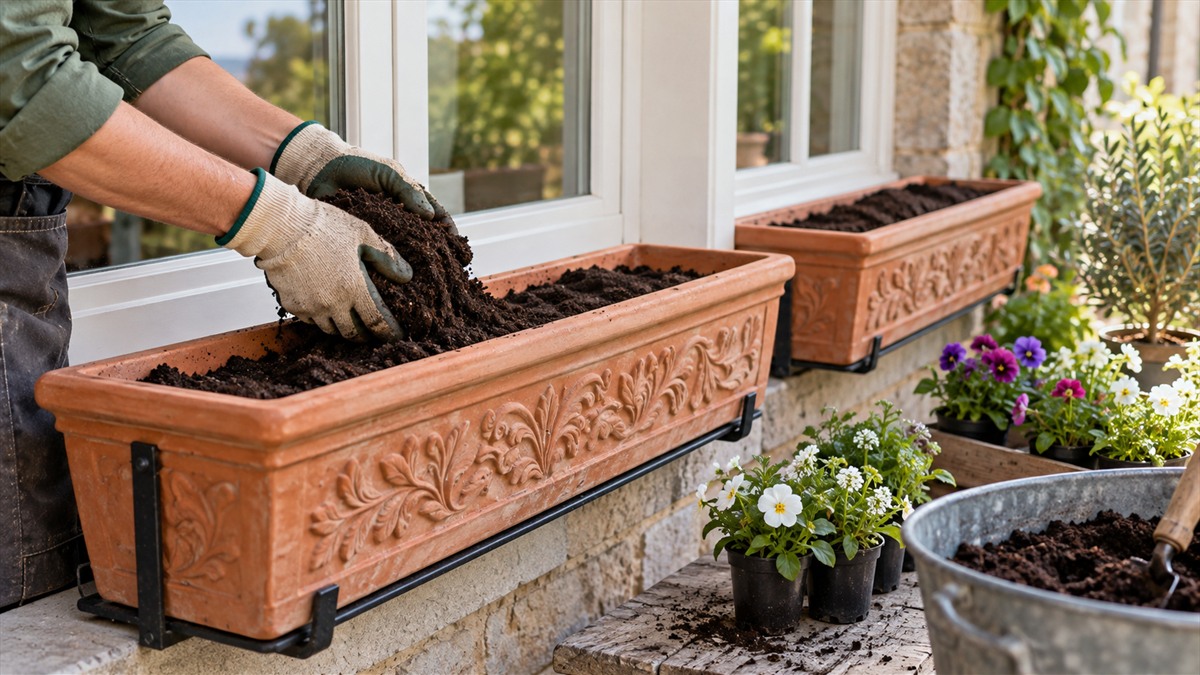
The best compost for window boxes is not a bag of compost used alone. Window boxes need a lightweight potting mix, and the extension pages we opened treat compost as one organic ingredient inside that mix, alongside peat moss or bark, vermiculite or perlite and sand. Garden soil and heavy compost both pack down in a shallow box and hold too much water. This guide explains what a good window box mix contains, where compost fits, and how to work out how much mix a box needs.
Quick answer
- Start with a potting mix, not garden soil. The University of New Hampshire Extension says garden soils are not a good choice for containers because they can become compacted and waterlogged.
- Expect compost as one ingredient. The same UNH page says good potting mixes contain an organic component such as peat moss, compost or bark, plus vermiculite or perlite, sand, nutrients and limestone.
- Look for air space. Iowa State University Extension describes high-quality potting media as roughly 85 percent pores, compared with about 50 percent for a good garden soil.
- Drill drainage holes and skip the gravel. The University of Maryland Extension says containers need holes or slits to drain, and that gravel in the bottom does not improve drainage.
Why a window box is a different growing space
A window box is a container, and containers behave differently from the ground. Iowa State notes that soil in the ground is deep enough to give a long column for drainage, but when soil goes into a container, the lack of depth can slow drainage. That is the core reason the extension pages steer gardeners away from garden soil in boxes.
The University of Maryland Extension adds that the material of the container matters as well. It says containers made from porous materials such as clay, ceramic, concrete and wood dry out more quickly than containers made from plastic, resin, fiberglass or metal. A wooden window box will therefore usually need watering sooner than a plastic one, even with the same mix. The mix and the box both shape how often you water, and the mix is the part you can control most directly when you fill the box.
The Maryland page also makes a point about size. It says containers should be large enough to keep plants stable in the potting mix. A shallow box that is too small for its plants will not hold them steadily, which the same page treats as part of planning.
What goes into a good window box mix
The University of New Hampshire Extension gives the clearest breakdown of what a container mix is made of. The table below sets out each component the page names, with its role as the page describes it.
| Component | Role described by the pages | Note for a window box |
|---|---|---|
| Peat moss, compost or bark | The organic component of a good mix | Compost is one option here, not the whole mix |
| Vermiculite or perlite | Helps the mix retain moisture | Keeps the box lighter than soil |
| Sand | Listed as part of good mixes | Adds drainage in the mix |
| Nutrients and limestone | Listed as part of good mixes | Many mixes already carry some fertilizer |
| Garden soil | Not a good choice for containers | Packs down and holds too much water |
The Iowa State potting media article explains the reason behind this list. A good potting media is meant to be lightweight and porous, which means it does not stop air from reaching the roots, yet it holds enough water for the plant. The article describes a standard peat-based potting media as having better drainage than sand or soil, and it notes that vermiculite is good at holding water and, to some degree, nutrients.
The UNH page also makes a point that sounds obvious but matters in practice. Air space is one of the most critical aspects of potting mix. If the roots do not get enough air, the plant usually does not survive, so a box that stays soggy can fail even when the mix looks rich.
Where compost fits in a window box
Compost is a natural ingredient in a good container mix. The UNH page lists it as one organic option, next to peat moss and bark. That makes compost a reasonable part of a window box mix when the mix is made to a container recipe.
The pages we opened do not give a ratio for adding compost to a window box. The only compost-ratio warning in this batch comes from Ask Extension answer #926507, which is written about raised beds, not containers. That answer says heavy, regular applications of compost can build up phosphorus and soluble salts in the soil. The same principle probably applies to a box, because a box is a small soil volume that gets fed and watered often, but the source does not address containers, so treat that as a caution rather than a rule.
For that reason, the safest approach is to buy a potting mix made for containers and avoid turning a window box into a compost-only planter. If you add your own compost, keep it as a small part of the mix, and use finished material. The Iowa State guidance on raised bed soil calls for compost that is well done, mature and not too salty, and those tests make sense for any mix that contains compost.
Drainage and container basics
The Maryland page is direct about drainage. Every container needs adequate holes or slits to drain excess water, which keeps plant roots from drowning and rotting. Excess fertilizer salts are also flushed out through the drainage, which is one more reason the holes matter.
The Maryland page also addresses a common habit. Adding rocks, gravel or broken pot shards to the bottom of a container will not improve drainage. The page says this can raise the water table, which leads to waterlogging of the potting mix and can kill plants. For a window box, that means the holes do the work, and the mix should fill the box to the bottom.
To keep the box draining freely, lift it off a sill or a tray where that is practical, and empty any saucer after watering. The Maryland page recommends raising pots on bricks, scrap lumber or pot feet, which lets the bottom drain freely.
How much mix a window box needs
Volume is the number that controls the cost and the weight of the box. A standard calculation uses length, width and depth in the same units, then converts to cubic feet.
Take a box 36 inches long, 8 inches wide and 8 inches deep. The volume is 36 x 8 x 8 is 2,304 cubic inches. There are 1,728 cubic inches in a cubic foot, because 12 x 12 x 12 is 1,728. So 2,304 divided by 1,728 is 1.33 cubic feet of mix.
For two boxes of that size, 1.33 x 2 is 2.66, so plan on about 2.7 cubic feet in total. Buy a little extra rather than a little short.
Choosing and checking a bag
Read the label before you buy. Garden soil and potting mix are different products, and the UNH page says garden soils are meant for use in the ground and contain minerals and organic matter, while potting mixes are specifically made for growing potted plants. A bag labelled garden soil is the wrong product for a box.
Look for the components the UNH page lists. A good mix should have an organic part, vermiculite or perlite, and the other items it names. The UNH page also says some mixes contain fertilizer or moisture-retaining treatments, and that these are usually indicated on the label. Read that line before you plan your feeding schedule.
The Iowa State article gives a useful test. A high-quality potting media should be roughly 85 percent pores and lightweight to handle. If a bag feels heavy and dense, it is probably closer to soil, and the pages we opened suggest it will drain poorly in a box.
Common mistakes the sources warn about
Filling a box with garden soil. The UNH page says garden soil can quickly become compacted and waterlogged in a container. This is the most common mistake and the one the sources warn about most directly.
Using compost as the only ingredient. No page in this batch recommends a compost-only window box. The Ask Extension answer on heavy compost applications is written for beds, but it is the closest warning available.
Adding gravel for drainage. The Maryland page says gravel does not improve drainage and can raise the water table.
Skipping drainage holes. The Maryland page says every container needs holes or slits. A box without them has no outlet for excess water, whatever the mix.
How we chose
We began with the way a window box is planted: a container, filled once, and watered often. We looked for university extension pages that explain container mixes and drainage, and we used the New Hampshire, Iowa State and Maryland pages because they answer those questions in detail. We kept only pages we could open and read in full, and we checked each quoted sentence against the saved page text before we used it.
We did not recommend a brand and we did not compare products. The sources do not name products, and a recommendation would have gone beyond what the pages support.
What we could not verify
- The pages we opened do not give a replacement schedule for window box mix. We could not confirm how often to replace it, or whether to replace only the top layer.
- The sources do not give a ratio for adding compost to a container mix.
- An Ask Extension question about reusing window box soil was listed in our search, but the answer text was not available in the page we opened, so we did not use it.
- The pages do not compare herb, tomato or annual window boxes separately, so a single mix guideline may not fit every plant.
- We did not find an extension page on window boxes that covers the exact box size and material of your sill.
- Local rules about compost, fertilizer or watering restrictions are outside the pages we opened.
Related reading
For starting your own compost to use in the garden beds, see how to start a compost bin. For a homemade bin that uses a bucket, see a DIY compost bin from a 5-gallon bucket. For a planter built to fit a deck railing, see a DIY planter box for a deck railing.
FAQ
Can I fill a window box with compost alone?
The pages we opened do not recommend a compost-only window box. A good container mix combines an organic component with vermiculite or perlite, sand and other parts, and the Maryland page makes clear that drainage comes from holes, not from gravel.
Is garden soil fine for a window box?
No. The University of New Hampshire Extension says garden soils are not a good choice for containers because they can become compacted and waterlogged, which reduces the air space around the roots.
Should I replace the soil in a window box every year?
The pages we opened do not give a yearly schedule. Check the mix for compaction and drainage at planting time, and replace it when it has packed down. We could not confirm a fixed interval from the sources.
Do I need gravel in the bottom of the box?
No. The University of Maryland Extension says gravel, rocks or broken pot shards do not improve drainage and can raise the water table. The drainage holes are the part that matters.
What makes a window box mix lightweight?
The pages point to the organic component, vermiculite or perlite and the air space they create. Iowa State describes high-quality potting media as roughly 85 percent pores, which is why a lightweight mix handles differently from garden soil.
Bottom line
Use a container potting mix in a window box, let compost be one organic ingredient rather than the whole fill, and make sure the box has drainage holes and no gravel layer, so the roots keep the air they need.
Sources
- University of New Hampshire Extension, “What is the best soil for potted plants?”: the components of a container mix, the problem with garden soil, and the role of air space.
- Iowa State University Extension, “Potting Media: Components and Handling”: why containers drain differently from the ground and the pore percentages of potting media.
- University of Maryland Extension, “Growing Vegetables in Containers and Salad Tables”: drainage holes, the gravel myth, container size and container material.
- Ask Extension, “Raised garden bed soil” (#926507): the warning about heavy, repeated compost applications, written for raised beds.