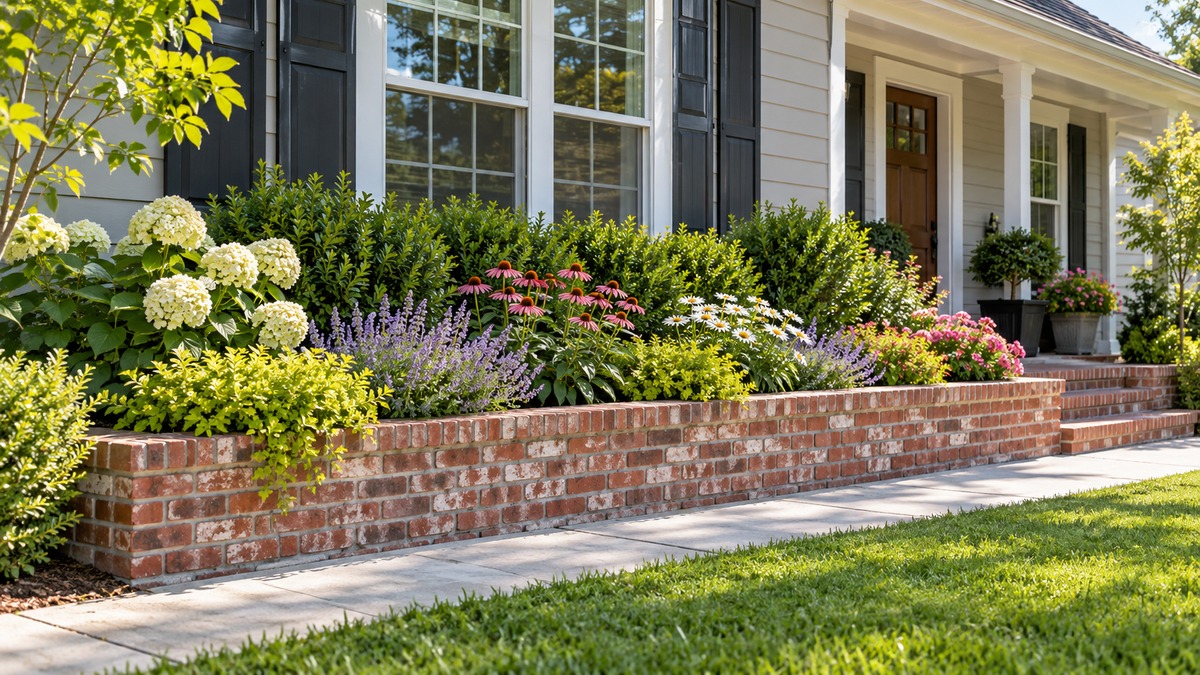
Raised Brick Planter in Front of House
As an Amazon Associate we earn from qualifying purchases. Details
A raised brick planter in front of a house is a bed with a front-door audience: it sits close to the foundation, close to the walk and close to the spigot. That position changes the planning. You are not only choosing how tall to build it. You also have to think about buried utilities, where roof water goes, how far you can reach into a bed that backs onto a wall, and which plants will survive a winter above ground. This guide covers those points using four pages we opened on 2026-10-18: Iowa State University Extension, This Old House (two pages) and 811. Brick laying itself is not covered by any of them, and the guide says so where it matters.
Quick answer
- Before digging: contact 811 a few days ahead. Even shallow digging counts.
- Next to the house: the soil around the foundation should slope away from the house, and roof water should be carried away from it. Do not build a planter that holds water against the wall.
- Width: if you can reach the bed from one side only, Iowa State says to keep it to about 1.5 to 2 feet wide. If you can reach from both sides, 3 to 4 feet works.
- Sun: most vegetables and flowers need at least six hours of full sun, per Iowa State.
- Soil: a light, well-drained mix, such as about 70% topsoil and 30% compost, with 1 to 2 inches left for mulch.
Step 1: Call 811 before you dig
The 811 Before You Dig site says anyone digging, even to plant a garden, must contact 811 a few days in advance. It says shovels are the second most common tool involved when buried utilities are damaged, that some utilities are buried just inches below the surface and that shallow digging still counts as digging. Treat it as the first step, not an afterthought: removing sod and loosening soil for the bed is digging too.
Step 2: Look at the ground next to the foundation
This Old House’s guide to grading around a foundation says soil that slopes toward the foundation can cause moisture problems, pests or rot. It lists these signs of poor grading: cracks in foundation walls, mold or mildew on the lower parts of exterior walls, soil that comes up to the bottom of the siding, water pooling near the foundation after rain and a wet basement or crawl space. If you see any of them, fix the grade before you build anything beside the wall.
The page gives two grade figures. One step says to slope soil away from the house at about 6 inches over a distance of 10 feet. Another passage, quoting the magazine, says the surrounding soil should pitch away at a slope of at least 1/4 inch per foot, and that downspout extenders should send roof water at least 10 feet from the house. It also lists “failing to maintain proper distance between soil and siding” as a common mistake, and advises against planting trees or large shrubs too close to the foundation.
Our reading of that page, not a statement from it: a planter filled with wet soil is a block of moisture. If you set one flush against a wall, you are putting soil against siding or masonry. A planter that stands a short distance from the wall, or that is separated from it, avoids that. If you are unsure about your house, ask a landscape contractor or the building inspector, because the page does not address planters against walls.
Step 3: Choose the size
Iowa State University Extension gives the sizing rules. Beds should be built so you can reach everything without stepping in. A bed against a building, fence or wall that can be reached from one side should be no wider than about 1.5 to 2 feet. A bed reachable from both sides can be 3 to 4 feet wide. Raised bed heights typically run from 6 inches to 20 inches or more, and 11 inches is a common height. Taller beds are easier to work in but need more soil. Most plants need at least 6 to 12 inches of soil for good rooting.
Worked example (our own arithmetic, using Iowa State’s one-side width): a front planter 8 feet long, 18 inches (1.5 feet) wide and 12 inches (1 foot) tall holds 8 x 1.5 x 1 = 12 cubic feet at the brim. Leaving 2 inches for mulch, the fill height is 10 inches, so the soil volume is 8 x 1.5 x 0.83 = about 10 cubic feet, or about 0.37 cubic yard (10 divided by 27). With the 70% topsoil and 30% compost mix from the Iowa State page, that is about 7 cubic feet of topsoil and 3 cubic feet of compost. Round up, because soil settles after it is watered.
Step 4: Walls, brick and drainage
Iowa State lists brick among the materials a permanent raised bed wall can be made from, along with wood, concrete block, rock and metal. It says to secure the wall materials firmly so they do not bow outward, to reinforce the corners to prevent wall failure, and to set the top level. That is the extent of what the opened pages say about brick walls.
The pages we opened do not cover brick laying, mortar mixes, footing depth, how tall a brick wall can be before it needs engineering, or weep holes in a masonry wall. The This Old House raised planting bed project is built from 6×6 timbers, not brick. For that timber bed it recommends a 6-inch trench with a 2-inch gravel base and weep holes every 4 feet for drainage. Those details belong to a timber bed, and we are not carrying them over to brick. If you plan a mortared wall more than a few courses high, check your local code, ask your homeowners association if you have one, and consider a mason.
Measure the brick you actually buy. Brick sizes vary, so divide your target wall height by the brick height plus the joint thickness to get the number of courses, and divide the wall length by the brick length plus the joint to get bricks per course.
Step 5: Fill the planter
Iowa State says raised bed soil should be light and well drained, and gives two mixes: equal parts topsoil, organic matter and coarse sand, or about 70% topsoil and 30% compost. It says to test the mix for nutrients and pH, and to bring the pH to about 6.0 to 6.5 with lime or sulfur if the test calls for it. Before filling, remove sod and loosen the soil underneath, then add the mix in layers and work it into the existing soil, so the planter does not develop distinct layers that slow water and root growth. Grade the filled soil so it slopes slightly from the center to the edge and away from adjacent structures, and leave 1 to 2 inches for mulch. Beds dry out faster than ground beds, so plan on more frequent watering in dry weather.
Step 6: Plants and winter
For plant choice, the Iowa State page makes two points that matter for a front bed. First, annual flowers and vegetables are well suited to raised beds. Second, perennials, both herbaceous plants and woody shrubs, can have winter-hardiness problems in raised beds, especially in beds with a small soil volume or tall walls, because the soil can freeze faster than ground soil. The page recommends an insulating layer of mulch placed in late fall as the ground begins to freeze, and removed in early spring. If you live where the ground freezes and want perennials in a front planter, choose plants known to be hardy where you live and mulch them as the page describes.
Common mistakes
- Digging without calling 811.
- Filling a planter against a wall without checking that the grade next to the foundation slopes away.
- Making a one-sided bed wider than about 2 feet, so you cannot reach the back.
- Skipping a soil test, then adding lime or sulfur by guesswork.
- Planting perennials in a shallow, exposed planter and leaving them unmulched.
- Filling to the brim, leaving no room for mulch.
FAQ
How tall should a raised brick planter be?
Iowa State gives a typical range of 6 inches to 20 inches or more, with 11 inches common. Taller beds are easier on your back and take more soil. This Old House’s timber project says a raised bed should rise at least a foot off the ground, so a height of about 12 inches is a reasonable starting point.
How wide can a planter be if it backs onto the house?
Iowa State says a bed reachable from one side should be about 1.5 to 2 feet wide.
How much soil does a planter need?
Multiply length by width by fill height in feet to get cubic feet, then divide by 27 for cubic yards. Round up, because soil settles. See the worked example above.
Do I need to call 811 for a small planter?
The 811 site says every digging project requires contacting 811 a few days in advance, regardless of depth, and gives planting a garden as an example.
Can I build it against the house wall?
The pages we opened do not address that directly. They do warn about soil too close to siding and about water near the foundation. If you want the planter close to the wall, ask a landscape contractor how to keep the wall dry.
Where to go next
For the soil volume, see how much soil a raised bed needs, and for the filling order, how to fill raised beds. If your front yard is a deck or porch rail rather than a bed, the DIY planter box for a deck railing is the nearest topic on the site. Before the first freeze, preparing raised beds for winter covers the mulch step.
Sources we opened
- Iowa State University Extension, Creating Raised Bed Planters, last reviewed March 2024, opened 2026-10-18.
- This Old House, How To Grade Around a Foundation, updated 06/15/2026, opened 2026-10-18.
- This Old House, How To Build a Raised Planting Bed, updated 06/03/2026, opened 2026-10-18.
- 811 Before You Dig, home page, opened 2026-10-18.
The short version
Call 811, make sure the ground beside the foundation slopes away, keep a one-sided planter to about 2 feet wide, fill it with a light mix and leave room for mulch. The brick work itself is not covered by the sources above, so treat wall height, mortar and footings as questions for local code and a mason.