Build a Raised Garden Bed With Bricks
As an Amazon Associate we earn from qualifying purchases. Details
A brick edge is a border you build once and then plant inside. Before you buy a single brick, settle three numbers: the inside width you can reach across, the soil depth your crops need, and how many courses of brick it takes to reach that depth.
The figures here come from two university extension pages and a brick reference, all opened for this guide and dated where the page showed a date. None of them covers wall stability, mortar, or local building rules, so those points are flagged below rather than answered.
Quick answer
Keep the inside width between 3 and 4 feet so you can reach the middle from both sides. Plan at least 8 inches of soil if the bed sits on a patio or driveway, and 12 inches or more for tomatoes, peppers and squash. A dry-stacked wall of standard brick needs six courses to reach 12 inches. The worked example below uses a 4 by 8 foot outside size, which is a common starting point for a bed that you can reach from every side.
What the sources say about size and soil
Iowa State University Extension says beds that can be reached from both sides can be about 3 to 4 feet wide. The same page says most plants need at least 6 to 12 inches of soil for good rooting and growth. Its general range for raised beds runs from about 6 to 20 or more inches tall.
The University of Maryland Extension page is more specific about hard surfaces. It says raised beds placed on hard surfaces are fine if they are a minimum of 8 inches deep, and it recommends 12 to 24 inches for pepper, tomato and squash. It also says beds on hard surfaces dry out quickly and that plants may be stressed by sunlight absorbed and reflected from the surface.
The two sources do not give the same soil mix. Maryland recommends filling the bed with compost and a soilless growing mix in a 1:1 ratio. Iowa State’s page, as opened, does not give a mix ratio. Use the Maryland ratio as the only stated figure, and check the label of the soilless product you buy.
Brick sizes and courses
Wikipedia’s entry on brick gives the most commonly used US modular brick as 7-5/8 by 3-5/8 by 2-1/4 inches. With a standard 3/8-inch mortar joint, the nominal size becomes 8 by 4 by 2-2/3 inches. A dry-stacked wall uses the actual size, so the course height is 2-1/4 inches and the length is 7-5/8 inches. A mortared wall adds the joint, which changes the height per course.
The brick reference does not say how high a wall can be built safely or how a corner should be bonded. Treat the course count below as a planning number, not a structural rule.
Worked example: a 4 by 8 foot bed
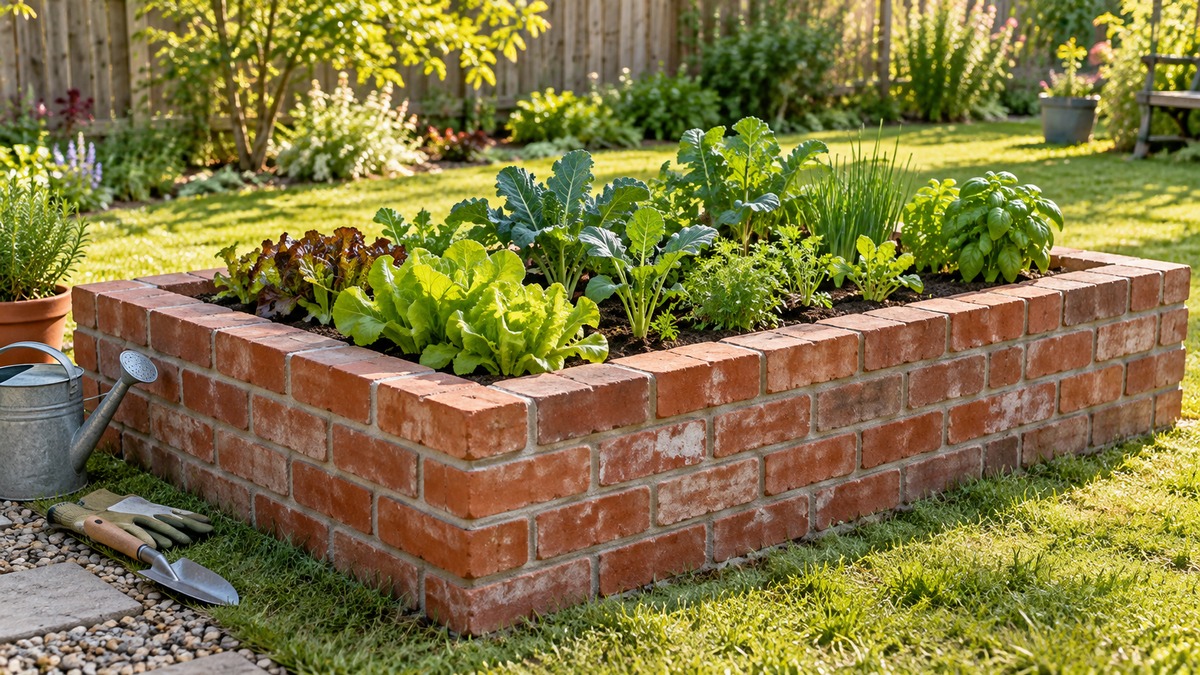
Start with an outside size of 48 inches by 96 inches. Assume each wall is one brick wide, which is 3-5/8 inches of actual brick. The inside is then 48 minus 7.25, or 40.75 inches wide, and 96 minus 7.25, or 88.75 inches long. That is about 3 feet 5 inches by 7 feet 5 inches, inside the 3 to 4 foot reach from both sides.
For depth, five dry-stacked courses reach 11.25 inches and six reach 13.5 inches. Six courses let you fill to 12 inches and keep the top course as a clean edge. Each course needs about 38 bricks along the 288-inch perimeter, because 288 divided by 7.625 is about 37.8. Six courses come to about 228 bricks before corner adjustments and breakage. Filling the inside to 12 inches takes about 25 cubic feet of soil, or close to one cubic yard. Order a little more than that and check the count against the final layout.
Mistakes to avoid
- Building wider than you can reach. The Iowa State figure of 3 to 4 feet for two-sided access is the limit to plan around.
- Setting the bed on pavement with only a few inches of soil. Maryland’s 8-inch minimum for hard surfaces is the floor, and deeper beds suit tomatoes and squash.
- Guessing the soil mix. Use the 1:1 compost and soilless ratio from the Maryland page, or say in your notes that you used a different mix.
- Assuming wood advice applies to brick. Iowa State names decay-resistant wood such as cedar or redwood for permanent walls, and it does not address brick durability.
- Using salvaged brick without a plan. The sources opened for this guide say nothing about reclaimed brick, so this guide makes no claim about it.
Related guides
For the soil amount in more detail, read Best Raised Bed Garden How Much Soil. For the filling step after the walls are up, see Best Way to Fill Raised Beds. If you are choosing what to plant once the bed is ready, Best Easiest Vegetables to Grow in Raised Beds covers crops that suit a shallower bed.
Sources
- Iowa State University Extension and Outreach, “Creating Raised Bed Planters,” last reviewed March 2024. yardandgarden.extension.iastate.edu
- University of Maryland Extension, “Soil to Fill Raised Beds,” updated November 6, 2024. extension.umd.edu
- Wikipedia, “Brick” (no date shown on the page). en.wikipedia.org
FAQ
How wide should a brick raised bed be?
Iowa State says beds that can be reached from both sides can be about 3 to 4 feet wide. The worked example uses a 4 by 8 foot outside size, which leaves a narrower inside because the walls take up space.
How deep should the soil be?
Most plants need at least 6 to 12 inches of soil, according to Iowa State. The Maryland extension page says a bed on a hard surface should be at least 8 inches deep, and 12 to 24 inches for pepper, tomato and squash.
How many bricks do I need?
For the 4 by 8 foot example, six courses of dry-stacked standard brick come to about 228 bricks before cuts and breakage. Your count changes with the bed size and the way you lay the corners.
What soil mix should I fill it with?
Maryland recommends a 1:1 ratio of compost and a soilless growing mix. Check the label of the soilless product you buy, because the sources here do not name a specific brand or mix.
Does this guide cover wall height and safety?
No. The sources opened for this guide do not cover wall height limits, mortar, or footings. Check your local building rules before you build a tall wall.