PVC Pipe for Garden Bed Cover: Hoops, Spacing and Limits
As an Amazon Associate we earn from qualifying purchases. Details
Updated 19 October 2026 | Author: Editorial team, homelycapers.com
Using PVC pipe for garden bed cover is a practical way to add a frame that holds a sheet of plastic or fabric above the plants. The hoops are the frame, and the cover is what protects the crop from frost, wind and insects. The extension sources we downloaded describe PVC as one of several hoop materials, with spacing and height rules that matter more than the pipe itself. This guide covers the hoop size, the spacing, the cover choice, the frost numbers the sources give, and how to hold the cover down.
Quick answer
- Pick bendable PVC hoops. Utah State University Extension lists “3/4-inch bendable PVC, metal hoops, or small wire hoops” as options. Oregon State says PVC can be bent into 6- to 8-foot-long hoops for a low tunnel.
- Set the height and depth. Oregon State says the top of the hoop should be 2 to 3 feet above ground, with the ends pushed into the soil at least 6 inches on each side.
- Space the hoops 4 to 5 feet apart. Use 4-foot spacing where snow is possible, because the tunnel should not collapse under the weight of snow.
- Match the cover to the frost. New Mexico State says row covers can deliver a frost protection factor of 2 to 7 degrees Fahrenheit, depending on the material, and heavier fabric gives more protection but lets in less light.
What the hoop does
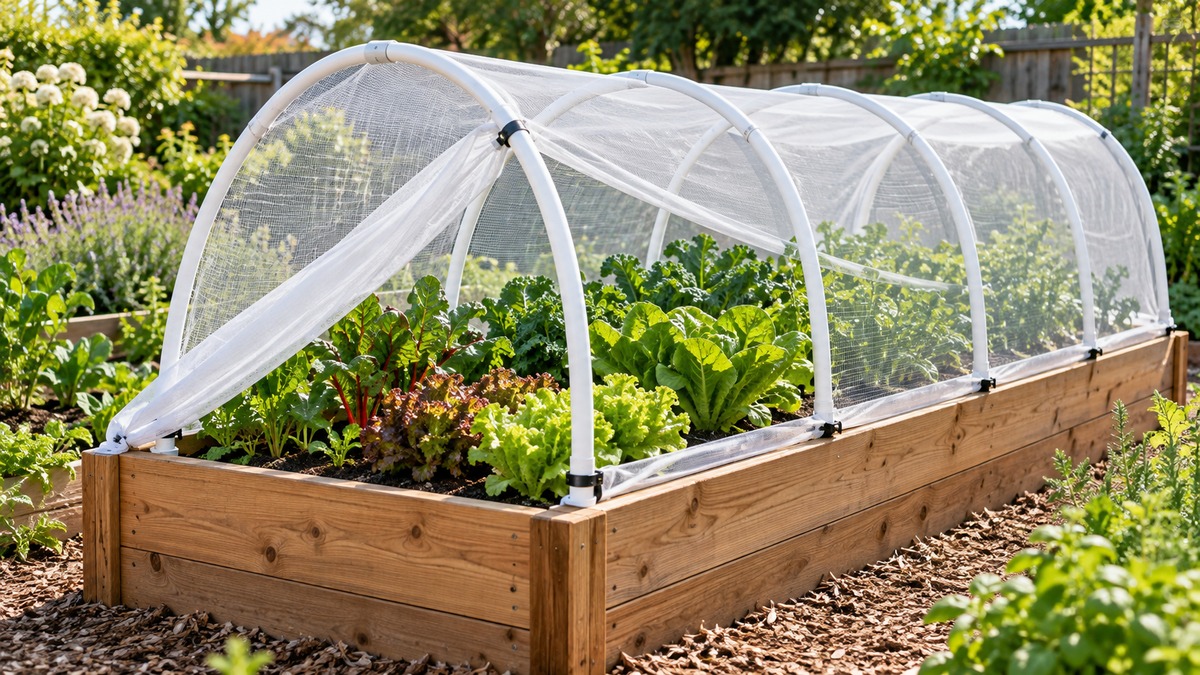
A hoop is a support, not a cover. The Utah State guide says row covers “provide both frost protection and a form of mechanical control” against insects, and it gives the setup plainly: “Support row covers by hoop structures or by laying directly over the tops of crops needing protection.” The hoops hold the cover up, so it does not need to rest on the plants. The Oregon State low tunnel guide describes the same system as a temporary structure of plastic draped over hoops that covers one row of plants.
PVC is a practical hoop material because it is light, easy to cut and bends into an arch when it is the right size and thickness. Utah State names 3/4-inch bendable PVC as one option beside metal hoops and small wire hoops. Oregon State names PVC among the materials for long-lasting hoops, alongside galvanized electrical conduit and galvanized wire, and gives the 6- to 8-foot length for the hoops. The sources do not claim PVC is stronger than metal. They treat it as a lighter, lower-cost option that still works when spacing is right.
Hoop count and length
The spacing rule gives you the hoop count. Oregon State recommends placing hoops every 4 to 5 feet down the bed or row, and says to use 4-foot spacing if you may get snow in fall or early spring. Count the hoops with the simple formula: divide the length of the bed by the spacing, then add one for the first hoop.
For a 20-foot row, the formula gives two results. At 5-foot spacing, 20 ÷ 5 = 4 spaces, and 4 + 1 = 5 hoops. At 4-foot spacing, 20 ÷ 4 = 5 spaces, and 5 + 1 = 6 hoops. The 4-foot spacing costs one extra hoop, and it is the choice Oregon State gives for snowy areas. For a longer row, the same formula works: a 40-foot row at 4-foot spacing needs 40 ÷ 4 = 10 spaces, so 11 hoops.
The table below shows the hoop count for common row lengths at the two spacings in the Oregon State guide.
| Row length | Hoops at 5-foot spacing (20 ÷ 5 style) | Hoops at 4-foot spacing (snow areas) |
|---|---|---|
| 10 feet | 10 ÷ 5 = 2 spaces, 3 hoops | 10 ÷ 4 = 2.5 spaces, so 3 spaces, 4 hoops |
| 20 feet | 20 ÷ 5 = 4 spaces, 5 hoops | 20 ÷ 4 = 5 spaces, 6 hoops |
| 40 feet | 40 ÷ 5 = 8 spaces, 9 hoops | 40 ÷ 4 = 10 spaces, 11 hoops |
For the 10-foot row at 4-foot spacing, the last hoop has to sit at the end of the row, so a partial space rounds up to a full space. The arithmetic is simple, but the rounding rule matters for the count.
Hoop material also affects how long the frame lasts. Oregon State names galvanized electrical conduit as the sturdier option for low tunnel hoops, and notes that heavier hoop materials give more support at more expense. PVC is the lighter, lower-cost choice in that comparison, so a long row or a windy site may justify the sturdier material.
Height, depth and width
Oregon State gives the dimensions to build to. The top of the hoop should measure 2 to 3 feet above the ground once the ends are pushed into the soil at least 6 inches deep on each side. Adjust the width of the hoops to the width of the row or bed. Use smaller hoops for shorter crops such as lettuce and longer, taller hoops for taller crops such as eggplant, as the same Oregon State page advises.
Depth matters because the ends have to be anchored in the soil to hold the shape. The sources also say the spacing depends on the site, including prevailing winds, windbreaks and slope. Oregon State states that spacing “may depend on site conditions, such as prevailing wind speeds, wind breaks and slope,” and says to add hoops for structural integrity where the site calls for it.
Choosing the cover and the frost numbers
The cover is the part that decides how much frost the plants can take. New Mexico State says row covers deliver a frost protection factor of 2 to 7 degrees Fahrenheit, depending on the material. The same guide says heavier spunbonded polypropylene gives greater frost protection but tends to exclude more light. The choice is therefore a trade-off between warmth and sunlight.
Lightweight covers are cheaper and easier to lay, but they wear quickly. The Utah State guide says lightweight row covers “tend to rip easily, and thus, have a short life span (up to a few months).” Those covers are often used as insect barriers in spring rather than as frost protection, which the same guide describes as a separate use. Heavier fabric costs more, and the New Mexico State guide notes that supported row covers carry greater costs because of the hoops they need.
Clear plastic over hoops is the Oregon State low tunnel design. It is a plastic sheeting draped over the frame, so the plants get light and some protection from rain, frost, hail and strong wind, as that guide lists. The sources do not give a light transmission figure for PVC-framed plastic, so treat the sunlight trade-off as a general one.
Holding the cover down
A cover that blows away is a waste of the hoops. Utah State advises shoveling soil or placing large rocks about every 3 feet along each side of the row cover, which also excludes insect pests. It also describes laying the cover over the frame and securing it, which is the step that keeps the cover from lifting. Oregon State notes that if your site is windy, extra hoops may be needed for structural integrity. Check the anchors after each storm, because the cover is only as good as its edges.
How we chose
We chose three extension sources that cover row covers and low tunnels directly: Utah State University Extension, New Mexico State University’s H-251 guide and Oregon State University’s EM 9333 on low tunnels. Each one addresses hoops, cover choice or frost protection, which is the question in the keyword. We did not include product listings or hardware kits, because the question is about how to build the frame and what it protects against. Where the sources give a number, the post gives it. Where they give a range or a condition, the post keeps that range.
What we could not verify
The sources we downloaded do not give a service life for PVC hoops in sunlight, and they do not state a temperature at which PVC becomes brittle. They also do not give a UV rating for the cover you buy, and they do not say which plastic thickness suits a given climate. The frost factor from New Mexico State is a general range for row covers, not a promise for any particular cover or hoop. Check the cover’s own label and your local frost dates before you rely on it.
What an earlier crop can gain
The reason to build hoops is usually the calendar, not the cold. New Mexico State says that “When combined with black plastic mulch, many crops may mature one to three weeks earlier than under normal cropping practices.” In days, one to three weeks is 1 x 7 = 7 days to 3 x 7 = 21 days earlier. That range is a general figure from the guide, not a promise for a particular crop, but it shows what the frame and cover are for.
The same guide adds that earlier production of cool-season crops such as spinach and leaf lettuce also increases total yields. Those are the crops a cover is most useful for in early spring and late fall, when frost is the limit on the season. A cover that lets you sow earlier or harvest later can add to the total you pick from the bed, which is the yield argument the sources make.
The Utah State guide describes plastic-covered trenches as another way to get an early start, since they allow early seeding and plant growth and give some frost protection. The sources compare the two methods on early growth and frost protection, and they do not rank one above the other for every crop.
The New Mexico State guide adds that row covers supported with wire hoops protect crops from wind and blowing sand. That is a second use for the same frame, and a reason to anchor the cover firmly.
FAQ
Can I use PVC pipe for hoops on a garden bed?
Yes, according to the sources. Utah State lists 3/4-inch bendable PVC as one option, and Oregon State says PVC can be bent into 6- to 8-foot hoops. The hoops should sit 2 to 3 feet above the ground with the ends pushed at least 6 inches into the soil.
How far apart should the hoops be?
Oregon State says every 4 to 5 feet, and 4 feet where snow is likely. For a 20-foot bed that is 5 or 6 hoops, depending on the spacing you choose.
How much frost protection will a cover give?
New Mexico State gives a frost protection factor of 2 to 7 degrees Fahrenheit for row covers, depending on the material. Heavier fabric protects more and lets in less light. Treat the figure as a range, not a guarantee.
How do I keep the cover from blowing off?
Utah State advises shoveling soil or placing large rocks about every 3 feet along each side of the cover. Check the edges after wind or storms.
Why does my lightweight cover keep tearing?
Utah State says lightweight row covers tend to rip easily and have a short life span of up to a few months. Use a heavier cover where frost is the main risk, and accept the loss of some light.
Related reading
For preparing a bed before the cold sets in, see our guide to preparing raised beds for winter. For a crop that does well in a cool bed, see planting carrots in raised beds.
Bottom line
Use bendable PVC hoops, set them 2 to 3 feet tall and 4 to 5 feet apart, push the ends at least 6 inches into the soil, and anchor the cover every 3 feet. Choose a heavier fabric for frost and a lighter one for insects, and expect light to drop as frost protection rises.
Sources
- Utah State University Extension, “Row Covers” (Volesky and Wagner): PVC, metal and wire hoop options, lightweight cover life, frost and wind use, and anchoring every 3 feet.
- New Mexico State University, Guide H-251, “Row Cover Vegetable Production Techniques”: the frost protection factor range, the trade-off between heavier covers and light, and the cost of supported covers.
- Oregon State University Extension, EM 9333, “Low tunnels for season extension in Oregon”: PVC hoops of 6 to 8 feet, the 2 to 3 foot height, the 6-inch insertion depth, spacing of 4 to 5 feet and 4 feet for snow.