Building a Raised Bed With Breeze Blocks
As an Amazon Associate we earn from qualifying purchases. Details
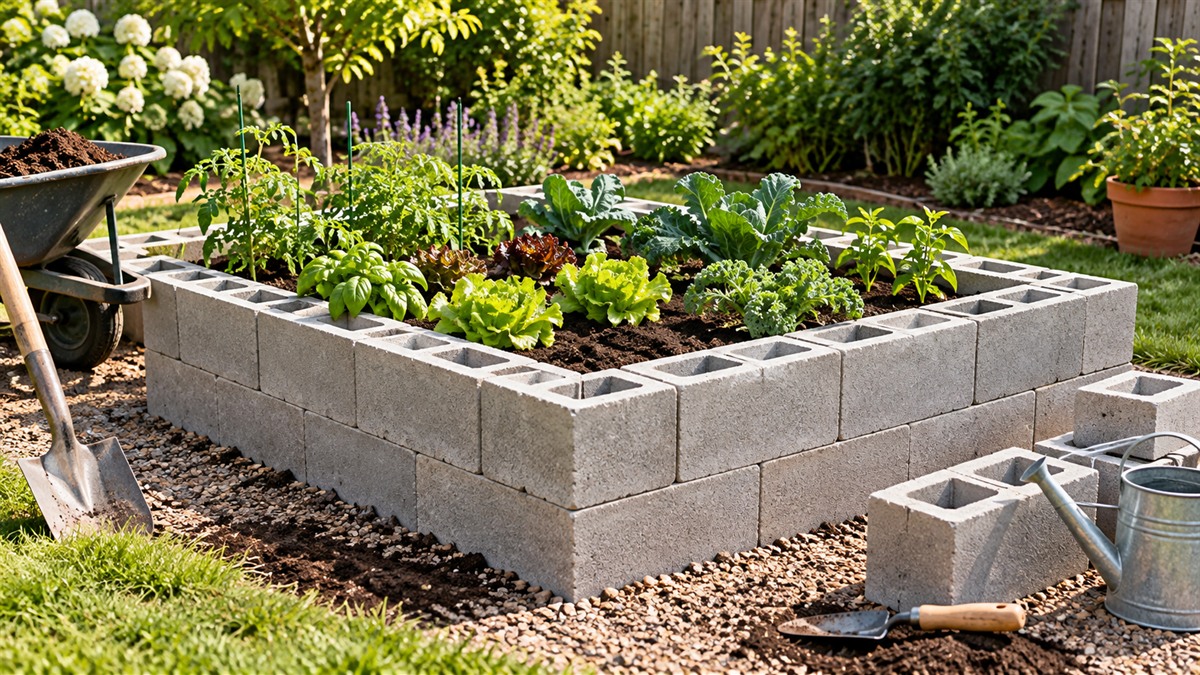
Breeze blocks can frame a raised bed, but concrete raises a question that wood does not: does the block affect the soil? This guide sets out what the one extension-network source we opened says about concrete blocks, shows a simple build plan, and works through a block-count example. It also says where the source stops, because it does not address breeze blocks specifically, so you can judge the answer for the blocks you actually buy. The source details are listed in the Sources section near the end of the guide.
Quick answer
Breeze blocks can frame a raised bed. The one extension-network source we opened, an Ask Extension answer, says concrete blocks can slowly leach lime and raise soil pH over time. It found no conclusive research that the blocks are dangerous for a garden bed. If you want to limit contact with the blocks, the answer suggests lining the inside walls with 6-mil plastic. Test the soil pH before you plant.
What the source says, and what it does not
The source is an Ask Extension answer dated October 30, 2015. Ask Extension is a land-grant university network service, but the answer does not name a university, and it is about concrete and cinder blocks in general. It does not address breeze blocks (open-pattern concrete blocks) specifically, so treat the findings as applying to concrete blocks until you check your blocks.
- Lime: concrete blocks can leach lime over time, which changes soil pH.
- Fly ash: some blocks may contain fly ash, which may leach other compounds. The answer found no conclusive research that this is dangerous for a garden bed.
- Precaution: line the inside walls with 6-mil plastic if you want to limit contact. The answer advises against lining the bottom, so the soil can drain.
- Testing: the answer recommends checking soil pH.
Ask your supplier what the blocks contain, including whether they contain fly ash.
What you need
- Breeze blocks, enough to make the rows you plan (see the worked example below).
- Soil for the bed. For a mix, see our guide to a DIY raised bed soil mix, linked below.
- Optional: 6-mil plastic to line the inside walls.
- A soil pH test kit, or a lab test, before and after planting.
Steps
- Pick the size and depth. Decide the length, width and depth before you buy blocks.
- Ask about the blocks. Check whether they contain fly ash, as described above.
- Lay the first row level. A level first row makes the rest easier to stack.
- Stack the rows. Count the blocks per row and per course before you buy.
- Line the inside walls if you choose. Use 6-mil plastic on the walls only, not the bottom.
- Fill and test. Fill with your soil, then test pH. Test again after planting to see whether it changes.
Worked example
This example uses our arithmetic. The block size is an assumption for illustration. Measure your own blocks, because the source does not give a size for breeze blocks.
- Bed size: 4 ft wide, 8 ft long, 1 ft deep. Volume: 4 x 8 x 1 = 32 cubic feet. In inches, the sides are 48 inches and 96 inches, and the depth is 12 inches.
- Soil needed: 32 cubic feet, which is about 1.2 cubic yards (32 divided by 27).
- Block count, assuming each block is 16 inches long: an 8 ft (96 inch) side needs 96 divided by 16 = 6 blocks. A 4 ft (48 inch) side needs 48 divided by 16 = 3 blocks.
- Blocks per row around the outside: 2 x 6 + 2 x 3 = 18 blocks.
- Two rows: 2 x 18 = 36 blocks, before cuts and waste.
Who should skip this
Skip this build if you cannot test the soil pH, or if you are not willing to check what the blocks contain. Wood or a purpose-built raised bed kit avoids the concrete question altogether. This guide does not compare products, and it does not name a block supplier.
Mistakes to avoid
- Building the bed without checking what the blocks contain.
- Lining the bottom of the bed, which the source advises against because the soil needs to drain.
- Planting before you test the soil pH.
- Assuming the example block size matches your blocks.
Products
This guide does not name any product. No Amazon listing was used.
Sources
Source for this guide: Ask Extension, question 287745 (answered October 30, 2015). The answer does not name a university.
FAQ
Are breeze blocks safe for vegetables?
The source we opened does not find conclusive harm from concrete blocks in a garden bed. It notes that they can leach lime and change soil pH, so test the soil. It does not address breeze blocks specifically.
Do I need to line the bed?
No. The source suggests lining the inside walls with 6-mil plastic only if you want to limit contact. Do not line the bottom.
How many blocks do I need?
It depends on your block size and bed size. Use the method in the worked example with your own block length.
Should I test the soil?
Yes. The source recommends checking soil pH, and a test before and after planting shows whether the blocks are changing it.
Related guides
For filling the bed, see Best Way to Fill Raised Beds. For how much soil a bed needs, see Best Raised Bed Garden How Much Soil. For what to plant, see Best Vegetables to Plant in Raised Beds.