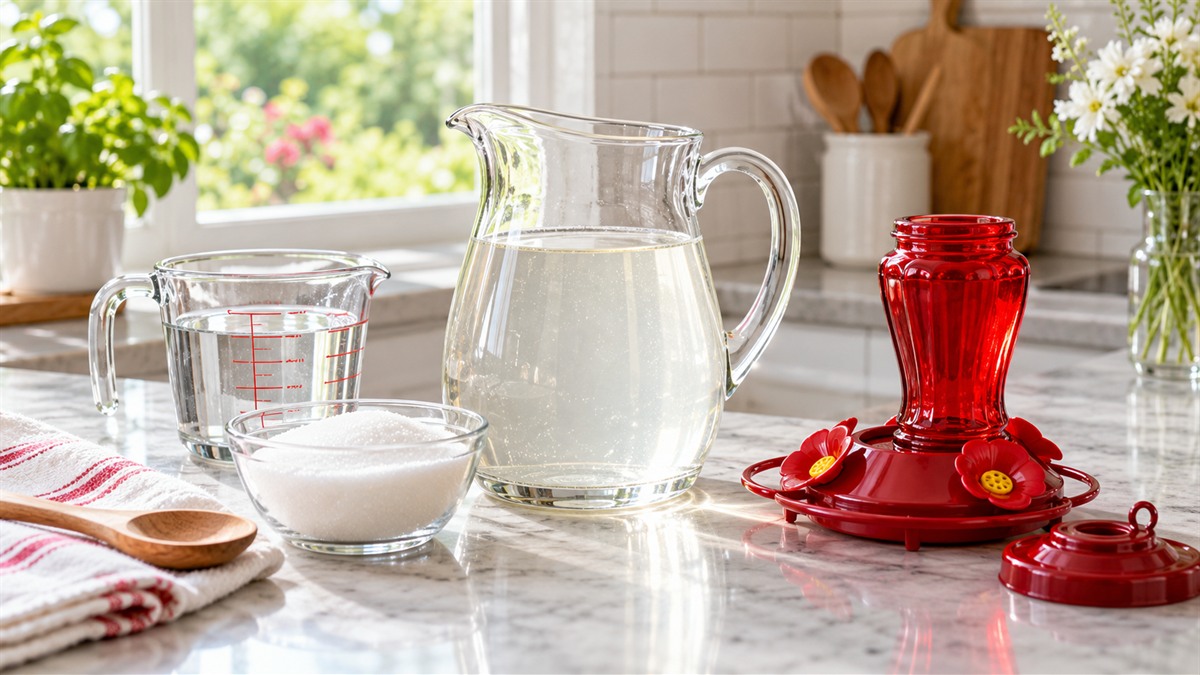
Making Hummingbird Nectar at Home: Ratio and Safe Mixing
As an Amazon Associate we earn from qualifying purchases. Details
Updated 19 October 2026 | Author: Editorial team, homelycapers.com
Making hummingbird nectar at home takes two ingredients and one ratio: one part refined white sugar to four parts water, stirred until the sugar dissolves. The mix is cheap and quick, and the sources we downloaded agree on the ratio and on the sugar. They differ on one step that many people ask about, which is whether the water must be boiled. This guide sets out the ratio, the sugar to avoid, the boiling question, and how long the mix keeps in the refrigerator.
Quick answer
- Use one part sugar to four parts water. Penn State Extension states the mix as “1 part sugar to 4 parts water,” and the Smithsonian gives the same ratio with an example of 1 cup of sugar with 4 cups of water.
- Use refined white sugar only. The Smithsonian advises refined white sugar, and says honey, corn syrup and raw, unprocessed sugars should not be used.
- Skip the red dye. Penn State says red dye is unnecessary, because hummingbirds are drawn to the red coloring of the feeder itself.
- Expect the sources to differ on boiling. The Smithsonian says the water does not need to be boiled, while Penn State and Mississippi State describe boiling. Both methods appear in the sources, and the notes below explain each one.
The ratio and how to scale it
The ratio is the whole recipe. One part sugar mixed with four parts water is a five-part total, so the sugar is one fifth of the finished volume and the water is four fifths. The Smithsonian’s worked example uses one cup of sugar with four cups of water, which fits the same rule. Penn State describes the mix the same way, as one part sugar to four parts water.
Because the ratio is by parts, you can scale it to any size you need. The table below shows the sugar and water for a few common batch sizes, using the five-part total. The sugar is the total divided by five, and the water is the total minus the sugar.
| Total nectar wanted | Sugar (1 part) | Water (4 parts) |
|---|---|---|
| 1 cup | 1 ÷ 5 = 0.2 cup | 0.8 cup |
| 2 cups | 2 ÷ 5 = 0.4 cup | 1.6 cups |
| 4 cups | 4 ÷ 5 = 0.8 cup | 3.2 cups |
The Smithsonian’s own example scales the same way in larger amounts. If one part equals two cups, the recipe is two cups of sugar and eight cups of water. Its examples are all measured by volume, so a kitchen measuring cup is enough for the job.
Stir the sugar into the water until it is fully dissolved. The Mississippi State guidance says to mix until the sugar dissolves, and the Smithsonian gives the same instruction in its own words. Stirring until the sugar is gone is the step that makes the mix consistent from one batch to the next.
Which sugar to use
The sugar is the part of the recipe that matters most, because the wrong sugar can harm the birds. The Smithsonian is direct: use refined white sugar, which is regular table sugar, and do not use honey, corn syrup or raw, unprocessed sugars. The Mississippi State page also says to stick with refined white sugar. It reports the National Audubon Society’s view that other sugars, including honey, organic, natural and raw sugars, can be harmful to the birds.
The Smithsonian adds a note on powdered sugar. Its page says powdered or confectioners’ sugar often contains additional ingredients, such as cornstarch, so it is a poor choice for nectar. The safest choice across all three sources is plain refined white sugar, dissolved fully in water.
Do not add coloring. Penn State says red dye is unnecessary because hummingbirds are attracted to the red coloring of the feeder. The Smithsonian says red dye or coloring is not needed to attract hummingbirds and could be harmful to the birds. A feeder that is red already does the job the dye would otherwise do.
The boiling question
The sources do not agree on whether to boil the water. The Smithsonian says the water for nectar does not need to be boiled, and advises stirring until the sugar dissolves before filling the feeder. Penn State describes bringing the water to a boil, pouring it over the sugar, and letting the solution cool to room temperature before it goes into the feeder. Mississippi State says to mix one part refined white sugar with four parts water that has been boiled for two minutes, and explains that boiling kills bacteria that may cause the mixture to spoil more quickly.
Both approaches use the same ratio and the same sugar. The difference is the water step. If you boil, let the mix cool before it goes into the feeder, which is the Penn State step. If you do not boil, stir until the sugar is fully dissolved, as the Smithsonian describes. The sources we downloaded do not say which method gives the better result for the birds, so this guide does not name a winner. In either case, the feeder is what needs regular attention, and the water step does not replace cleaning.
How long the mix keeps
Keep leftover mix in the refrigerator, not on the counter. The Smithsonian says extra sugar water can be stored in the fridge, but for no more than one week. If you see any mold in the stored mix, throw it away and make a fresh batch. The same page sets the cleaning rhythm for feeders: it says feeders should be cleaned and refilled at least twice a week in hot weather, and once a week in cooler weather, to prevent the growth of mold.
Only the Smithsonian in these sources gives a storage time, so the one-week limit is the figure to follow for both boiled and unboiled mixes. The Mississippi State and Penn State pages do not give a storage time for the refrigerator, and this guide does not invent one for them.
Weather changes how often you need to act. The Smithsonian ties the cleaning schedule to hot weather, and it gives a longer interval for cooler weather. Set a reminder on a calendar rather than waiting for the nectar to look cloudy, because the sources describe the schedule as a way to prevent mold before it shows.
Strength matters too
The ratio is not a suggestion to be adjusted by taste. Penn State says weaker solutions are less attractive to hummingbirds, and stronger solutions may be harmful. A mix that is too thin may be ignored, and a mix that is too strong is a risk to the birds. The one-to-four ratio is the strength the sources recommend.
That makes the measuring step more important than it looks. If you make the mix by eye, or by adding sugar until it tastes sweet, you are no longer following the source ratio. A measuring cup and a clear jar are the simplest tools for keeping the strength steady from one batch to the next.
How we chose
We chose the three sources that give the ratio, the sugar choice and the boiling guidance in their own words. The Smithsonian’s National Zoo and Conservation Biology Institute gives the most detailed sugar and cleaning guidance, including the storage limit. Penn State Extension gives the plainest ratio and the cooling step. Mississippi State University Extension gives the boiling method and the Audubon warning about other sugars. We did not rank feeders or brands, because the question is about the mix itself. Where the sources differ, we say so instead of picking one as the rule.
What we could not verify
The sources do not settle the boiling question, so this guide does not name a winner. They also do not address brown sugar, which is not a refined white sugar, and none of the pages we downloaded mention it. Only one of the three pages gives a storage time for the refrigerator, so the one-week limit rests on that page alone. The pages do not give a feeder size that suits a particular garden, and they do not say how many feeders a yard needs.
Why homemade nectar is a supplement
Homemade nectar is a supplement for visiting hummingbirds, not a replacement for the rest of their food. Mississippi State says that “Store-bought nectar is perfectly fine, but homemade sugar water is simple to make.” It also explains the purpose: “Sugar water is a way to supplement the birds’ diets, especially since they can eat up to half their body weight in nectar each day.” That second line is a reason to keep a feeder filled and clean rather than letting it run empty for long stretches.
The sources do not give a feeder size, so choose the batch size you can refill and clean on the schedule the Smithsonian gives. A small batch made to the five-part ratio is easier to keep fresh than a large one that sits past the one-week limit.
Common mistakes to avoid
Most problems with homemade nectar come from a few shortcuts. Four are worth checking before you fill a feeder.
- Using a substitute sugar. Powdered sugar is a poor choice. The Smithsonian’s page says “Powdered sugar (also called confectioners’ sugar) often contains additional ingredients, such as cornstarch.” Stick to refined white sugar, as the sources advise.
- Measuring by eye. Once the ratio drifts, the mix is no longer the one the sources describe. Penn State’s warning that weaker and stronger solutions both cause problems is the reason to measure with a cup and keep to it.
- Keeping leftovers too long. The Smithsonian limit is one week in the refrigerator, and any mold means the mix goes out.
- Letting the feeder go unwashed. The Smithsonian ties cleaning to the weather: at least twice a week in hot weather, and once a week in cooler weather.
A small batch, worked through
The Smithsonian gives a small-batch example in which one part equals half a cup. The sugar is then half a cup, and the water is four parts, so 4 x 0.5 = 2 cups of water. The total is 0.5 + 2 = 2.5 cups. That is the same five-part ratio, scaled down. The worked figures are our arithmetic on the Smithsonian ratio, not a figure the source gives.
FAQ
Can I use honey instead of sugar in hummingbird nectar?
No. The Smithsonian says honey, corn syrup and raw, unprocessed sugars should not be used. Mississippi State reports the National Audubon Society’s view that honey and other sugars can be harmful to the birds. Refined white sugar is the only sugar the sources recommend.
Do I need to add red dye to the nectar?
No. Penn State says it is unnecessary, and the Smithsonian says red dye could be harmful to the birds. The red on a feeder attracts hummingbirds without any coloring in the mix.
Should I boil the water for hummingbird nectar?
The sources disagree. The Smithsonian says boiling is not needed, while Penn State and Mississippi State describe boiling. If you boil, let the mix cool before filling the feeder, as Penn State advises. Whichever method you choose, keep the one-part sugar to four-part water ratio and clean the feeder regularly.
How long can I keep the nectar in the refrigerator?
The Smithsonian says extra sugar water can be stored in the fridge for no more than one week. Throw out any mix that shows mold and make a fresh batch.
How often should I clean and refill the feeder?
The Smithsonian says feeders should be cleaned and refilled at least twice a week in hot weather, and once a week in cooler weather, to prevent mold. Check the nectar at each refill, and act sooner in hot weather.
Related reading
For hanging a feeder once the nectar is ready, see how to hang a hummingbird feeder. For a feeder you can make at home, see our DIY hummingbird feeder from a glass bottle.
Bottom line
Make hummingbird nectar with one part refined white sugar to four parts water, stirred until the sugar is fully dissolved. Skip the honey, the raw sugars and the red dye, keep leftovers in the refrigerator for no more than a week, and clean the feeder at least once or twice a week depending on the weather.
Sources
- Smithsonian’s National Zoo and Conservation Biology Institute, “Hummingbird Nectar Recipe”: the 1 part sugar to 4 parts water ratio, refined white sugar only, no boiling needed, no red dye, fridge storage up to one week, and cleaning every week or twice a week.
- Penn State Extension, “Hummingbird Feeders”: the 1 to 4 ratio, boiling and cooling to room temperature, the effect of weak and strong solutions, and no red dye.
- Mississippi State University Extension, “How to Attract Hummingbirds”: refined white sugar with water boiled for two minutes, why boiling helps prevent spoilage, and the Audubon warning about other sugars.