How to Grow Rosemary in a Pot
As an Amazon Associate we earn from qualifying purchases.
How to grow rosemary in a pot comes down to three things: drainage, sun and restraint with water. The Texas A&M AgriLife guide, the University of Vermont Extension and North Dakota State University Extension all treat rosemary as a container-friendly herb, and all three warn against too much water. Three general container-herb guides from Illinois, Iowa State and the University of Maryland fill in the gaps about pots and indoor care.
A pot changes the picture in two ways. It holds less soil, so it dries out faster than a garden bed, and in colder places the pot has to move indoors for winter. The sources also give different light figures, so this guide shows each one beside its page.
Quick answer
- Choose a pot with drainage holes. NDSU Extension says “clay or terracotta pots are best as they can help prevent overwatering.”
- Give it full sun. The Texas guide says rosemary “should receive at least 6 hours of sun each day,” and NDSU says about eight hours.
- Water only when the soil is dry. The Texas guide says to “Allow the plants to dry out thoroughly between each watering.”
- Bring it indoors before the first frost in cold areas, as the Vermont page advises.
Choose the plant and the pot
You can start with a nursery plant, a cutting or seed. The Texas guide says seed is readily available and usually inexpensive, but that its germination rate is usually only about 15 percent. Its table gives the usual span to harvest as about three months from a nursery plant, one year from a cutting and 15 months from seed. The Vermont page says rosemary can be grown from seed, though not recommended, or by rooting stem cuttings. For a pot, a nursery plant is the quickest route to a harvest.
Pick an upright, common form. The Vermont page advises choosing a common rosemary with an upright form, and the Texas guide says upright varieties are best for both fresh and dried use.
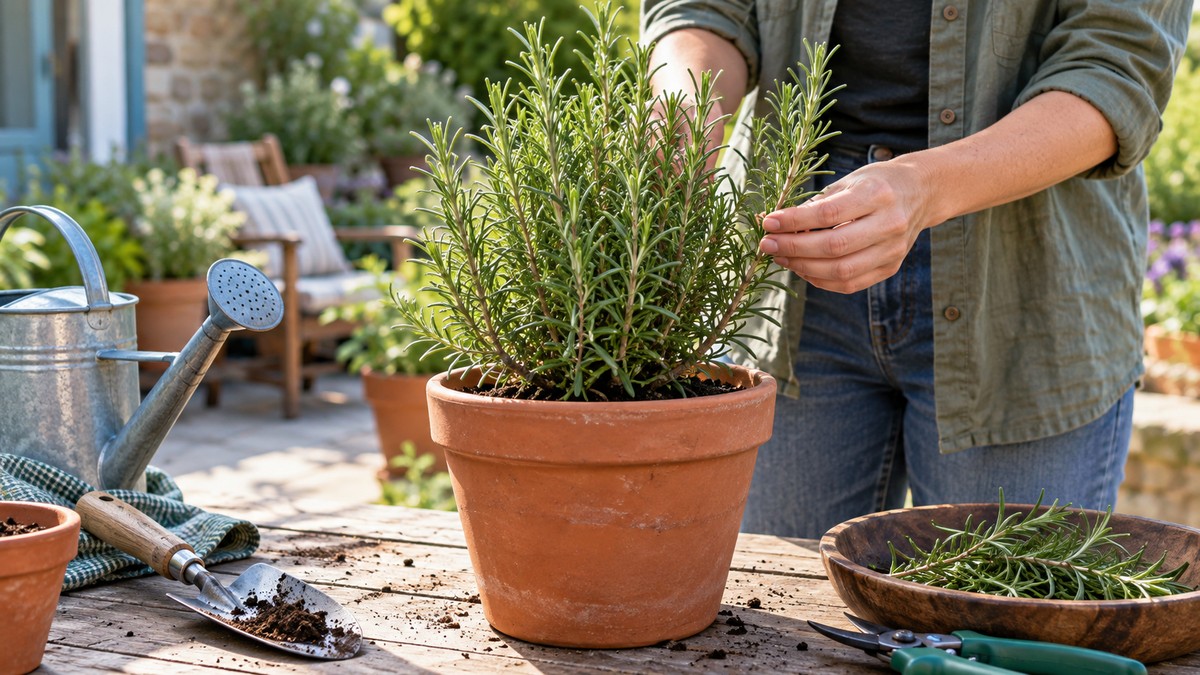
The container should leave room for the roots. NDSU Extension says to “Choose a pot that is large enough for your plant,” and adds that the pot “should also be deep enough to accommodate the plant’s deep roots.” The Vermont page offers an option: start in a smaller container and transplant to a larger one as the plant grows. Its own pot was 10 inches across and 9 inches tall, with a drainage hole at the bottom, which gave the plant room to grow into.
Material matters too. The Illinois guide says herbs can be grown in any type of container “so long as it has drainage holes.” NDSU favors clay or terracotta. The Iowa State guide says herbs grown in clay containers may need more frequent watering because they tend to dry out faster, and it notes that plastic is lighter and therefore easier to move around.
Start from a cutting
The Texas guide describes the cutting method in detail. Clip a 3-inch branch from the stem of a healthy plant. Trim off most of the lower leaves, then plant one or two cuttings in a 3-inch pot. Water them and place the pot on a windowsill with indirect sunlight and temperatures between 60 and 70 degrees F. After about 8 weeks, the guide says, “the cuttings will be rooted” and ready to move to their permanent pot or spot.
The Texas guide says the best way to propagate rosemary is from a cutting taken from an already vigorous plant. Seed is usually inexpensive, but its low germination rate and long span to harvest make a cutting the faster route.
Soil and drainage
Drainage decides how much water the roots can tolerate, and the soil is where that gets set. The Vermont page says to “use soil amended with compost” and adds that “Drainage is important, as rosemary will not tolerate excess water, but do not let your plant dry out.” NDSU recommends “Use well-draining potting soil or a sandy blend of soil,” so the roots get air and the mix does not stay waterlogged.
The Illinois guide says to “Use loose, well-drained potting mix.” The University of Maryland guide gives a mix for indoor plants: “two-parts soilless potting mixture and one-part perlite.” It also says containers need adequate drainage holes. For the ground, the Texas guide says that raised or slightly mounded beds give rosemary the best drainage, and it puts the preferred soil pH between 6.0 and 7.0.
If you are also planning a bed, our guide to the easiest vegetables to grow in raised beds covers the kinds of plants that share the same drainage needs. For a herb bed beside vegetables, see our guide to raised bed companion planting and garden layout.
Light and placement
Light is where the sources differ. The Texas guide says rosemary “should receive at least 6 hours of sun each day” and grows best in full sun. The Vermont page gives the same six-hour minimum: place it “in a spot where it will get at least 6 hours of sunlight daily.” NDSU says it “needs around eight hours of direct sunlight.” Choose a spot that gets the longer figure if you can, and treat six hours as the lowest the sources support.
Indoors the rules change. NDSU says the potted rosemary should be placed “in a south-facing window or under grow lights.” The Iowa State guide says herbs “require full sun whether they are grown indoors or outside,” and it asks for at least 4 to 6 hours of sunlight. The Maryland guide suggests a south or west window and says grow lights are needed in winter, set to run 14 to 16 hours a day.
Watering without overdoing it
Overwatering is the common failure, and the sources all say so. The Texas guide says “Too much water can cause root rot.” It adds that because rosemary’s needles do not wilt the way broad leaves do, it can be hard to tell when a plant needs water. On average, the guide says, water every one to two weeks, depending on plant size and climate, and let the plant dry out thoroughly between waterings.
NDSU puts it more bluntly. It says “Root rot is a major issue with growing rosemary inside,” and advises that you “Water the plant sparingly and only when the soil is dry.” The Vermont page gives a sign to watch for: “If you notice that some leaves are no longer green, more water is needed.” Watering on a schedule can miss both extremes, so check the soil before you water.
Seasonal changes matter. The Maryland guide says to “Water them less frequently in cooler weather,” and the Iowa State guide notes that herbs in clay containers tend to dry out faster.
Indoor care and humidity
Rosemary likes humidity, which indoor air often lacks. NDSU suggests that you “place the pot on a shallow tray filled with rocks and some water,” so that the water evaporates around the plant. The Maryland guide offers two other options: mist the plants daily or group them on a tray of moistened pebbles. It also says to keep indoor herbs away from drafts, dry heat vents and temperature extremes.
Feeding, pruning and harvest
Feed rarely. The Texas guide says “Rosemary seldom needs fertilizer,” but if growth is slow or the plant looks stunted or pale yellow, it advises applying fertilizer “once in early spring before new growth appears.” The Illinois guide adds a warning: “Do not over fertilize herbs.” The Vermont page says its author fertilizes the plant when it is outside.
Prune to keep the plant shapely. The Illinois guide says to pinch herbs during the growing season to keep them bushy and compact. The Vermont page says its only pruning was to clip stems for cooking and to remove dead stems, and that you can shape the plant if you wish. The Texas guide says pruning overgrown plants improves air circulation within them.
Harvest small amounts often. The Texas guide says that once the plant is a suitable size, you can “pick several small branches without harming it,” and it advises that you “allow the plants to replace their growth between harvests.” Fresh cuttings keep their best flavor for “2 to 7 days in the refrigerator,” according to the Texas guide, and for longer storage the guide suggests hanging the clippings in bundles to dry. The Iowa State guide says perennial herbs can take only the top third of the plant at a time.
Bring it indoors for winter
The Texas guide says rosemary is a perennial in most areas in Texas, which means USDA Cold Hardiness Zone 7 and warmer. The North Dakota guide says rosemary is only hardy to 20 degrees Fahrenheit, so it is usually grown indoors there. The Vermont page says it is not a perennial in Vermont, but it can be enjoyed all year in a container.
The timing of the move matters. The Vermont page says to bring the pot outside in warmer weather and inside before the first frost. The Illinois guide says to acclimatize herbs in early fall and move them indoors gradually, so they adjust to indoor temperature and light. The Maryland guide says that tender herbs, including rosemary, do not always survive the state’s winters, especially in western Maryland, and can be overwintered indoors.
Indoors, the air is often drier than rosemary likes. NDSU notes that rosemary prefers humid climates, something North Dakota winters lack, which is why the tray matters. The Iowa State guide says perennial herbs grown indoors over winter may need supplemental lighting, and the Maryland guide sets grow lights at 14 to 16 hours a day in winter.
How we chose
We opened six pages on 2026-10-22: three rosemary-specific pages (a Texas A&M AgriLife fact sheet, EHT-039, marked 1-17 in the PDF; a University of Vermont Extension article dated December 15, 2021; and an NDSU Extension column dated December 9, 2025) and three general container-herb guides (Illinois Extension, Iowa State University Extension, and University of Maryland Extension). All six are university or land-grant extension pages.
We kept a statement only when one of these pages states it in plain words. Where pages disagree, as they do on light hours, we give each figure with its page. The Vermont article contains a recipe section that is outside this guide’s scope, so we did not use it.
What we could not verify
The three rosemary pages cover the plant well, but they do not all cover the same growing stages, and the container guides are general rather than rosemary-specific. The gaps below show where this guide stops.
What the sources do not say
No page gives a pot volume for rosemary beyond the Vermont example, and the Texas guide’s table gives harvest timing without a yield figure. None of the pages gives a fixed number of weeks between waterings for a pot in a given climate; the Texas guide gives one to two weeks as an average. The Maryland guide mentions yearly repotting for indoor herbs, but the sources say nothing about how to tell when a pot is root-bound. The Vermont page does not give a feeding schedule beyond outdoor use.
Frequently asked questions
Can you grow rosemary in a pot all year?
Yes, if you move it. The Vermont page says rosemary can be enjoyed all year in a container, bringing it outside in warm weather and inside before the first frost. The Texas guide says rosemary is a perennial in most of Texas, but it does not cover pots in colder places.
How often should I water a potted rosemary?
The Texas guide says on average every one to two weeks, depending on plant size and climate, and it says to let the plant dry out thoroughly between waterings. NDSU says to water sparingly and only when the soil is dry.
What is the best pot material for rosemary?
NDSU Extension says clay or terracotta pots are best because they help prevent overwatering. The Iowa State guide says herbs in clay containers tend to dry out faster, and that plastic is lighter and easier to move.
Does rosemary need full sun indoors?
Yes, in a bright spot. NDSU says the potted plant should go in a south-facing window or under grow lights, and that grow lights usually need to run longer than the plant would get from a window. The Iowa State guide says herbs require full sun indoors and outdoors.
Is rosemary safe to have around pets and children?
NDSU Extension says the plant is nontoxic to pets and children. That is the only safety statement in these sources, so treat it as NDSU’s view rather than a general rule for every plant in the herb family.
Sources
- https://aggie-horticulture.tamu.edu/wp-content/uploads/sites/10/2013/09/EHT039.pdf (opened 2026-10-22)
- https://www.uvm.edu/extension/news/fresh-rosemary-every-season (opened 2026-10-22)
- https://www.ag.ndsu.edu/news/columns/dakota-gardener/dakota-gardener-the-houseplant-you-didn2019t-know-you-needed-2014-growing-rosemary-indoors (opened 2026-10-22)
- https://extension.illinois.edu/container-gardens/growing-herbs-containers (opened 2026-10-22)
- https://yardandgarden.extension.iastate.edu/how-to/growing-herbs-containers (opened 2026-10-22)
- https://www.extension.umd.edu/resource/growing-herbs-containers-and-indoors (opened 2026-10-22)