Best Bird Houses for Bluebirds: Six Boxes Compared by Entrance, Access and Mounting
As an Amazon Associate we earn from qualifying purchases. Details
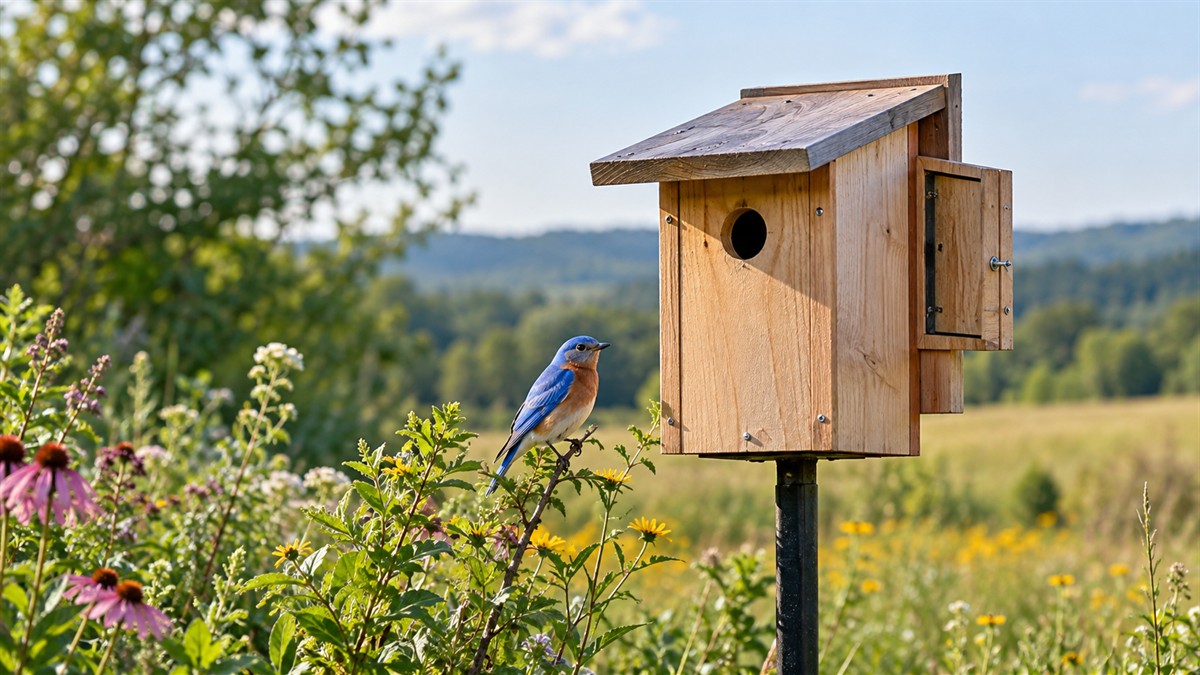
The best bird houses for bluebirds share four traits: a round entrance hole close to 1½ inches, a floor set well below that hole, a roof that overhangs, and a front or side panel that opens for cleaning. The person typing best bird houses for bluebirds wants a box a bluebird will use, that starlings and house sparrows are less likely to take over, and that can be emptied after the nesting season. This guide compares six bluebird boxes from their listings and checks each listing against three university extension publications.
Quick answer
- Look for a 1½-inch entrance. Penn State Extension states: “Entry hole should be 1½ inches for eastern bluebirds.” Only four of the six listings here state an entrance size at all.
- Pick a box that opens from the front or side. Penn State says to “open the boxes after each nesting season and remove all nesting materials,” so the access panel decides how easy that job is.
- Mount it on a pole with a baffle when you can. Penn State advises: “Attach a predator baffle to the pole below the box.”
- Read the height and floor figures before you order. The listings give them in different units and formats, and three of the six give no height a buyer can use.
What a bluebird box has to do
A bluebird box is a simple structure with three jobs: keep a pair of birds dry and warm, keep the entrance small enough for a bluebird, and let a person reach inside. The extension sources agree on the basic shape. Penn State describes a box with a floor set low and a roof that overhangs, and it lists the eastern bluebird entry at 1½ inches. Purdue’s bluebird row in its nest box table gives the same entry size, but it also notes that the hole can be a narrow vertical slit.
Penn State’s dimensions are the most specific we opened. It says the floor should sit 8 inches below the entry hole, and that the roof should slant with the back higher than the front and overhang “2 inches or more to keep rain and sun out of entry hole.” Those two numbers are the ones to check on a listing, because a box with a shallow floor or a short roof will let rain into the nest.
Purdue’s table gives slightly different figures for the same species. Its bluebird row lists a hole 6 to 7 inches above the floor, a floor of 4 x 4 inches, a total box height of 11 to 12 inches, and a mounting height of 3 to 6 feet above ground. Penn State gives an 8-inch floor drop, which is one to two inches deeper than Purdue’s 6 to 7 inch hole height. Neither source is wrong for every box, but a buyer should not treat either set of numbers as the only correct answer.
NC State Extension’s songbird box guide makes a related point: “By choosing the correct dimensions and entrance hole sizes, you can furnish cool, dry, durable, easily-cleaned boxes for any of the small to medium-sized bird species in the table.” The phrase that matters for shopping is “easily-cleaned.” A box that is hard to open is harder to keep dry and clean, whatever its dimensions.
The entrance hole: round, slit or a size limit
The entrance is the feature that decides who gets in. Purdue puts it plainly: “The size of the entrance hole is a major factor in determining what species can use the box and what species can be excluded from the box.” For a bluebird owner, that sentence has two parts. The hole should be the right size for bluebirds, and it should be too small for birds that compete with them.
Purdue also reports that “Now bluebird specialists are promoting a box design with a long, narrow slit at top rather than a round opening.” That is a design choice, not a rule, and every listing in this guide uses a round hole or does not say. Penn State gives a separate limit for starlings, which it writes as “Prevent starlings from using boxes by making the entrance hole less than 19⁄16 inches in diameter.” The fraction is printed that way on the page, so check the source before you drill to a size close to that limit.
Purdue also makes a point that matters more than the diameter alone: “The size of the internal cavity is arguably more important than the entrance hole diameter.” A box with a perfect hole and a cramped interior may still be a poor nest site. None of the six listings gives an interior measurement, so this is one of the gaps this guide cannot close.
Access for cleaning when two broods are normal
Penn State notes that “Most adults will raise two broods in a season.” A box that gets two nests in one year needs to be emptied between them, and it must be opened at the end of the season. The same page says access should be easy: “Access Side or front should swing open for monitoring and cleaning, and should be secured at bottom with a screw to prevent tampering.”
Penn State also warns against one design: “Top-opening boxes are hard to clean and must be mounted too low to be safe from predators.” That sentence rules out a top lid for most buyers. A front or side panel is the design the extension page describes, and four of the six listings describe an access door, a side panel or a clean-out door. The Wild Wings listing says its “Clean-out door allows easy access to clean between broods,” and the Nature’s Way listing says a hinged side panel allows “quick nest removal and interior inspection.”
Two listings describe a kit that you assemble with a screwdriver. Assembly is a fair trade if the panel fits well and the screws hold. Check that the access panel is secured with a screw or latch that a raccoon cannot lift. Penn State’s own wording on this point is the easiest test: the access side “should be secured at bottom with a screw to prevent tampering.”
Predator guards and baffles
Predators are the main reason a bluebird box fails, so the guard is the second feature to check after the hole. Penn State describes the standard pole baffle: “Predator baffles are usually conical structures placed beneath the box to keep animals like snakes, raccoons, and skunks from climbing up to the box.” The same publication advises attaching the baffle to the pole below the box.
Several listings here describe a guard around the entrance instead of a baffle on the pole. The Gtongoko pack and the ColorfulLaVie pack describe a metal or wire guard inside or around the entrance, and the SISTERBIRD listing describes a copper guard around the hole. The Nature’s Way and Wild Wings listings describe an extended entrance shield. A front guard helps keep a snake or a squirrel from reaching the entrance, but the extension guidance is built around a pole baffle that keeps climbing animals below the box.
That gap means a buyer should plan the pole before the box. If the box will hang from a tree, the baffle described by Penn State has nowhere to go. The two listings that describe hanging hardware, CEDAR ALPHA and ColorfulLaVie, include a cable or a rope. Those mounts may suit a tree site, but the sources we opened describe a baffle on a pole, so a hanging box needs a separate plan for climbing predators.
Perches and placement
Penn State gives a clear rule about perches: “To prevent avian predators, such as hawks, from ambushing bluebirds as they enter or leave the nest, do not locate perches too close to nest boxes, and never put perches on nest boxes.” The CEDAR ALPHA listing describes a perch that “slides out smoothly.” The listing does not say whether that perch is a feeding perch, a cleaning rod or a decoration. Penn State’s rule means that a perch attached to the box itself is the wrong design, so a buyer should ask the seller what the perch is and where it sits.
Placement is the other half of the decision. Purdue gives a height of “3-6” feet above ground for the bluebird row and advises that boxes should “Face north or east, spaced 100 yards apart in open fields, orchards, and meadows.” Those are the figures a buyer can use to plan a yard. The spacing is a planning figure from Purdue, not a rule that every yard can meet, and a small yard may need one box rather than several.
Listing data against the extension figures
The table below uses only what each listing states. Where a listing gives no figure, the cell says so rather than guessing.
| Listing | Entrance stated | Size as listed | Access or guard | Mounting in listing |
|---|---|---|---|---|
| Wild Wings WWCH3 (listed brand Nature’s Way) | Not stated | 3.2 x 2.17 x 4.72 inches | Clean-out door; guard extends the entrance | Not stated |
| Nature’s Way Cedar Bluebird House | Not stated | 7.88 x 5.19 x 12 inches | Hinged side panel; entrance shield | Pole or flush mount |
| Gtongoko 2-pack | 1-1/2 inch | 5.71 D x 5.51 W x 10.63 H inches | Front access door; metal guard | Not stated; kit |
| CEDAR ALPHA cedar box | 1.5 inch | 9.05 x 9.9 x 8.5 inches | Slide-out perch; internal tube | Stainless hanging cable |
| ColorfulLaVie 2-pack | 1-1/2 inch | Not stated | Front latch; internal wire mesh | Screws and rope |
| SISTERBIRD 2-pack | 1-1/2 inch | Not stated | Copper guard around entrance | Not stated |
Two readings from this table matter. The Gtongoko listing gives its height explicitly as 10.63 inches, which is 0.37 inches short of the 11-inch lower end of Purdue’s total height range. The Wild Wings listing gives 4.72 inches as its largest figure, which is far below any height in the extension tables, so we treat that line as unreliable until the seller confirms it. The Nature’s Way figures give 12 inches as the largest of three numbers, which fits Purdue’s range, but the listing does not label the height.
Drainage and ventilation holes
A nest box has to shed water as well as keep it out. NC State Extension says that “Boxes need at least four 1⁄4-inch holes in the bottom to allow water to drain.” The same guide adds that “An alternative to drilling drainage holes is cutting corners of the floor board to create drainage holes,” which is useful to know if a box arrives with a solid floor.
Several listings mention ventilation, and the wording differs. The Wild Wings listing says “Air vents allow for proper air ventilation through wall and floor openings.” The Nature’s Way listing describes “integrated wall and floor ventilation,” and the Gtongoko listing mentions “Multiple ventilation holes.” None of these listings gives the number or the diameter of the drainage holes in the floor. That is the detail NC State asks for, so a buyer should count the bottom holes on the box before ordering, not rely on the word ventilation.
Penn State’s roof rule protects the entrance from the top. Its roof should overhang “2 inches or more to keep rain and sun out of entry hole.” A listing that does not state the roof overhang leaves that protection unverified, which is why the roof belongs on the checklist with the entrance and the access panel.
How we chose
We searched Amazon for bird houses for bluebirds and read the first page of results. We kept six listings from five listed brands and required each to be a nest box, not a feeder or a decorative birdhouse with no entrance described. A listing made from a kit still counted, because the kit is the product people buy. We read each listing’s own bullets and specification rows, and we compared those with the extension publications named in the sources, using only text we opened.
We did not weight the choice by any rating, count or ranking shown on the listings. The point of the list is the set of features a bluebird owner can check, not an order of quality.
What we could not verify
We did not verify how any of these boxes performs in a yard. The extension sources describe the design features, not any product, so nothing here says that a given box will be used by bluebirds, will keep starlings out or will survive a winter.
The listings do not state interior dimensions, floor size, wall thickness in every case, or how the access panel locks. Two listings give no entrance size, and the Wild Wings and Nature’s Way listings give no entrance diameter at all. Materials are stated as cedar, wood or copper guard in different places, and some listings use the same word for a finish, a species or a color. The Purdue table and the Penn State page disagree on floor size as well as depth. Penn State gives a floor of “4½ to 5½ inches square,” while Purdue’s table gives 4 x 4 inches, and we report both rather than choosing one.
Picks
1. Wild Wings WWCH3 Cedar Blue Bird Box House (Wild Wings cedar box with a clean-out door and extended entry guard)
Specs from the listing (checked ):
- Product Dimensions: 3.2 x 2.17 x 4.72 inches; 2.07 pounds
- Manufacturer: Wild Wings
Pros
- The bullets describe a clean-out door for cleaning between broods
- The bullets say an added predator guard extends the entrance hole
- The bullets describe grooves below the entry hole for young birds to climb
Cons
- The bullets do not state the entrance hole diameter
- The listed product dimensions are 3.2 x 2.17 x 4.72 inches, which the box height guidance does not support
Best for: A buyer who wants a cedar box with a clean-out door and an entrance guard
Skip if: You need a stated entrance diameter before you order
View on Amazon (affiliate link)
2. Nature's Way Cedar Bluebird House for Outdoor Nesting, Predator Guard, Ventilated Design & Easy (Nature's Way cedar box with a hinged side panel and pole or flush mounting)
Pros
- The bullets describe a hinged side access panel for nest removal and inspection
- The bullets say the box is compatible with pole or flush mounting
- The bullets describe built-in fledgling kerfs inside the entrance
Cons
- The listing gives three dimensions without labels, so the height is not clear
Best for: A buyer who wants a side-opening box that can go on a pole
Skip if: You need the entrance size and height labeled in the listing
View on Amazon (affiliate link)
3. 2 Pack Bluebird Houses for Outside with Metal Predator Guard Black (Gtongoko two-pack bluebird box with a metal predator guard)
Specs from the listing (checked ):
- Item Dimensions: 5.71"D x 5.51"W x 10.63"H
- Item Weight: 3.3 pounds
Pros
- The bullets state a 1-1/2 inch entrance hole
- The bullets describe an elevated mesh floor and a clean-out door
- The listed height is 10.63 inches, labeled H in the dimension line
Cons
- The bullets say the pack includes two kits and a screwdriver, so assembly is required
- The listed height is 0.37 inches below the 11-inch lower end in the Purdue table
Best for: A buyer who wants two boxes and does not mind assembling them
Skip if: You want a box delivered fully built
View on Amazon (affiliate link)
4. Large Cedar Bluebird House for Outside – Bamboo Shingles Roof Birdhouse for Bluebirds – Weather (CEDAR ALPHA thick cedar box with a bamboo shingle roof)
Specs from the listing (checked ):
- Product Dimensions: 9.05 x 9.9 x 8.5 inches
- Item Weight: 2.8 pounds
Pros
- The bullets state a 1.5-inch entry for small birds and a 13/16-inch cedar panel
- The bullets describe a bamboo shingle roof and a slide-out perch
- The listing gives three dimensions: 9.05 x 9.9 x 8.5 inches
Cons
- The bullets describe a stainless steel hanging cable, so a pole baffle does not fit
- The bullets describe a perch that slides out but do not say what the perch is for
Best for: A buyer who wants a thick cedar box to hang from a tree or a bracket
Skip if: You need a pole-mounted box with a baffle below it
View on Amazon (affiliate link)
5. 2 Pack Bluebird Houses for Outside Thick Wood Bluebird House (ColorfulLaVie two-pack with a fledgling groove and wire mesh inside)
Specs from the listing (checked ):
- Model Number: ZP0812M
- Warranty Description: 1 year manufacture
Pros
- The bullets state a 1-1/2 inch entrance hole and a groove for fledglings
- The bullets describe an internal wire mesh guard and a pole beside the entrance
- The listing says the pack holds two boxes and includes a one-year manufacturer warranty
Cons
- The listing gives no height, floor size or outside dimensions
- The bullets describe a screwdriver assembly and a rope for hanging
Best for: A buyer who wants two boxes for two locations
Skip if: You need listed dimensions before you order
View on Amazon (affiliate link)
6. 2 Pack Bluebird Houses for Outside, Warming Gifts Bluebird House (SISTERBIRD two-pack cedar box with a copper predator guard)
Specs from the listing (checked ):
- Model Number: Wooden with Metal Guard
- Manufacturer Part Number: BH0206-LY
Pros
- The bullets describe a copper predator guard around the entrance hole
- The bullets describe untreated, unpainted cedar construction
Cons
- The bullets describe a kit that needs a screwdriver to build
- The listing gives no height, floor or access-panel description
Best for: A buyer who wants a copper guard on an untreated cedar box
Skip if: You need a box with a documented access panel and a stated height
View on Amazon (affiliate link)
FAQ
Will a bluebird box attract other birds?
Yes. Purdue says the entrance size “is a major factor in determining what species can use the box and what species can be excluded from the box.” A 1½-inch hole is the bluebird figure from Penn State, and the same page names tree swallows and house wrens among the cavity nesters that compete with bluebirds. Penn State adds a separate limit for starlings. If you want only bluebirds, the entrance and the location both matter, and no listing can control the location for you.
How high should I mount a bluebird box?
Purdue’s bluebird row gives a height of “3-6” feet above ground. Use the lower part of that range if you need to reach the box for cleaning, and keep the box on a pole with a baffle below it. Penn State’s advice to attach the baffle to the pole is the reason a pole mount is the safer plan than a hanging cable.
How often should I clean the box?
Penn State says to “open the boxes after each nesting season and remove all nesting materials.” It also reports that “Most adults will raise two broods in a season,” so a box that has had one nest may be needed again. Plan on an access panel that opens without a tool or with one screw, so cleaning does not take much time between nests.
Can I hang a bluebird box from a tree?
You can, but the extension sources we opened describe a box on a pole with a baffle below it. A box on a cable has no pole for that baffle, so the predator plan is different. The CEDAR ALPHA and ColorfulLaVie listings both include hanging hardware, and their guards and entrance sizes should be checked against the points above before you use a tree mount.
What should I check on the box before I buy?
Check the entrance diameter first, then the access panel, then the mounting hardware. Ask the seller for the floor size and the height if the listing does not give them, and confirm that any perch is not attached to the box, because Penn State says “never put perches on nest boxes.”
Bottom line
Buy a box with a stated 1½-inch entrance, an access panel that opens for cleaning, and a mounting plan that includes a baffle on a pole. When a listing gives no entrance size or no height, treat it as unverified until the seller answers.
Related reading: Best Birdhouse for Hanging on a Tree covers the hanging-mount side of this decision, and Best Free Standing Bird Feeder Squirrel Proof covers the climbing-predator problem for feeders on the same pole.
Sources
- Penn State Extension, Managing Habitat for Eastern Bluebirds: https://extension.psu.edu/managing-habitat-for-eastern-bluebirds
- NC State Extension, Building Songbird Boxes: https://content.ces.ncsu.edu/building-songbird-boxes
- Purdue Extension, FNR-246-W Size Does Matter: Nest Boxes for Wildlife: https://www.extension.purdue.edu/extmedia/fnr/fnr-246-w.pdf