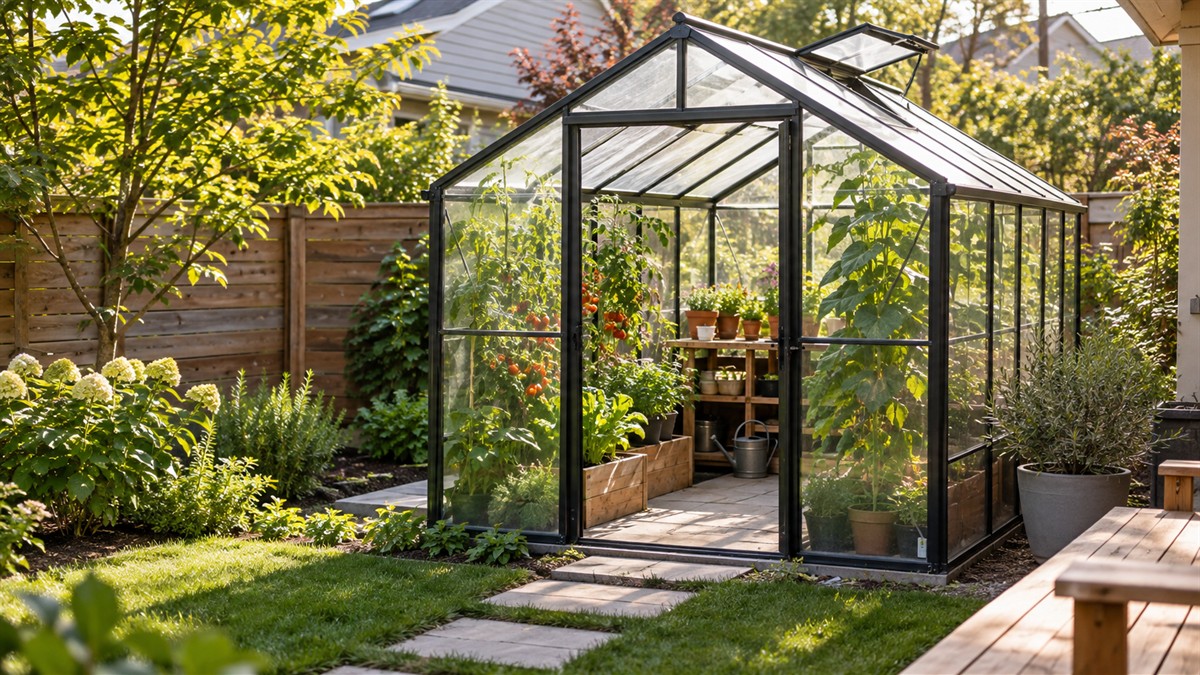
Best Greenhouse for Small Spaces: Eight Kits Compared by Footprint, Height and Ventilation
As an Amazon Associate we earn from qualifying purchases. Details
The best greenhouse for small spaces is the one whose footprint fits your patio, balcony or yard corner and whose vents can be opened on a warm day. The person typing best greenhouse for small spaces wants a plant enclosure that does not take over the yard, that can stay upright in wind, and that can be used in spring and fall. This guide compares eight kits from their listings, works out each one’s footprint and volume from the listed dimensions, and checks the features against four university sources on greenhouse ventilation and wind.
Quick answer
- Measure the floor first. The footprints in the table below run from about 2.6 square feet for a 3-tier wooden frame to about 23 square feet for a pop-up tent, so the floor size decides which kinds fit.
- Pick a height you can reach. The shelf-style kits are 54 to 63 inches tall, and the walk-in kits are 76 to 89 inches tall. A tall kit is harder to vent by hand.
- Plan for vents before you need them. NC State says “Exhaust fans should be sized to exchange the total volume of air in the greenhouse each minute,” and Purdue warns that tunnels can overheat “on bright sunny days when there is little or no ventilation.”
- Anchor the frame for wind. Colorado State advises “Close end wall doors and side wall ventilation during storms,” and several listings include ground stakes, wind ropes or a stated wind rating.
Footprint and volume from the listed dimensions
A greenhouse for a small space is a footprint problem before it is a plant problem. The table gives the floor area in square feet and the internal volume in cubic feet, both worked out from the length, width and height figures in each listing. Footprint is length times width; volume is length times width times height. Where a listing gives two different heights, the table uses the dimension row and notes the other figure.
| Kit (listed brand) | Listed size (in) | Footprint (sq ft) | Volume (cu ft) |
|---|---|---|---|
| Bamworld 3-tier wooden | 22.8 x 16.7 x 54.1 | 2.64 | 11.92 |
| Pure Garden 4-tier | 27 x 19 x 63 | 3.56 | 18.70 |
| Velway 4-shelf | 23.2 x 19.3 x 63 | 3.11 | 16.32 |
| Yesker mini | 36 x 18 x 36 (size row says 33 high) | 4.50 | 13.50 (12.4 at 33 high) |
| Solayis mini kit | 47.2 x 23.6 x 23.6 | 7.74 | 15.21 |
| Greengro walk-in | 57 x 28 x 76 | 11.08 | 70.19 |
| SPECILITE walk-in | 55.1 x 55.1 x 77.6 | 21.08 | 136.34 |
| EAGLE PEAK pop-up | 70.9 x 47.2 x 88.6 | 23.24 | 171.58 |
The first three kits are shelf units with a cover, and they take the least floor. The Bamworld kit has the smallest footprint in the table at 2.64 square feet and the smallest volume at 11.92 cubic feet. The walk-in kits give a person room to stand, but they need a flat spot about 11 to 23 square feet in area, and the two largest enclose more than 130 cubic feet of air.
The table also shows a point that is easy to miss. The Yesker listing gives its dimensions as 36 by 18 by 36 inches in one row and 36 by 18 by 33 inches in the size row. The volume shifts from 13.50 to about 12.4 cubic feet depending on which height is correct, so a buyer should ask the seller for the height before counting on the difference.
Shelf units and walk-in kits do different jobs
Shelf-style kits, such as the Bamworld, Pure Garden and Velway listings, are built around the plants: each shelf holds trays or pots, and the cover keeps the air around them moist and slightly warmer. The Pure Garden listing gives a weight capacity of 24 pounds per shelf, the Velway listing gives 17.6 pounds per shelf, and the Bamworld listing gives 15.8 inches of clearance per shelf. These kits fit a windowsill-sized footprint, but a tall stack needs a steady spot, because the upper shelves are the first to tip in wind.
Walk-in kits, such as the Greengro, SPECILITE and EAGLE PEAK listings, give a person room to work and carry a lot of plant material. The Greengro listing gives a 22-pound capacity for its shelves, and the SPECILITE listing says it “can easily fit up to 24 plant pots at once.” The EAGLE PEAK listing describes a “one person setup” with no tools. A walk-in kit is the right choice for a patio where the space is open, and its frame needs a clear ground surface for the stakes.
The Solayis mini kit sits between the two. Its footprint of 7.74 square feet is larger than the shelf units, and it stands 23.6 inches tall, so it is a low, wide tent rather than a tower.
Ventilation: the feature small greenhouses are judged on
Ventilation decides whether a small greenhouse works in summer and whether it cooks the plants in spring. NC State Extension describes the fan layout for a small greenhouse: “For small greenhouses (less than 60 feet long), place the fans in diagonally opposite corners but out from the ends and sides.” It also describes the airflow that a fan creates: “Mechanical ventilation uses an exhaust fan to move air out of one end of the greenhouse while outside air enters the other end through motorized inlet louvers.”
Most of the kits here do not include a fan, so the vents are the main control. The SPECILITE listing says to “Open the zipper roller shutter door and the two screen side windows to ensure proper internal ventilation,” and the Yesker listing describes “two semi-circular zippered doors on the top” for ventilation and watering. The Solayis listing includes “two mesh windows” with a roll-up zipper door. Those features are the right kind for a small structure: openings at more than one height, with a door that can be left open.
Purdue’s high tunnel guidance is for larger structures, but its winter warning applies to any enclosed space. The publication says that “Ventilation can be important in winter to keep temperatures in the best range for the crop,” and that “High temperatures can occur in tunnels in the winter on bright sunny days when there is little or no ventilation.” A kit with only a roll-up door and no vent at the top gives you less control on a sunny afternoon, so check where the openings are before you buy.
Wind, stakes and anchoring
Small greenhouses act like sails. Colorado State Extension’s presentation on hoophouses describes them as “like big kites,” and recommends for storms that you “Close end wall doors and side wall ventilation during storms.” The same presentation lists careful site selection to avoid constant wind as the first step against lift-off.
Several listings address wind directly, and the claims differ. The Greengro listing says its PE cover is “designed to withstand winds of up to 45 mph,” a figure the listing gives without a test source. The Solayis listing includes “Extra wind ropes and ground stakes,” which is the anchoring that Colorado State’s advice implies. The Bamworld listing says its cover blocks “wind and light frost,” which describes shelter but not anchoring. None of these figures is a wind rating we could check against a standard, so treat them as the seller’s claims and add ground stakes or ties whether or not the listing includes them.
NC State Extension also points to the site. Its backyard greenhouse guide says the structure “should also be located where air drainage is good; avoid low areas surrounded by woods or buildings.” A low corner can trap cold air and damp air at the same time, so a small greenhouse belongs on the high, open side of the yard when that is possible.
Heat and winter use
Winter use is where many small greenhouses fail. NC State’s backyard guide says that “Other sources of heat can be used, but even very small gas or oil heaters will usually overheat a greenhouse this small and may not burn well if not properly ventilated.” That is a warning against adding a flame heater to a small enclosure without planning the vent.
UF/IFAS Extension publishes the combustion risk in plain terms. Its heating publication says that “other gases that are harmful to humans (i.e., carbon monoxide) and many plants (i.e., ethylene, sulfur dioxide, and unburned hydrocarbons) are also by-products of combustion,” and that “These can cause serious problems if the exhaust gases from unit heaters are not properly vented to the outside.” None of the eight kits in this guide is a heater, and none of their listings describes a heating element. If you add one, the venting and the carbon monoxide risk come with it, and that decision belongs to a heater guide, not to a kit listing.
For a kit without heat, the winter question is ventilation in the cold, not heat. Purdue’s high tunnel guidance notes that ventilation is needed in winter to hold the crop’s temperature range, so a kit with a door and vent you can open on a mild day is more useful than a kit that seals tightly all year.
What a fan would have to move
If you add a fan, NC State’s rule gives you the size to aim for. Its appendix says that “Exhaust fans should be sized to exchange the total volume of air in the greenhouse each minute.” Read literally, one full exchange per minute means a fan rated in cubic feet per minute that is at least equal to the enclosure’s volume in cubic feet. That is a sizing benchmark from the source, not a target the sources set for home kits, and it is the most demanding reading of the rule. The figures below apply it to the volumes in the first table.
| Kit | Volume (cu ft) | Fan at one full exchange per minute (cu ft/min) |
|---|---|---|
| Bamworld 3-tier wooden | 11.92 | about 12 |
| Yesker mini | 13.50 | about 14 |
| Solayis mini kit | 15.21 | about 15 |
| Velway 4-shelf | 16.32 | about 16 |
| Pure Garden 4-tier | 18.70 | about 19 |
| Greengro walk-in | 70.19 | about 70 |
| SPECILITE walk-in | 136.34 | about 136 |
| EAGLE PEAK pop-up | 171.58 | about 172 |
The point of the table is scale. A shelf kit under 20 cubic feet needs a small exhaust fan, while the walk-in tents need a fan sized for their full volume and a clear inlet for the replacement air. NC State’s appendix describes a fan at one end pulling air out while “outside air enters the other end through motorized inlet louvers,” so a fan without an inlet does less than the rule assumes. The kits in this guide have doors and side windows that can serve as the inlet, which is why the door placement matters as much as the fan size.
Setup claims and how long a kit takes
Assembly time is a practical limit for a small greenhouse, especially one moved between seasons. The listings state their setup in different ways, and the table repeats each one as written, with the source row noted.
| Kit | Setup claim in the listing |
|---|---|
| Bamworld 3-tier wooden | “Push-fit wooden frame assembles in about 15 minutes.” |
| Velway 4-shelf | “Snap the frame together with 8 clips and plastic connectors, no screws or tools” |
| Greengro walk-in | “without any tools needed” |
| EAGLE PEAK pop-up | “pre-assembled frame designed for quick, effortless one person setup. No tools required.” |
| Yesker mini | “can be easily assembled without any tools” |
| SPECILITE walk-in | “No tools required.” |
| Pure Garden 4-tier | Not stated; the listing describes locking wheels |
| Solayis mini kit | Not stated; the listing describes included stakes and wind ropes |
One kit gives an assembly time, one names a person count, and five say no tools or no screws are needed, including the EAGLE PEAK listing. The phrase “no tools” is not the same as “no help,” and the walk-in frames here stand 76 to 89 inches tall, which is easier to raise with two people. The EAGLE PEAK listing is the only one that says one person can set it up, and it describes a pre-assembled frame, so the claim covers the frame, not the cover or the stakes.
How we chose
We searched Amazon for greenhouses for small spaces and read the first page of results. We kept eight listings from eight listed brands. We required each to be a freestanding greenhouse kit, a shelf-style plant enclosure or a small walk-in tent, and we excluded indoor grow tents that were sold only as lighting products and a listing that gave no dimensions. The table uses the length, width and height figures each listing gives, and it notes where two figures disagree.
We did not use the number of reviews, the ranking or any star rating shown on the listings. The order of the picks follows the footprint story, not a quality score.
What we could not verify
We did not verify wind performance, UV transmission, frame strength or cover life for any kit. Several listings make those claims. The Bamworld listing gives a light transmission figure of 75 percent in one bullet and 85 percent clear cover in another, and the Solayis listing gives a weight of 5.5 pounds in one place and 6.6 pounds in the specification row. We report the conflicts and do not pick a figure.
Plant-specific results are outside this guide. The sources we opened describe air movement, drainage and the venting of heaters. They do not say how a given kit will affect a given crop, and no listing says which crops it suits.
The listings do not state frame material for every kit in the same way. Some say steel, some say wood, and some say rust-resistant coating without naming the metal. The covers are described as PE, PVC or polyethylene mesh, and the thickness is given for only two kits.
Picks
1. Bamworld 3-Tier Wooden Greenhouse 54" Tall Portable Green House (Bamworld 3-tier wooden greenhouse with a roll-up zipper door)
Specs from the listing (checked ):
- Item Dimensions: 22.8"L x 16.7"W x 54.1"H
- Item Weight: 8.45 pounds
Pros
- The footprint is 22.8 by 16.7 inches, the smallest in this group
- The listing gives 15.8 inches of clearance per shelf for tall pots
- The listing describes a push-fit wooden frame that assembles without tools
Cons
- The listing calls the cover 85% clear in one heading and says it transmits 75% of sunlight in a bullet
- The listing gives no wind rating or anchoring hardware
Best for: A balcony or sunny windowsill that needs a compact seedling shelf
Skip if: You need a walk-in space to stand in
View on Amazon (affiliate link)
2. 4 Tier Mini Greenhouse – Portable Greenhouse with Locking Wheels and PVC Cover for Indoor or (Pure Garden 4-tier mini greenhouse on locking wheels)
Specs from the listing (checked ):
- Item Dimensions: 27"L x 19"W x 63"H
- Model Number: HC-4201
Pros
- The listing gives 24 pounds of weight capacity per shelf
- The locking wheels let you move the frame between rooms or outdoors
- The frame is listed as tubular steel with a PVC cover and a zippered roll-up door
Cons
- The listing gives a 63.3-inch height, which is tall for a balcony with low railings
- The listing gives no vent at the top of the cover
Best for: A buyer who wants to move a shelf greenhouse between a patio and a sunroom
Skip if: You need a vent at the top of the cover
View on Amazon (affiliate link)
3. Mini Greenhouse Indoor Outdoor 4 Tier Portable Greenhouse Shelves Small (Velway 4-shelf mini greenhouse with a breathable PE mesh cover)
Specs from the listing (checked ):
- Item Weight: 8.38 pounds
- Cover Material: Polyethylene (PE)
Pros
- The listing gives 17.6 pounds per shelf on reinforced 1.8 mm wire shelves
- The listing describes a rust-resistant steel frame with an electrophoresis coating
- The listing gives 23.2 by 19.3 inches of footprint, which is 3.11 square feet
Cons
- The mesh cover is described as breathable, so it keeps less heat than a solid cover
- The listing gives no vent placement beyond the zipper
Best for: A buyer who wants a lightweight shelf unit that stacks upward
Skip if: Night warmth matters more than airflow
View on Amazon (affiliate link)
4. Greengro Greenhouse, 28 x 57 x 76'' Walk in Greenhouses for Outdoors Indoor, Small Plant Green (Greengro walk-in greenhouse with screen windows and a 16 mm base)
Specs from the listing (checked ):
- Item Dimensions: 57"L x 28"W x 76"H
- Nominal Wall Thickness: 16 millimeters
Pros
- The listing gives a 57 by 28 by 76 inch footprint and height
- The listing says the PE cover is designed to withstand winds of up to 45 mph
- The listing describes screen windows for airflow
Cons
- The 45 mph figure is the seller's claim and no rating body is named
- The listing gives 22 pounds for shelf capacity but no anchoring kit
Best for: A yard buyer who wants a walk-in greenhouse with screen side windows
Skip if: You need a wind rating from a test body
View on Amazon (affiliate link)
5. EAGLE PEAK 6×4 Easy Setup Small Pop Up Greenhouse, Clear/White (EAGLE PEAK 6 by 4 pop-up greenhouse with a roll-up door)
Specs from the listing (checked ):
- Item Dimensions: 70.9"L x 47.2"W x 88.6"H
- Color: CLEAR/WHITE
Pros
- The listing says the frame is pre-assembled for one-person setup with no tools
- The listing describes a heavy-duty steel frame with a powder-coated, rust-resistant finish
- The listing gives 70.9 by 47.2 by 88.6 inches as its dimensions
Cons
- The 88.6-inch height is tall for a small patio under a roof
- The listing describes the cover as plant-safe and UV-resistant without naming a standard
Best for: A patio buyer who wants a tent-style greenhouse that sets up quickly
Skip if: You need a low kit for a covered balcony
View on Amazon (affiliate link)
6. Solayis Mini Greenhouse Kit, 47.2"L x 23.6"W x 23.6"H White (Solayis mini greenhouse kit with stakes, wind ropes and two mesh windows)
Specs from the listing (checked ):
- Item Dimensions: 47.2"L x 23.6"W x 23.6"H
- Item Weight: 6.6 pounds
Pros
- The listing includes extra wind ropes and ground stakes for stability
- The listing describes a roll-up zipper door and two mesh windows
- The listing gives 47.2 by 23.6 by 23.6 inches as its dimensions
Cons
- The listing gives 5.5 pounds in one bullet and 6.6 pounds in the specification row
- The 23.6-inch height is low for shelf-style growing
Best for: A patio buyer who wants a low tent with anchoring already included
Skip if: You need several tiers of shelves
View on Amazon (affiliate link)
7. Yesker Mini Greenhouse 36"x18"x33" Portable Small Green House for Indoor Outdoor Greenhouses (Yesker mini greenhouse with top zippered doors and a PVC cover)
Specs from the listing (checked ):
- Item Dimensions: 36"L x 18"W x 36"H
- Size: 36x18x33"
Pros
- The listing describes two semicircular zippered doors on the top for ventilation
- The listing gives a 36 by 18 inch footprint, which is 4.5 square feet
- The listing describes a transparent PVC cover and a powder-coated iron frame
Cons
- The listing gives 36 inches and 33 inches for the height in different rows
- The listing gives no weight capacity for the shelves
Best for: A buyer who wants a top vent that opens without a door swing
Skip if: You need the height confirmed before you buy
View on Amazon (affiliate link)
8. SPECILITE 56x56x78Inch Walk-in Greenhouse for Outdoors Garden Plant, Green, Thicken PE Cover, Steel (SPECILITE walk-in greenhouse with a zipper roller door and screen windows)
Specs from the listing (checked ):
- Item Dimensions: 55.1"L x 55.1"W x 77.6"H
- Item Weight: 22 pounds
Pros
- The listing gives 55.1 by 55.1 by 77.6 inches and says it fits up to 24 plant pots
- The listing gives a 22 pound weight capacity for the frame
- The listing describes a zipper roller shutter door and two screen side windows for ventilation
Cons
- The listing says to close the door and windows in rain or snow, which means the vents are not open in bad weather
Best for: A yard buyer who wants a walk-in greenhouse with a roller door and side screens
Skip if: You need a kit that stays open in rain
View on Amazon (affiliate link)
FAQ
Is a small greenhouse worth it on a balcony?
It can be, if the footprint is under about four square feet and the kit has a door and a vent you can reach. A 3-tier wooden frame at 2.64 square feet or a 4-tier steel frame at 3.56 square feet fits a balcony corner. The sources we opened describe ventilation and wind, so a balcony needs the same checks as a yard: the vents, the door and the anchoring.
How do I keep a small greenhouse from overheating?
Open the door or the top vent on warm days, and place fans as NC State describes if you add them. Purdue says tunnels can overheat “on bright sunny days when there is little or no ventilation,” so the vent matters more than the cover color.
Does a small greenhouse need a heater?
Not for every climate or crop. The sources we opened do not say that a kit needs heat, but they do warn about flame heaters in small enclosures. If you add one, follow UF/IFAS on venting exhaust gases, and do not treat a kit listing as a heating plan.
Can I use a walk-in kit in wind?
Only with anchoring and a plan for the doors. Colorado State advises closing end wall doors and side wall vents during storms. A walk-in kit with a stated wind figure is still the seller’s claim until you add stakes, ties or weight to the base.
Which kit gives the most floor room?
The question is the footprint against the work you want to do. The walk-in kits in the table give 11 to 23 square feet of floor and more than 70 cubic feet of air, but they need open ground. The shelf kits give 3 to 8 square feet of floor and suit a patio or balcony where space is short.
Bottom line
Choose the footprint first, then the vent and the anchoring, then the cover. A small greenhouse that you can open on a warm day and anchor in a storm will do more for seedlings than a larger kit that stays closed.
Related reading: Best Raised Bed Companion Planting Garden Layout covers what to plant once the space is set, and Best Hose Attachment for Watering Plants covers the watering side of a small growing space.
Sources
- NC State Extension, Gardener Handbook Appendix E: Season Extenders and Greenhouses: https://content.ces.ncsu.edu/extension-gardener-handbook/appendix-e-season-extenders-and-greenhouses
- NC State Extension, A Small Backyard Greenhouse for the Home Gardener: https://content.ces.ncsu.edu/a-small-backyard-greenhouse-for-the-home-gardener
- UF/IFAS Extension, AE015 Heating Greenhouses: https://edis.ifas.ufl.edu/publication/AE015
- Purdue Extension, HO-297-W Managing the Environment in High Tunnels for Cool Season Vegetable Production: https://www.extension.purdue.edu/extmedia/ho/ho-297-w.pdf
- Colorado State University Extension, Adams County, Greenhouses for Small Farms presentation: https://adams.extension.colostate.edu/wp-content/uploads/sites/67/2021/06/SmallGhsePresentation.pdf