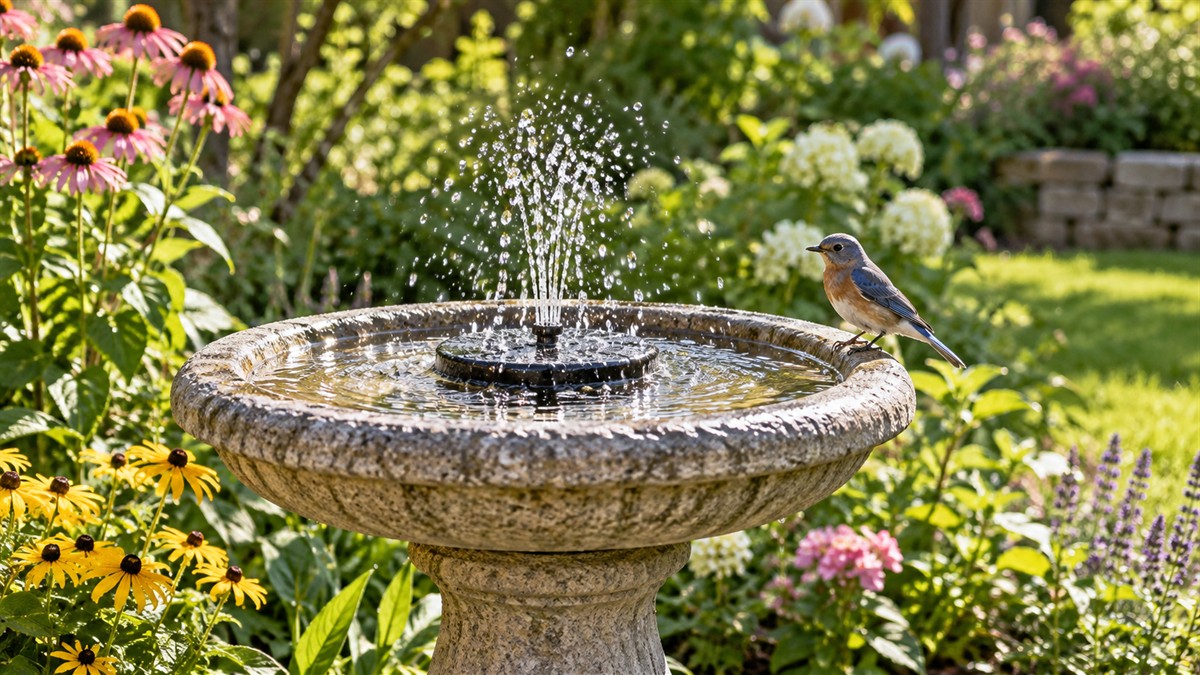
Best Solar Bird Bath Fountain
As an Amazon Associate we earn from qualifying purchases. Details
The best solar bird bath fountain is a floating pump with a solar panel, a stated size that fits your bath, and a spray you want to see from the window. This guide compares six solar fountain listings from six different makers, using only the power, size, weight and features that each listing states. A solar fountain moves the water without a cord, but the water still needs regular changes, so the extension guidance on water matters as much as the pump. Read the power rating and the size first, then choose the spray pattern.
Quick answer
- Start with the water, not the fountain. Penn State Extension says a bird bath should ideally be changed every day, and that daily summer changes stop mosquito larvae from hatching where West Nile virus is a concern.
- If you cannot change it daily, change it every two or three days. UF/IFAS Gardening Solutions and Penn State Extension both give that interval for mosquito control.
- Pick by size and power. Three of the six listings use a 3.5W panel, and the others range from 1.4W to 6.5W.
- Expect less flow on dull days. The Vumyhuby bullets say water flow varies with available sunlight.
What a solar bird bath fountain does
A solar bird bath fountain is a small pump that sits on the water surface, powered by a panel on top. The listings describe it as a floating pump with nozzles that change the spray shape. The pump keeps the water moving, which the Biling bullets describe as water that keeps flowing to attract birds and avoids stagnant water. Moving water is not the same as clean water, though. A fountain can keep a bath lively and still hold dirt, algae or mosquito larvae if the water sits unchanged.
That is why the water schedule comes first in this guide. Penn State Extension’s guidance on bird baths says the water should ideally be changed every day to prevent dirt and debris from building up. The same page says that daily summer changes also prevent mosquito larvae from hatching in the bath, which is a concern where West Nile virus may be present. A fountain does not replace that routine, and the listings do not claim that it does.
Sun and algae are linked in the extension advice too. Penn State Extension says a shady location keeps algae levels low and keeps the bath from overheating in summer, and it recommends the weekly scrub to remove algae. A solar pump wants sun, so the spot you choose is a trade-off, which the depth and placement section below covers.
What the six listings state
The table uses only the fields each listing shows. Where a listing gives a range or two values, both appear.
| Listing | Power and pump | Size and weight | Features named in the listing |
|---|---|---|---|
| Jbobbju, 3.5W float | 3.5W solar panel, no battery | 7.08 by 6.69 by 1.77 inches; 9.1 ounces | 6 removable nozzles, 4 fixing rods |
| Vumyhuby, 1.4W float | 1.4W integrated solar panel | Round body, 6.3 inch design | Six nozzles in the title |
| Paxverra, 3W pump | Upgraded 3W solar pump | 7 by 7 by 1.75 inches; 1 pound | 23 LEDs, 5 spray patterns |
| Biling, 6.5W pump | 6.5 watt rating, solar powered | 1.72 pounds | Circulation to keep water flowing |
| AISITIN, 3.5W pump | 3.5W solar panel | 9 by 8 by 2 inches; 12.7 ounces | 3 anti-drift brackets, 8 or more nozzles, filter |
| FYDGTPI, 3.5W float | 3.5W solar panel | 7.08 by 6.69 by 1.77 inches | 6 interchangeable nozzles, 4 fixed rods |
Three of the six list a 3.5W panel, which makes it the most common rating in this set. The Biling listing gives the highest rating at 6.5 watts, and the Vumyhuby listing gives the lowest at 1.4 watts. The Paxverra listing is the only one that names a light display, with 23 LEDs that cycle through colors. Two listings, Jbobbju and FYDGTPI, give exactly the same footprint of 7.08 by 6.69 by 1.77 inches, so a buyer can compare them on the spray features rather than the size.
Size matters because the float has to fit the basin. The AISITIN bullets say its brackets adjust to fit different bird bath sizes and can be hidden inside the fountain. The Vumyhuby listing gives the smallest figure in the table, a 6.3 inch round design. If your bath has a small basin, a compact body keeps the pump from crowding the birds that use it.
1. Solar Fountain for Bird Bath, 3.5W Floating Solar Water Fountain with 6 Spray Nozzles & 4 Fixing (3.5W float with six removable nozzles and four fixing rods)
Specs from the listing (checked ):
- Item Dimensions: 7.08″L x 6.69″W x 1.77″H
- Item Weight: 9.1 ounces
Pros
- The bullets say a built-in 3.5W panel drives the pump in direct sunlight with no battery
- The bullets say six removable nozzles change the spray shape without tools
- The listing gives a compact 7.08 by 6.69 by 1.77 inch size at 9.1 ounces
Cons
- The bullets describe audible flow sounds but give no sound level
- The listing does not state a flow rate or a spray height
Best for: A bird bath owner who wants several spray shapes from one float
Skip if: The bath sits in shade, since the bullets describe operation in direct sunlight
View on Amazon (affiliate link)
2. 1.4W Solar Fountain,Solar Bird Bath Fountains with 6 Nozzles Fixer (1.4W compact round float for a small basin)
Specs from the listing (checked ):
- Horsepower: 1.4 watts
- Material Type: Plastic
Pros
- The bullets say the 1.4W panel powers the pump in direct sunlight
- The listing describes a round body with a 6.3 inch design that rests on the water
- The listing gives a plastic material and a submersible product style
Cons
- The bullets say water flow varies with available sunlight, so cloudy days mean a weaker spray
- The listing does not give an item weight
Best for: A small bird bath or basin that needs a compact floating pump
Skip if: You want the same flow on overcast days
View on Amazon (affiliate link)
3. Solar Bird Bath Fountain with Fixed Rods & Color-Changing LEDs (3W pump with 23 color-changing LEDs and five spray patterns)
Specs from the listing (checked ):
- Item Highlight: Powerful Water Display, 5 Spray Patterns, Attracts Birds
- Item Weight: 1 pounds
Pros
- The bullets say the upgraded 3W pump gives a stronger, more consistent spray in direct sunlight
- The bullets describe 23 LEDs that cycle through colors and stay visible day and night
- The listing gives five spray patterns and a 7 by 7 by 1.75 inch footprint
Cons
- The bullets do not say how long the LEDs stay lit after sunset
- The listing gives a 1 pound weight but no pump flow figure
Best for: A bird bath or pond owner who wants color lights at dusk
Skip if: You want a fountain with no lights
View on Amazon (affiliate link)
4. Biling 6.5W Solar Fountain for Bird Bath Attracts Birds with Flowing Water (6.5W floating pump that keeps bird bath water moving)
Specs from the listing (checked ):
- Horsepower: 6.5 watts
- Item Weight: 1.72 pounds
Pros
- The bullets say the pump keeps water flowing so a bird bath does not sit stagnant
- The listing states a 6.5 watt rating and an ABS plastic body
- The bullets say no complicated wiring or power source is required
Cons
- The bullets give no flow rate for the 6.5 watt rating
- The safety wording in the bullets is a seller claim that the sources we opened do not address
Best for: A bird bath or small pond in a spot with no nearby outlet
Skip if: The bath sits in shade or gets little sun on most days
View on Amazon (affiliate link)
5. AISITIN 3.5W Solar Fountain Pump for Bird Bath Separated Design & 8 Nozzles (3.5W pump with three anti-drift brackets and a filter)
Specs from the listing (checked ):
- Item Dimensions: 9″L x 8″W x 2″H
- Item Weight: 12.7 ounces
Pros
- The bullets list three anti-drift brackets that adjust to fit different bird bath sizes
- The bullets say the fountain includes a filter to reduce clogging and is easy to clean
- The listing gives a 9 by 8 by 2 inch size and a 12.7 ounce weight
Cons
- The listing gives no flow rate to compare with the other pumps
- The bullets say the brackets can be hidden inside the fountain, which does not change the spray
Best for: An owner with a bird bath of uncertain size who wants adjustable brackets
Skip if: You need a stated flow rate before buying
View on Amazon (affiliate link)
6. 3.5W Solar Fountain with 6-in-1 Spray Nozzles & 4 Fixed Rods (3.5W float with six interchangeable nozzles and four fixed rods)
Specs from the listing (checked ):
- Horsepower: 3.5 watts
- Item Dimensions: 7.08″L x 6.69″W x 1.77″H
Pros
- The bullets say the 3.5W panel runs the fountain automatically in direct sunlight
- The listing says six interchangeable spray nozzles change the water display
- The title names four fixed rods for the fountain
Cons
- The listing gives no item weight for a buyer to compare
- The bullets describe it as floating but give no flow or height figure
Best for: A bird bath owner who wants six spray shapes and a fixed rod setup
Skip if: You need a weight figure before buying
View on Amazon (affiliate link)
Sun, flow and the cloudy-day problem
Every solar listing in this set depends on direct sunlight. The Jbobbju bullets say the built-in 3.5W panel drives the pump when exposed to direct sunlight, and the FYDGTPI bullets say the fountain runs automatically under direct sunlight with no power supply needed. The Vumyhuby bullets say flow varies with the sunlight available, which is the honest way to describe a solar pump. On a dull day, expect a weaker spray or a spray that starts and stops as the cloud passes.
Put the fountain where it gets sun for most of the day, and check the flow after a few cloudy days. A solar panel is not a battery, so a long dim spell will slow the pump. If your bath sits in deep shade, a solar fountain may disappoint, and you may prefer a pump with a cord and an outlet nearby. The Biling bullets say the product avoids the need for an electrical outlet, which is a benefit only if sunlight reaches the bath. Penn State Extension makes the same point about solar bath heaters, which it says work well under sunny conditions but not when it is cloudy or overcast.
If you are also choosing solar lighting for the same yard, our guide to solar powered LED outdoor lights covers the lighting side of a solar setup.
Changing the water and cleaning the bath
The routine is simple, and the extension sources agree on the basics. Penn State Extension recommends that you scrub the bath with a brush, mild soap and water every week to remove algae. Penn State Extension lists the weekly scrub as a separate step from the daily water change. UF/IFAS Gardening Solutions asks for the water in birdbaths to be changed every two or three days, and it says keeping them clean with fresh water discourages mosquitoes.
Penn State Extension’s mosquito checklist gives a clear rule for any birdbath that holds water. It says to stir the water or empty and change it frequently, every 2 to 3 days. The checklist does not mention fountains, so read the interval as the rule for any birdbath that holds water.
For a wider guide to cleaning backyard bird gear, see our guide to cleaning bird feeders with vinegar, which covers the same kind of routine for a different piece of equipment.
Depth, placement and the shade question
Depth matters more than most buyers expect. Penn State Extension says birds will only use a bird bath with shallow water, no more than two to three inches at the deepest. A fountain that throws water high in a deep basin does not make the bath more useful to birds, and the listings do not recommend deep water for their pumps. Measure the depth of your bath before you choose a pump, because a float sized for a shallow dish will not suit a deep one.
Placement puts the two sources in tension. The solar pumps in this group run in direct sunlight, while Penn State Extension says a shady location keeps a bath from overheating in the summer and keeps algae levels low. That is a real trade-off, not a contradiction in the sources. A spot that gets sun for part of the day and shade for the rest is a practical middle ground, because the panel needs light for a few hours and the water needs shade in the heat. Check where the sun falls in your yard on a clear day before you commit to a spot.
The same extension page advises placing a bird bath near shrubs or low branches so birds can escape quickly if a predator is nearby. It also says a ground-level bath should sit where birds can see a cat or other predator approaching. A fountain does not change that advice. Keep the bath close enough to cover for birds, and avoid placing it underneath bird feeders, since food and droppings will dirty the water.
Five checks before you order
Work through these in order, because each one can rule a listing out before you compare the rest.
First, depth. Penn State Extension says birds use a bath with no more than two to three inches of water at the deepest, so a deep basin needs a different plan from a shallow one. Measure the basin before you compare pumps.
Second, sun. Every listing in this set describes operation in direct sunlight, and the Penn State page says solar bath heaters work well under sunny conditions but not when it is cloudy or overcast. Count the hours of direct sun the bath gets on a typical day. The Vumyhuby bullets say flow varies with available sunlight, so a bath that is sunny only in the morning should expect a weaker spray.
Third, size. The table gives the footprint of each float. Jbobbju and FYDGTPI share the same 7.08 by 6.69 by 1.77 inch footprint, so size will not separate them. The AISITIN listing is the largest in the table at 9 by 8 by 2 inches, so it needs the widest basin.
Fourth, the flow figure. None of the six listings gives a flow rate, so a higher wattage does not promise a stronger spray. Read the spray claim in each set of bullets, and decide whether that claim is enough for you.
Fifth, cleaning access. The routine in the sections above asks for a weekly scrub and a water change every few days. A pump that lifts out cleanly makes that routine quicker. The bullets we read describe a clean-up feature only for the AISITIN listing, where the filter is described as easy to clean. Check how each float comes apart before you order.
Mistakes to avoid
- Ignoring the depth limit. Penn State Extension says birds use a bath with two to three inches of water at the deepest.
- Choosing a pump that does not come apart for cleaning. The weekly scrub is easier when the float lifts out.
- Relying on the fountain instead of changing the water. The Penn State and UF/IFAS sources both ask for regular changes, and the listings do not replace that routine.
- Buying a fountain that is too large for the basin. Check the listing size against the bath before you order.
- Expecting the same spray on a cloudy day. The Vumyhuby bullets say flow varies with available sunlight.
- Choosing by the light display alone. The Paxverra lights are a feature of that listing, not a change to its pump.
- Skipping the weekly scrub. Penn State Extension recommends brushing the bath to remove algae every week.
How we chose
We searched Amazon.com in Chrome on 21 October 2026 for the phrase solar bird bath fountain and read the first results. We kept listings whose titles or bullets describe a solar-powered fountain pump for a bird bath or a basin, and we set aside plain bird baths that only include a fountain as a feature. We then picked six listings from six different makers, one per maker, so the set does not repeat a brand. We read each listing’s title, its first bullets and its specification fields, and we limited our facts to what those fields state. We did not read every result on the search pages, so the set is a sample.
We did not include a bird bath sold with a solar fountain attached, because the buyer is looking for the pump itself. That choice is ours, not a rule from any source.
What we could not verify
- The flow rate of any pump. None of the six listings states gallons per hour, so we cannot rank the pumps on flow.
- How high any spray rises. The listings describe nozzle shapes but do not give a height.
- Whether the Jbobbju and FYDGTPI listings are the same product. Both give the same footprint of 7.08 by 6.69 by 1.77 inches, but they carry different brands and different power ratings, and we did not investigate further.
- The 6.5W rating on the Biling listing, which the fields state but do not explain in terms of flow.
- The durability and water-quality claims in the bullets, including the filter on the AISITIN listing. We did not check those claims against a source.
- How the fountains perform in winter, when the sources we opened do not cover solar pumps and water that freezes.
FAQ
Does a solar fountain keep mosquitoes out of a bird bath?
Not by itself. Penn State Extension says that changing the water every day in summer prevents mosquito larvae from hatching in a bird bath, and its mosquito checklist asks for the water to be emptied or changed every 2 to 3 days. A fountain keeps the water moving, but the change schedule is what the extension sources describe as the control.
How often should I change the water if the fountain is running?
Penn State Extension says ideally every day. UF/IFAS Gardening Solutions says every two or three days. If you cannot manage daily changes, the two-to-three-day interval is the one that both extension sources support, and it is the one to use as a minimum.
Will a solar fountain work on a cloudy day?
Less well. The Vumyhuby bullets say water flow varies with available sunlight, and the Jbobbju and FYDGTPI bullets say the pump runs under direct sunlight. Expect a weaker spray on dull days and no spray in deep shade.
Which power rating should I choose?
Start with the basin size and the spray you want. Three of the six listings use a 3.5W panel, the Paxverra listing gives 3W, the Biling listing gives 6.5 watts and the Vumyhuby listing gives 1.4 watts. None of the listings gives a flow rate, so the rating alone does not tell you how strong the spray will be.
Do I need to clean the bath when I add a fountain?
Yes. Penn State Extension recommends scrubbing the bath with a brush, mild soap and water every week to remove algae. The fountain does not remove the need for that scrub.
Does the AISITIN filter stop clogging?
The AISITIN bullets say the fountain has a filter to reduce clogging and is easy to clean. We did not verify that claim, and the sources we opened do not cover fountain filters, so treat it as a seller claim. Clean the filter on the same schedule as the bath, and check the spray pattern after each clean so you can see whether a nozzle is blocked.
Bottom line
Choose a solar float whose size fits your basin, expect less flow on cloudy days, and treat the water change as the main job. Change the water every day if you can, and at least every two or three days, because the extension sources tie that schedule to mosquito control and clean water.
Sources
- University of Florida IFAS Gardening Solutions, Mosquitoes: https://gardeningsolutions.ifas.ufl.edu/care/pests-and-diseases/pests/mosquitoes
- Penn State Extension, Water for Wildlife: Bird Baths and Backyard Ponds: https://extension.psu.edu/water-for-wildlife-bird-baths-and-backyard-ponds
- Penn State Extension, Controlling Mosquito Breeding Hotspots: https://extension.psu.edu/controlling-mosquito-breeding-hotspots-activity