How to Plan a Garden Layout
As an Amazon Associate we earn from qualifying purchases.
Knowing how to plan a garden layout before the first shovel goes in saves a lot of rework later. A good layout puts vegetables in enough sun, keeps them clear of tree roots, sets beds at a width you can reach across, and leaves each plant room to grow. The advice below follows university extension publications on those choices, from picking the site to sketching the plan on paper.
Every point comes from one of four extension pages we opened on October 22, 2026. Where a page gives a number, we give it with the source. Where the pages say nothing, the final sections say so.
Quick answer
- Choose a site with at least six hours of direct sun a day, well-drained soil, and no competing tree or shrub roots.
- Start smaller than you think. Iowa State suggests that many new gardeners do better with a plot as small as 4 by 8 feet.
- Use beds 3 to 4 feet wide with walkways between them, and check how big each plant gets before you set the row or plant spacing.
Start with sun, drainage and distance from trees
Sun comes first. Iowa State University Extension makes full sun the top siting priority and defines it as six or more hours of direct sunlight each day. University of Wisconsin-Madison Extension uses the same six-hour benchmark. It also asks gardeners to watch the site through the growing season, because trees or buildings can shade the area from late morning through the afternoon.
Oklahoma State University Extension describes the ideal site as one exposed to full or near full sunlight, with deep, well-drained, fertile soil. Its guide also covers shadier yards. It says light-shade areas that get only one to two hours of direct sun a day can still grow crops such as beans, beets and spinach, though the harvested parts are reduced in size and form. Fruiting vegetables may benefit from afternoon shade during hot periods in the summer.
Drainage matters as much as light. Iowa State warns that heavy clay or poorly drained soil can cause root rot and reduce the harvest. University of Wisconsin-Madison says water should not puddle or flow significantly through the garden during heavy rain, and it advises avoiding low spots where frost settles in late spring or early fall. Oklahoma State adds that if a site drains poorly, or the topsoil is thin or has too much sand or clay, raised beds or containers may be the better choice.
Keep the garden away from tree and shrub roots. Iowa State notes that these roots compete for nutrients and moisture and can block sunlight. University of Wisconsin-Madison goes further. It says not to place a garden within the root zone of black walnut trees, and it reminds readers that tree roots can grow three to five times the height of the tree away from the trunk. Before you dig, make sure there are no underground utility lines where you plan to garden.
Water and access decide how easy the garden is to keep. Iowa State recommends siting the garden near your home and a water source to simplify watering and harvesting. University of Wisconsin-Madison suggests a convenient water source, such as access to a hose, so you can water during dry spells. Iowa State also recommends a fairly level site, and says that on a slope you can build terraces or walls to limit erosion.
Clear the ground before you plan the beds. Iowa State says to remove grass and weeds by smothering, tilling or digging. University of Wisconsin-Madison advises removing existing vegetation, particularly grass, and covering whatever remains with cardboard, a tarp or black plastic to smother it. Its ideal timeline starts the year before planting.
Pick a size you can keep up with
Size is the next decision, and both Iowa State and University of Wisconsin-Madison push new gardeners toward a smaller plan than they might first imagine. Iowa State calls a 100-square-foot plot, about 10 by 10 feet, a manageable starting size. It then notes that many new gardeners benefit from starting even smaller, such as 4 by 8 feet.
University of Wisconsin-Madison ties the size to what you want to harvest. It names beans, beets, herbs, lettuce, onions, potatoes, radishes, squash and tomatoes as good first crops, and it suggests starting with just a few crops that are easy to grow and care for. Before you settle on the plan, look up how large each crop gets at maturity. Then leave enough room so the plants are not crowded.
Choose rows, blocks or raised beds
Once the site is picked, sketch the planting pattern. Iowa State describes three options. Traditional rows work when you place taller crops north of shorter ones to minimize shading. Wider rows of two or three plants reduce the space given to aisles. Block planting, sometimes called square-foot gardening, enhances pollination and shades more of the soil, which reduces weeds, and it needs no aisles at all.
Colorado State University Extension makes the case for block beds in more detail. It says block layouts, also called close-row or wide-row plantings, can increase yields fivefold compared with the traditional row-style layout. Its method is to replace long single rows with rectangular blocks, such as a block of carrots next to a block of beets, which removes walkways that would otherwise take up space. Its example is a 24-foot traditional row of carrots that fits into a bed three feet by two feet when it is planted in a block with equal spacing in both directions.
Block plantings have conditions. Colorado State says they need weed-free, fertile, well-drained soil that is rich in organic matter, along with frequent, light fertilizing and extra attention to watering because of the higher plant density. Overcrowding cuts air circulation, and that can raise the risk of disease, so the block has to be planted with some restraint.
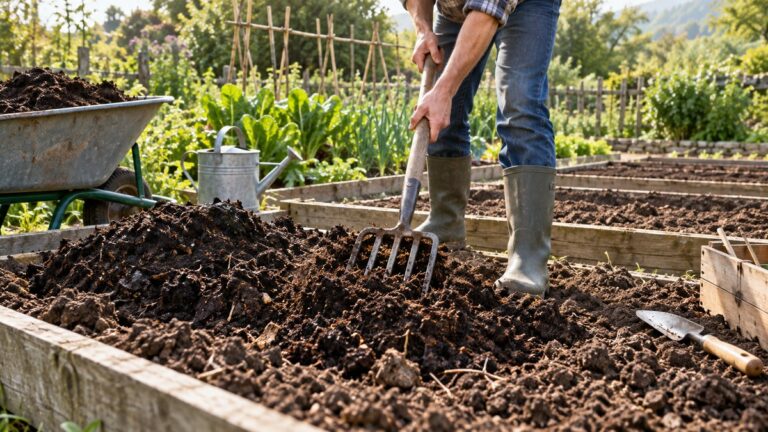
Raised beds fit either pattern. Iowa State recommends keeping beds three to four feet wide for easy access, and notes that raised beds warm up and dry out faster in spring, which allows earlier planting. Colorado State calls a four-foot bed ideal for most vegetables, since you can reach the entire bed from the side without stepping on the growing soil. It recommends walkways 18 to 24 inches wide. For the soil volume a bed needs, see our guide to how much soil a raised bed needs.
Colorado State sees no clear advantage in bed orientation, so it says to orient beds in whatever direction suits the landscape design.
Set spacing with the extension tables
Spacing is where many layouts go wrong, so start from a published table. Oklahoma State’s Garden Planning Guide lists row and in-row spacing for the traditional row method. The figures below come from its warm-season and cool-season tables. Smaller spacing suits container and square-foot gardens, and Oklahoma State says compact varieties such as tomato and eggplant are a good choice for those settings.
| Crop | Between rows | Within rows |
|---|---|---|
| Tomato | 4 ft | 2 to 3 ft |
| Pepper | 3 ft | 2 ft |
| Eggplant | 3 ft | 1 1/2 ft |
| Summer squash | 4 ft | 3 ft |
| Winter squash | 5 ft | 4 ft |
| Cabbage | 3 ft | 1 to 1 1/2 ft |
| Carrot | 1 1/2 ft | 3 in |
| Radish | 1 ft | 2 in |
| Spinach | 1 1/2 ft | 2 in |
Block plantings use much closer spacing. Colorado State’s suggested spacing for kitchen garden vegetables in a block bed includes carrots at 2 to 3 inches, and spinach and beets at 4 to 6 inches. It also says to start with the wider spacings and reduce them with experience and as the soil improves in fertility and tilth.
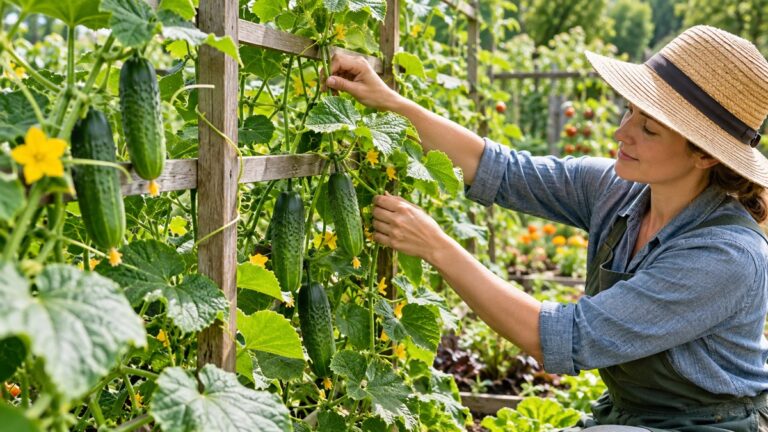
Vining crops need a plan too. Iowa State says cucumbers can ramble along the surface, or they can climb a trellis to save space and make harvest easier. Colorado State recommends trellising tomatoes, with at least 24 inches between plants down a single row, and cucumbers at about 9 by 12 inches along a trellis. University of Wisconsin-Madison makes the same point from another angle: tomato plants should not touch each other when fully mature.
Sequence the plantings
Intercropping lets you grow more in less space, and the timing matters. Iowa State gives examples such as radishes between tomatoes, leaf lettuce between broccoli, spinach between peppers and arugula between cabbage. The short-season crop is harvested before the larger crop shades it out. Taller plants can also cast useful shade. Iowa State lists lettuce beneath trellised pole beans and cilantro beneath tomatoes, and it says this helps cool-season crops during summer afternoons.
Succession planting spreads the harvest across weeks. Iowa State recommends sowing again every 7 to 10 days, and it lists radish, sweet corn, carrots, beets, lettuce and beans as crops that suit the method. A row replanted after each harvest keeps the bed productive, which is the same idea Colorado State describes when it says to replant after harvesting a row of radishes, beets, lettuce or spinach.
Plan rotation before you plant. Iowa State advises avoiding the same plant family in the same spot for three to four years. It adds that many soil-borne diseases persist for years, so rotating vegetables can lessen their severity and curb insect problems. If you want more ideas for pairing crops in a raised bed, our guide to companion planting in raised beds covers that next step.
Group crops by temperature needs as well. Iowa State says cool-season vegetables usually mature before summer heat affects their quality, while warm-season vegetables are not frost-tolerant.
Draw it to scale and keep records
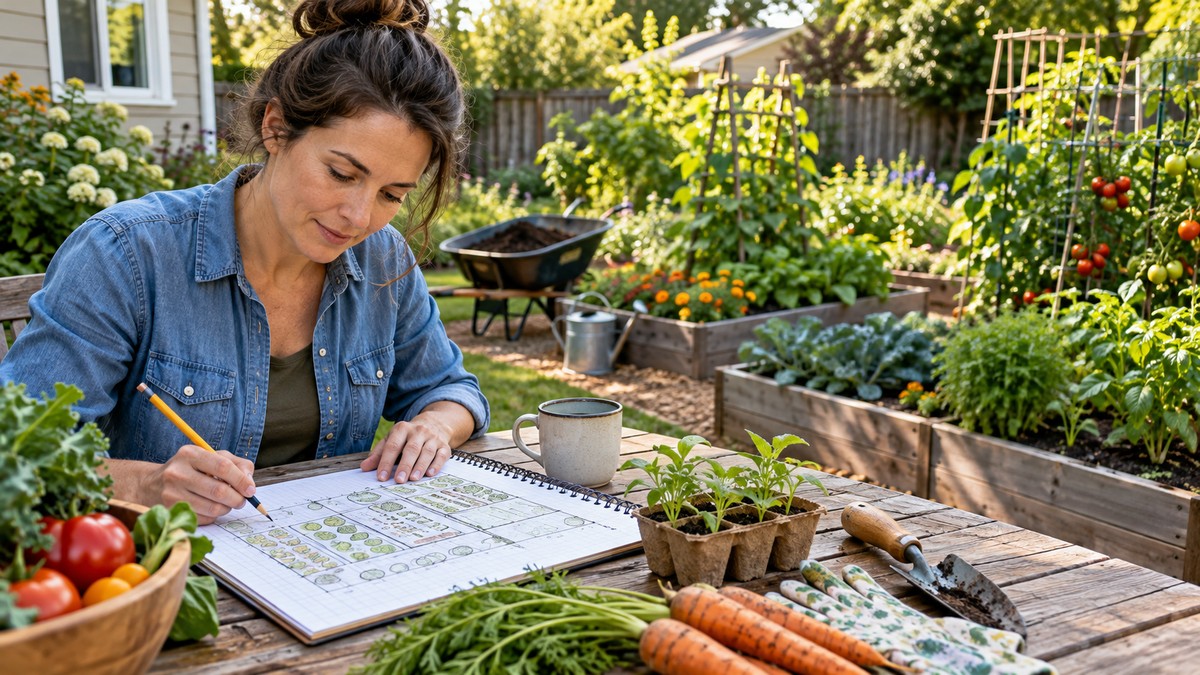
A paper plan is the cheapest check you can make. University of Wisconsin-Madison recommends drawing a map to scale on graph paper so you can see whether the plants fit. Iowa State adds that labeled maps or photos help you track which varieties went where, and it describes a garden journal as a record of what you planted. Its records list includes soil test results, planting maps, fertilizer applications and notes on varieties.
Layout mistakes to avoid
- Starting too large. Iowa State calls this a common mistake, because a larger garden demands more time and effort.
- Planting too closely. Oklahoma State says tight planting prevents walking or working in the garden, may favor disease, and interferes with normal plant development.
- Putting tall crops where they shade shorter ones. Iowa State recommends placing taller crops north of shorter crops.
- Ignoring drainage. Iowa State links poorly drained soil to root rot, and Oklahoma State offers raised beds or containers as the alternative.
- Scattering perennials. Oklahoma State recommends planting perennial vegetables such as asparagus and rhubarb at one side or end of the garden for efficient operation.
Containers when the yard has no good spot
If you cannot find an ideal garden spot, containers are a practical alternative, according to Iowa State. It recommends potting soil rather than garden or topsoil, and containers at least 10 inches across. It also suggests dwarf or compact vegetable varieties for the best results. Oklahoma State’s compact tomato and eggplant suggestion points the same way.
How we chose
We limited this guide to university and cooperative extension pages that cover site, size, layout and spacing. The four pages are Iowa State University Extension’s planning guide, University of Wisconsin-Madison Extension’s site selection fact sheet, Oklahoma State University Extension’s garden planning guide and Colorado State University Extension’s block layout guide. We opened each one on October 22, 2026. We left out pages that returned errors when we opened them.
We did not rank products, and this article names no product. The spacing figures come from the named table, and the yield figure comes from the Colorado State page as that page states it. When two sources give different advice, we show both.
What we could not verify
The sources we opened do not give one correct layout for every yard, and none of them predicts how a specific garden will perform. Our reading covers the four pages listed above. A layout still has to be checked against your own sun, slope and drainage.
What the sources do not say
- How far a garden should sit from a house, fence or driveway. The pages say to keep away from tree and shrub roots, but they give no fixed distance.
- A yield for a specific yard. The Colorado State yield figure is that publication’s own statement about block layouts, and we did not check it against another source.
- Block spacing for every crop. The Oklahoma State table covers the traditional row method, and the block figures on the Colorado State page cover only some vegetables.
- Space requirements from the University of Wisconsin-Madison bulletin it names for further detail. We did not open that bulletin, so no figure from it appears here.
- Layouts for hot or dry climates in detail. Check local extension guidance for your region before you finalize spacing.
Frequently asked questions
How big should a first vegetable garden be?
Iowa State gives around 100 square feet as a manageable starting size, and it says many new gardeners do better starting even smaller, such as 4 by 8 feet. Starting small keeps a new gardener from becoming overwhelmed, and it leaves room to expand in a later season.
How much sun does a vegetable garden need?
Plan for at least six hours of direct sunlight a day, as Iowa State and University of Wisconsin-Madison both advise. Some vegetables tolerate partial sun, but Iowa State says maximizing sunlight is key.
Can a garden layout work without raised beds?
Yes. Oklahoma State says raised beds or containers are the better alternative when a site drains poorly or its topsoil is thin, sandy or heavy with clay.
How far apart should tomato plants be spaced?
Oklahoma State’s table lists 4 feet between rows and 2 to 3 feet within rows for tomatoes under the traditional row method. Colorado State says trellised tomatoes need at least 24 inches between plants down a single row, and University of Wisconsin-Madison says tomato plants should not touch at full size.
Should crops with similar care be grouped together?
Yes. Oklahoma State advises grouping vegetables that have similar care needs, so the work is easier. Iowa State also says to avoid the same plant family in the same spot for three to four years, which means a crop group should not return to the same spot for several years.
Sources
- https://yardandgarden.extension.iastate.edu/how-to/planning-your-vegetable-garden (opened 2026-10-22)
- https://hort.extension.wisc.edu/files/2023/12/Beginning_Vegetable_Gardening_Basics_Site_Selection_and_Soil_Preparation.pdf (opened 2026-10-22)
- https://extension.okstate.edu/fact-sheets/oklahoma-garden-planning-guide (opened 2026-10-22)
- https://extension.colostate.edu/resource/block-style-layout-in-raised-bed-vegetable-gardens/ (opened 2026-10-22)