How to Check Soil Moisture Before You Water
As an Amazon Associate we earn from qualifying purchases.
Knowing how to check soil moisture helps you avoid both thirsty plants and soggy roots. Extension pages from Oregon State, New Mexico State, the University of Nevada and the University of Nebraska describe checking the soil below the surface, then watering deeply enough to reach where most roots grow. The steps below use only what those pages say, so they fit raised beds, in-ground rows and containers alike.
Quick answer
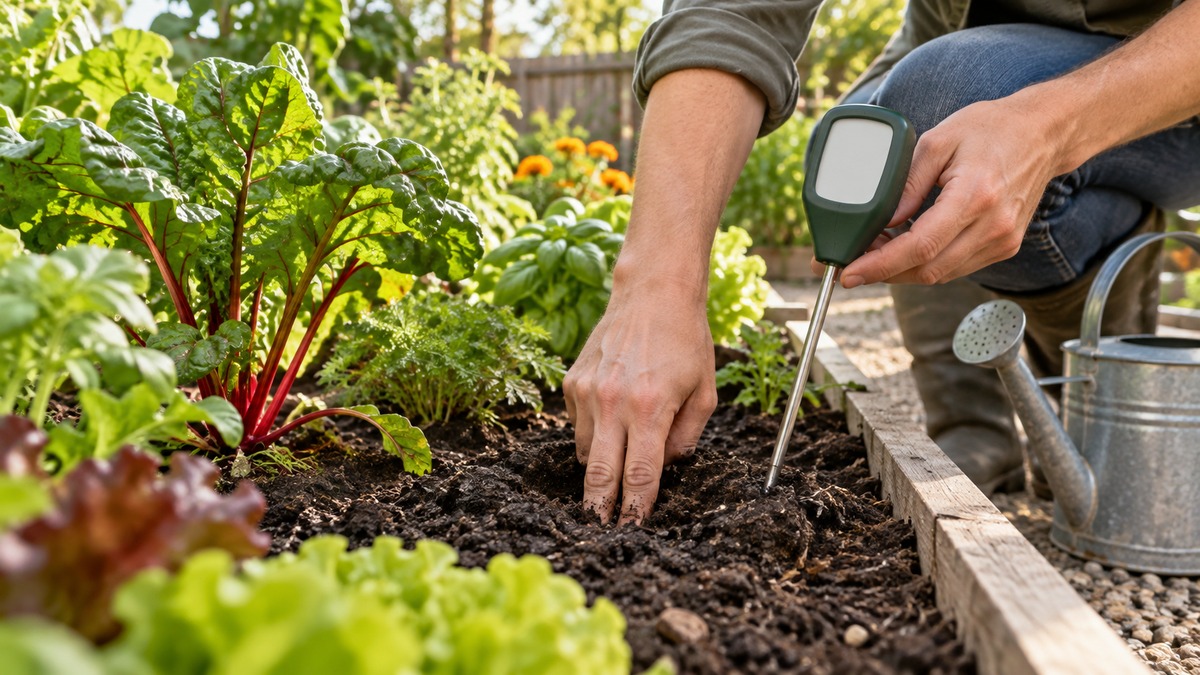
- Push a finger about 2 inches into the soil near the plant. If the soil feels dry all the way to your fingertip, it is time to water.
- To check deeper, push a long-bladed screwdriver or metal rod into the ground. In moist soil it should move easily.
- Water slowly and deeply, then check again. Most vegetable roots reach 6 to 12 inches down, according to the University of Nevada.
- Water early in the morning, when the air is cooler and there is usually less wind.
Start with the depth of the roots
Watering works best when you know how far down the roots go. Nebraska Extension states the goal in one line: “The goal is to water to the bottom of the roots.” Its guide adds that “applying water deeply promotes a more extensive root system and makes plants healthier overall.” It also gives rough ranges for different plants: “Generally, 6 inches for turf, 8-12 inches for ornamentals and vegetables, and 12-24 inches for trees and shrubs.”
The University of Nevada gives a similar picture for vegetables. It says “Most vegetable plant roots go down 6 to 12 inches into the soil.” It also notes that long-season plants such as tomato, corn, squash and melon can go down as deep as 24 inches or more. The two extension pages differ slightly on vegetable depth, with 8 to 12 inches in Nebraska and 6 to 12 inches in Nevada. Neither page says which end of its range fits a particular crop, so the answer depends on what you grow.
Check the top two inches with your finger
Oregon State University Extension gives the simplest check, and it starts with a plain instruction: “Check your soil moisture to know when to water.” The method is to push a finger in near the stem. In the guide’s words, “You can do this by pushing your finger about 2 inches deep into the soil near a plant stem.” If the soil feels dry all the way to your fingertip, it is time to water. If the soil feels moist at your fingertip, you can wait. The guide adds that “Different plants will need different amounts of water, so check soil moisture around your garden on most days.”
New Mexico State University’s guide describes a related hand check. It is written for pecan orchards, so its depth figures do not carry over to a flower bed. The method itself is still useful to know: “Take soil samples from the auger and feel their moisture content by gently pressing them in your hand.” The soil comes up with an auger, and the moisture is judged by pressing the sample in your palm.
Probe deeper with a screwdriver or metal rod
A finger reaches only the top couple of inches. For deeper soil, Nebraska Extension suggests a probe: “Use a long-bladed screwdriver or other metal probe and push it into the ground.” The same guide says the probe “should move easily through moist soil and may even come out wet or muddy when moisture is very high.” When the probe is hard to push in, the guide reads that as low moisture, and irrigation may be needed.
The University of Nevada describes the same idea with a rod used after watering. It says “You can check the depth of your irrigation by inserting a metal rod or screw driver into the ground after watering.” The point of that check is to see how far the water went. Its guidance is to “Provide enough water to wet the soil to the depth at which most of the roots are found.”
Check again after you water
A check before watering tells you whether to water. A second check tells you whether the water went deep enough. Oregon State says “Check soil moisture again after watering.” It sets a threshold for the second check: “If you don’t feel moisture at least 2 inches deep, more water is needed.” The guide also recommends “Give your plants a slow, deep soaking to encourage deep root growth.” For containers it advises: “Water containers slowly until you notice water dripping from the bottom drain holes.”
New Mexico State’s orchard method waits longer before the second check. It advises “About 24 hours after irrigation, push the rod down until it is impeded by dry soil.” That timing is written for a deep orchard root zone. The sources do not give a wait time for garden beds, so the after-watering finger check from Oregon State is the one to rely on there.
Soil type and containers change the schedule
Soil type sets how fast water soaks in and how long it stays. Nebraska puts it plainly: “Clay soil holds more water and stays moist longer, while sandy soil holds less water and will require more frequent irrigation.” Oregon State adds that “Clay soil absorbs water slowly but holds moisture well.” It also says “Raised bed soil and soil with added compost absorbs water well and also drains well.”
Containers need closer attention. Oregon State says “Sandy soil and container or potting mix drains well and dries fast.” It also notes “You may need to water twice a day in the summer,” and advises “On hot summer days, check containers twice a day.” Mulch changes the picture as well: “Soil covered by straw or other mulch will hold water better.” If you want a tool to read the soil for you, a soil moisture meter for garden beds is one option to compare, though the sources above do not say how accurate any meter is.
Mulched and bare beds
Mulch and bare soil can give different readings at the surface. The Oregon State guide says mulch holds water better, and that a mulched bed may be watered less often. The sources do not say how much mulch changes the schedule, so use the finger check rather than a fixed rule.
Read the plant as well as the soil
The soil check is not the only clue. Oregon State says “If the soil is always wet, you may be watering too much.” It warns that “Too much water causes root damage and disease.” On the other side, “If the soil is dry and pulls away from the plant, or the leaves are wilted and dry, you may be watering too little.” The same guide adds that “Too little water can cause a plant to be small and make less food.”
Nebraska’s guide on turf lists visible signs in lawns: a bluish cast on the leaf blades, footprints that stay on the grass after you walk through it, and rolled or folded leaf blades. Those signs describe lawns, so treat them as a rough cue for other plants and confirm with your finger or probe before you water.
Choose the time of day to water
Timing affects how much water reaches the roots and how wet the leaves stay. Nebraska advises “Water early in the morning, 4-8 AM.” and “Avoid watering on windy days.” Oregon State says “The best time to water is in the morning, when the air is cooler and there is usually less wind.” It also warns “Avoid getting water on the leaves, especially in the evening, because wet leaves encourage plant diseases like fungus.”
Oregon State does not let timing delay a needed watering. It says “While watering early in the day is best, it is important to water plants whenever they need it.” The practical reading is simple: when the check says dry, water, even if it is not morning.
A routine you can repeat
Put the checks in order, and keep each one short. The list below follows the sources above, with no extra rule added.
- Check the top 2 inches with a finger on most days, and check containers twice a day in hot weather.
- If the soil is dry, water slowly until the root zone is wet. In containers, water until you see drainage from the holes.
- Probe with a screwdriver or rod to see how deep the water went, then check the top 2 inches again.
- Water early in the morning, and keep water off the leaves in the evening.
If you run a hose timer for garden watering, set its run time from what the checks above show. The timer does not replace the checks, because the soil decides when a bed needs water.
Common mistakes
- Watering a little every day. Nebraska says most gardeners water too frequently and apply too little water at each irrigation. The University of Nevada adds that watering too frequently limits root access to oxygen.
- Stopping at a damp top layer. Oregon State’s after-watering check asks for moisture at least 2 inches deep, so a damp surface alone does not finish the job.
- Wetting leaves in the evening. Oregon State ties wet leaves in the evening to plant diseases such as fungus.
- Using one rule for every soil. Clay, sandy, raised-bed and container soils drain at different rates, as the sections above explain.
Slow watering also matters. Oregon State’s drip and soaker hose description notes that these hoses water near the roots, and a soaker hose for deep watering is worth comparing if you water by hand often. The guide also says you will need to experiment to learn how long to run the water for your plants.
How we chose
We chose pages that describe checking soil moisture by hand or with a probe, that come from university or state extension services, and that we could open and read on 2026-10-21. The four pages used are New Mexico State University’s Guide H-637, a University of Nebraska Extension factsheet, a University of Nevada Cooperative Extension publication and an Oregon State University Extension page. We quote a page only where its text supports the claim, and we paraphrase everything else. We left out pages that returned an access error or a bot-check page when we opened them. The New Mexico guide is about pecan orchards, so its figures are marked as orchard figures. This article is an organizing guide, and it recommends no product.
What we could not verify
This section lists what the sources do not establish. Read it before you change a watering routine based on the advice above.
What the sources do not say
- The sources do not give a number of gallons or inches for a garden bed of any size.
- They do not give a watering frequency for winter, or a schedule for a specific crop beyond the depth ranges above.
- The 3-foot figure in the New Mexico guide applies to pecan orchards, and none of the pages gives a garden equivalent.
- They do not state how accurate a moisture meter is, so this article does not rank meters.
- They do not say how long water takes to reach the root zone in a raised bed.
Frequently asked questions
How deep should I check soil before I water?
Start with the top 2 inches, as Oregon State describes. Probe deeper when you want to know whether the water reached the roots. Nebraska Extension treats the bottom of the roots as the target, and puts the depth for vegetables at 8 to 12 inches.
Can a screwdriver really show soil moisture?
Nebraska Extension recommends it. Push a long-bladed screwdriver or metal probe into the ground and notice how easily it goes in. Easy movement points to moist soil, and a hard push points to dry soil that may need water.
How often should I check my garden?
Oregon State advises checking around the garden on most days, and checking containers twice a day on hot summer days. The sources do not give one schedule that fits every bed.
Is evening watering a good idea?
Oregon State recommends morning watering, when the air is cooler and there is usually less wind. It also warns that wet leaves in the evening can invite plant disease. If plants are wilting, the same guide says to water as soon as you can.
What if the top is damp but the soil is dry deeper down?
That is the case a probe is for. Nebraska Extension says the probe should move easily through moist soil and that a hard push means low moisture. New Mexico State describes pressing soil samples from an auger, but the sources do not give a rule for a damp surface over dry subsoil.
Sources
- https://pubs.nmsu.edu/_h/H637/index.html (opened 2026-10-21)
- https://hles.unl.edu/sites/unl.edu.ianr.extension.community-environment/files/media/file/WD.Water_.Use_.factsheet.24.pdf (opened 2026-10-21)
- https://extension.unr.edu/publication.aspx?PubID=3526 (opened 2026-10-21)
- https://extension.oregonstate.edu/imported-publication/watering-basics (opened 2026-10-21)