How to Use a Soaker Hose
As an Amazon Associate we earn from qualifying purchases.
How to use a soaker hose comes down to a few rules that the sources state: keep the hose level, run it at low pressure for a long time, check the soil with a trowel, and cover the hose with mulch. None of the sources sets one watering schedule for every bed, because soil, sun and weather change how fast a bed dries. This guide sets out those rules, works one run-time calculation with the Iowa State formula, and marks the points the sources leave open.
Quick answer
- Run the hose at low pressure for a long time. Soaker flow is low and measured in gallons per hour, so short runs deliver little water.
- Keep the hose level, and no longer than 100 feet from the water source.
- Check moisture with a trowel. The Ask Extension answer aims for moisture to reach about 8 inches deep on average.
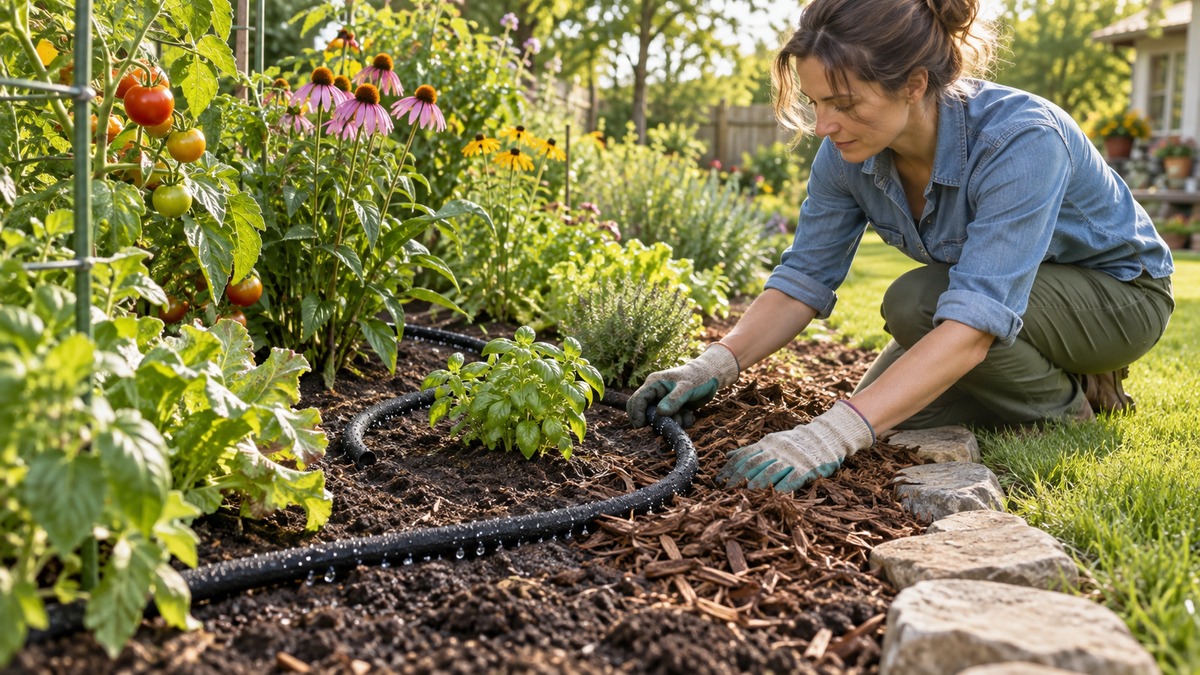
- Dig the hose a couple of inches into the bed, then cover it with mulch.
Set the hose up before you plant
The Washington State University Extension Master Gardener article puts setup first: “Hoses of various types, sprinklers, drip irrigation systems and soaker systems should be examined in the spring and set up before planting.” Doing this before the bed is full of plants leaves room to change the layout.
Length is the first check. The same article says that “The recommended length of a soaker hose is 100 feet or less from water source to the end.” If the hose runs out of pressure before it fills, the article’s advice is simple: “If your water pressure isn’t sufficient to fill the hose before it runs out, try a shorter hose.” Filling takes time as well, and “It will take some time to fill the hose and for water to start seeping out.”
Layout matters as much as length. The Ask Extension answer says a soaker hose needs a level surface. In its example, a hose ran uphill out of a raised bed and over a potted pepper, so water ran off the slope and little water went into the pot.
Plant the bed first
The Ask Extension answer gives the planting order that the hose should follow. “Begin by planting moist rootballs into moist root media (soil or potting mix).” Before planting, the answer says: “To thoroughly moisten the rootballs, submerge them in water until bubbles top rising.” The growing medium in the bed should be moist too, since the answer notes that “The growing media in the planting in the raised bed (also garden plot or container) should also be moist.”
The first weeks need extra care. “The first week or so, supplement the soaker irrigation by watering the rootballs individually.” After that, the hose takes over the job, and the answer’s guidance on run time applies.
Run it at low pressure for a long time
Pressure sets the character of the output. The Ask Extension answer gives a simple check when the water is first turned on: “the hose should sweat, not spray.” A hose that sprays gives uneven output along its length, and in the answer’s words, “Some plants will be too dry, others too wet.”
The WSU article uses the same idea: “The preferred method of watering with a soaker hose is to leave it at low water pressure for an extended time.” That is the reason run times are long. The Ask Extension answer explains the mechanics: “Thus, a soaker hose must be run a relatively long time as compared to sprinklers.” Its goal is “to moisten the entire root system.”
Run times change as the plants grow. The answer advises that, as roots spread into the surrounding soil, you “gradually increase run time for the soakers and, at the same time, increase the interval between consecutive irrigations.” That is a change over the season, not a single fixed schedule.
Measure the flow and work out the run time
The Iowa State University Extension page gives the method, and it starts with the package: “For a soaker hose, the flow rate is provided on the package in gallons per hour (GPH).” To convert it, “To get gallons per minute, divide the GPH by 60.” Then, “Take the number of gallons needed divided by the gallons per minute to get the number of minutes needed to water.”
The water a bed needs comes from the page’s conversion: “It takes 0.623 gallons of water to supply 1 inch of water to 1 square foot of garden space.” The page also warns that “While the flow rate will vary with water pressure, this calculation is typically close enough for home garden watering.”
The table works through a 10 by 3 foot bed, which is 30 square feet. Multiplying by 0.623 gives 18.7 gallons for one inch of water and 37.4 gallons for two. The flow rates in the first column are assumed for illustration only. Read the real figure from your own package, because none of the sources gives a rate for any hose.
| Assumed flow (GPH) | Gallons per minute (GPH ÷ 60) | Minutes for 1 inch (18.7 gallons ÷ GPM) | Minutes for 2 inches (37.4 gallons ÷ GPM) |
|---|---|---|---|
| 20 | 0.333 | 56 | 112 |
| 30 | 0.500 | 37 | 75 |
| 45 | 0.750 | 25 | 50 |
Every flow rate in the table needs a long run, which fits the Ask Extension answer’s point that soaker hoses must run a long time. The table is our own calculation, and it does not show what your hose will deliver. A timer can hold a run length once you have one. For that step, see our guide to hose timers for the garden.
Check the soil with a trowel, not the clock
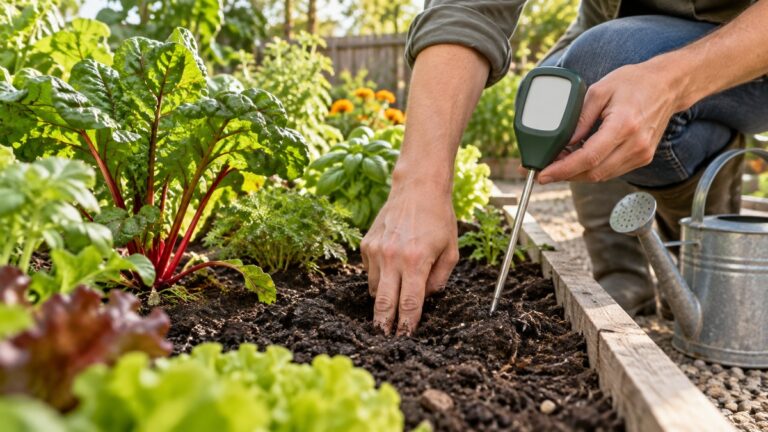
The Ask Extension answer gives the check to use: “To determine when to water again, check the moisture content by probing with a trowel.” It also sets a depth target: “On average, you want to moisten to an 8-inch depth.” The WSU article gives the same method for the hose itself: “Remember to recheck during the summer that the hose is watering the whole length and also the depth of the water transfer by using a trowel and digging beside the hose.”
Soil dries at different rates. The Ask Extension answer lists the factors: “The important factors in how rapidly the soil will dry include the characteristics of the soil mix in the beds; sun exposure; and the prevailing weather”. Its own example is a raised bed run for 1.5 to 2 hours every 5 days once plants are established, with a partial 45-minute run on particularly hot days. The answer adds: “But your timing is likely to be different.” For a meter in place of a trowel, see our soil moisture meter guide.
Lay the hose, bury it and mulch it
Once the flow looks right, the WSU article says to dig the hose a couple of inches into the bed. The hose is then covered with the mulch around the plants, and the article explains why: “This keeps the water in the ground without shooting little streams up on the foliage.” The point is to keep water off the foliage.
The article lists compost, straw, bark and lawn clippings as mulch options. It says the clippings should be dried out first, and then used to lightly cover the hose.
Layout can change as plants grow. The WSU author describes moving hoses along with the plants, and the article notes that “Depending on the garden beds you have, you may need multiple soaker hoses.” Its comparison with drip systems is fair: “Drip irrigation systems are wonderful for conserving water and allowing differing amounts of water to water different plants, but they are more expensive and after set-up are a bit less flexible than soaker hoses.”
Fix common flow problems
The sources give a short list of causes and fixes. The table below pairs each problem with what the cited page says.
| Problem | Cause the source names | Fix the source gives |
|---|---|---|
| Water does not reach the end of the hose | Hose length or water pressure | Try a shorter hose (WSU article) |
| Some plants too dry, others too wet | Output that is uneven along the hose (Ask Extension answer) | Lay the hose on a level surface, and check that it sweats rather than sprays |
| Old sections stop letting water out | Holes clogged by impurities such as limestone or iron (WSU article) | Soak the coiled hose in vinegar water, a cup of vinegar to 5 gallons of water |
| Plant at the end of the line gets too little | A layout that sends the hose uphill and over a pot (Ask Extension example) | Keep the hose level so the water stays in the pot or bed |
The WSU article explains the first cause in its own words: “Some issues to look for if water isn’t flowing are the length of the hose and your water pressure.” For the clogged sections, it suggests “try soaking the coiled hose in vinegar water (cup of vinegar to 5 gallons of water) to loosen impurities in your water that may have clogged the holes (limestone or iron).”
Water the containers and check the connections
Containers are a special case. The UNL Water article says that “Once a planter has been installed and watered initially, consider soaker hoses and drip irrigation systems.” It then adds that these “are fairly commonplace in tree and shrub watering, but not in container gardens.” The same article sets the goal for any planting: “Watering to the bottom of the roots” while keeping “the roots moist, not soggy or dry.” Its water-efficiency steps also include “checking for loose hose connections.”
Soaker hoses are for beds, not everything in the yard. The WSU article says that “Soaker hoses are not adequate for watering large trees and shrubs or turf grass.” It adds that “They need larger volumes of water.”
Store the hose at the end of the season
The WSU article says that soaker hoses “stay where they’re put throughout the growing season and into the fall.” When the season is over, the hoses come out of the soil. The article’s cleaning step is simple: “Run water through them to clean off the particles on the outside of the hose and then pour the water out of their length and coil them and hang them inside to dry.”
For winter, the article gives the storage details: “Make sure there’s no water left in their length, coil them up in a roll 24 to 36 inches minimum and hang them inside for the winter.” It also warns: “You don’t want to store any hose with a kink in it at the point you hang it.”
How we chose
We opened four extension and university pages on 2026-10-22: a Washington State University Extension Master Gardener article on soaker hose irrigation, an Ask Extension answer on soaker hose layout and run time, an Iowa State University Extension page on how long to irrigate, and a UNL Water article on container gardens. We kept only extension and university pages. We used the statements these pages make in plain words, checked each quoted sentence against the text of its page, and used the Iowa State formula for every calculation. Retail listings, blogs and forum posts were left out, along with pages that returned 403 or 404.
What we could not verify
The four pages cover soaker hoses in beds in general, and they cover containers only briefly. They give no flow rate for any product, and they set no watering schedule that fits every bed.
What the sources do not say
- The flow rate of any particular soaker hose. The Iowa State page says to read it from the package, and the table uses assumed rates.
- A watering schedule for container plants. The only run time in the sources is one example for raised beds.
- How long a soaker hose lasts. None of the four pages gives a service life.
- How many feet of hose a single pot needs. The UNL Water article discusses containers but names no run length.
Frequently asked questions
How long should you run a soaker hose?
Run it long enough to reach the root zone, then check. The sources do not give one time for every bed. The Iowa State method turns the package flow rate into minutes, and the Ask Extension answer recommends probing with a trowel to see how deep the water went, aiming for about 8 inches on average.
How do you know a soaker hose is working?
Look for even sweating along the length rather than spray, which the Ask Extension answer treats as the right result. Then probe beside the hose with a trowel. The WSU article suggests checking that the hose waters the whole length and the depth of the transfer.
Can a soaker hose run 100 feet or more?
The WSU article gives 100 feet or less as the recommended length from the water source to the end of the hose. If water does not fill the hose before it runs out, the article says to try a shorter hose.
Do soaker hoses work for container plants?
The UNL Water article says soaker hoses are fairly commonplace in tree and shrub watering but not in container gardens. It suggests considering them once a planter is installed and watered initially. The sources do not give a container run time.
Should a soaker hose stay in the bed all year?
Not according to the WSU article, which says the hoses stay in place through the growing season and into the fall. At the end of the season, the hoses come out of the soil, get cleaned and dried, and are stored so that no water is left in their length before winter.
Sources
- https://wpcdn.web.wsu.edu/extension/uploads/sites/74/2016/07/MG.Article.pdf (opened 2026-10-22)
- https://ask.extension.org/kb/faq.php?id=643520 (opened 2026-10-22)
- https://yardandgarden.extension.iastate.edu/faq/how-long-does-it-take-provide-right-amount-water-when-i-irrigate (opened 2026-10-22)
- https://water.unl.edu/article/lawns-gardens-landscapes/water-efficiency-container-gardens (opened 2026-10-22)