How to Plant a Perennial Flower Bed
As an Amazon Associate we earn from qualifying purchases.
How to plant a perennial flower bed starts before the first plant goes in. Pick a site with the light and drainage the plants need, prepare the soil, and space each plant by its mature size. The four university extension pages we read follow roughly that order.
Perennials return year after year, so a careful first season pays off. The Penn State starting article expects a new bed to take about three years to fill in when you begin with one or two plants of each kind.
Quick answer
- Choose a site that gets the light the plants need. Colorado State says many perennials need 8 hours or more of sun on the longest days of summer.
- Clear the turf, work organic matter 12 inches deep into the soil, and complete a soil test before you plant.
- Group plants with similar water needs, and space each one by its mature height or width.
- Set each plant at its container depth, mulch 2 to 3 inches, and water often while the roots settle in.
Pick the site and the shape
Check sun, wind and drainage
Start by looking at the site. The Penn State article says to consider “the amount of sun, shade, and wind at the site,” along with how dry or damp the soil is and how loose or compact the soil is. Penn State also notes that perennial beds seed and spread, so nearby plants and the access you need should guide the design.
Colorado State says to locate a bed so it can be reached from at least two sides, and it notes how much sun many perennials need. Shade-loving perennials such as ferns, bleeding heart and hostas suit the north side of a home or filtered shade. If a bed will sit against a fence, wall or hedge, use that backdrop for the taller plants and leave room behind it for upkeep.
Plan the shape on paper
Colorado State suggests measuring the site and sketching it to scale, with 1 inch equal to 4 feet on graph paper. Mark existing structures, walks, trees and shrubs, and think about how big those plants will grow. To see the outline before you dig, the same guide suggests laying a garden hose around the proposed area.
One Penn State example leaves four feet between the bed edges and a hedge, with 4-foot paths between beds, so the author could reach the hedge and the beds for trimming and upkeep. That figure comes from one author’s plan, not from a rule, but the reasoning carries over: plan the access before the plants.
Prepare the soil
Clear the turf
Remove the grass or existing plants where the bed will go. The Penn State article says that “A thorough job of clearing turfgrass will save you hours of weeding in the future.” It describes digging, plowing or rototilling, with grass clumps raked out, as an effective method. Solarizing is another option: cover the grassy area with plastic or newspaper, add a good layer of mulch, and wait several weeks until the grass dies. If you are starting from lawn, our guide to creating a flower bed from scratch covers clearing, soil and drainage.
Add organic matter and test the soil
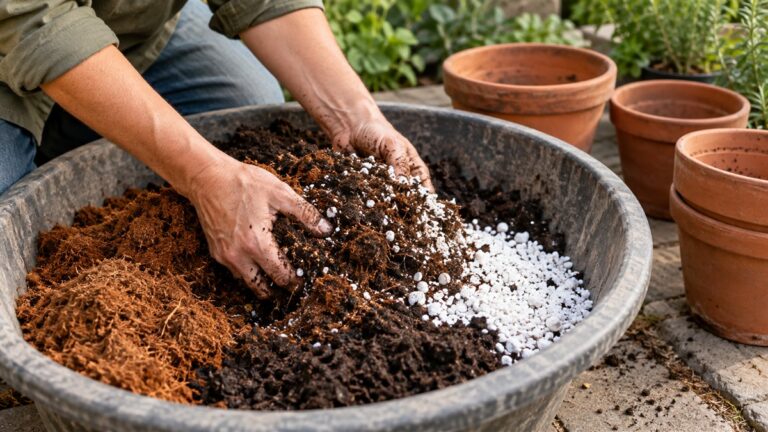
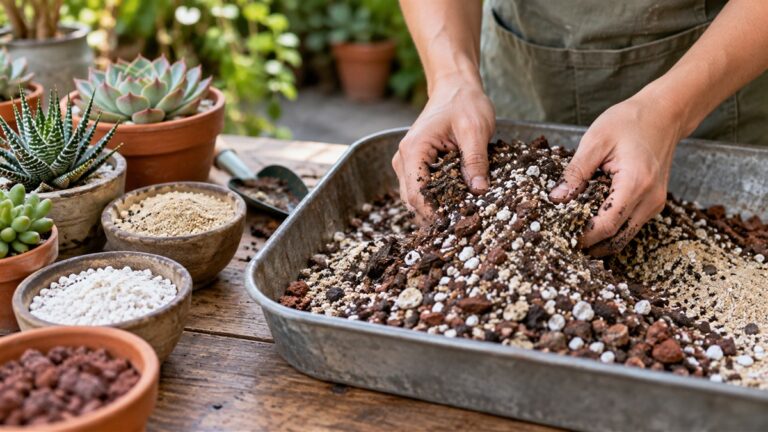
Colorado State recommends working organic matter into the bed 12 inches deep. It names compost, sphagnum peat and well-aged manure as options, and gives a general rate: “A general recommendation is 3 cubic yards of organic matter for every 1,000 square feet.” The same guide notes that this is the equivalent of a 1-inch layer over 1,000 square feet.
The North Carolina page for Forsyth County gives the simplest rule: “Complete a soil test and use the recommendations when you are preparing the garden.” Penn State’s care guide describes most perennials as growing best in soil that is well drained, with good fertility and a pH of 6.0 to 7.0. Organic matter improves fertility, texture and water-holding capacity, so the soil test and the amendment work together.
Install edging
Colorado State advises installing edging, so turf grass does not creep into the bed. For the edging itself, our flower bed edging guide compares the material, height and stake count of landscape edging.
Choose and arrange the plants
Group by water needs and bloom time
Colorado State says to group plants by their needs and to plan irrigation to match: “Place plants with like water needs together in the garden and plan to irrigate accordingly.” Its example puts drought-tolerant plants at the top of a slope and moisture-loving plants in a low spot where runoff collects. Penn State says to vary plant height, density and bloom time for the best impact, since flowers that bloom at different times keep color and texture going through the season.
Mix in groups and heights
Colorado State recommends placing plants of the same variety in groups of three, five or seven, and repeating each group two or three times so the bed has continuity. Taller plants go at the back, or in the middle if the bed is seen from several sides, and shorter plants go toward the front. Penn State notes that a perennial bed is most impactful when flowers are planted in mass groupings, which takes more plants at the start.
Match plants to your zone
Penn State advises choosing plants that are hardy in your zone, since plants that cannot survive leave gaps that someone has to replace. It also recommends native plants for the region over non-native ones, because some non-native plants can become invasive. The Forsyth County page places its county in zones 7b and 8a and points to the USDA Hardiness Zones Map for finding your own zone.
Plant the bed
Set each plant at the right depth
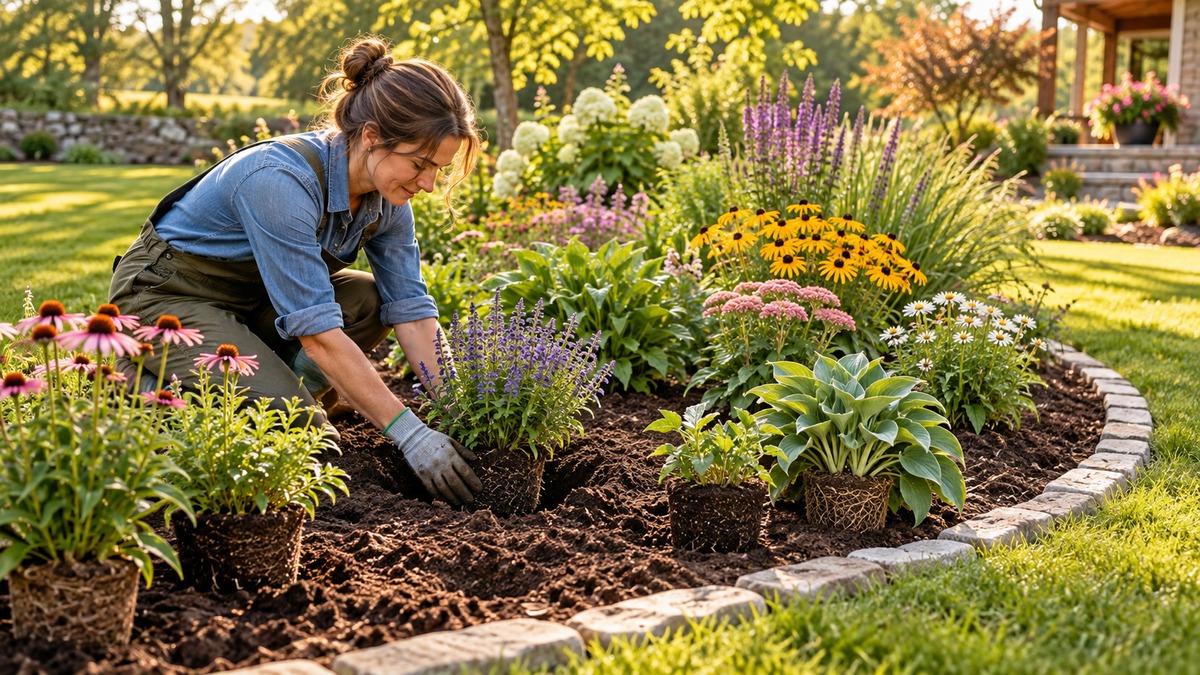
Colorado State says to place plants at the same soil level they had in the container, and warns that planting too deeply can be harmful: “Avoid planting perennials too deeply because plant roots can suffocate without sufficient available oxygen.” The Forsyth County page makes the same point from another angle, saying plants should sit at the same height or just slightly higher than in the container. It also warns that burying the crown or trunk can hurt the plant.
For plants grown in pots, loosen the root ball before planting so the roots grow down and out instead of circling. Colorado State also suggests choosing plants with fleshy, creamy white new roots, rather than roots that are discolored or root bound.
Space by mature size
Penn State’s care guide spaces plants by mature height. Plants 3 feet or taller go 2 to 3 feet apart, plants 2 to 3 feet tall go 1.5 to 2 feet apart, and plants below 2 feet tall go 1 foot apart. The same guide warns that a garden that is too densely planted is difficult to maintain. Penn State’s starting article adds a simpler rule: follow the plant tag for the depth and width of each hole, and for the spacing between plants.
The Forsyth County page says to give plants enough space to reach their mature size and to place taller plants at the back.
Mulch and water in
After planting, place a layer of mulch 2 to 3 inches deep. Penn State says it keeps weeds out and moisture in, and its care guide adds that it helps conserve water and keeps the soil cool. Soak the plants right after planting, then check them regularly so they do not dry out.
The guides differ on the first weeks. Penn State’s starting article says it is important to water at least daily for a week after planting. Colorado State describes full-sun beds that need water every couple of days during the first month, then longer gaps of four to six days to push roots into the soil. Colorado State adds that mulched plants will not dry out as quickly.
Add supports before they are needed
Tall perennials, such as delphinium, foxglove and hollyhock, may need staking in windy sites, according to Colorado State. Penn State’s starting article says to place supports when you plant, so you can attach the stems as they grow. Its care guide suggests staking early in spring so the plants grow through and around the stakes, which hides the stake by midseason.
Checks in the first season
After planting, water well and watch the bed for settling, then adjust plant height where needed. Colorado State lists drooping leaves or stems, and blossom drop, as signs that irrigation needs to increase. Those are the signs to watch for through the first weeks.
Keep the mulch in place and the bed weeded. Penn State’s care guide lists weeding, watering and deadheading among the usual growing-season tasks, and it gives the calendar in monthly steps, so you can plan the work across the year.
Common mistakes
Four mistakes come up across these pages. Planting too deep is the first, which Colorado State warns can suffocate roots. The second is burying the crown, which the Forsyth County page says can hurt the plant. The third is planting too densely, which Penn State says makes the garden difficult to maintain. The fourth is overfeeding. Penn State says many overfertilized perennials produce excessive soft growth and very few flowers.
A fifth mistake is skipping the soil test. Penn State says 10-10-10 or 5-10-5 fertilizer is sufficient for most perennials unless a soil test indicates otherwise, so the test decides how much to add.
Timing and division
Spring or fall planting
The Forsyth County page says spring is an excellent time to plant, and it calls fall “another wonderful time to install perennial plants in your yard.” Colorado State says containerized perennials can go in at any point in the growing season, as long as they can establish before dormancy and winter. It adds that bare-root perennials are best planted in spring in Colorado.
Divide and move plants
Colorado State says division of some perennials may be needed after three to five growing seasons, because overcrowded perennials bloom poorly. Penn State’s care guide puts it at every three to four years for most perennials, and notes that some resent being disturbed and do better from cuttings or seed. Colorado State advises dividing spring and summer bloomers in the fall, and mid-to-late summer or fall bloomers in the spring before growth begins.
How we chose
We limited this guide to university extension pages that opened with HTTP 200 on 2026-10-21. We read four: the Penn State Extension article on starting a new perennial garden (updated March 15, 2024), the Colorado State University Extension page on perennial gardening (published June 2000, reviewed August 2025), the Penn State Extension care and maintenance guide (updated March 9, 2026), and the NC State Extension Forsyth County page on perennial plants (updated May 27, 2025). We used a step only when one of these pages describes it. Penn State’s starting article describes one author’s three beds, so we treat its examples as examples. Colorado State’s winter and bare-root advice is written for Colorado, and the Forsyth County zones are local, so we name their region each time. We chose no products and left out retail pages, general websites and encyclopedia entries.
What we could not verify
The four pages do not cover every region. The Colorado and Forsyth County advice is local, and the watering and planting-time advice may not match your climate. The guides also do not give a planting plan for a specific site, so treat any layout here as an example only.
What the sources do not say
The pages do not give a number of plants per square foot, a bloom calendar for your area, or a cost for a new bed. They do not say how long a bed takes to fill in, apart from Penn State’s remark about its own bed. They do not name a sun requirement for each perennial, so check the plant tag for each one. They also do not say how to handle a bed in heavy clay beyond the organic matter and drainage advice.
Frequently asked questions
How much sun does a perennial bed need?
Colorado State says many perennials need 8 hours or more of sun during the longest days of summer. Shade-loving types such as ferns, bleeding heart and hostas do better in less sun, such as the north side of a home or filtered shade. The sources do not give a sun figure for each plant, so check the tag.
How deep should organic matter go into the soil?
Colorado State recommends 12 inches deep, using compost, sphagnum peat or well-aged manure. Its general rate is 3 cubic yards for every 1,000 square feet. A soil test shows whether your soil needs more than that, and the Forsyth County page says to follow the test recommendations.
How far apart should perennials be planted?
Penn State’s care guide spaces plants by mature height: 2 to 3 feet apart for plants 3 feet or taller, 1.5 to 2 feet for plants 2 to 3 feet tall, and 1 foot for shorter plants. Its starting article says to follow the plant tag for spacing, so the tag comes first when the two differ.
How often should new perennials be watered?
Penn State’s starting article says to water at least daily for a week after planting. Colorado State describes full-sun beds that need water every couple of days during the first month, then four to six days between waterings. The two schedules differ, so watch for drooping leaves and blossom drop as your signal to water more.
When is the right time to plant perennials?
The Forsyth County page calls spring an excellent time and fall another wonderful time. Colorado State says containerized perennials can go in any time during the growing season, while bare-root perennials are best planted in spring there. Penn State’s care calendar lists planting bare-root plants in April.
Sources
- Penn State Extension, Starting a New Perennial Garden. https://extension.psu.edu/starting-a-new-perennial-garden (opened 2026-10-21)
- Colorado State University Extension, Perennial Gardening. https://extension.colostate.edu/resource/perennial-gardening/ (opened 2026-10-21)
- Penn State Extension, Care and Maintenance of Perennials. https://extension.psu.edu/care-and-maintenance-of-perennials (opened 2026-10-21)
- NC State Extension, Forsyth County, Your Perennial Border. https://forsyth.ces.ncsu.edu/perennial-plants/ (opened 2026-10-21)