How to Start a Small Herb Garden in Pots
As an Amazon Associate we earn from qualifying purchases.
If you want to know how to grow a small herb garden in pots, start with the container, the mix and the light. The four extension sources we opened agree on drainage holes and a soilless potting mix. They differ on how many hours of sun herbs need, and on which herbs can share one pot. This guide walks through each choice, puts the figures side by side, and says where the pages stop short.
Quick answer
- Use containers with drainage holes, and fill them with a soilless or commercial potting mix.
- Give most herbs full sun. The sources give four to six hours, five hours indoors, or six or more hours outdoors.
- Group herbs that need the same water. Some herbs dry out between waterings, and others prefer to stay moist.
Choosing containers
Maryland puts the priority briefly: “Well-draining containers and potting mix is the key to success.” Iowa State says “Terra cotta and clay pots are popular”, and adds that “Hanging baskets and window boxes can also be used.” Illinois describes the scale of a small herb garden: “A few square feet allotted to growing herbs outside the kitchen window or along the patio can also serve the needs of those wanting a few fresh herbs.” It adds that “A single herb can be grown in a container as a specimen plant or several herbs can be planted together to give the balcony or patio gardener a functional culinary herb garden.”
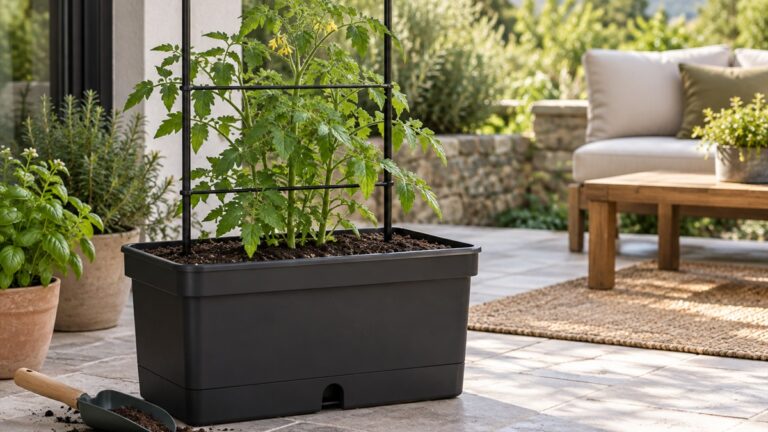
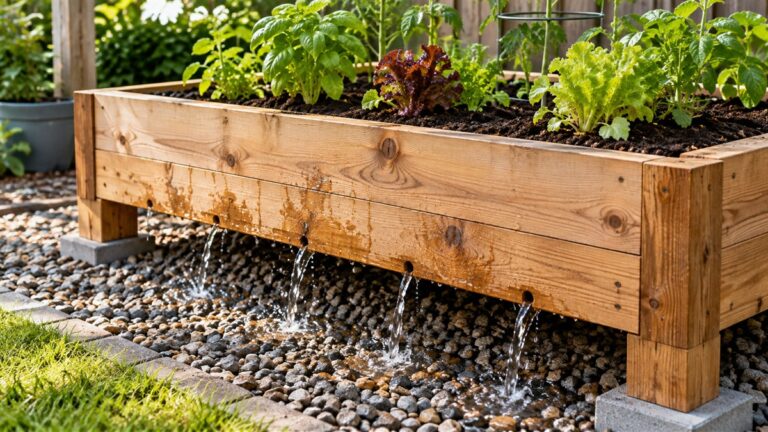
Start with drainage. Iowa State says “Be sure the container has sufficient drainage holes in the bottom.” Maryland adds that “Containers need to have adequate drainage holes.” UNH describes the failure on each side. “On the other hand, pots that are too large often stay wet for too long and may lead to root rot.” Small pots fail the other way: “Containers that are too small tend to dry out quickly and cause plants to wilt.”
Material is a matter of preference. Iowa State says “Clay pots work well because they provide a stable anchor and allow air to move through the root zone.” It adds that “Plastic works well too and is lighter and therefore easier to move around.” UNH says containers should be “wide and deep enough for the herbs planted”, but none of the four pages gives a size figure.
One container can hold more than one herb. Iowa State says “Several herbs can be grown in one container or each herb can have its own container.” A small garden could be one wide pot with three or four herbs, or several single pots. If you are weighing a deeper planter, see our guide to DIY planter boxes for deck railings.
Potting mix
Maryland says the “recommended potting media is a commercial soilless mix that drains well and is lightweight.” UNH agrees: “A quality soilless potting mix is the best choice for growing herbs and can be found at any garden center.” It explains that soilless mixes “are called such because they do not contain any garden soil.” The ingredients UNH names are peat, perlite, vermiculite, bark and coconut hulls, which hold moisture while still letting air reach the roots.
The recipes differ in detail. Iowa State offers two routes: “Select a well-drained, commercial potting mix or combine potting mix, peat moss, and perlite in equal parts.” Maryland’s recipe for indoor herbs is different: “When planting, mix two-parts soilless potting mixture and one-part perlite.” Illinois keeps it simple and asks only for a prepared potting mix. Pick whichever you can find, and keep the mix loose enough that water drains through.
Planting in order
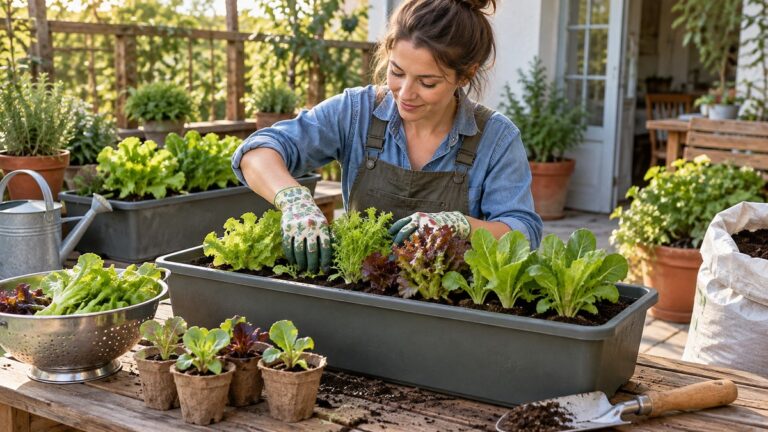
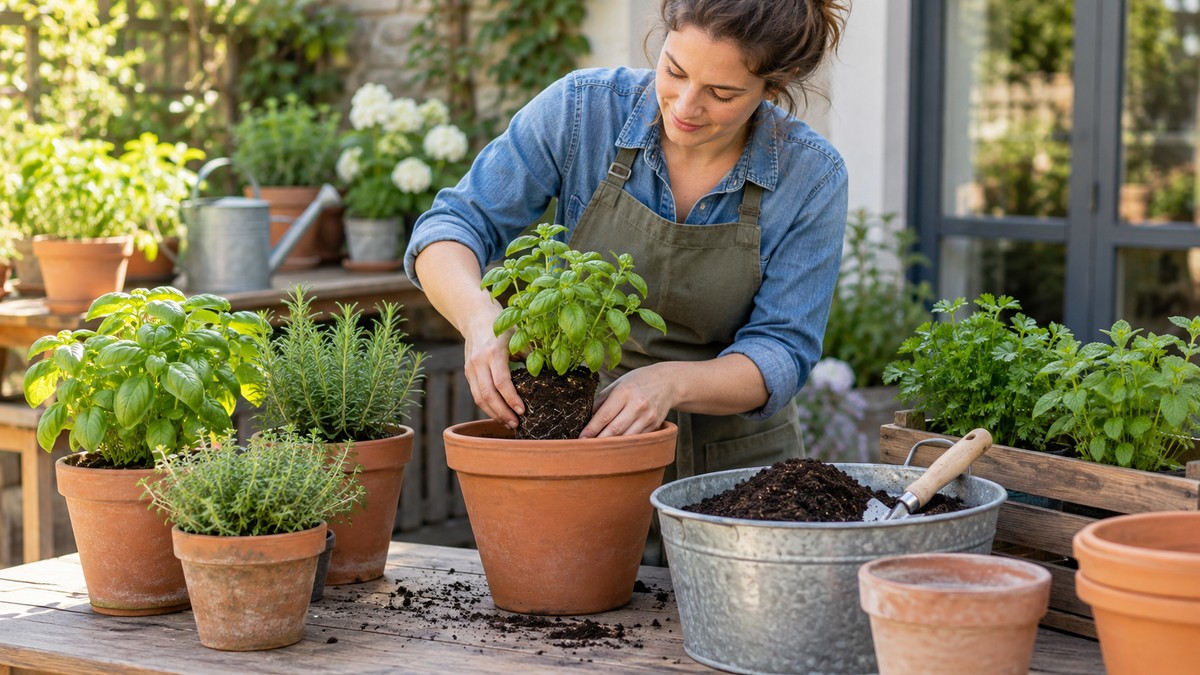
Illinois Extension gives a short order for a first pot. Choose the container first: “With container grown herbs, use a suitable sized container with ample drainage holes.” Then fill it: “Fill the container with a prepared potting mix.” Next comes the spot: “After planting, place the container in a sunny location.” Finally, keep up the routine, because “Regular, timely watering to keep the soil moist as well as a regular fertilization program will result in container herb gardens that produce all summer and maintain good appearance.” Illinois adds that “Careful attention to timely watering is also a key to producing good herbs.”
Light
Light figures are where the pages disagree most. The table lists each one with the setting it describes.
| Source | Light stated | Setting |
|---|---|---|
| UNH Extension | Six or more hours of direct sun a day | An outdoor container garden |
| Iowa State University Extension | At least 4 to 6 hours of sunlight each day | A container in a sunny location |
| University of Maryland Extension | At least five hours of sun a day | A south or west window, indoors |
| Illinois Extension | Most herbs do best in full sun | A sunny spot |
Maryland also says that in winter, grow lights or fluorescent lights set to shine 14 to 16 hours a day are necessary to supplement the light herbs get indoors. The sources do not say how much light a shaded pot needs, so test the spot before you plant.
Watering
Herbs do not share one water schedule. Iowa State says “Some herbs need to dry out between watering while others prefer to stay moist.” Maryland names the drying group: “Bay, marjoram, oregano, sage, and thyme need to dry out between watering.” Maryland’s routine is “Water regularly and thoroughly with room-temperature water”. It also warns “be careful not to overwater any of the containers.”
UNH takes a broader view: “Most herbs prefer moist, well-drained soils and can be planted together in the same container.” It also says “Other herbs, such as rosemary, prefer things on the drier side and perform better when planted singly.” Those two positions conflict. Iowa State’s rule is the more cautious one: “When grouping multiple herbs in one container, be sure their water requirements are comparable.”
Clay changes the timing. “Herbs grown in clay containers may require more frequent watering because they tend to dry out faster.” Iowa State advises watering “before they begin to wilt severely.” Clay pots therefore need more checks than plastic ones.
Grouping herbs in one pot
Iowa State offers three groupings for a single container: an Italian cooking set of parsley, basil, oregano, sage, rosemary and thyme; an aromatic set of lavender, hyssop, chamomile, pineapple sage and lemon verbena; and a tea set of chamomile, catnip, spearmint and peppermint. Its page marks parsley and basil as annuals. If you later move from pots to a bed, see our raised bed companion planting layout guide.
Rosemary is the awkward member of the Italian set. UNH lists rosemary among herbs that “prefer things on the drier side” and perform better when planted singly, while Iowa State’s grouping puts it with herbs in a shared pot. Check the water needs of each herb before you pot the set together. The UNH page separates the two life cycles: “Annual herbs such as cilantro and basil will only produce for one season”, while “perennial herbs such as rosemary, thyme, and lemon verbena can live for years if they are brought indoors for the winter.”
Feeding and harvest
Herbs need less fertilizer than most container plants. Iowa State says that “Although herbs do not require as much fertilizer as other container plants, they will benefit from periodic light fertilization with a dilute fertilizer solution.” Illinois says a general purpose liquid fertilizer “mixed properly (as per label direction) and applied every two weeks is sufficient to maintain quality plants.” Iowa State adds that “Rampant or spindly growth can be controlled by pinching.”
Harvest timing differs by life cycle. Iowa State says “Leafy annual herbs should be harvested when the flower buds first appear.” It also says to “Leave 4 to 6 inches of plant material on annual herbs.” For perennials, it says “Remove only the top third of the plant or the leafy tip growth on perennial herbs.” The reason it gives is that “Perennial herbs can not be harvested as heavily as annual herbs.”
Keeping herbs through winter
UNH says most herbs “are quite easy to grow and will reward you throughout the season and possibly beyond.” Winter is the harder part. Iowa State says “Some container-grown herbs can then be moved indoors when the growing season is over for further enjoyment.” Maryland lists rosemary, bay, lemon verbena, oregano, marjoram and scented geraniums as tender herbs that can be overwintered indoors, and it says “To prevent plant damage, bring herbs indoors before a frost.”
Indoors, Maryland notes the trade-off: “growing herbs indoors can be slightly more challenging than growing them outdoors.” It adds that “Indoor plants will need essentially the same conditions as herbs grown outdoors”. Those conditions are sunlight, or supplemental lights, and well-drained soil. Keep them “away from drafts, dry heat vents, and avoid temperature extremes.” “Water them less frequently in cooler weather.” Maryland describes the yearly routine: “You can maintain an indoor herb garden by periodic light fertilizing, yearly repotting, replanting of annual herbs, seasonal moves outdoors for perennial herbs, and occasional pruning.” Annual basil, it says, “can be grown indoors year-round.”
Common mistakes to avoid
- Overwatering the drying herbs. Maryland warns against it in every container.
- Using a pot with no drainage holes. All four pages require them.
- Choosing a pot far too large for the herb, which UNH says can keep roots wet.
- Mixing thirsty and drying herbs in one pot, against Iowa State’s grouping advice.
- Leaving perennials outside through winter. UNH says to bring them indoors, and Maryland says perennials do better moved outdoors in summer.
How we chose
We opened each page with curl on 2026-10-22 and read the text that came back. We kept four extension pages that returned HTTP 200 and covered container herbs: University of Maryland Extension, Iowa State University Extension, Illinois Extension and UNH Extension. The UNH page is a 2018 extension blog post, so its points are general rather than current. Maryland’s page was updated March 4, 2024, and Iowa State’s was last reviewed in January 2023. One candidate North Carolina PDF returned HTTP 404 and was dropped. Each quoted sentence was checked word for word against the fetched text.
What we could not verify
The four pages agree on the basics. They do not agree on figures, and several practical questions have no answer in them.
What the sources do not say
- No source gives a pot volume for a single herb, so the sources do not say how big a pot each herb needs.
- Light hours differ: four to six, five indoors, six or more outdoors, and full sun for most herbs. The sources do not explain the gap.
- The pages do not say how many herbs fit in one pot, only that several can share one.
- The sources do not give a watering schedule in days or weeks.
- None of the pages gives a yield or a harvest weight.
Frequently asked questions
How many herbs can go in one pot?
The sources do not give a number. Iowa State says several herbs can share a container, but it asks you to match their water needs. UNH says rosemary does better when planted singly, so give it a pot of its own.
How much sun does a container herb need?
It depends on the page. Iowa State says four to six hours of sunlight each day, Maryland says at least five hours of sun for an indoor window, and UNH says six or more hours of direct sun outdoors. Illinois says most herbs do best in full sun.
Can you use garden soil for herbs in pots?
The sources recommend a soilless or commercial potting mix instead. UNH says soilless mixes “are called such because they do not contain any garden soil”, and Maryland names a commercial soilless mix as the recommended media.
How often should you water herbs in pots?
The sources do not give days. Iowa State says to water before the plant wilts severely, and clay pots need more frequent watering. Maryland says to water regularly and thoroughly, without overwatering.
Can herbs stay outdoors all winter?
Some can, and some should come inside. UNH says perennial herbs such as rosemary, thyme and lemon verbena can live for years if they are brought indoors for the winter. Maryland says annual basil can be grown indoors year-round.
Sources
- https://www.extension.umd.edu/resource/growing-herbs-containers-and-indoors (opened 2026-10-22, HTTP 200)
- https://yardandgarden.extension.iastate.edu/how-to/growing-herbs-containers (opened 2026-10-22, HTTP 200)
- https://extension.illinois.edu/herbs/growing (opened 2026-10-22, HTTP 200)
- https://extension.unh.edu/blog/2018/05/growing-herbs-containers (opened 2026-10-22, HTTP 200)