How to Refresh Old Raised Bed Soil
As an Amazon Associate we earn from qualifying purchases.
Knowing how to amend old raised bed soil starts with a check and a test, not a bag of compost. Old beds tend to settle, and Illinois Extension notes that eventually every gardener with a raised bed needs to refresh the soil to keep it productive. The sources here agree on a sequence: check the frame and drainage, test the soil, top-dress with compost or topsoil, avoid tilling, and cover the surface.
Each step below says what the sources support. Where a source gives a rate, the text names the job that rate is for, because a building rate for new fill is not the same as a yearly top-dress.
Quick answer
- Test the soil first, then amend based on the result. Utah State University Extension says it is always best to test before identifying the additions a soil needs.
- Top-dress each year with a few inches of compost or rich topsoil, and do not till an established bed. Illinois Extension calls the annual top dressing the easiest refresh.
- Use a thin compost layer covered by coarse mulch on the surface, and work straw into clayey soil in the fall after it has served as mulch for a few seasons.
Check the bed before you add anything
Start with the frame. North Carolina’s extension article says to check that bed frames are intact and that the soil has not slumped. A bed that has dropped away from its boards needs a different fix than a bed with a sound frame and soil that has simply thinned out. The sources do not give a measure for slumping, so compare the soil level with the frame and note where the gap is.
Next, check compaction and drainage. If the soil has compacted, the same article recommends adding compost or pine bark fines. It also says raised beds improve drainage, but winter rains can still cause issues, and standing water for more than 24 hours indicates drainage issues. A bed that holds water after rain needs that problem solved before you add more organic matter on top.
Test the soil before you amend
Testing comes before the amendment, and the sources explain why. Utah State University Extension says that because soils vary in mineral and nutrient make-up, it is always best to have your garden soil tested in order to identify the fertilization additions it needs. A test tells you whether a bed needs lime, fertilizer or simply organic matter, so you are not guessing.
Timing matters. North Carolina’s article says winter is the ideal time to submit soil samples, and it notes that lime benefits from several months in the soil. It recommends applying lime well ahead of planting so it can adjust the pH. A winter test gives you time to act on the results before the spring rush.
The fill matters too. Utah State University Extension says soilless mixes are typically expensive and may become nutrient deficient over time. If an old bed was filled with a soilless mix, the test matters more, because the fill itself may be short on nutrients after several seasons.
Choose the organic matter
North Carolina’s article lists the top-dressings it recommends: finished, weed-free compost, shredded leaves, aged manure that is not fresh, and fully finished compost from a home bin. Each of these adds organic matter, and each needs to be finished or aged so that it works in the bed rather than against it. The article’s list is the simplest checklist in this guide.
Compost blends with a fine, soil-like texture are the best choice for replenishing organic matter and nutrients, according to the King County Conservation District fact sheet. The same sheet says these blends can be used in a thin layer, covered with a coarse textured mulch for weed suppression. That combination keeps the compost where it helps the soil and keeps the surface from becoming a seedbed.
For a bed with heavy clay, Colorado State University Extension has a specific suggestion. Certified weed-free straw is a good organic source for clayey soils. After using it as a summer mulch for a few years, you can thoroughly cultivate it into the soil as an amendment in the fall. The same resource notes that mulch used this way can later be plowed into the garden as an amendment, adding organic matter to the soil.
Vegetable beds have a simple seasonal option. The University of Nebraska-Lincoln Extension says straw or compost in vegetable gardens can easily be incorporated into the soil at the end of the season. Organic mulch also breaks down over time and needs replenishing, so the end-of-season top-up is a natural point to check depth.
How much to add
Illinois Extension gives the working measure for a yearly refresh: a few inches of compost or rich topsoil. It says that an annual top dressing of that depth should be enough to keep up with the settling soil level. That is the figure to use when you top up a bed that is already in use.
Utah State University Extension gives a different figure. If you are using existing soil as fill, amend the native topsoil with 30 to 50 percent, by volume, of well composted organic matter. That rate belongs to building or rebuilding the fill. It is not an annual top-dress rate, and the sources do not reconcile the two jobs, so keep them separate in your plan.
If you need to estimate volume for a top layer, our guide to how much soil a raised bed needs covers the sizing side of the job.
Work the layer in lightly, or leave it on top
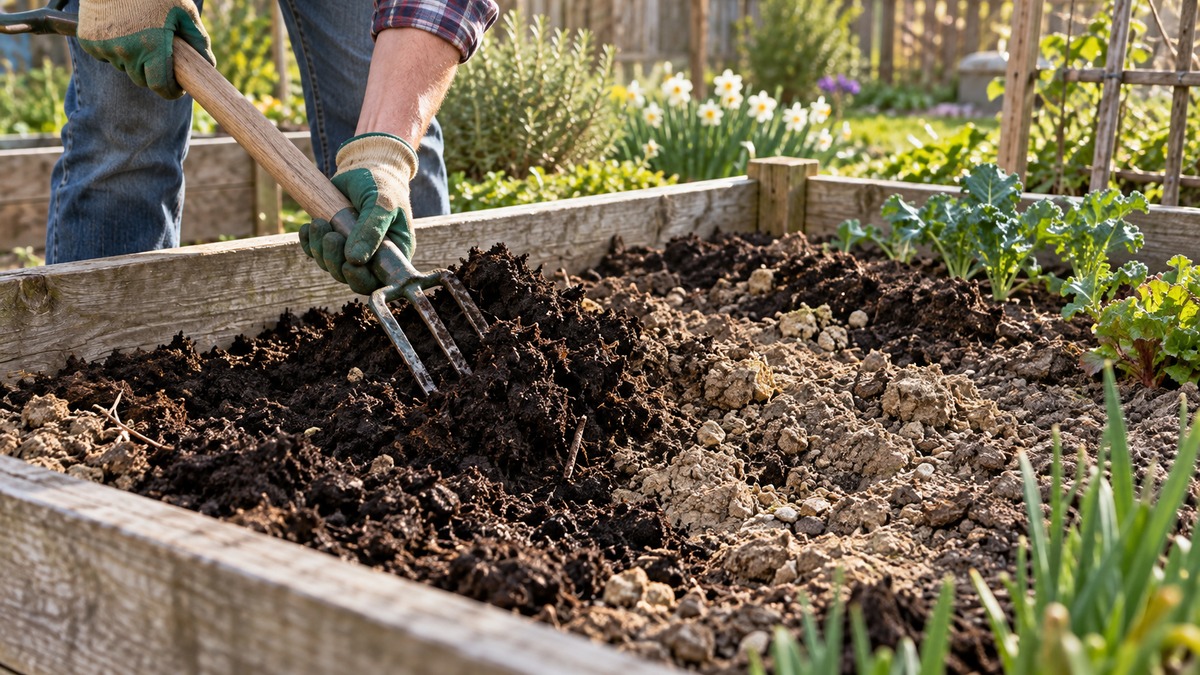
Tilling has its place in gardening but can be overdone, according to Illinois Extension. Its specific warning is for an established bed: avoid tilling it, because tilling can destroy the developing soil structure of a raised bed. Tilling is more useful when you are mixing new fill or planning significant amendments.
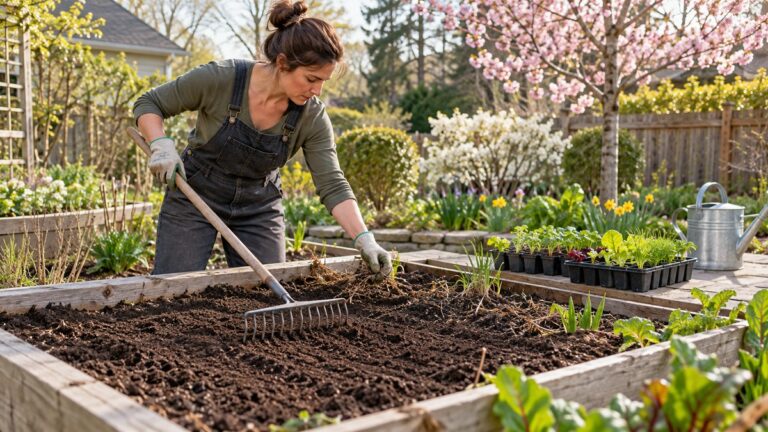
North Carolina’s article supports a light touch on the surface. Healthy plant residues can be chopped and incorporated lightly into the top few inches of soil, where they add organic matter as they break down. That means the top few inches get the work, and the rest of the bed stays intact.
Put together, the sources point to a simple rule. Work any leftover residue into the top few inches, spread the top dressing on the surface, and leave the lower structure alone. Illinois Extension describes that structure as the thing that tilling can destroy, so the surface routine protects it.
Cover the surface and let it work
Cover crops help the process. Illinois Extension says one way to help build structure is to sow cover crops in the off-season. It adds that while cover crops will not stop a raised bed from settling, they slow the process and build a vibrant growing medium. North Carolina’s article lists winter rye, crimson clover, Austrian winter peas and hairy vetch among the cover crops it commonly recommends for raised beds.
If you do not plant a cover crop, mulch still does the job. The King County sheet suggests a thin compost layer covered with coarse textured mulch. For a longer winter cover, North Carolina’s article recommends three to six inches of mulch for winter protection, which is a separate figure from the surface layer you use for weed suppression.
Organic mulch on the surface also breaks down over time, which is why checking it at the end of the season matters. The University of Nebraska-Lincoln Extension page says organic mulch breaks down over time and will need to be replenished periodically.
Mistakes to avoid
- Tilling an established bed. Illinois Extension warns that tilling can destroy the developing soil structure.
- Adding amendment without a test. Utah State University Extension says it is always best to test the soil first.
- Using fresh manure. North Carolina’s list calls for aged manure that is not fresh.
- Relying on fine compost alone on top. The King County sheet says highly composted, finely textured material is less effective at weed suppression, so cover it with coarse mulch.
- Ignoring compaction. North Carolina’s article recommends adding compost or pine bark fines when soil has compacted.
- Skipping the drainage check. Standing water for more than 24 hours indicates a drainage issue, according to the same article.
For a bed that will keep producing, our guide to making a compost pile is a practical next step if you want to build your own top dressing from the same kind of finished material.
How we chose
The sources are a university extension news release, a Utah State University Extension fact sheet, a North Carolina county extension article, a conservation district fact sheet, a Colorado State University Extension resource, and a University of Nebraska-Lincoln Extension page. Each one was fetched with curl on 2026-10-22, and its testing, top-dressing, tilling and compaction sections were read before any sentence was used. Quoted lines were checked word for word against the fetched text. Retail pages, vendor pages, single-site Q&A pages and pages that returned errors were left out, and no product is named or recommended.
Dates matter. The Utah State fact sheet is dated February 2012, and the North Carolina article is dated November 18, 2025. Rates and test timing depend on the climate and the soil, so check with your local extension office before you buy.
What we could not verify
The sources agree on the sequence of checking, testing and top-dressing, but they do not agree on amounts for every job. The Utah State rate for existing soil is a building figure, and the Illinois figure is an annual top-dress figure. The sources do not give a single number that covers both.
What the sources do not say
The sources do not give a dose of lime or fertilizer, and they do not say how far a test result should move the amounts. They do not measure how quickly an old bed regains structure after a top dressing. They do not give a cost for compost, topsoil, straw or mulch. They do not say how to tell apart a compacted bed from a bed that simply needs organic matter, beyond the drainage check and the compaction fix. Your local extension office can answer those questions for your soil.
Frequently asked questions
What is the first step to refresh old raised bed soil?
Check the frame, the drainage and the soil level, then test the soil. Utah State University Extension says the test identifies the fertilization additions a soil needs. North Carolina’s article says winter is the ideal time to submit samples, so a late-fall or early-winter test gives you time to act before spring.
How much compost should go into an old raised bed?
For the yearly top layer, Illinois Extension recommends a few inches of compost or rich topsoil. For existing soil used as fill, Utah State University Extension recommends 30 to 50 percent, by volume, of well composted organic matter. Those figures are for different jobs, so use the one that matches the work you are doing.
Can straw help with heavy clay in a raised bed?
Colorado State University Extension says certified weed-free straw is a good organic source for clayey soils. It recommends using straw as a summer mulch for a few years, then thoroughly cultivating it into the soil as an amendment in the fall. That approach builds organic matter over several seasons rather than fixing the soil in one step.
Should an old raised bed be dug up and replaced?
The sources do not describe full replacement as a routine. Illinois Extension says that occasionally a raised bed demands more significant attention to its soil structure, and it advises against tilling an established bed. The routine they describe is an annual top dressing, with checks on the frame and drainage.
What should be done if a raised bed holds standing water?
Treat it as a drainage problem before adding more organic matter. North Carolina’s article says standing water for more than 24 hours indicates drainage issues. Check that the frame is intact and that the soil has not slumped. If the soil has compacted, add compost or pine bark fines as the article recommends.
Sources
- https://extension.illinois.edu/news-releases/refreshing-raised-bed-soil-generates-exceptional-results (opened 2026-10-22)
- https://extension.usu.edu/yardandgarden/research/raised-bed-gardening.pdf (opened 2026-10-22)
- https://wilkes.ces.ncsu.edu/2025/11/winterizing-your-raised-garden-beds/ (opened 2026-10-22)
- https://cob.org/wp-content/uploads/Manage-Weeds-Naturally-Mulch-Booklet-Digital.pdf?pdftype=e (opened 2026-10-22)
- https://extension.colostate.edu/resource/mulches-for-the-vegetable-garden/ (opened 2026-10-22)
- https://byf.unl.edu/mulch (opened 2026-10-22)