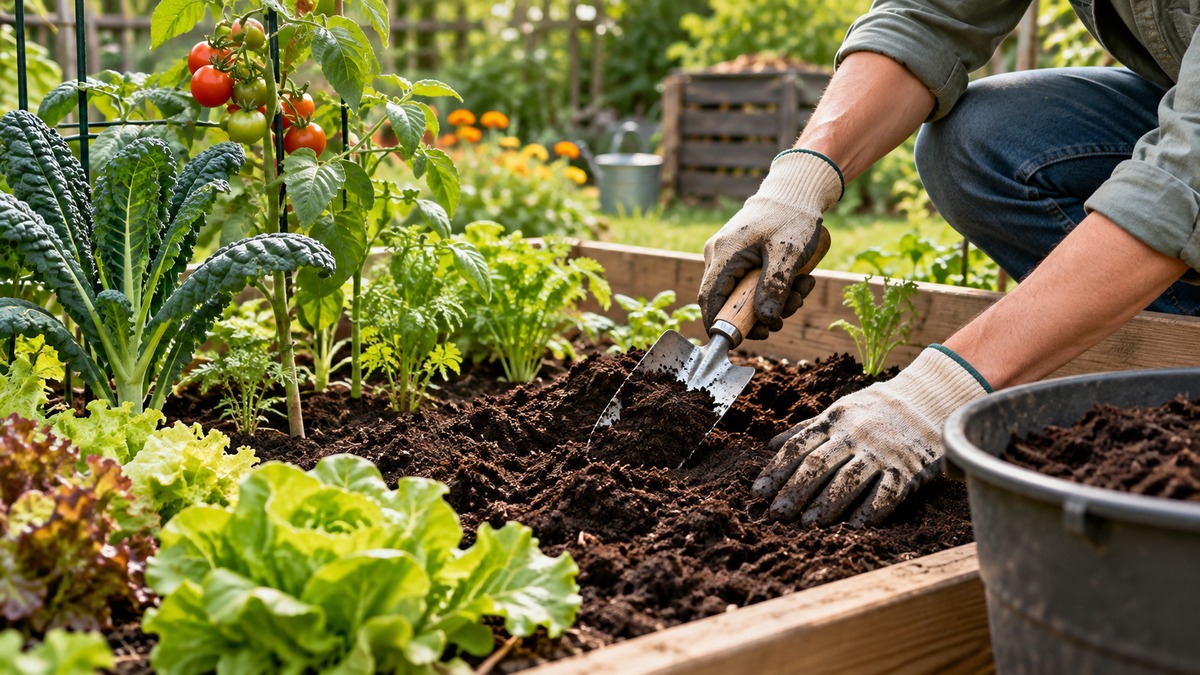
How to Use Finished Compost in Your Garden
As an Amazon Associate we earn from qualifying purchases.
Finished compost is one of the most useful things a garden can receive. How to use finished compost in your garden depends on three things: whether the compost is ready, what job you want it to do, and how deep you put it. The extension sources we opened agree on the basics. They differ on depth and on weed control, and this guide shows those differences rather than hiding them.
Start with a simple check. Ready compost looks and smells like good soil, and the sources describe it in similar words. After that, choose the job: mix it into the bed, spread it as mulch, or top-dress the surface of an existing bed.
Quick answer
- Check that the compost is dark, crumbly and earthy-smelling before you use it.
- To mix compost into a bed, work about 2 inches into the top 6 to 8 inches of soil once a year. To top-dress, add up to 1 inch on the surface.
- For mulch, spread 2 to 4 inches and keep the compost a few inches away from stems and trunks.
Confirm that the compost is ready
Finished compost has a recognizable stage. The Alabama guide says compost is ready when “most of the original plant materials are no longer recognizable.” The Oregon State fall bulletin describes the same stage: “Finished compost will be dark, crumbly, earthy-smelling and mostly unrecognizable from the original ingredients.” The Alabama guide adds that finished compost “is dark colored, crumbly, and looks and feels like soil.” The Arizona handout uses the same test: “Should be dark, crumbly and have earthy odor.”
The pile itself gives a second check. The Arizona handout says a finished pile “should feel only slightly warmer than ambient air temp” and that it “will reduce in size up to half.” Its cure step is a rest period: “Allow the finished pile to sit UNDISTURBED for 1 month.” If your compost still smells sharp or sour, or still holds whole leaves and stems, give it more time before you use it. For the pile-building steps that produce this stage, see our guide to building a compost pile from the start.
Choose the job: mix, mulch or top-dress
The three uses are different, and the sources give different depths for each. The table keeps the figures next to the source that gives them.
| Job | What the sources describe | Depth or amount they give |
|---|---|---|
| Mix into a bed | Work it into the soil, usually in spring or fall | About 2 inches a year, worked 6 to 8 inches into the soil (Virginia Tech) |
| Mulch | Spread on the soil surface around plants | 2 to 4 inches of finished compost (University of California); 2 to 3 inches along rows (Kansas State) |
| Top-dress | Apply to the surface of an existing bed | Up to 1 inch each year, preferably in late autumn (Ask Extension) |
Mix compost into the bed
Mixing is the job for a new bed or a tired one. The Virginia Tech guide gives the most specific figure: “If you produce large amounts of compost, spread about 2 inches over your entire garden annually and work it 6 to 8 inches into the soil.” It also warns against a heavy single dose: “More than 2 inches at one time may encourage grubs.” For a new raised bed, the same guide suggests “mixing 2 inches of compost with the top 6 to 8 inches of garden soil.” If you are also deciding how much soil a raised bed needs, see how much soil a raised bed needs.
Timing follows the field season. The Kansas State publication says “The best time to apply compost is just before tillage in either the spring or fall.” Tilling spreads the compost through the root zone, since “Tilling incorporates the compost throughout the plant root zone.” The publication also notes that gardeners in Kansas typically till in the fall, so the fall window is the common one there.
Soil type changes what compost does. The Alabama guide says: “Compost tilled into a sandy soil improves the soil’s capacity to hold water and nutrients.” For heavy soil, it says: “Added to a heavy clay soil, compost increases the air spaces between clay particles, which improves drainage and increases soil aeration.” The Arizona handout gives a different measure for hot compost used in a soil mix: “use a 1:1 ratio with existing soil.” That ratio and the Virginia Tech depth are not directly comparable, so use the one that matches how you plan to mix.
Use compost as mulch without burying the plants
Mulch is the job where the sources disagree most, so it is worth reading slowly. The University of California publication gives the placement rule: “If using finished compost as a mulch, spread a 2-4 inch layer on the soil surface, being sure to keep the compost a few inches away from plant stems and tree trunks.” For a planting in late spring, the Virginia Tech guide suggests “about 1 inch of compost around the plants,” covered with a mulch layer 2 to 3 inches deep. The Kansas State publication recommends a compost layer of 2 to 3 inches along rows and around perennials, trees and shrubs.
The weed claims conflict. The University of California publication says: “The one drawback of using compost as mulch is that it does not provide effective weed control.” The Alabama guide takes a broader view and says compost “can also be used as a mulch to conserve soil moisture, suppress weeds, prevent crusting of the soil surface, and buffer soil temperatures.” The Virginia Tech guide sides with the cautious reading: “Compost is not as effective for a mulch, as weed seed tends to grow rapidly in it.” This guide shows both statements and does not pick one.
Mulch does more than hold back weeds. The Kansas State publication says “Mulches hold moisture in the soil, prevent weed growth, and reduce soil crusting and splashing,” and that mulches “help to keep the soil cooler in the summer.” The same publication warns that a dark, cool surface can favor some insect pests, so keep mulch at the depths above rather than piling it on.
The University of California fix is to top off the compost with a standard mulch: “It may be best to use finished, well screened compost as a layer of mulch, but then top off with a standard mulch material to keep weed seeds from sprouting and getting established.” Unfinished material needs more care. The same publication warns that “it also may steal nitrogen from the soil while it decomposes.” At the end of the season, Kansas State suggests a different use for the mulch: “At the end of the garden season, till the mulch into the soil as a source of organic material.”
Top-dress existing beds each year
For beds you are already growing in, the Ask Extension answer gives a yearly limit: “Our recommendation is to apply up to 1-inch of compost to the surface of your soil each year, preferably in late autumn.” The same answer adds a cover rule: “Then, and always, cover any exposed earth with 2 to 3 inches of organic mulch.” That is a lighter pattern than the mixing figure, and it fits beds that you do not want to dig. The Arizona handout matches a chunkier product to the same use: “Cold Composting creates a chunky compost with larger bits of organic matter to use as a top dressing or mulch.”
Compost feeds plants slowly. The Alabama guide says: “Most of the nitrogen and phosphorus are present in an organic form, and they are released gradually.” It also says that “That makes compost a good slow-release fertilizer for trees and shrubs.” The same guide is clear about vegetables: “Generally, additional fertilizer will have to be added for vegetables and bedding plants.” Think of finished compost as a base for the bed, not a complete feed for heavy feeders.
The nutrient content is not fixed. The Alabama guide says that “Finished compost contains nitrogen, phosphorus, and potassium, although the amount of each element varies.” Without a test of your own compost, the sources give no figure to plan around, so this guide gives none either.
Mistakes to avoid
- Spreading more than 2 inches at once. The Virginia Tech guide links a heavy single dose to grubs.
- Piling mulch against stems and trunks. The University of California publication says to keep it a few inches away.
- Relying on compost alone to stop weeds. The University of California publication says it does not provide effective weed control.
- Using coarse, unfinished compost as mulch. The same publication warns that it may steal nitrogen while it decomposes.
- Expecting compost alone to feed vegetables. The Alabama guide says extra fertilizer is generally needed for them.
How we chose
We drew on seven pages: the Alabama Cooperative Extension composting guide, the University of Arizona Yavapai County backyard composting handout, the Virginia Tech publication SPES-304 on using compost, the University of California Cooperative Extension compost mulch publication, the Kansas State publication MF3370, an Oregon State fall composting bulletin, and an Ask Extension answer on top-dressing. We kept the depth, timing and weed statements that a page makes directly, and we show the conflicting ones side by side. We cite the Ask Extension answer only for its own figure, since it is a single reply to one question.
What we could not verify
The pages give practical figures, but they do not agree on everything, and they do not cover every garden. This section lists the gaps so you can plan around them.
What the sources do not say
The sources do not say how much nutrient a given batch of compost supplies, beyond the general point that the amount varies. They do not give a rate for container mixes. The Arizona handout gives a 1:1 ratio for hot compost in gardens, containers or turf, but it does not say how much compost a container mix should hold. The Virginia Tech depth is written for garden beds. None of the pages gives a storage time for finished compost once it is bagged or piled. The depth figures also differ: up to 1 inch a year in the Ask Extension answer, about 2 inches a year in the Virginia Tech guide, and 2 to 4 inches of mulch in the University of California publication. The sources do not say which depth suits your soil, so this guide does not choose one. The weed claims conflict, and the pages do not settle which view holds in your garden.
Frequently asked questions
Can finished compost go right against a plant?
Keep it off the stem. The University of California publication says to keep compost “a few inches away from plant stems and tree trunks.” The Virginia Tech guide places compost around the plants, not against them, and covers it with a separate mulch layer.
How much finished compost should go on a bed each year?
The sources differ, so match the figure to the job. The Ask Extension answer recommends up to 1 inch on the surface each year. The Virginia Tech guide suggests about 2 inches spread and worked into the soil once a year, for gardeners who make large amounts of compost. Use the surface figure for beds you do not want to dig and the mixing figure for beds you can work.
Is finished compost enough fertilizer for vegetables?
Not by itself, according to the Alabama guide. It says “Generally, additional fertilizer will have to be added for vegetables and bedding plants.” Its nutrients are released gradually, so compost works as a base that a feeding program builds on.
Will compost mulch keep weeds away?
The sources disagree. The University of California publication says it “does not provide effective weed control” and suggests topping it with a standard mulch. The Alabama guide says compost can “suppress weeds.” The Virginia Tech guide says weed seed “tends to grow rapidly in it.” If weeds are your main problem, top the compost with a standard mulch, as the University of California publication suggests.
When is the best time to apply finished compost?
For mixing, the Kansas State publication says “The best time to apply compost is just before tillage in either the spring or fall.” For top-dressing, the Ask Extension answer prefers late autumn. Choose the window that fits your bed, and avoid heavy single doses at any time.
Sources
- https://www.aces.edu/wp-content/uploads/2018/11/ANR-0638.REV_.pdf (opened 2026-10-22)
- https://www.extension.arizona.edu/sites/default/files/attachment/BackyardCompostingHandout2021.pdf (opened 2026-10-22)
- https://www.pubs.ext.vt.edu/content/dam/pubs_ext_vt_edu/426/426-704/SPES-304.pdf (opened 2026-10-22)
- https://ucanr.edu/sites/default/files/2013-05/166238.pdf (opened 2026-10-22)
- https://bookstore.ksre.ksu.edu/download/using-compost_MF3370 (opened 2026-10-22)
- https://extension.oregonstate.edu/es/node/80766/printable/print (opened 2026-10-22)
- https://ask.extension.org/kb/faq.php?id=865769 (opened 2026-10-22)