How to Keep Raccoons Out of Your Compost Bin
As an Amazon Associate we earn from qualifying purchases.
How to keep raccoons out of compost bin comes down to three habits: take away the food, keep the lid tight, and block the climbing and digging routes. The five extension pages we opened cover raccoon control in general. None of them gives instructions for a compost bin specifically, so the steps below apply their advice to one.
Most of the sources agree that food draws raccoons in, and that exclusion, meaning physical barriers, is the approach they favor. Where they are silent on compost, this guide says so rather than filling the gap.
Quick answer
- Remove food raccoons can reach, including pet food, bird seed, garden produce and compost left outdoors overnight.
- Use tight-fitting or clamped lids, because an unfastened lid invites raccoons to pry it open.
- Block climbing and digging with barriers, since a simple fence is often not enough.
- Treat lights, radios and similar scare tactics as temporary, and check state and local rules before any trapping.
Why raccoons come to a compost bin
Raccoons are omnivorous. The Montana page lists fruit, nuts, corn, grains, insects, eggs and many small animals in their diet, and notes they are normally found near water but can travel far from it. Near homes, that food is easier to find. The Iowa page says pet food, wild birdseed, garden fruit and vegetables, and leftovers in garbage containers form a steady supply all year.
The Iowa page also reports research in several states finding that this food often helps raccoons keep higher, more stable populations in towns than in natural areas. The Arizona page adds that near homes raccoons den in chimneys, under houses, in abandoned structures and in woodpiles. Because they are active mostly at night, you may find only tracks or smudges the next morning.
Remove the food and water first
The Arizona page gives the order of work: remove any food or water source, feed pets indoors, and secure garbage containers. Apply the same order to the compost bin. Only one of the five sources, the Nebraska page, names compost at all, so the list below uses the items each page names.
- Pet food: the Arizona page says to feed pets indoors. The Purdue publication also lists dog food left out when it is not feeding time as food to remove.
- Bird seed: the Nebraska page says to avoid leaving bird seed outdoors overnight. The Arizona page makes birds the only exception to its rule against feeding wildlife on purpose.
- Garden produce: the Nebraska page says to harvest fruits and vegetables as soon as they ripen.
- Trash and leftovers: the Iowa page lists leftovers in garbage receptacles as food, and the Purdue publication says to remove accidental food such as trash.
- Compost: the Nebraska page names compost left outdoors overnight. The sources do not say whether a closed bin counts, so this guide reads that advice as covering any bin with a loose lid.
Water matters as well. The Arizona page puts water sources in the same instruction, so look for standing water near the bin during the same check. For setup questions beyond this guide, see using a rotating compost bin.
Close the lid and secure the bin
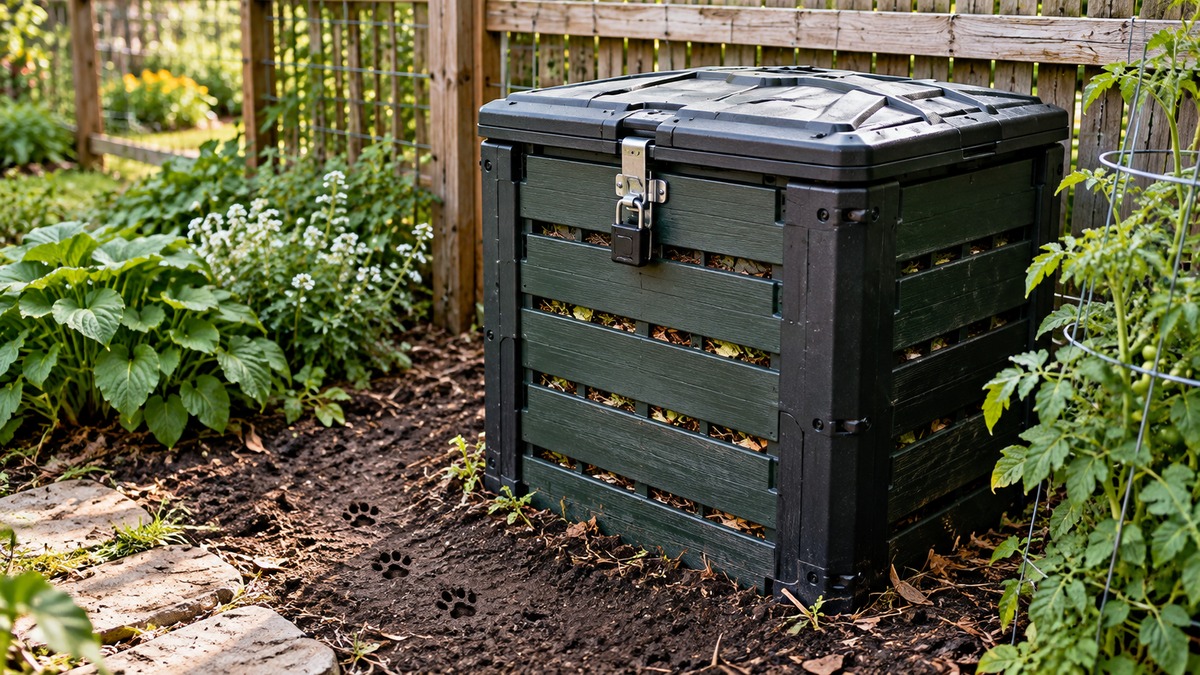
Lids are the part of the advice that carries over most directly. The Nebraska page says to use trash cans with tight-fitting lids or raccoon-proof containers. The Montana page says wire or clamps keep raccoons out of garbage cans whose lids do not fit tightly. The Iowa page says to seal or clamp the tops of bins, and gives the reason in one line: “an unfastened lid is simply an invitation for raccoons to pry them open.”
None of these pages describes a compost bin, so check the fit yourself. If the lid lifts, slides or pushes aside, the Montana advice on wire or clamps applies. Follow the manufacturer’s manual for any clamp, latch or wire you add. If you are still choosing a bin, compare building or choosing a compost bin and options for setting up a compost bin, then return here for the barrier checks.
Block climbing and digging
The Iowa page explains why a simple fence is often not enough: raccoons are expert climbers. The Arizona page says raccoons can climb almost any fence, that an electric wire strand at the top will likely discourage them, and that raccoons also dig under fences. For a bin close to a tree or pole, the Montana page recommends aluminum flashing or galvanized sheet metal placed around the tree or pole to stop climbing.
The Iowa page covers buildings too. It suggests capping chimneys, wide sheet metal along roof edges, and porcupine wire around downspouts and corners. Those fixes apply to a shed or porch next to the bin rather than to the bin itself. Electric fencing needs care: this guide gives no electric fence set-up steps, so follow the maker’s manual and local rules for any electric fence you consider.
Deterrents, and why they fade
Two of the pages address frightening devices directly. The Montana page says lights, radios, dogs, pie pans and plastic windmills work only temporarily. The Nebraska page says motion-activated lights or sprinklers can startle and deter raccoons, and that electric fencing around vegetable gardens is also effective. The sources do not say how long a motion light or sprinkler keeps raccoons away.
Chemical shortcuts are a different matter. The Montana page says no repellents, toxicants or fumigants are currently registered for raccoon control. The Iowa page warns against mothballs and naphthalene, which it says are not approved for keeping raccoons out and are a health hazard to people, pets and livestock. This guide offers no product advice for raccoons.
Timing through the year
The Iowa page says winter is the best season to exclude raccoons, before they den and give birth in spring. It recommends preventive work in early winter, because barriers put up during spring or summer might trap a raccoon family inside a chimney or another hard-to-reach part of a building. The Arizona page places breeding usually between January and March, and the Montana page says breeding is mainly in February and March. Those dates point to finishing barriers before the breeding window opens.
The Iowa page also says to make sure no raccoon is already inside before you seal anything. It notes that young raccoons make chirping sounds from denning spots in spring and summer, so listen before you close an opening.
Trapping and local rules
Three of the pages discuss trapping, and each ties it to rules. The Montana page calls trapping often the most logical way to stop raccoon damage, then says to check state and local regulations before using any trap. It also warns about risks to non-target animals. The Nebraska page calls live trapping an option for especially troublesome raccoons, and says to adhere to local wildlife regulations.
The Iowa page says you can consult a licensed nuisance wildlife control operator if you would rather have someone else handle a troublesome raccoon. It also says to release a captured raccoon only on property where you have the landowner’s prior permission. The Arizona page says raccoons are managed as game animals under state law and points readers to the state game and fish department. This guide gives no trap set-up or relocation steps, because the rules differ by place and the sources send readers to them.
Raccoon feces and roundworm
Raccoon feces may carry roundworm eggs, which is a health reason to keep raccoons away from a compost area. The Purdue publication says the eggs pass in feces and can infect people, that most reported severe cases involved small children, and that about 12 severe or fatal cases were recorded in the United States from 1981 through 2002. It also says there is currently no effective treatment for the infection. The best way to stay healthy, the publication says, is to reduce or avoid contact with raccoons and their feces.
The publication notes that raccoons tend to use flat, elevated spots such as rooftops, decks and wood piles as latrines, and that feces about the diameter of a dime or nickel are tubular with blunt ends. Latrines may also form on the ground in gardens. The Arizona page lists rabies, distemper, mange and canine and feline parvovirus among the diseases raccoons can carry.
If you clean up droppings, the publication’s steps are specific. Wear an N95-rated dust mask and gloves. Mist dry feces lightly with water instead of soaking them. Do not spray them with a disinfectant such as chlorine bleach, because the eggs resist most household disinfectants. Eggs take 14 to 28 days to become infective, so clean up feces as soon as you find them. Wash skin with plain soap and warm water, and wash clothes separately in hot, soapy water.
The publication says heat or flame is needed to kill the eggs, and it says to contact the local fire department before any outdoor burning. This guide gives no flame steps, so local fire rules and the manufacturer’s manual come first. If someone or a pet has direct contact with feces, wash as described and ask a doctor or veterinarian for advice.
Checks after the job
- Look for raccoon tracks and paw smudges around the bin, which the Iowa page lists as signs.
- Confirm the lid closes fully, stays shut when pushed, and that any clamp or wire holds.
- Check that no pet food, bird seed or compost is left outside overnight, as the Nebraska page advises.
- Inspect nearby sheds, roofs, chimneys and vents for gaps, and seal entry points only once no raccoon is inside.
- Look for piles of droppings on flat, raised surfaces, which the Purdue publication says raccoons favor, and clean them with its steps.
Common mistakes
- Relying on lights or radios for the long term. The Montana page says these work only temporarily.
- Using mothballs or naphthalene. The Iowa page says they are a health hazard to people, pets and livestock.
- Leaving pet food or bird seed out overnight, which the Nebraska page warns against.
- Sealing openings in spring or summer while a raccoon family may be inside, which the Iowa page warns can trap them.
- Cleaning feces with bleach. The Purdue publication says most household disinfectants do not kill the eggs.
- Feeding raccoons on purpose. The Arizona page says not to, with birds as the only exception.
How we chose
This guide answers one question: how to keep raccoons out of a compost bin at home. Five extension and state-agency pages were read, all opened on 2026-10-21: Montana State University Extension, University of Nebraska-Lincoln Extension, University of Arizona Extension, Iowa State University Extension and Purdue Extension. A point made the cut only if one of these pages states it and it bears on food, lids, barriers, deterrents, timing, trapping rules or disease risk. Where a page covers a garden, farm or building rather than a compost bin, the guide says so. The guide recommends no products and describes no product.
What we could not verify
What the sources do not say
The sources do not cover compost bins by name, so the lid and food advice is applied to a bin by inference. They do not say whether a closed compost bin draws raccoons less than an open pile. They do not say how long a motion light or sprinkler keeps working, or how far a barrier must extend under a bin. The Nebraska page shows no date, the Arizona page is dated October 2023, the Iowa page was last reviewed in June 2019, and the Purdue publication was revised in April 2010. The Montana page shows no date either, so its statement that no repellents are registered may be out of date.
Frequently asked questions
Will a lid alone keep raccoons out of a compost bin?
The sources do not say a lid alone is enough. They do say that tight or clamped lids matter, because a loose lid lets raccoons pry it open. Pair the lid with removing food, and check that it closes fully.
Do lights, radios or sprinklers work against raccoons?
The Montana page says lights, radios and similar devices work only temporarily. The Nebraska page says motion-activated lights or sprinklers can startle and deter raccoons. The sources do not say how long either keeps working, so treat them as one part of the plan rather than the whole plan.
Can I use a repellent or mothballs?
Do not. The Montana page notes that raccoon control has no registered repellents, toxicants or fumigants at present. The Iowa page says mothballs and naphthalene are not approved for keeping raccoons out and are a health hazard to people, pets and livestock.
Is raccoon feces dangerous to handle?
It can be. The Purdue publication says raccoon feces may contain roundworm eggs that can infect people, and that most reported severe cases involved small children. Clean up droppings promptly, wear an N95-rated mask and gloves, and avoid bleach. The publication also says there is no effective treatment for the infection, so keeping contact low is the main protection.
When is the best time to keep raccoons out?
The Iowa page says winter is best, before raccoons den and give birth in spring, and it recommends early winter for preventive work. The Arizona page places breeding usually between January and March, and the Montana page says mainly February and March. Finish barriers before that window when you can.
Sources
- Montana State University Extension, Non-Chemical Raccoon Control: https://animalrangeextension.montana.edu/wildlife/prevention_and_control/organic-raccoon-control.html (opened 2026-10-21)
- University of Nebraska-Lincoln Extension, Raccoons (Backyard Farmer): https://byf.unl.edu/raccoons/ (opened 2026-10-21)
- University of Arizona Extension, Raccoons (Backyard Gardener #111): https://extension.arizona.edu/sites/extension.arizona.edu/files/attachment/Raccoons.pdf (opened 2026-10-21)
- Iowa State University Extension, Raccoons: Damage Management: https://naturalresources.extension.iastate.edu/encyclopedia/raccoons-damage-management (opened 2026-10-21)
- Purdue Extension, ADM-17-W, Protecting Yourself From Wildlife Diseases: Raccoon Roundworm: https://www.extension.entm.purdue.edu/publications/ADM-17.pdf (opened 2026-10-21)