How to Get Rid of Fruit Flies in a Compost Bin
As an Amazon Associate we earn from qualifying purchases.
Fruit flies around a compost bin are a nuisance, and they start with food the flies can reach. The good news is that the sources we opened treat the fix as mostly cleanup. Here is how to get rid of fruit flies in compost bin setups, in the order the extension and state pages suggest, with trap methods as a backup.
Two of the pages describe the flies themselves, one from Massachusetts and one from the University of New Hampshire Cooperative Extension. The rest of the advice comes from a city tip sheet, a university extension publication and an Alabama composting guide, so the steps reflect more than one region.
Quick answer
- Keep the bin lidded, bury food scraps, and clean drains and bins. Sanitation is the main control.
- In an outdoor pile, keep enough dry, high-carbon material on top of the food scraps.
- Use vinegar or jar traps as a backup, not as a replacement for cleanup.
Start with the lid and the kitchen bin
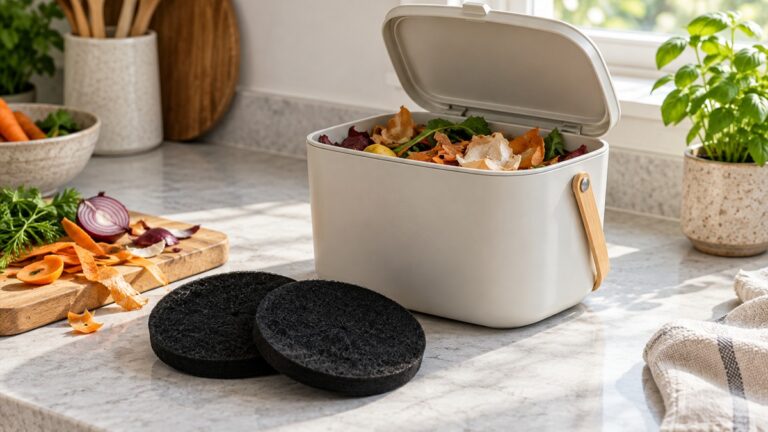
The Charleston tip sheet puts the lid first. It says that “making sure your kitchen compost bin has a good and secure lid on it is the most important thing you can do to prevent a fruit fly infestation.” The Arizona publication makes the same point for containers in general. It says trash cans, dumpsters and compost bins should be cleaned regularly, and that “Their lids should be closed when not in use.”
Time matters as much as the lid. The Charleston guide suggests holding only a little food at a time: “Hold only one to two days’ worth of food scraps in your kitchen bin.” Less food in the kitchen means fewer places for eggs to be laid, and the same guide advises moving the bin outdoors in warm weather: “Consider storing your bin outside during summer months instead of inside your kitchen.” Store the bin where the lid will stay closed, and take the scraps out on a regular schedule.
Bury scraps and balance an outdoor pile
The Alabama guide does not name fruit flies, but it gives a rule that limits odor and pests in the same way. It says: “Kitchen scraps, such as vegetable and fruit scraps, egg shells, and coffee grounds, can be added to the pile, but make sure they are buried in the pile to avoid odor.” A scrap sitting on the surface is the one a fly can reach, so burying each batch matters for the outdoor bin.
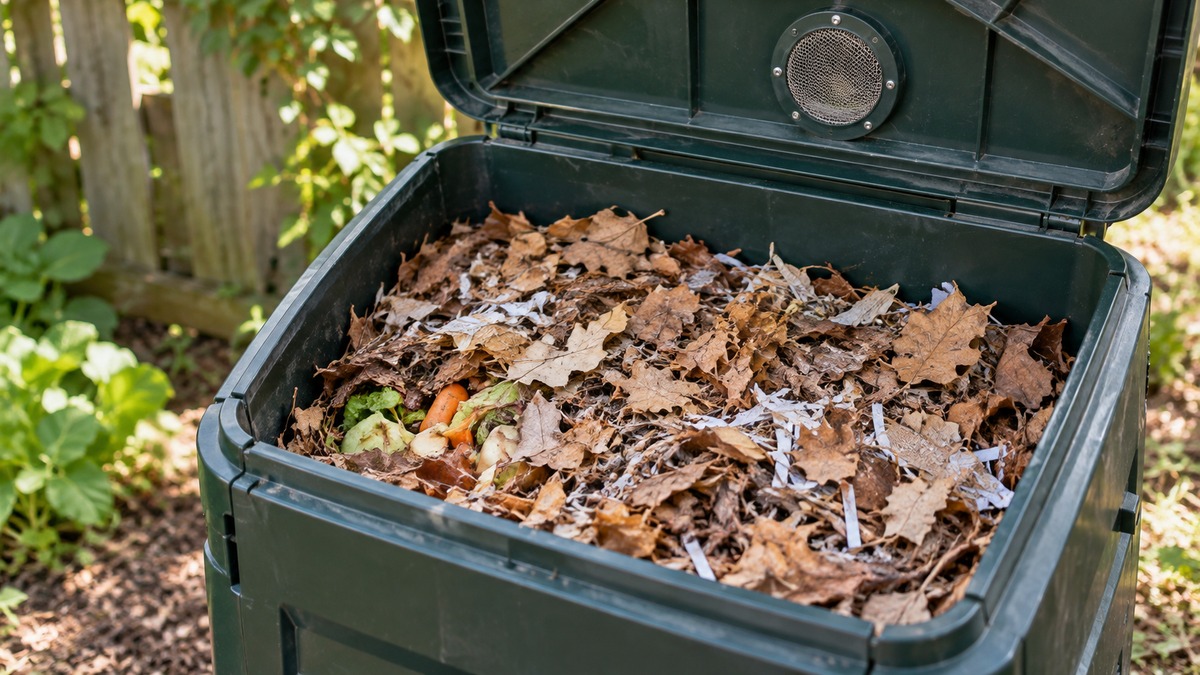
The Massachusetts document makes the balance point directly for outdoor bins. It says that “If fruit flies become a nuisance in an outdoor compost bin, this indicates that the ratio of food scraps to high carbon material is too high.” Its fix is to add high-carbon material: “Add enough high carbon materials, such as brown leaves, shredded paper or cardboard, until this material comprises at least 50 percent of the total material in the bin.” It also suggests a surface layer: “Try to keep about 12 inches of high carbon material on the surface of your pile, under which the food scraps are buried.” For the basic pile setup, see our guide to setting up an outdoor compost pile.
Clean the drains, the buckets and the bin
The University of New Hampshire page names the less obvious breeding spots. It says: “The insects also breed on organic slime in drains and compost buckets and in wet mops.” That is why the kitchen cleanup covers more than the bin itself. The same page advises: “Keep kitchen drainpipes, traps and garbage disposal pipes clean.”
The Arizona publication asks for the same routine on sinks: “Clean sinks and drains regularly, making sure to keep them unclogged and free of organic matter.” For the bucket, the Charleston guide gives a simple method: “Rinse empty bins regularly with hot, soapy water between collections to get any eggs out that have been laid.” Empty the bucket each time you take scraps out, and rinse it before you put it back under the sink.
Store produce cold and wash it
Fruit flies do not always arrive in the bin. The Charleston guide warns that “Often when you purchase fresh fruits and vegetables, fruit fly eggs travel into your home ON that produce.” Its advice is to wash produce to remove eggs, and to keep fresh items out of the open. The University of New Hampshire page gives the storage rule in four words: “Refrigerate all fresh fruits and vegetables.”
The same Charleston guide also describes freezing scraps between trips, and says: “The cold temperature will kill any fruit fly eggs.” It advises that you “store food scraps temporarily in the freezer in between visits” if you have the room. The sheet gives no time or temperature for this step, so this guide does not give one either. If freezer space is limited, the other steps still apply.
Use traps as a backup
Traps catch the flies already in the kitchen, and they do not stop new eggs. The Charleston tip sheet gives a vinegar cup. It says to “Add equal parts water and vinegar (best is apple cider vinegar or balsamic vinegar) so the container is about 1/4 – 1/2 full,” then to “Add three drops of dish soap on top and gently swirl.” The guide explains why it works: “The scent of the vinegar attracts the flies and the soap cuts the surface tension of the vinegar so they sink and drown.” It also says to “Clean out and replenish cups as needed all summer.”
The University of New Hampshire page describes a paper funnel in a jar: “You can make your own trap inserting a paper funnel (rolled from a sheet of notebook paper) into a jar baited with a few ounces of cider vinegar.” It advises to “Place the jar trap(s) wherever you see fruit flies.” The same page is clear about how much weight traps carry: “Although trapping is nowhere near as effective as practicing good kitchen sanitation.”
The Massachusetts document describes a banana-peel trap for a worm bin, and it makes a strong claim: “Within 24 hours, about 99 percent of the fruit flies will be inside the plastic container.” That figure belongs to the document’s worm-bin setup. The sources we opened do not show the same result for an outdoor pile. If you keep a worm bin too, see our guide to keeping worms in a compost bin for that setup.
Watch the season
The University of New Hampshire page describes the flies’ timing: they “seem to appear out of nowhere in mid to late summer, then disappear with the arrival of cold weather in fall.” The Arizona publication agrees that the flies are “especially active during warm summer months.” That makes summer the time to be strict about lids, scrap removal and drains, since the flies are most active then.
Plan the work around that window. Start the lid and drain routine before the warm months, and keep the outdoor pile balanced through summer. The sources do not give a start date, so use the first warm week in your area as your cue, based on your own weather.
Know the difference from fungus gnats
Fungus gnats are a different insect, and the Massachusetts document describes them separately. It says they are “usually about 1 millimeter in size,” and that they are attracted to moisture and fungus, which is why they also visit compost bins. The document says: “There currently seems to be no method for trapping fungus gnats.” Its advice is to remove what attracts them: “their presence can be controlled by eliminating what attracts them, moisture and fungus, from the area where the gnats are not wanted.”
If gnats seem to come from houseplants, the same document reads that as a moisture sign: “If fungus gnats seem to be coming from your house plants, this may indicate too much moisture.” Check the pot and the bin for damp spots, and let the top layer dry where you can.
Mistakes that keep the flies coming
- Leaving the lid off between trips. The Arizona publication asks for closed lids when containers are not in use.
- Keeping scraps in the kitchen longer than a day or two. The Charleston guide sets the limit at one to two days.
- Leaving fresh produce on the counter. The Charleston guide says fruit flies are attracted to produce “whether it is ripe, rotting or decaying,” and it recommends the fridge.
- Running an outdoor pile heavy on food. The Massachusetts document ties nuisance flies to a food-to-carbon ratio that is too high.
- Ignoring the drain. The University of New Hampshire page names drains and buckets as breeding spots.
- Relying on traps alone. The University of New Hampshire page says trapping is far less effective than sanitation.
How we chose
We built these steps from five pages: the Massachusetts fly and gnat document, the University of New Hampshire fruit fly publication, the University of Arizona household fly publication, the City of Charleston kitchen bin tip sheet, and the Alabama backyard composting publication. We kept a step only when one of those pages states it directly. Where a page describes a worm bin rather than an outdoor pile, the text says so. We did not use any product, retail page or pest-control service, and this guide leaves out chemical control advice.
What we could not verify
The pages cover prevention and trapping well, but they leave some questions open. This section sets out the gaps so you can plan around them.
What the sources do not say
The sources do not give a time or temperature for freezing scraps. The Charleston guide says the cold “will kill any fruit fly eggs,” but it gives no figure, so this guide gives none. The Massachusetts trap figure of 99 percent comes from a worm-bin setup, and the document gives no equivalent number for an outdoor bin. The only timing in the Massachusetts document is three or four days for a worm bin, and that note depends on no more food being added. The pages do not compare lids or bin designs, so this guide makes no claim about which bin works best. They also do not give a count of traps per bin. This guide sticks to sanitation and trapping and leaves other control methods out.
Frequently asked questions
Do fruit flies come from the compost itself?
They breed in moist organic material. The University of New Hampshire page says: “Female fruit flies lay as many as 2,000 eggs singly on the surface of moist, unrefrigerated organic materials.” Kitchen scraps waiting to go outside are one such place, which is why the sources focus on lids, short storage and burying. The pages do not rank the kitchen bin against the outdoor pile, so this guide treats both.
Are fruit flies dangerous?
The Massachusetts document says that “These insects are not dangerous or harmful; however, their presence can be a nuisance, particularly indoors.” The University of New Hampshire page adds a caution about food: fruit flies “do have the potential to contaminate food with bacteria and other disease-producing organisms.” That is a reason to keep them away from food prep areas, not a reason to panic.
Is it worth moving a kitchen bin outside?
The Charleston guide suggests it in summer: “Consider storing your bin outside during summer months instead of inside your kitchen.” It does not give the same advice for winter. The University of New Hampshire page says the flies disappear with the arrival of cold weather in fall, so the seasonal pattern is the clearest guide the sources offer.
Does a banana peel trap work in an outdoor compost bin?
The Massachusetts document describes its banana-peel trap for a worm bin, and its 99 percent figure is the document’s own claim for that setup. No page we opened reports that result for an outdoor pile. Treat the trap as a backup to burying scraps and balancing the pile, not as the main fix.
Is a fungus gnat the same as a fruit fly?
No. The Massachusetts document says fungus gnats are “usually about 1 millimeter in size” and that they are attracted to moisture and fungus. Its advice is to remove what attracts them, and it says there is no current trapping method for them. If gnats come from houseplants, the document reads that as a sign of too much moisture.
Sources
- https://www.mass.gov/files/documents/2018/02/05/flies-gnats.pdf (opened 2026-10-22)
- https://extension.unh.edu/sites/default/files/migrated_unmanaged_files/Resource000535_Rep557.pdf (opened 2026-10-22)
- https://extension.arizona.edu/sites/default/files/2024-08/az2052-2023.pdf (opened 2026-10-22)
- https://www.charleston-sc.gov/DocumentCenter/View/32222/Managing-Fruit-Flies-in-Your-Kitchen-Compost-Bin (opened 2026-10-22)
- https://www.aces.edu/wp-content/uploads/2018/11/ANR-0638.REV_.pdf (opened 2026-10-22)