Best Heavy Duty Plant Pot Feet: Seven Risers Compared by Height, Material and Pack Count
As an Amazon Associate we earn from qualifying purchases. Details
The best heavy duty plant pot feet are rubber or rigid plastic risers that lift a pot off a deck or patio, keep its drainage hole clear, and stay put under a heavy planter. The person typing best heavy duty plant pot feet wants feet that will hold a full pot without crushing, that will not slide on a deck board, and that will leave the drainage hole open. This guide compares seven pot feet from their listings, works out the height and pack count from the listed figures, and checks the drainage job against three university extension publications on containers.
Quick answer
- Start with the drainage hole. NC State Extension says “Drainage holes are necessary in all containers to prevent plant roots from standing in water and developing root rot.” Feet help keep that hole clear, but they do not replace it.
- Check the height in the listing before you buy. Listed heights run from about 0.5 inches to about 1 inch, and some listings give only a diameter or a bag weight.
- Count the pack against your pots. A 12-pack gives three sets of four feet, and a 24-pack gives six, so the pack size decides how many pots you can lift.
- Treat load claims as the seller’s claim. One listing says its feet “support up to 6000 lbs,” and we did not find a test standard for that figure in the listing.
What pot feet are for
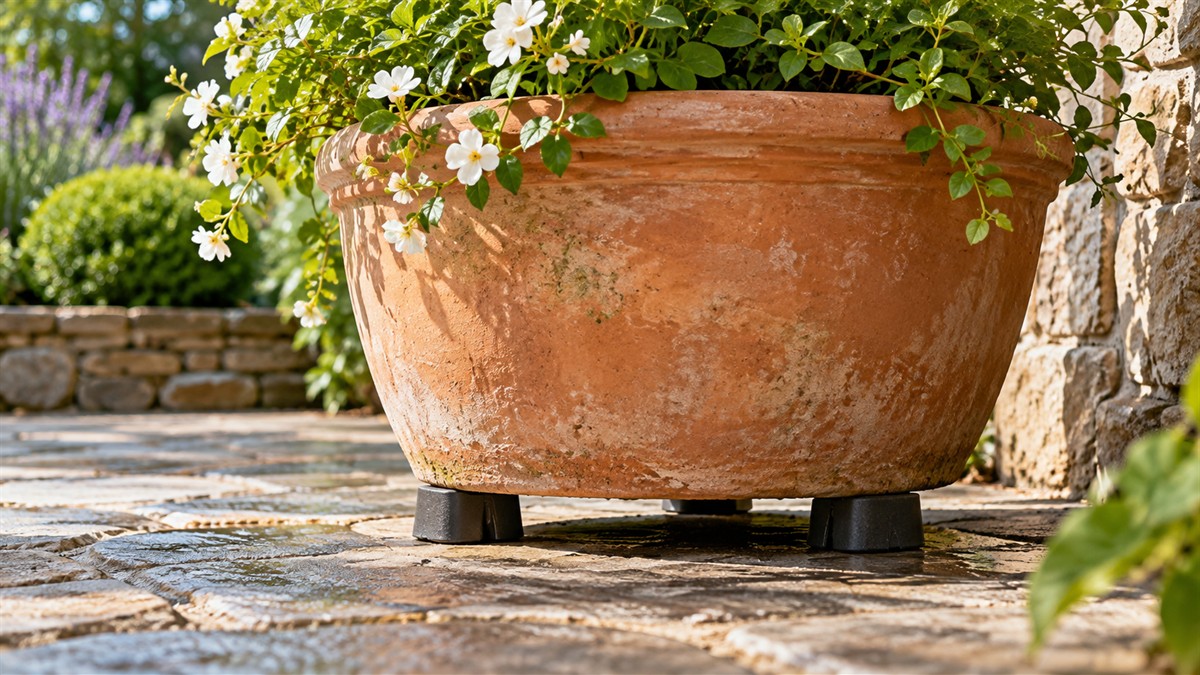
A pot standing flat on a hard surface blocks its own drainage hole. NC State Extension gives the practical fix for that case: “If the container sits flat on a solid surface such as a paved patio, drainage holes can be placed along the side of the container, ¼-inch to ½-inch from the bottom.” Feet are the other fix. They lift the bottom edge of the pot so that water can leave through the base instead of pooling on the surface.
The drainage hole remains the requirement. Iowa State Extension’s container guide says “All containers must have a drainage hole,” and adds that “Putting a layer of gravel in the bottom does not make up for the lack of a drainage hole.” Pot feet do not fix a pot that has no hole, and they are not a reason to buy a solid planter with no opening at the base.
Wisconsin Extension explains why standing water matters. Its root rot article says that “Root rot is a general term that describes any disease where the pathogen (causal organism) causes the deterioration of a plant’s root system.” A raised pot that drains well is one way to reduce the wet conditions that let that disease take hold, but the sources we opened do not say how much height a foot needs to achieve that.
Height is the first number to check
The height of a foot sets how much air and water can move under the pot. The listings give that height in different ways, so the table below converts each figure to inches where the listing gives centimeters, and it marks the figures the listing does not give.
| Listing (listed brand) | Pieces in pack | Height as listed | Diameter or footprint as listed |
|---|---|---|---|
| UFelice invisible risers | 24 | Not stated | Round; 35 g per piece |
| AlpineReach hexagon feet | 20 | Not stated | Hexagonal |
| Ziopetru solid rubber | 24 | 0.5 inch | 1.8 inch diameter |
| The Garden Gecko dual size | 20 | 0.55 inch | 1.89 by 1.89 inch |
| Ruinuonice triangular | 12 | 2.5 cm (about 0.98 inch) | 7 by 6 cm (about 2.76 by 2.36 inch) |
| Eptcp triangular | 24 | 0.87 inch | 2.75 by 2.25 inch |
| Petzriz EPDM rubber | 24 | Not stated | Round |
The lowest feet in the group are the Garden Gecko and Ziopetru pieces at about half an inch. The Ruinuonice feet are about the same height in centimeters, at 2.5 cm, which converts to about 0.98 inch. The tallest measured foot is the Eptcp at 0.87 inch. A foot under an inch leaves a narrow gap, and a wet deck board can still hold water in that gap. The listings do not say which height is best for a given pot, so the choice depends on how wet your surface gets and whether the gap stays open.
The listings also disagree with themselves on size. The Ruinuonice bullets give 7 by 6 by 2.5 centimeters, while its dimension row reads 1 by 1 by 1 inch. We use the centimeter figures from the bullet, since they are more specific, and we note the mismatch.
Material, weight and what the listings say about it
Four materials appear across the seven listings: solid rubber, EPDM rubber, polypropylene (PP) plastic and a rubber described only as “non-slip.” The material decides how a foot handles a heavy pot and a wet deck. The Garden Gecko and UFelice listings describe solid rubber, and the UFelice bullet gives a weight of “35G (1.23oz) PER PIECE.” The Garden Gecko listing gives “35g per piece / 700g per pack,” which matches its 20-piece pack: 20 times 35 is 700 grams.
The Ziopetru listing gives a pack weight of 15.5 ounces for 24 pieces, which comes to about 0.65 ounces each. That is lighter per piece than the UFelice foot, and the listings do not explain the difference. The Ruinuonice and Eptcp listings describe PP plastic resin, and the Petzriz listing describes EPDM rubber. The Petzriz bullets say the rubber will “resist flattening, cracking, and wearing under massive loads,” but no weight or test figure is given.
Weight matters less than the base. A foot that flattens under a loaded pot stops lifting the pot, and rubber that cracks in the sun has to be replaced. The listings describe their materials as resistant to UV and weather in several places, and those are claims we could not check against a standard.
How many pots a pack covers
A simple count shows how far a pack goes. Most pots sit on four feet, one at each corner. On that basis, a 24-pack covers six pots, a 20-pack covers five, and a 12-pack covers three. These counts are the arithmetic of the pack, not a rule about pots, because a round pot may need three feet and a large planter may need more.
A buyer with a long run of planters on a deck should count the pots first and then the feet. The Eptcp and Ziopetru packs both give 24 pieces, so they cover the same six pots, but the Eptcp feet are taller, at 0.87 inch against 0.5 inch for the Ziopetru. The UFelice pack of 24 lists 24 adhesive pads among its included components, so the pads decide whether a pack suits a surface you do not want to mark or move.
Load claims and the heavy duty label
“Heavy duty” is the word in the keyword, and it is the word the sellers use most. The AlpineReach listing says its feet are “Weather resistant and compression resistant rubber feet support up to 6000 lbs.” That is the largest load figure in this group, and it is the seller’s figure. The listing does not name a test body, a test method or a per-foot value, so a buyer cannot tell whether 6000 pounds is the total for a set or the limit for one foot.
The Garden Gecko listing calls its feet “A HEAVYWEIGHT CHAMP” and gives a weight per piece, not a load. The Ruinuonice and Eptcp listings describe PP plastic, which is a different material. The Petzriz listing describes “massive loads” without a figure. We treat all of these as descriptions. For a heavy pot, a buyer can check the foot’s rating only by asking the seller for the test method, which none of these listings supplies.
Surface protection and decks
Several listings say their feet protect a deck from water rings and stains. The Petzriz bullet says the feet “Prevent water rings, scratches, and stains on wooden decks, patios, and tiles.” The UFelice bullet says the feet prop plants “above lawns, patios, and decking to rise above the challenges of stains, soil build-up infestation.” The AlpineReach bullet says its feet “Prevent Surface Stains” by providing ventilation and drainage.
These are plausible uses, because a raised pot leaves a gap for air and water, but the sources we opened do not test a deck finish. The NC State guidance supports the drainage side: the drainage hole should not be blocked, and a pot sitting flat on a hard surface needs another route for water. Whether a given foot stops a stain is a claim we could not verify.
Decorative pots, saucers and gravel
Feet are often bought for a decorative pot, and a decorative pot is where the drainage advice gets ignored. NC State’s container chapter is direct about the trade-off: “If herbs or a fruit tree are to be showcased in an attractive pot that does not have drainage holes, the plant needs to be double-potted.” Double potting means a plain inner pot with holes sits inside the decorative outer one. A foot under the outer pot does not solve that problem, because the water still collects in the outer pot.
The gravel habit is the next thing to avoid. NC State also says: “Never put a layer of gravel or rocks in the bottom of a container beneath the potting mix in an effort to improve drainage.” Iowa State Extension makes the same point about the hole, so a buyer who uses feet for drainage should check the pot’s base before putting anything else under it.
Iowa State’s container guide also addresses the saucer question. It says that “A tray or saucer to collect excess water is not required, especially for outdoor containers.” For a pot on a deck, a foot can serve the same purpose as a saucer, which is to keep the base out of standing water, but the saucer collects the water and the foot only lifts the pot. A pot on feet over a saucer is still sitting in whatever the saucer holds, so the saucer should be emptied after watering.
What a 6000-pound claim would mean
The AlpineReach figure is the largest number in this group, and it is worth working through. If the 6000-pound figure applies to one foot, a set of 20 feet would be rated far beyond any pot a home gardener would use. If it applies to the whole set, the figure spreads across the set and gives a much smaller number for each foot. The listing does not say which reading applies, so the claim is not usable as a per-foot rating.
The weight figures in the listings give a more modest scale. The UFelice listing gives 35 grams per piece, so 24 pieces at that weight come to 840 grams, or about 1.85 pounds, for the whole pack. The Garden Gecko pack of 20 pieces at the same 35 grams comes to 700 grams. Those numbers describe the feet themselves. They say nothing about how much a loaded pot weighs, and a buyer should weigh the pot with soil and water before deciding how many feet a pot needs.
A simple check is to ask the seller for the load test method, or to look for a stated per-foot rating in the listing title. Without that, a load figure is a description, not a measurement.
A checklist before you buy pot feet
Four checks cover most of the decisions in this guide. First, confirm that the pot has a drainage hole, because ISU says “All containers must have a drainage hole.” Second, check the base for gravel or rocks you may have added, since NC State advises against them. Third, read the height figure, and if it is missing, ask the seller for it before ordering. A foot at half an inch leaves a narrow gap compared with one near an inch, and the listings give no guidance on which gap a given pot needs.
The fourth check is the surface. NC State’s guidance for a pot on a paved patio is to place drainage holes “along the side of the container, ¼-inch to ½-inch from the bottom” when the bottom cannot drain. Pot feet are a second way to keep the base clear, so a pot with side holes on a patio may need only a light foot or none. The pack count and the surface then decide how many pieces to buy.
How we chose
We searched Amazon for heavy duty plant pot feet and read the first page of results. We kept seven listings from six listed brands. We required each to be a pot foot, riser or lifter sold as a set, and we excluded plant stands, caddies and wheeled trolleys, which are a different product. The height, material and count figures come from the listing bullets and specification rows, and we converted centimeter figures to inches where the listing gave them.
We did not use the number of reviews, the ranking or any star rating shown on the listings. The picks are described by what the listing says, not by a judgment of quality.
What we could not verify
We did not verify any load rating, UV or weather claim, or the stain protection claimed by several listings. The sources we opened describe drainage and root rot, not the load a foot can carry or the finish a foot can protect.
Several listings are missing the figure a buyer most needs. The UFelice, AlpineReach and Petzriz listings do not give a height in the rows we opened. The Ruinuonice listing gives two different sizes, and the AlpineReach listing gives a load figure without its basis. We report those gaps as they are.
We also could not verify how many pots a foot supports in practice, because the four-foot count is arithmetic and not a test. Pot weight, soil type and how wet a deck gets all change the answer, and no listing gives those inputs.
Picks
1. 24 Pack Invisible Pot Feet with Enhanced Non-Slip Surface Grip Plant Pots and Flowers, Solid Rubber (UFelice 24-pack invisible solid rubber risers with adhesive pads)
Specs from the listing (checked ):
- Included Components: 24 x Strong Adhesive Pads
- Unit Count: 24 Count
Pros
- The bullets give 35 grams, or 1.23 ounces, per piece for weight
- The listing includes 24 strong adhesive pads for securing the feet
- The bullets describe an invisible design that stays tucked under the pot
Cons
- The listing does not give a height for each foot
- The stain and soil build-up claim is a general claim with no test figure
Best for: A buyer who wants a heavy rubber riser that can be fixed in place
Skip if: You need a listed height or a load rating before you order
View on Amazon (affiliate link)
2. AlpineReach Extra Heavy Duty Pot Feet Risers 20 Pack Hexagons & Adhesive Pads – Protect Healthy (AlpineReach 20-pack hexagon feet with studded bottoms)
Specs from the listing (checked ):
- Shape: Hexagonal
- Set Name: 20 Pack
Pros
- The bullets describe six points of balance and studded bottoms
- The listing says the air gap beneath the pot helps water absorption and drainage
- The listing gives support up to 6000 lbs, which is the largest load figure in this group
Cons
- The 6000 lb figure has no test method or per-foot basis in the listing
- The listing does not state a height for the hexagon feet
Best for: A buyer who wants hexagon feet with a stated load figure
Skip if: You need the load figure explained before you rely on it
View on Amazon (affiliate link)
3. Ziopetru 24 Pack Non-Slip Rubber Pot Feet for Outdoor Indoor Planters (Ziopetru 24-pack solid rubber feet with an anti-slip base)
Specs from the listing (checked ):
- Shape: Round
- Item Dimensions: 1.8 x 0.4 x 1.8 inches
Pros
- The listing gives 1.8 inches across and 0.5 inches high
- The listing describes an anti-slip base for patios, decks and indoor floors
- The pack has 24 pieces and fits round, square, ceramic, resin and concrete pots
Cons
- The 0.5-inch height is low for a deck that stays wet
- The listing gives a pack weight of 15.5 ounces and no load rating
Best for: A buyer who wants a low, light set of rubber feet for many pots
Skip if: You want a foot high enough for a standing puddle
View on Amazon (affiliate link)
4. Little & Large Plant Pot Feet, Dual Size, 20 Pack (The Garden Gecko dual-size pot feet, 20 pack)
Specs from the listing (checked ):
- Set Name: Little & Large Invisible Pot Feet 20 Pack
- Item Dimensions: 1.89"D x 1.89"W x 0.55"H
Pros
- The listing says each piece can be used whole or pushed apart to double up
- The listing gives 35 grams per piece and 700 grams per 20-piece pack
- The inner piece is described as ideal for smaller succulent pots
Cons
- The listing gives 1.89 by 1.89 by 0.55 inches, so the height is under an inch
- The listing gives no load rating and no test method
Best for: A buyer with a mix of large and small pots on one deck
Skip if: You want a foot that lifts a large planter well clear of the surface
View on Amazon (affiliate link)
5. Pot Feet for Outdoor Planters, Invisible Breathable Pot Stands Toes Lifters for Heavy Indoor (Ruinuonice triangular planter feet, 12 pieces)
Specs from the listing (checked ):
- Item Dimensions: 1"D x 1"W x 1"H
- Set Name: 12 Pcs
Pros
- The bullets give 7 by 6 by 2.5 centimeters per foot
- The bullets describe PP plastic for long-lasting durability
- The bullets say the feet can also stabilize furniture
Cons
- The dimension row gives 1 by 1 by 1 inch, which conflicts with the centimeter figures
- The bullets name 12 and 24 sets in one line, so the pack count is unclear
Best for: A buyer who wants a small triangular foot for a few pots
Skip if: You need one clear pack count and a single size
View on Amazon (affiliate link)
6. 24 Pack Pot Feet for Outdoor Planters, Black (Eptcp 24-pack triangular outdoor risers in black)
Specs from the listing (checked ):
- Item Dimensions: 2.75"D x 2.25"W x 0.87"H
- Number of Pieces: 24
Pros
- The listing gives 2.75 by 2.25 by 0.87 inches for each piece
- The bullets describe thickened PP resin with UV and corrosion resistance
- The listing says the feet stack and adjust for uneven surfaces
Cons
- The UV and impact resistance are stated without a test standard
- The stacking design means a single piece may not stand alone under a pot
Best for: A buyer who wants a taller plastic riser that can be stacked
Skip if: You want a rubber foot rather than PP plastic
View on Amazon (affiliate link)
7. Plant Pot Feet Rubber Pot Risers Planter Feet for Outdoor Indoor Planters (Petzriz round EPDM rubber pot feet for indoor and outdoor use)
Specs from the listing (checked ):
- Shape: Round
- Indoor/Outdoor Usage: Indoor, Outdoor
Pros
- The bullets describe EPDM rubber that resists flattening, cracking and wear
- The listing says the feet protect decks from water rings and stains
- The listing gives indoor and outdoor usage in its specifications
Cons
- The listing gives no height and no diameter in the rows we opened
- The color is listed as Balck, which suggests a typing error on the listing
Best for: A buyer who wants round rubber feet for a deck or a patio
Skip if: You need a listed height before you order
View on Amazon (affiliate link)
FAQ
Do pot feet fix a pot with no drainage hole?
No. Iowa State Extension says “All containers must have a drainage hole.” Feet lift the pot, but they do not make water leave a solid container. Drill or buy a pot with a hole before you rely on feet.
How high should pot feet be?
The sources we opened do not give a height for pot feet. NC State describes side drainage holes for a pot sitting flat on a paved patio, which suggests that a gap under the pot matters. The listed heights here run from about half an inch to just under an inch, so a buyer should pick the height that matches how wet the surface is.
Will rubber feet stop a stain on a deck?
The listings say so, but we did not verify it. The drainage advice from NC State is the sound part: a pot that drains through the base is less likely to sit in water on a board. The finish of the deck and the feet’s material both change the result.
How many pot feet do I need per pot?
Most pots sit on four feet, one at each corner, which is the count this guide uses. A large planter may need more, and a round pot may work with three. The pack count tells you how many pots you can cover, not how many you need for each.
Can I use the feet indoors?
The Petzriz specification row lists indoor and outdoor usage, the Ziopetru bullets name patio, deck and indoor floors, and the Ruinuonice listing mentions use under furniture as well as pots. The drainage advice still applies inside, because the root rot problem comes from water that cannot leave the pot.
Bottom line
Pick the foot by height and pack count first, check that the pot has a drainage hole, and treat the load and stain claims as the seller’s claims until you have a test figure. A foot that lifts the pot clear of a wet surface does the job the sources describe.
Related reading: Best Diy Planter Box for Deck Railing covers the deck-side planter choice, and Best Using Raised Bed Soil in Pots covers the soil side of a pot on a deck.
Sources
- NC State Extension, Gardener Handbook Chapter 18: Plants Grown in Containers: https://content.ces.ncsu.edu/extension-gardener-handbook/18-plants-grown-in-containers
- University of Wisconsin-Madison Division of Extension, Root Rots on Houseplants: https://hort.extension.wisc.edu/articles/root-rots-houseplants/
- Iowa State University Extension, How to Select Quality Plant Containers: https://yardandgarden.extension.iastate.edu/how-to/how-select-quality-plant-containers