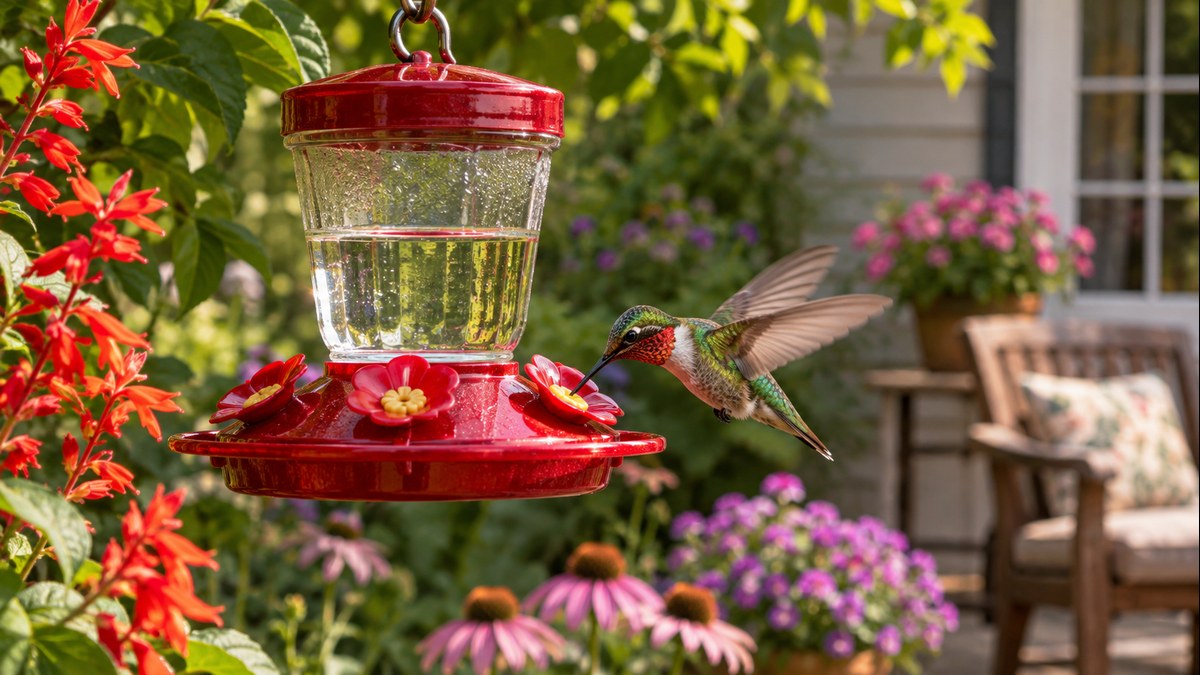
Youvip Metal Roof Bird Feeder Review
As an Amazon Associate we earn from qualifying purchases.
This Youvip metal roof bird feeder review covers a hanging seed feeder with a metal top and base, a steel cable for height adjustment, and a 360-degree perch. The Amazon listing describes the feeder as chew-proof, quick to take apart, and easy to refill with one hand. The listing names finches as the target species and gives the option color as bronze, sold as a single 1.7-pound unit. This page sticks to what the listing states and what three university extension sources say about feeder cleaning, placement and squirrels. It makes no claim about how the feeder performs in a yard, and it does not rank it against other feeders.
Quick answer
- The listing describes a metal top and base, a 360-degree perch, a high guardrail seed tray, and a steel cable for hanging height.
- The listing says the feeder disassembles without tools and can be refilled with one hand by pressing a roof button and sliding the roof up.
- Extension guidance says seed feeders should be cleaned at least every two weeks, and that feeders work best near cover and beyond squirrel jumping distance.
- The chew-proof and squirrel-damage claims are manufacturer statements. This page does not verify them.
What the listing says
The specification table lists the brand as Youvip, the material as metal, and the target species as finch. The recommended use is seed. The special features are 360-degree perch, chew proof, easy-refill top, and a metal roof described as more stable. The option shown is 1 piece weighing 1.7 pounds, in bronze. The table does not give product dimensions, seed capacity, or a hook type, so those figures are not reported here.
The About this item bullets make the main claims. The top and base are described as metal, which the listing says makes the feeder sturdier and resistant to squirrel damage. The seed tray is described as having a high guardrail that keeps seed from falling while birds feed. The bullets say the feeder takes about 30 seconds to disassemble without tools, and that the roof lifts with a button for one-handed refilling. The 360-degree perch is described as letting several birds feed at once, and the steel cable is described as adjustable to set the hanging height.
The listing also says no assembly is required and presents the feeder as a gift for families and children. The gift language is marketing copy. The listing does not describe the gauge of the metal, the coating on the top, or the diameter of the seed ports, so those points are not stated here.
All-metal build and chew resistance
The listing says the top and base are made of metal, and that advanced metal processing makes the feeder more sturdy for outdoor use and resistant to squirrel damage. Chew resistance matters because squirrels and rodents gnaw plastic feeders. The listing does not describe a metal test, a gnaw test, or a warranty against chewing. The claim is therefore a manufacturer statement, and a buyer who has seen a squirrel chew through a plastic feeder should check the claim against their own yard conditions.
The listing does not say whether the seed tray is metal or plastic. The bullets describe the tray as a high guardrail design, so the tray material matters for chew resistance. A buyer who wants a fully metal feeder should check the material of the tray before ordering. The listing names the top and base only.
The extension guidance on squirrels is useful background. The Penn State Extension article says that many feeders on the market claim to be squirrel proof, and that squirrels are intelligent and hard to outsmart. A feeder that resists chewing solves one problem, but it does not stop a squirrel from reaching seed if the feeder hangs within jumping distance of a branch or fence.
Refilling and cleaning
The one-handed refill is the feature the listing spends the most words on. The bullets say to press the roof button and slide the roof up, where it locks in place on the steel cable. The listing says the feeder does not need to be taken off the cable to refill. That is useful for a feeder hung high on a pole or a tree.
The NC State Extension guidance on washing bird feeders gives the cleaning rule. It says seed feeders should be cleaned at least every two weeks, and more often when there are many visitors, when there is rain, or when dead birds are found in the yard. It says to soak each section in a diluted bleach solution or hydrogen peroxide for 10 minutes. It says that research shows that 10% bleach (1 part bleach to 9 parts water) is the most effective method to get rid of salmonella. It also says to scrub each part, rinse all parts, and allow the feeder to dry completely before refilling.
The listing says the disassembly takes about 30 seconds and that the feeder is easy to maintain and refill weekly. The weekly refill is a manufacturer suggestion. The extension guidance gives a longer cleaning interval for the wash itself, so a buyer should refill weekly and wash every two weeks, as the guidance says.
The same NC State guidance says to sweep up spilled seed and empty hulls from the ground once a month. A feeder with a high guardrail tray may drop less seed, but the listing does not claim that seed never falls. Buyers should still plan the monthly cleanup.
Perch design and bird access
The listing describes a 360-degree perch that lets multiple birds feed at the same time without being limited to fixed feeding holes. That is a claim about layout. It means birds can approach from more than one side. The listing does not give the number of feeding ports or the size of the openings, so a buyer cannot tell from the page how many finches the feeder can serve at once.
The listing names finch as the target species, and the seller describes the feeder as suited to wild birds in general. Finches are small seed eaters, and a seed tray with a guardrail is a common feature on feeders for small birds. The listing does not describe a perch size, so buyers who want to attract larger birds should check whether the perch fits them.
For more on choosing seed for finches and other small birds, see the how to choose bird feed guide. For goldfinch-specific advice, see how to attract goldfinches.
Placement near cover
The UNH extension guidance on feeder placement says birds visit feeders placed close to branches of trees or shrubs, especially evergreens, more readily than feeders in the open. It says feeders in the open are more exposed to the elements and to predators. That advice favors hanging this feeder near cover. The listing’s adjustable steel cable lets a buyer set the height, which helps place the feeder at a useful height in relation to nearby branches.
The same UNH guidance says that if squirrels are a problem, a buyer should use baffles and place the feeder just beyond jumping distance. The Penn State guidance describes a baffle as a bowl- or umbrella-shaped plastic or metal barrier placed on the pole on which the feeder is mounted. It adds that the idea behind a baffle is that squirrels cannot get past it, although they often do. A buyer who hangs this feeder from a pole should plan for a baffle regardless of the chew-proof claim.
The listing does not say whether the feeder includes a baffle or hanging hardware for a pole. Buyers should check what is in the box before planning the mount.
Who this feeder suits
This feeder fits a buyer who wants a hanging seed feeder with a metal top and base, a one-handed refill, and a simple cleaning routine. It is a reasonable choice for a yard where finches are common. It is less suited to a buyer who wants a feeder that is guaranteed squirrel-proof, because the listing makes a damage claim, not a squirrel-proof guarantee. It is also less suited to a buyer who needs a large seed capacity, since the listing does not give one.
How we chose this product
This page was built from the product fields on the Amazon listing and from three university extension sources. The listing fields were copied into the research notes as written. The product was not selected from a ranking, and no model was compared against another in this draft.
What we could not verify
We could not verify the chew resistance of the metal top and base, the squirrel-damage claim, the roof lock, the perch design, or the disassembly time. The listing is the only source for those points. The extension sources address general cleaning and placement, not this model.
What the sources do not say
The NC State guidance does not discuss hanging feeders with metal tops. The UNH guidance does not give a seed capacity, a cleaning interval, or a tray design. The Penn State guidance covers baffles on poles and does not discuss this model. None of the three sources gives a rating for metal gauge, coating durability, or chew resistance.
Frequently asked questions
Is the feeder squirrel-proof?
The listing says the metal build is resistant to squirrel damage. It does not claim the feeder is squirrel-proof. The Penn State guidance says baffles often fail to stop squirrels, so placement and a baffle matter.
How often should the feeder be cleaned?
The NC State Extension guidance says seed feeders should be cleaned at least every two weeks, and more often in wet weather or when there are many visitors.
Does the listing say the feeder needs assembly?
The listing says no assembly is required and that the feeder can be disassembled without tools for cleaning.
Sources
- NC State Extension, McDowell County Center, Washing Bird Feeders. https://mcdowell.ces.ncsu.edu/news/washing-bird-feeders/ (HTTP 200, opened 2026-10-27).
- University of New Hampshire Cooperative Extension, bird feeding guidance (PDF). https://extension.unh.edu/sites/default/files/migrated_unmanaged_files/Resource000899_Rep952.pdf (HTTP 200, opened 2026-10-27).
- Penn State Extension, Squirrels and Bird Feeders. https://extension.psu.edu/squirrels-and-bird-feeders (HTTP 200, opened 2026-10-27).