How Does Temperature Change Mosquito Larval Development?
As an Amazon Associate we earn from qualifying purchases.
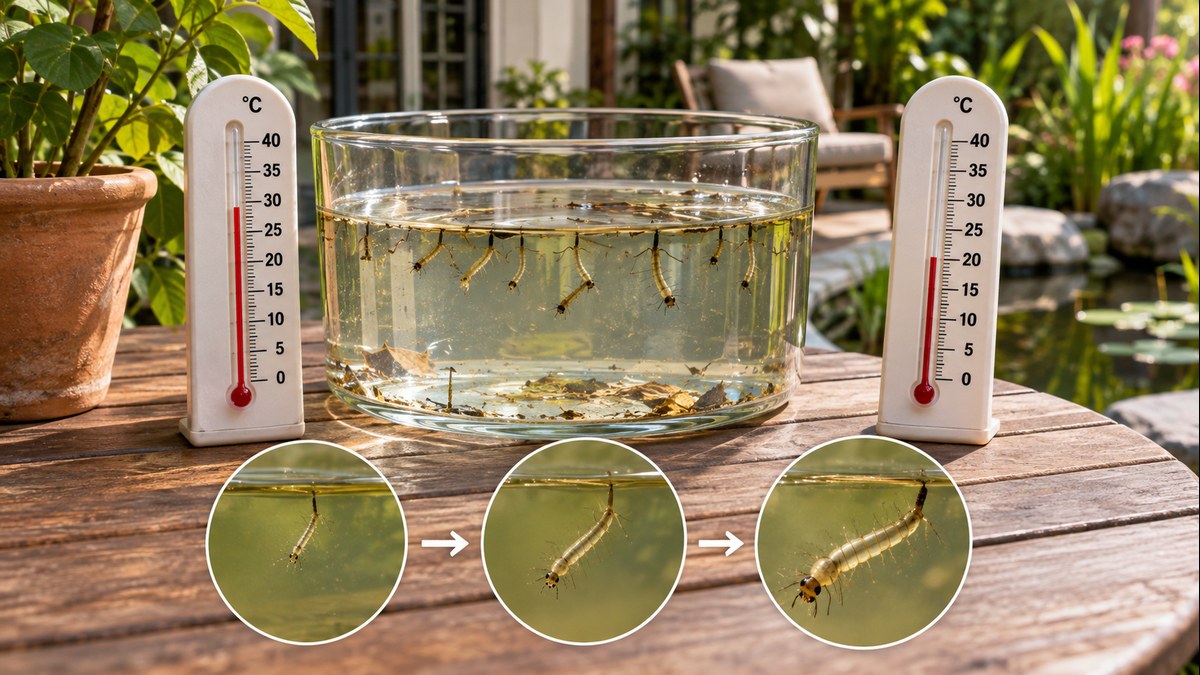
How does temperature change mosquito larval development? Temperature changes how fast a mosquito larva grows, how long each larval stage lasts, and how well the larva survives when food runs short. The short answer is that warmer water generally speeds larval development. The longer answer matters more for gardeners and wildlife watchers: the same warmth also changes how much energy a larva has in reserve, and that can make a larva less able to survive a lean period. This article explains the mechanism, using two peer-reviewed sources on Aedes mosquitoes, and states clearly where the sources stop.
Quick answer
- Higher temperature increases the development rate of mosquitoes, and it reduces the time each larval instar takes.
- Warmer larvae that also lack food may run short of energy sooner, which lowers starvation survival in early instars.
- Larval size and adult wing size shift with temperature, so temperature affects the adults that emerge as well as the timing.
Why temperature speeds the larval clock
A meta-analysis of Aedes studies describes temperature as a crucial determinant influencing the biology of mosquito vectors such as larval development and survivability. In the Aedes aegypti experiments, the authors state that heightened temperature increases the development rate of mosquitoes. That is the basic direction of the effect: more heat, faster progress through the larval stages.
The same experiments also found that increased temperature reduced the duration of each instar. A larva passes through four larval instars before it becomes a pupa. When each instar takes fewer days, the whole larval period is shorter.
The effect is not limited to the larvae themselves. The review notes that smaller adults are associated with faster larval development at higher temperatures. It also reports that, in general, the wings of Aedes mosquitoes are shorter at higher temperatures than at lower temperatures. So a warm larval period can produce a faster-developing larva, and the adult that results can be smaller with shorter wings.
Food, energy and the trade-off
Development speed is only half of the picture. Food limitation also affects how fast a larva develops. The Aedes aegypti study states that food limitation reduces development rate by prolonging the attainment of a critical level of energy reserves, which are likely to trigger the physiological processes resulting in pupation. In other words, a larva that has too little food takes longer to build the energy stores it needs before it can pupate.
The study then makes the central point. Starvation resistance in Aedes aegypti depends on both instar and temperature, generating a tradeoff between increased development rate and reduced starvation survival of early instar larvae. The authors explain that this trade-off is particularly strong in the lower and middle temperatures of the dengue endemic 20-30°C range. Put simply, the warmth that speeds a larva up can also leave it with less reserve when food is scarce.
The data behind this point are specific. Increased temperature (above 22°C) consistently reduced starvation resistance in the first larval instar. The study also found that both growth rate and starvation resistance were lower in the first three larval instars than in the fourth, where greater than 75% of growth occurred. The early instars are the stage the study singles out for this trade-off.
Why starvation kills larvae
The mechanism behind starvation death is energy use. The study explains that by depleting energy reserves, starvation will directly induce mortality when larvae are no longer able to maintain basal metabolic functioning. A larva that cannot maintain its basal metabolism runs out of the reserves it needs.
The study asked how temperature affects the capacity of larvae to withstand starvation, and the answer is that it depends on the instar. The authors also describe a second source of energy loss in crowded containers: energy depletion may occur through density dependent resource competition with other larvae.
Water temperature itself can vary. The study notes that water temperature may vary broadly in the larval container environments of Aedes aegypti.
What the experiments measured
The experiments were designed to separate the effects of temperature from the effects of food. The authors carried out experiments at 2°C intervals between 20 and 30°C on the growth, maturation rate and the longevity of optimally fed larvae placed in starvation. Larvae were transferred daily and monitored daily until death or pupation.
The results are therefore instar-specific. The study reports that in L2-L4, 2°C increments decreased starvation resistance between 20 and 24°C, but had weaker and instar-specific effects above 24°C. The effects differ between the lower range and the range above 24°C.
How we chose
Both sources were chosen because they address mosquito larval development directly and both are available as full text from PubMed Central. The first is a systematic review and meta-analysis of Aedes studies, which pools results across many experiments. The second is a laboratory study of Aedes aegypti larvae, which reports measured survival and development at set temperatures. Together they cover the general pattern and the detailed mechanism.
Both pages were fetched directly and returned full article text. Each claim in this article is tied to a verbatim quote in the research note for this slug. Statements that the sources do not support have been left out rather than filled in from memory.
What we could not verify
The two sources do not give one universal number of days for each temperature. The meta-analysis reports development time as a theme with high heterogeneity across the studies it pooled, so the exact days depend on the study, the species and the conditions. This article therefore does not give a day-count table for a given temperature.
What the sources do not say
The sources do not give a single temperature at which larval development is fastest for every Aedes species. They also do not describe every mosquito genus or every container type, and the Aedes aegypti laboratory study covers only one species at 2°C steps. Readers who need an exact timetable for a specific location should look for local data, because the sources do not provide one. For broader garden context on how warm conditions change decomposition and organic matter, see how to speed up composting at home.
Frequently asked questions
Does warmer water always make mosquito larvae grow faster?
The sources report that heightened temperature increases the development rate of mosquitoes, so the general direction is faster development in warmer water. The same sources also show that the speed comes with a cost in starvation survival, especially for early instars. Speed alone does not describe the whole effect.
Why do early-stage larvae die more often without food when water is warm?
The Aedes aegypti study found a trade-off between increased development rate and reduced starvation survival of early instar larvae. It also reports that increased temperature (above 22°C) consistently reduced starvation resistance in the first larval instar. Warm early larvae therefore have less reserve to survive a food shortage.
Do mosquito larvae become adults that are smaller in warm conditions?
The meta-analysis states that smaller adults are associated with faster larval development at higher temperatures. It also says that in general, the wings of Aedes mosquitoes are shorter at higher temperatures than at lower temperatures. The sources link warmth to smaller adults with shorter wings.
Why does crowding matter in a container?
The starvation study describes energy depletion through density dependent resource competition with other larvae. The sources do not give a density threshold.
Do the sources tell me how to control mosquitoes in my garden?
No. The sources describe how temperature and food affect larval development and survival in laboratory and review settings. They do not describe control methods, and this article does not offer any. For related garden reading that stays on the soil and compost side, see how to compost at home for beginners.
Sources
- Systematic review and meta-analysis of the effects of temperature on the development and survival of the Aedes mosquito. https://pmc.ncbi.nlm.nih.gov/articles/PMC9806355/ (checked 2026-10-28, HTTP 200)
- Temperature induces trade-offs between development and starvation resistance in Aedes aegypti (L.) larvae. https://pmc.ncbi.nlm.nih.gov/articles/PMC3136550/ (checked 2026-10-28, HTTP 200)