How Does Sunlight Fade Fabric Dyes?
As an Amazon Associate we earn from qualifying purchases.
Gardeners often ask how does sunlight fade fabric dyes, and the research answer is chemical. The studies describe the dye molecule itself changing under light, which changes the color it reflects. This article explains that mechanism using two peer-reviewed studies from the PubMed Central archive. One study examines a historical silk curtain dye, and the other examines cotton knitwear exposed to daylight. Both describe the chemistry at a level that a gardener or homeowner can follow, and both are limited to the materials they tested.
Quick answer
- Light can break down the dye molecule, which changes the color that the fabric reflects.
- A historical curtain study names the degradation of the dye by light as the cause of the color change.
- Reactive dyes on cotton form covalent bonds with the fiber, which the cotton study connects to durable color.
- The sources do not give a fade rate for a specific fabric in a specific garden or patio setting.
How we chose these sources
Both sources are research articles that examine fading directly. The first studies a silk marquisette curtain from a historical collection, and it identifies the dye and its degradation pathway. The second studies dyed cotton knitwear under natural sunlight and artificial light. Neither is a retail or product page, so the claims below stay close to their wording.
Light changes the color by changing the dye
The historical curtain study states the cause of the change plainly. It says that "As panel curtains, they were exposed to light, and so underwent fading." The fading is attributed to exposure to light, and the study then looks at the dye that gives the curtain its color.
The study identifies the dye and its breakdown route. It reports that "The textile colorant was identified as malachite green (MG), and its degradation by light was subsequently studied by dynamic photolysis experiments in a kinetic solution for the rapid exploration of by-products." The word photolysis means the breakdown of molecules by light, and the study used it to look at the dye’s by-products.
The study also states that the breakdown is a set of chemical steps rather than a simple loss of color. It says that "The main degradation pathways were thus identified and the factors responsible for the induced color changes were discussed." The color change is therefore linked to specific pathways in the dye molecule.
The introduction gives the same explanation in broader terms. It says that "Although it has excellent qualities, such as brilliant shades and high tinting strengths, the color could change greatly, resulting from the chemical processes that occur on its exposure to light". The bright color that makes the dye attractive is the same property that can change when light reaches the molecule.
Why some dyes hold color longer
The cotton study explains how a common dye type is made to last. It says that "In cotton fibres, colouration is primarily achieved using reactive dyes, i.e., chemical compounds that strongly absorb visible light and form covalent bonds with cellulose". The study describes the result of this bonding as "durable and vibrant colouration".
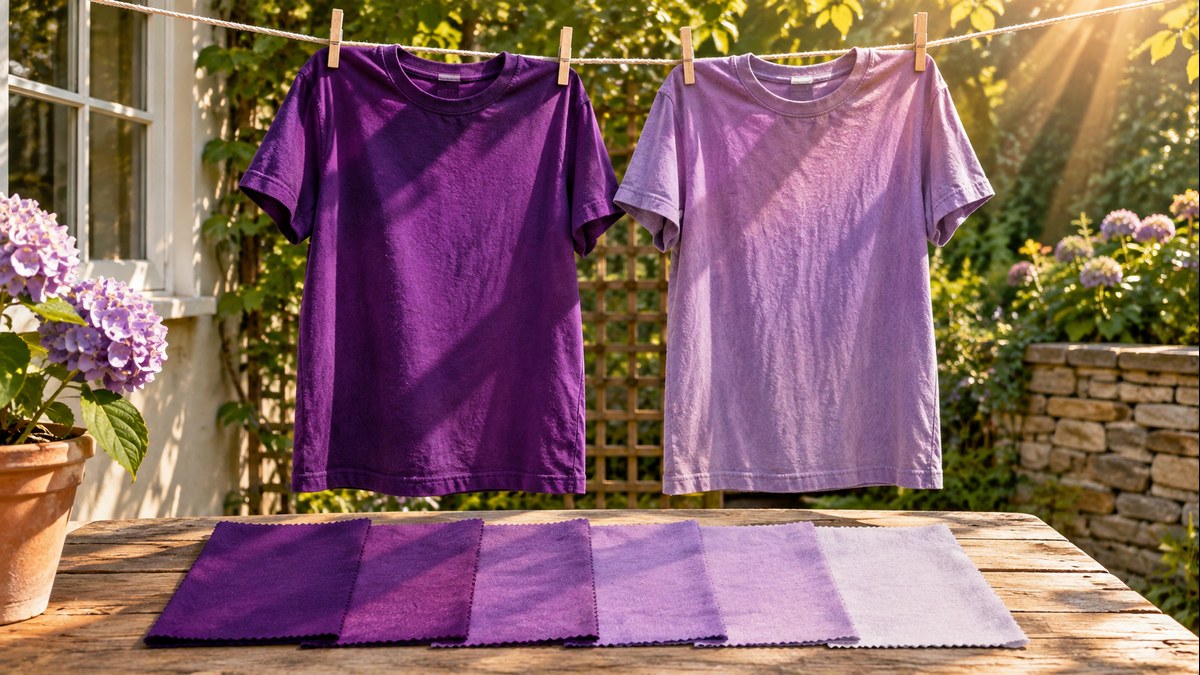
The study also describes the color itself as a result of light absorption. It says that "The perceived colour of an object arises from the selective absorption of incident light and the reflection or transmission of non-absorbed wavelengths". A dye looks colored because it absorbs some wavelengths and reflects others. If the dye molecule changes, the set of wavelengths it absorbs and reflects can change too.
The two statements together give a consistent picture. A dye absorbs visible light to look colored, and a bond to the fiber keeps the dye in place. The curtain study links the chemical changes to exposure to light.
What the outdoor exposure study tested
The cotton study compares natural sunlight with artificial light. It reports that "Fabrics of three distinct colours were exposed to two types of irradiation: natural sunlight and artificial light in a controlled climatic chamber."
The study frames the stakes for the material. It says that "The colour fastness of dyed cotton knitwear exposed to solar radiation is a key factor influencing both the material’s performance and its relevance in forensic fibre analysis." The study places colour fastness in the context of solar exposure.
The study also reports a useful caution about measurement. It says that "Microspectrophotometric measurements did not reliably capture colour changes in single cotton fibres, particularly in samples exposed to natural sunlight." The fabric may look changed at the scale of the whole cloth while single fibers do not show a clear signal under the same method.
The study’s conclusion also separates scales. It says that "The findings indicate that, while light exposure may induce perceptible colour alterations in cotton knitted fabrics, the forensic examination of single fibres does not necessarily reflect these macro-scale changes." For a homeowner, the lesson is that a visible fade is a whole-fabric effect, and the chemistry at one fiber does not always tell the full story.
Where the mechanism applies in a home
The two sources cover a silk curtain and a cotton knit under lab and natural light, so the mechanism applies to dyed textiles in general terms. The sources do not test patio cushions, outdoor curtains, or banners. Their fade rates are not established here.
Exposure is the variable the sources emphasize. The curtain study ties the fading to exposure to light, and the cotton study compares sun with lab light. Shade, angle, and the number of hours of direct light are not measured in either source, so a homeowner should not assume a particular timeline.
For a related outdoor decor question, see how to use garden shade cloth. For planning a sheltered seating spot, see how to plan a small garden bed.
Limits of the mechanism
The curtain study concerns one historical marquisette with one dye, studied through photolysis in a kinetic solution. The cotton study concerns cotton knitwear and a forensic measurement method. Neither source tests a modern outdoor fabric or a set of commercial dyes against a weather schedule.
The sources also do not describe rain, humidity, heat, or wind, all of which can work with light to change a dye. These factors are outside the two papers, so any conclusion about outdoor fabric should stay within the light-exposure evidence they provide.
What we could not verify
The sources do not give a fade rate, a number of months to visible fading, or a comparison of dyes for outdoor use. They explain the chemical mechanism and the exposure conditions, but they do not provide a time frame that a homeowner could apply to a specific product.
What the sources do not say
The sources do not discuss patio cushions, outdoor rugs, or umbrella fabric. They do not compare synthetic dyes with natural dyes, and they do not give a cleaning or storage method that slows fading. Those topics are not covered by the two studies.
Frequently asked questions
Does sunlight really break down dye?
The curtain study reports that the color change comes from "the chemical processes that occur on its exposure to light". The study shows this for one dye, and the sources do not test every dye type.
Why do cotton fabrics keep their color?
The cotton study says that reactive dyes "form covalent bonds with cellulose". The bond keeps the dye attached to the fiber, which is the reason the study describes the color as durable.
Is fading visible on the whole fabric?
The cotton study reports that "the forensic examination of single fibres does not necessarily reflect these macro-scale changes." The visible fade is a whole-fabric effect, which may not appear at the level of one fiber.
Does lab light match sunlight?
The cotton study compares "natural sunlight and artificial light in a controlled climatic chamber." The sources report the comparison, but they do not state that the two light sources always give the same result.
Can these sources predict how fast my fabric will fade?
No. The sources explain the mechanism and the test conditions, but they do not give a fade rate for a particular fabric in a particular place, so no timeline is verified here.
Sources
- PubMed Central article PMC9322362, historical marquisette curtain fading study, https://pmc.ncbi.nlm.nih.gov/articles/PMC9322362/ (HTTP 200, opened 2026-10-28)
- PubMed Central article PMC13211215, dyed cotton knitwear light exposure study, https://pmc.ncbi.nlm.nih.gov/articles/PMC13211215/ (HTTP 200, opened 2026-10-28)