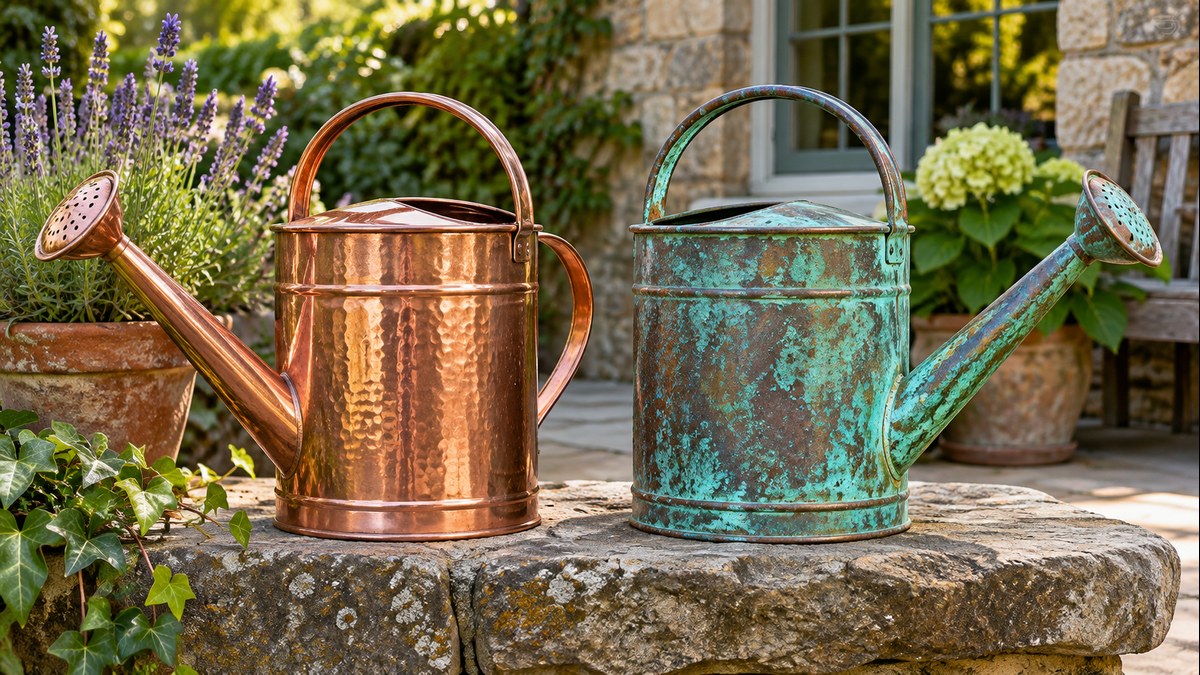
How Does Copper Form a Green Patina Outdoors?
As an Amazon Associate we earn from qualifying purchases.
Copper does not turn green in one step. The question of how does copper form a green patina outdoors has a layered answer: the metal oxidises, the released metal ions react with air, water and minerals, and the products build up into a surface layer over time. This article follows that sequence using two research papers, one on buried bronze and one on outdoor copper alloy artworks. It also marks where the sources stop, because they study museum objects and burial sites rather than garden fixtures.
Quick answer
- Outdoor copper alloys corrode through “oxidation, sulfidation, and chlorination, which are promoted by environmental factors such as oxygen, moisture, organic compounds, and atmospheric pollutants.”
- The first step is that “Metal elements from the alloy oxidize, in accordance with the electrochemical series of the standard potentials.”
- The products vary: some “can be stable and protect the bulk from a deeper corrosion,” while others “can further react once the external environmental conditions have changed.”
The starting point: copper alloys and their corrosion
The outdoor study begins with the materials themselves. It states that “The artworks composed of copper alloys are prone to various forms of corrosion, including oxidation, sulfidation, and chlorination.” It adds that these processes are driven by the surroundings, since they are “promoted by environmental factors such as oxygen, moisture, organic compounds, and atmospheric pollutants.”
The same paper groups the products that matter most outdoors. In its words, “Copper alloys form various corrosion products such as sulfides and chlorides.”
Step one: copper atoms leave the metal
The burial study describes the first chemical step. It says “Metal elements from the alloy oxidize, in accordance with the electrochemical series of the standard potentials.”
What happens to those ions depends on their chemistry. The paper states that “Depending on the solubility and reactivity of the oxidized species, the metal cations can diffuse toward the ground or reprecipitate as mineral corrosion products.” In other words, some ions travel away from the metal, while others settle back onto it as solid minerals.
Step two: the ions form a mineral layer
The solid products build the patina. The burial paper describes it as “typically consists of a mixture of stratified mineral compounds, which can affect the chemico-physical stability and disfigure the artifact.”
The same paper explains that the layers can behave in two different ways. Some “can be stable and protect the bulk from a deeper corrosion (as copper hydroxycarbonates) or can further react once the external environmental conditions have changed (as copper chlorides).”
Why the surface can look green
The burial study names the main minerals found in its patinas. It reports that “XRD detected the ubiquitous presence of cuprite, copper hydroxychlorides and terrigenous minerals.”
The authors also describe the green layer as something that can be removed. They write that “It is worth noticing that after a few minutes the green corrosion products can be selectively removed.” That remark points to a difference between the green surface layer and the metal underneath.
The outdoor study lists the mineral families it tested. Among them are “copper carbonates (malachite and azurite)” and “copper sulfides (antlerite, brochantite, and chalcanthite).”
Outdoor exposure over time
The outdoor study reports on real artworks. It says that “After the on-site analysis of copper alloy artworks exposed to outdoor environments for over 30 years, corrosion products such as malachite, brochantite, and moolooite were detected.”
The burial study shows a comparison in time. Its authors buried bronze disks: “bronze disks were intentionally buried for 15 years in the soil of the archaeological site of Tharros.” They compared those patinas with an older object: “The patinas developed in 15 years were compared with an archaeological bronze recovered from the same site after about two thousand years of burial.” The paper concludes that the two show “a similar corrosion behavior, especially in terms of chemical composition and corrosion mechanisms.”
Chlorides can speed up damage. The burial paper states that “Chlorides are in fact highly aggressive toward Cu-based alloys as they can penetrate into the porous patina’s layers promoting the formation of the dangerous nantokite (CuCl), which is the first step toward bronze disease.”
Why not every patina is protective
The outdoor study separates protective and damaging products. It says that “sulfide patina forms a protective layer that imparts esthetic and historical values to copper alloy artworks.” It then warns that “the excessive accumulation of sulfate (SO 4 ) ions may induce their corrosion.”
The chloride products are the more serious case. The paper states that “chloride patina can cause serious corrosion issues such as pitting corrosion and bronze disease.” It also describes a specific compound: “dicopper chloride trihydroxide is formed rapidly within a short period, weakly adheres to the underlying layer, possesses a highly porous crystalline structure, and causes a volume expansion.”
The same study names the compound it found most clearly. It says that “In particular, dicopper chloride trihydroxides (such as atacamite and clinoatacamite) were clearly distinguished as corrosion products whose early identification is crucial.”
How researchers identify the products
The outdoor study tests a field method. It concludes that “This study demonstrates that portable Raman spectrometers can be effectively used to identify corrosion products and assess the conservation state of copper alloy artworks.”
The burial study used a different toolkit. Its authors combined several methods, and the paper says the patinas were analysed with “optical microscopy (OM), field emission scanning electron microscopy coupled with energy dispersive spectrometry (FE-SEM-EDS) and X-ray diffraction (XRD).”
For a related garden topic on metal surfaces, see how to get rust off garden tools and how to keep garden tools from rusting.
How we chose
Both sources are peer-reviewed research articles from PubMed Central. Boccaccini and Riccucci published “Reproducing bronze archaeological patinas through intentional burial: A comparison between short- and long-term interactions with soil” in Heliyon in 2023. Kwon and Kim published “On-Site Identification of Corrosion Products and Evaluation of the Conservation Status of Copper Alloy Artworks Using a Portable Raman Spectrometer” in Materials in 2025. Neither source is a retail page, and each claim in this article is tied to a quote from one of them.
What we could not verify
Two research papers cover the chemistry, so the points below rest on those two papers alone.
What the sources do not say
The sources study museum objects and buried bronzes, not garden fixtures. The burial paper describes “archaeological corrosion patinas” and “archaeological artifacts,” and the outdoor paper describes “copper alloy artworks.” Neither source covers household or garden metal items.
The sources do not give a fixed time for a green surface to appear. The burial study compares “15 years” of exposure with a bronze that spent “about two thousand years of burial,” and the outdoor study reports objects “exposed to outdoor environments for over 30 years.” Neither provides a timeline between those points.
The sources do not give a colour chart for each mineral. The outdoor paper names malachite, azurite and other minerals, but the excerpts used here do not give their colours in a comparable form.
Frequently asked questions
Why does copper turn green?
The burial paper links the green appearance to corrosion products, noting that “the green corrosion products can be selectively removed.” The minerals behind that colour include the “copper carbonates (malachite and azurite)” that the outdoor study lists.
Does a green patina protect copper?
Some do. The burial paper says some products “can be stable and protect the bulk from a deeper corrosion.” Others do not. The outdoor paper warns that “chloride patina can cause serious corrosion issues such as pitting corrosion and bronze disease.”
Are outdoor copper products always chlorides?
No. The outdoor paper says that “Previous studies have primarily classified the corrosion products of outdoor copper alloys into sulfides and chlorides.” It lists both families.
How long does a patina take to form?
The burial study gives two points on the timeline: “15 years” of burial in the field, and “about two thousand years of burial” for the archaeological object. It compares the two and finds “a similar corrosion behavior.”
How are copper corrosion products identified?
The outdoor paper says “portable Raman spectrometers can be effectively used to identify corrosion products.” The burial study used “X-ray diffraction (XRD)” in the lab to confirm the mineral mix.
Sources
- Boccaccini F, Riccucci C. “Reproducing bronze archaeological patinas through intentional burial: A comparison between short- and long-term interactions with soil.” Heliyon. 2023. https://pmc.ncbi.nlm.nih.gov/articles/PMC10558880/
- Kwon H, Kim L. “On-Site Identification of Corrosion Products and Evaluation of the Conservation Status of Copper Alloy Artworks Using a Portable Raman Spectrometer.” Materials. 2025. https://pmc.ncbi.nlm.nih.gov/articles/PMC11901308/


