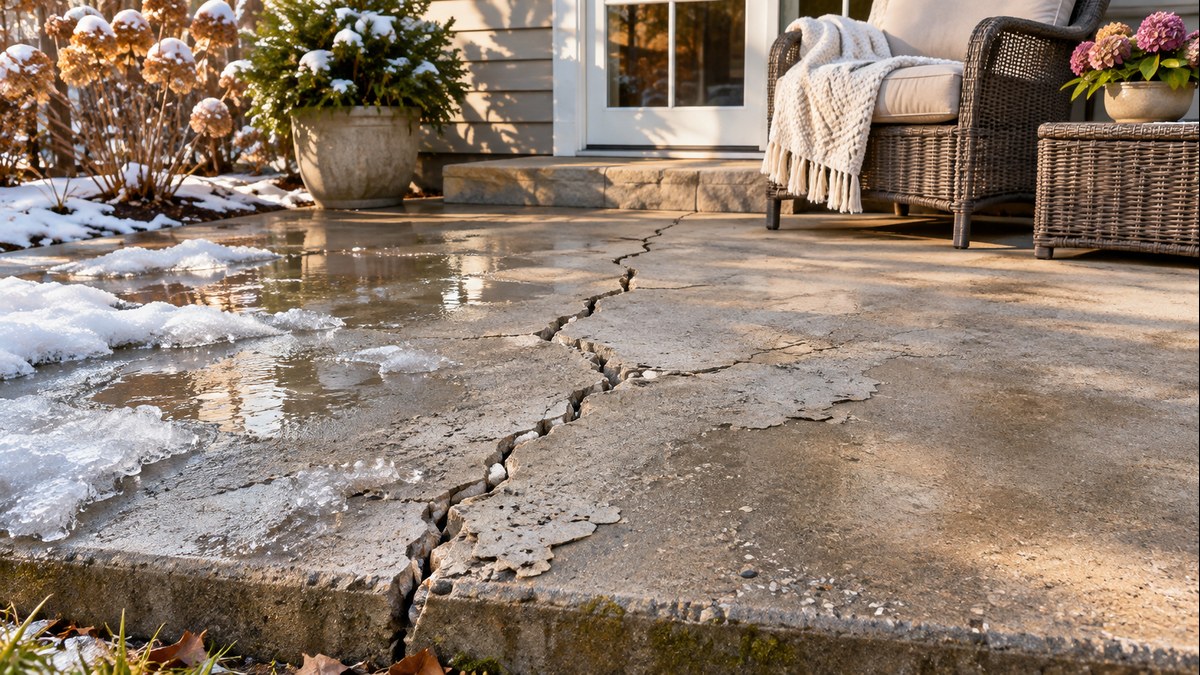
How Does Freeze and Thaw Cycling Crack a Concrete Patio?
As an Amazon Associate we earn from qualifying purchases.
How does freeze and thaw cycling crack a concrete patio? The process starts with water inside the concrete. One review explains that “a portion of the pore water in the concrete pore space will change from liquid water to solid ice and expand by 9% in volume.” A second review describes the long-term result as “cyclic fatigue damage caused by repeated frost-induced expansive pressures.” The first review studies concrete pavement rather than patios, so the mechanism is described here as it is reported for pavement. This article explains the steps, the factors that change the outcome, and the limits of the evidence.
Quick answer
- Water in the pores of the concrete freezes and expands. One review states that the water changes to ice and “expand by 9% in volume.”
- The pressure has to go somewhere. The review explains that “hydrostatic pressure is generated and acts in the surrounding matrix,” and that this can start micro-cracks.
- Repeated cycles add up. “Under continuous freeze–thaw cycles, the cracks caused by the damage will slowly accumulate, and the pores will become connected.”
- How wet the concrete is matters. “freeze–thaw damage development depends on the saturation rate of the concrete.”
How we chose
Both sources are review articles, and their titles say so. The first is “Impact of Freeze–Thaw Cycles on the Long-Term Performance of Concrete Pavement and Related Improvement Measures: A Review.” The second is “Deterioration of Concrete Under the Combined Action of Sulfate Attack and Freeze–Thaw Cycles: A Review.” Each article is cited only for claims that a verbatim quote supports. The sections below keep the two reviews separate so readers can see which one makes each point.
The water that does the damage
The first review frames the question at the level of the pores. It says that “the freeze–thaw deterioration mechanism of concrete pavement has not been fully understood,” and it names the main theories as “the hydrostatic pressure hypothesis, osmolarity, and salt crystallization pressure hypothesis.” The expansion of freezing water is the starting point of the hydrostatic idea, and the quoted passage above states that expansion directly.
The second review uses similar language for the same process. It says that “Freeze–thaw deterioration in concrete originates from cyclic fatigue damage caused by repeated frost-induced expansive pressures and osmotic pressures generated during phase changes in free pore water under temperature fluctuations.” Two kinds of pressure are named there, and expansion of freezing water is one of them.
The second review also places the damage in particular pores. It says that “the capillary pores constitute primary damage zones.” It adds that the sequence “initiates when environmental water infiltrates capillary pores”, so the first step is water getting into the concrete.
How pressure becomes a crack
The first review describes the pressure build-up in steps. When water freezes, “This will force the still unfrozen pore solution in the frozen zone to migrate towards the unfrozen zone”. That movement creates pressure, since “hydrostatic pressure is generated and acts in the surrounding matrix.” The review adds that “The hydrostatic pressure increases with the length of the pore water flow, so there is a limited flow length in the tensile strength of the concrete.”
When that limit is passed, the material gives way. The review states that “the resulted hydrostatic pressure exceeds the tensile strength of the cement matrix, resulting in the initiation and prorogation of micro-cracks.”
Cracks do not stay separate. The same review says that “the cracks caused by the damage will slowly accumulate, and the pores will become connected” under continuous cycles. It then concludes that “The accumulated micro-scale damage will finally lead to macro-scale deterioration of the concrete materials.” This is the stage at which damage becomes visible at the surface.
The review also describes a second route. It says that “The crystallization pressure exceeds the concrete tensile strength under a subcooling state,” and that “cracks are then generated.” This route involves ice forming from larger pores into smaller ones, which is a different physical process from the expansion of water alone.
Why wet concrete is more exposed
The first review identifies saturation, meaning how full the pores are with water, as a key factor. It states that “It has been widely confirmed that freeze–thaw damage development depends on the saturation rate of the concrete.” The review also describes a threshold idea: “Once this threshold is exceeded, the material can only withstand one freeze–thaw cycle before cracking or becoming damaged.”
The same review notes that the simple threshold does not capture every case. It says that “the freeze–thaw damage cannot occur when pore saturation is lower than 91.7%,” and then adds that “freeze–thaw damage can be observed in concrete with a saturation rate of 70–80%.” The review presents this mismatch as one reason the mechanism is still debated.
A third factor is temperature change. The first review describes a thermal shock idea in which “The change in the concrete volume caused by the temperature stress results in tensile stresses inside the concrete.” If the induced tensile stress is higher than the tensile capacity of the concrete, the concrete will crack. This is a separate route from the pore-water mechanism, and the two can act together.
What slows the process
The first review lists measures that affect the outcome. It says that “Air-entraining agents stabilize the air bubbles generated during concrete mixing and prevent tiny bubbles from collecting and escaping.” The review also states that “Surface treatment of concrete to improve its frost resistance is relatively efficient and inexpensive,” which is a statement about frost resistance, not a guarantee for a particular slab.
The second review adds a note about laboratory work. It highlights “significant discrepancies between laboratory conditions and field exposure,” so a result from a test specimen may not match a slab outdoors. Readers should treat any single laboratory number as a guide to the mechanism rather than as a forecast for a particular patio.
For a related concrete topic, readers can look at building a raised garden bed with concrete blocks. That article covers construction, not freeze and thaw damage, so it does not replace the mechanism explained here.
What we could not verify
This section lists the points the two reviews leave open. They explain the mechanism, but they do not give a finished timeline for a patio.
What the sources do not say
The first review’s main subject is concrete pavement, and it states that “Freeze–thaw damage can easily lead to surface spalling of concrete pavement.” The quoted passages do not give a freeze count, a moisture level or a time to surface damage for a residential patio.
The reviews also do not settle which theory is correct. The first review says that the freeze–thaw damage mechanism “has not been fully understood.” The second review names the “Hydrostatic Pressure Theory and the Osmotic Pressure Theory” as the two most widely validated frameworks, which is a ranking of support, not a final verdict.
The passages used here do not address patio coatings, sealers, drainage or repairs. Readers looking for those answers will need other sources. For a separate question about concrete, see how to clean concrete planters, which covers cleaning rather than freeze and thaw damage.
Frequently asked questions
Why does water inside concrete cause cracks when it freezes?
The first review says that pore water changes to ice, and that ice will “expand by 9% in volume.” The expansion pushes on the unfrozen water and the surrounding material, and when the pressure exceeds “the tensile strength of the cement matrix,” it causes “micro-cracks.”
Does every freeze and thaw cycle crack concrete?
The reviews describe damage that builds up over repeated cycles. The first review says that “Under continuous freeze–thaw cycles, the cracks caused by the damage will slowly accumulate.” The quoted passages do not say how many cycles a given slab can take before cracking.
Does moisture level change the risk?
According to the first review, yes. It states that “freeze–thaw damage development depends on the saturation rate of the concrete.” The review also reports damage “in concrete with a saturation rate of 70–80%.”
Are concrete patios and concrete pavement the same for this purpose?
The reviews do not say. The first review is about concrete pavement, and the quoted passages do not compare pavement with patio slabs. The mechanism described here is general, but the amount of damage on any given slab depends on conditions the reviews do not measure for patios.
Do these sources explain how to stop cracking on a patio?
No. The quoted passages explain the mechanism and mention measures such as air-entraining agents, but they do not give a verified procedure for a home patio. They should not be read as a repair or sealing guide.
Sources
- Impact of Freeze–Thaw Cycles on the Long-Term Performance of Concrete Pavement and Related Improvement Measures: A Review. PubMed Central, https://pmc.ncbi.nlm.nih.gov/articles/PMC9267915/ (HTTP 200, opened 2026-10-28)
- Deterioration of Concrete Under the Combined Action of Sulfate Attack and Freeze–Thaw Cycles: A Review. PubMed Central, https://pmc.ncbi.nlm.nih.gov/articles/PMC12471968/ (HTTP 200, opened 2026-10-28)