Best Garden Rake: Bow and Soil Rakes Compared by Head and Handle
As an Amazon Associate we earn from qualifying purchases. Details
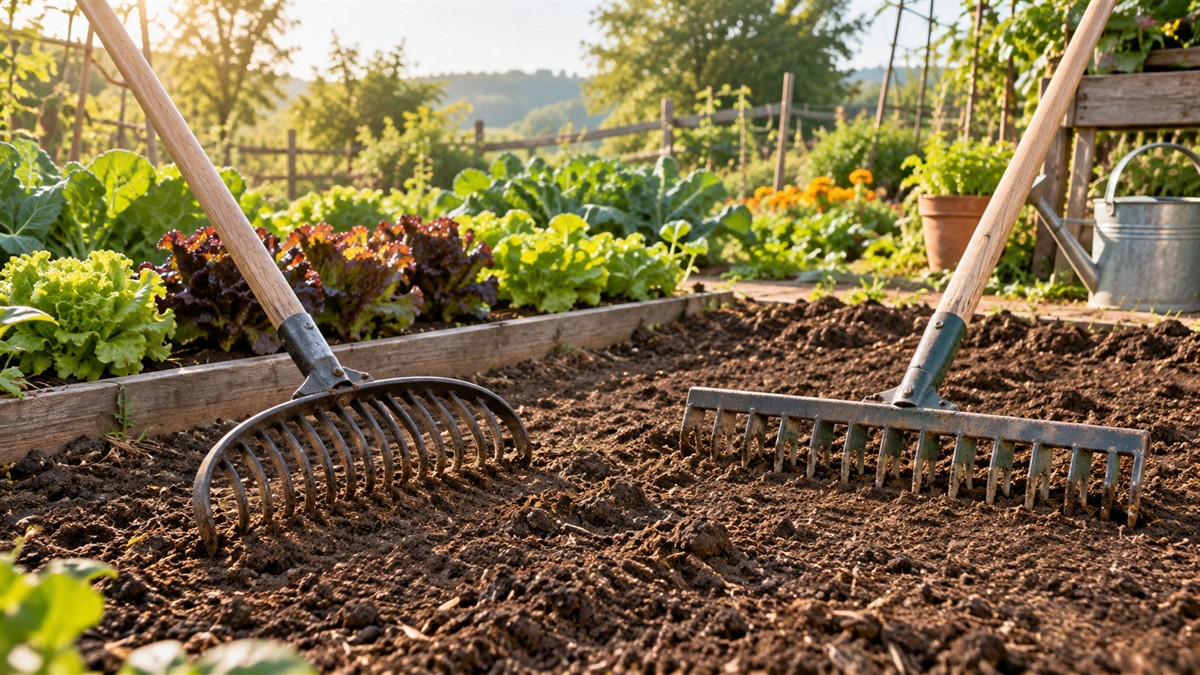
The best garden rake for most soil jobs is a bow rake: a steel-headed tool with a curved frame of tines on a long handle, which lets you level a bed without bending. This guide compares six bow and soil rakes listed on Amazon.com on 2026-10-21. Each comparison uses only the head design, tine count, handle length, and steel type that the listing states. Leaf rakes and lawn dethatching rakes are outside this guide. Three university extension services cover the soil steps, and every product claim is attributed to the listing that makes it.
Quick answer
- Choose a bow rake with a steel head when loosening compacted soil, spreading mulch, and leveling a bed before seeding are your main jobs.
- Check the handle, because the six overall lengths run from 55 inches to 77 inches, and every listing describes some form of adjustable or multi-section handle.
- Read the spec rows for the head material, because two listings name a different material in their title or bullets than their spec rows show.
- Use a leaf rake for leaves and a stone rake or landscape rake for stones larger than two inches, since grading rakes are not meant for stone removal.
What a bow rake does in soil work
A bow rake has a head shaped like a bow, with a row of tines across the front and a shaft attached at the center. All six titles in this guide name 17 tines. Five of the six spec rows give a head size of 17 inches, and the sixth, GlimHirVox, has no head size row, so its width is not stated in the data used here.
The bullets for these six products describe two main jobs. The first is loosening or breaking up soil before planting. The second is moving loose material such as mulch, gravel, or topsoil so that the surface ends up level. Those two jobs are the yardstick for every pick below.
Colorado State University Extension’s guide to growing annual plants from seed says that before seeding or planting annual flowers or vegetables in new beds, the garden area should be spaded 6 to 10 inches deep. The same page says that when it is time to plant seeds, the surface should be raked smooth and large clods removed or broken down. That final raking step is the leveling job most of these listings describe.
Iowa State University Extension’s managing garden soil guide says to simply turn the soil with a fork, shovel, hoe, or rake. A rake is therefore one of several tools for turning a bed, and a spade or a hoe may suit a different stage of the same job.
Penn State Extension’s lawn establishment guide says grading rakes are designed for moving small amounts of soil and should not be used for stone removal. That guide is written for lawns, so its advice applies to garden beds only by analogy.
Head design: tines, bow frame, and welds
Tine count is the most consistent number across the six listings, since every title names 17 tines. Tine length is described differently from one listing to the next. The DIIG bullets give tines that are 2.5 inches long on a 17-inch head. The GlimHirVox bullets give 4-inch tines. The BlumeTrec bullets say its tines extend 4 inches into the ground, which describes reach rather than tine length. The other listings give no tine length in inches.
Tine thickness appears in two listings only. DIIG says its head has 3mm thickness, and GlimHirVox says its 4mm thickened tines resist bending and breaking. MQHUAYU describes fully reinforced steel tines, and CKLT describes tempered spring steel tines, but neither set of bullets gives a thickness figure.
Weld and joint claims also differ. DIIG says it is triple welded at the connection of the bow rake, GlimHirVox and Walensee both describe triple-welded construction, and MQHUAYU describes triple-welded joints. Walensee adds double-locking screws. BlumeTrec says its 17 solid tines are welded securely to the bow frame, without a triple-weld claim. CKLT relies on 304 stainless steel screws for the connection between head and handle.
Four of the six listings describe a dual-sided head. MQHUAYU, BlumeTrec, and Walensee call their heads double-sided or dual-sided, and CKLT describes short tines on the back of its head. In each case the bullets say one side loosens soil while the other side levels or spreads material.
GlimHirVox says its wide-head design increases coverage by 20 percent compared with 14-tine models. For tine count alone, 17 minus 14 equals 3, and 3 divided by 14 equals 0.21, so 17 tines is about 21 percent more than 14. The 20 percent figure is the seller’s claim, and this guide has no coverage measurement for any listing.
Handle length and adjustability
Handle length varies more than any other spec in the set. The titles give overall lengths of 77 inches for MQHUAYU, 63 inches for DIIG and Walensee, 62 inches for CKLT, and 55 inches for GlimHirVox, while the BlumeTrec bullets state 68 inches overall. Some listings give a single figure for a multi-section or telescopic handle, so that figure may describe one setting rather than the full range.
The MQHUAYU spec rows list an item height of 75 inches, two inches shorter than the 77-inch title. The arithmetic is 77 minus 75 equals 2 inches. The bullets describe telescopic adjustment, so the working length depends on how far the shaft is extended.
The GlimHirVox bullets describe three adjustable lengths of 24, 40, and 55 inches. The steps between them are 40 minus 24 equals 16 inches and 55 minus 40 equals 15 inches. The adjustment is therefore coarse, with settings about 15 to 16 inches apart.
The remaining four listings describe multi-section or adjustable poles. DIIG says length changes by connecting different numbers of poles. BlumeTrec describes a detachable multi-section pole that adjusts for different tasks or user heights. Walensee describes adjustable multi-section poles. CKLT says its handle length adjusts to accommodate various user heights.
Handle material is uneven too. Four spec rows list stainless steel: MQHUAYU, DIIG, BlumeTrec, and Walensee. The CKLT spec rows list aluminum, although its title and bullets describe a stainless steel handle. The GlimHirVox spec rows list a wooden handle, and its bullets name beech wood handles in the set.
Several bullets make ergonomic claims. MQHUAYU says its extended handle effectively reduces the strain of bending over, BlumeTrec says its long handle reduces strain on the back and knees, and CKLT says its long handle protects your back from bending over. These are listing statements. The sources used in this guide do not cover rake handle ergonomics.
Weight and size compared
The table uses only the values that each listing’s spec rows state. Head size is a width and overall length is a height, so the two measurements should be read separately.
| Listing | Head size | Head material | Handle material | Item weight |
|---|---|---|---|---|
| MQHUAYU | 17 inches | Carbon Steel | Stainless Steel | 3.06 pounds |
| DIIG | 17 (no unit given) | Metal | Stainless Steel | 3.85 pounds |
| BlumeTrec | 17 inches | Manganese steel | Stainless Steel | 3.58 pounds |
| Walensee | 17 inches | Metal | Stainless Steel | 3.43 pounds |
| CKLT | 17 inches | Alloy Steel | Aluminum | 3.67 pounds |
| GlimHirVox | not stated | Manganese steel | Wooden | 3.3 pounds |
The six item weights add up to 20.89 pounds: 3.06 plus 3.85 plus 3.58 plus 3.43 plus 3.67 plus 3.3 equals 20.89. Divided by six, 20.89 divided by 6 equals 3.48 pounds, so the average listed weight is about 3.48 pounds.
The heaviest spec row is DIIG at 3.85 pounds, and the lightest is GlimHirVox at 3.3 pounds. The gap is 3.85 minus 3.3 equals 0.55 pounds. For buyers who think in ounces, BlumeTrec’s 3.58 pounds times 16 equals 57.28 ounces.
Soil preparation: which tasks a bow rake fits
Start with the stones. Penn State Extension’s lawn guide says stones larger than two inches in diameter should be removed by hand with a stone rake and shovel, or mechanically with a landscape rake. None of the six listings says its head removes stones of that size. GlimHirVox does mention gravel and crushed stone among materials to distribute, and CKLT lists removing gravel among its tasks, so the bow rake’s role with stone is moving smaller material.
Loosening compacted soil is the task named most often. MQHUAYU says one side of its head loosens compacted soil, DIIG says its head can loosen soil without deformation or break, and GlimHirVox says its tines are suited to turning hard soil or gravel. Breaking up clumps appears in three listings: DIIG, GlimHirVox, and CKLT.
Mulch is the second common task. DIIG, GlimHirVox, and Walensee all mention spreading mulch, and GlimHirVox adds topsoil and compost to the list of materials its rake can distribute.
Order of work matters more than the tool itself. The Colorado State guide puts the deep work with spading, 6 to 10 inches for new beds, and the surface work with raking. A bow rake, on that reading, is a finishing tool for a bed that has already been turned. The Iowa State vegetable garden guide adds a moisture check before any soil work: if soil forms a ball that retains its shape, it should be left a few days to dry out before it is worked.
Read together, and not as a single prescribed method, the three university pages suggest this sequence: check the moisture, turn the bed with a spade, fork, shovel, hoe, or rake, remove large stones by hand or with a landscape rake, and finish the surface with a rake. A bow rake fits the last step and the leveling part of the middle step.
Six picks in this guide
Each card below uses the listing’s own bullets and spec rows for its strengths and limits. The cards are not ranked; each one names the buyer it fits.
1. 77'' Bow Rake for Soil Leveling, 17 Tines Heavy-Duty Garden Rakes (MQHUAYU 77-inch bow rake with a telescopic handle and detachable head)
Pros
- The bullets describe a double-sided head, with one side for loosening soil and the other for leveling.
- The bullets say the handle offers telescopic adjustment, so the working length can change.
- The listing states that four bolts let the head detach from the handle for storage.
Cons
- The spec rows list carbon steel for the head, while the bullets name heat-treated manganese steel.
- The title says 77 inches, but the spec row lists 75 inches as the item height.
Best for: Yard owners who want one double-sided head for loosening soil and leveling gravel or mulch.
Skip if: You need the head material and overall height to match, since this listing does not reconcile them.
View on Amazon (affiliate link)
2. 63'' Bow Rake ,17 Tines Metal Head Rakes with Stainless Steel Handle,Heavy Duty Garden Rake (DIIG 63-inch bow rake with 17 metal tines and a stainless handle)
Pros
- The bullets give 2.5-inch tines on a 17-inch head with a 3mm head thickness.
- The bullets say the bow connection is triple welded to keep the head from falling off.
- The bullets say the handle is multi-section, with length set by connecting a different number of poles.
Cons
- The dimension row reads 1 inch by 1 inch, which does not match the 63-inch title.
- The spec rows give the head material only as Metal, with no steel grade.
Best for: Gardeners who want a clearly stated tine length and a multi-section handle for mixed yard tasks.
Skip if: You need a verified overall length, because the dimension row cannot be reconciled with the title.
View on Amazon (affiliate link)
3. Bow Rake, 68-Inch Adjustable Handle Garden Rake with 17 Steel Tines, Heavy Duty Dual-Sided Metal (BlumeTrec 68-inch dual-sided bow rake with a manganese steel head)
Pros
- The spec rows list manganese steel for the head, which matches the bullet wording.
- The bullets say long tines loosen compact soil while short tines spread and level it.
- The listing states a 68-inch overall length and an item weight of 3.58 pounds.
Cons
- The bullets describe a multi-section pole but do not state how many sections it has.
- The bullets give a 4-inch reach into the ground but no tine length in inches.
Best for: Owners of large plots who want one head for loosening, spreading mulch, and leveling.
Skip if: You need a stated section count or a tine length in inches before you decide.
View on Amazon (affiliate link)
4. Walensee Heavy Duty Dual-Sided Bow Rake, 63″ Stainless Steel Handle, Heat-Treated Manganese Steel (Walensee 63-inch dual-sided bow rake with a heat-treated manganese steel head)
Pros
- The bullets describe a heat-treated manganese steel head with double-locking screws.
- The spec rows list an item size of 17 inches wide by 63 inches high.
- The bullets say adjustable multi-section poles allow flexible length changes.
Cons
- The spec rows give the head material only as Metal, which is less specific than the bullets.
- The bullets describe 17 steel tines but give no tine length in inches.
Best for: Homeowners who want a dual-sided head and a stated 63-inch handle for lawn and garden work.
Skip if: You need a steel grade on the spec rows, because they say only Metal for the head.
View on Amazon (affiliate link)
5. 62 Inch Garden Rake with 17 Tempered Spring Steel Tines (CKLT 62-inch garden rake with 304 stainless steel screws)
Pros
- The bullets say 304 stainless steel screws resist rust and keep the head attached to the handle.
- The title and bullets describe 17 tempered spring steel tines with a sand texture finish.
- The bullets say the short tines on the back of the head are for leveling garden soil.
Cons
- The title says stainless steel handle, but the spec rows list aluminum for the handle.
- The spec rows give no manufacturer or model number for this listing.
Best for: Gardeners who want an adjustable long handle and a head with both long and short tines.
Skip if: You need the handle material confirmed, since the title and the spec rows disagree.
View on Amazon (affiliate link)
6. Bow Rake Heavy Duty 17-Tine, 55″ Wooden Handle Garden Rake (GlimHirVox 55-inch bow rake with three handle settings and a wooden handle)
Pros
- The bullets describe three adjustable lengths of 24, 40, and 55 inches.
- The spec rows list a wooden handle, and the bullets name beech wood handles in the set.
- The bullets say the head detaches from the handle for flat storage.
Cons
- The spec rows give no head size, so the head width is not stated in the data.
- The bullets claim 20 percent more coverage than 14-tine models, and no measurement is given.
Best for: Gardeners who want a wooden handle that adjusts in three steps and a head that stores flat.
Skip if: You need a stated head width or a metal handle, since this set uses a wooden handle.
View on Amazon (affiliate link)
How we chose
We searched Amazon.com on 2026-10-21 with the query garden bow rake steel head. The results page showed ten different rake listings. We opened six product pages, and those six make up the picks. The inclusion rule was a bow rake or a soil and landscape rake with a steel or metal head, sold for loosening soil, leveling, or moving mulch and gravel. Leaf rakes, lawn dethatching rakes, and accessories were excluded. The brand rule allowed one pick per brand, which gave six picks from six brands. The four other listings on the results page were not opened and are not in the picks. This guide makes no claim about how any product performs in use. Every product statement comes from the listing text or its spec rows.
What we could not verify
The listings and extension pages leave several questions open.
- Three listings disagree with their own spec rows. CKLT’s title and bullets describe a stainless steel handle, but its spec rows list aluminum. MQHUAYU’s bullets name manganese steel for the head, but its spec rows list carbon steel. DIIG’s title gives 63 inches, but its dimension row reads 1 inch by 1 inch.
- MQHUAYU’s title says 77 inches, while its spec row lists a 75-inch height. The sources do not explain the difference, which is 77 minus 75 equals 2 inches.
- Tine thickness is stated only for DIIG (3mm) and GlimHirVox (4mm). A tine length in inches is stated only for DIIG (2.5 inches) and GlimHirVox (4-inch tines). BlumeTrec gives a 4-inch reach into the ground.
- GlimHirVox claims 20 percent more coverage than 14-tine models. That is the seller’s statement, and no coverage measurement is given.
- Durability is described with words such as long term use and sturdy, but the listings give no duration, no load limit, and no independent results.
- The GlimHirVox spec rows give no head size, so its head width is not stated in the data.
- Warranty terms are not stated in the text read. The MQHUAYU page points to warranty information without giving the terms, and the GlimHirVox bullets mention a guarantee without naming its length.
- The Penn State page is written for lawns, and the Colorado State and Iowa State pages are general garden guides. None of the three names a rake model or a steel grade.
Who should skip a bow rake
A bow rake is the wrong first tool for some jobs. For leaves, a leaf rake is the tool to compare, and this guide does not cover leaf rakes; see the leaf rake guide. For digging, a spade is the tool to compare, and for weeding between plants a hoe is the tool to compare. See the garden spade guide and the garden hoe guide. If a bed holds stones larger than two inches, skip the bow rake for those stones and use the stone rake or landscape rake that the Penn State page describes.
FAQ
Is a bow rake the same as a leaf rake?
No. The six listings describe soil and gravel work first, and leaves appear as one task among several. This guide does not cover leaf rakes. For that choice, see the leaf rake guide.
How long should a garden rake handle be?
The six overall lengths run from 55 inches to 77 inches, so the listings offer a wide range rather than one answer. Choose the setting that matches the user’s height, which is the point the CKLT and BlumeTrec bullets make. Check the overall figure on the spec row before you buy, because the MQHUAYU title and spec row differ by 2 inches.
Can a bow rake remove stones?
Not according to the sources used here. Penn State Extension says stones larger than two inches in diameter should be removed by hand with a stone rake and shovel, or mechanically with a landscape rake, and that grading rakes should not be used for stone removal. The bow rakes in this guide are described for loosening soil, leveling, and moving gravel, so keep stone removal with a stone rake.
Should I rake the soil before planting?
Yes. The Colorado State University Extension guide says that when it is time to plant seeds, the surface should be raked smooth and large clods removed or broken down. Iowa State University Extension says soil can be turned with a fork, shovel, hoe, or rake. Check the moisture first, because the Iowa State vegetable garden guide says soil that forms a ball that keeps its shape should be left a few days to dry.
Which head material should I look for?
Read the spec rows rather than the title alone. The spec rows list manganese steel for BlumeTrec and GlimHirVox, alloy steel for CKLT, carbon steel for MQHUAYU, and plain metal for DIIG and Walensee. The sources do not rank these materials, so this guide does not rank them either.
Does any listing state a warranty term?
Not in the text read. The MQHUAYU page links to warranty information without giving the terms, and the GlimHirVox bullets mention a guarantee without naming its length. The sources used here do not cover rake warranties.
Bottom line
Decision rule: if your main jobs are loosening compacted soil and leveling a bed, buy a 17-tine bow rake with a steel head and a handle that adjusts to your height. If your main job is leaves or stones larger than two inches, choose a different tool.
Sources
- Penn State Extension, Lawn Establishment: https://extension.psu.edu/lawn-establishment
- Colorado State University Extension, Growing Annual Plants from Seed: https://extension.colostate.edu/topic-areas/yard-garden/growing-plants-from-seed-7-409
- Iowa State University Extension, Managing Garden Soil: https://yardandgarden.extension.iastate.edu/how-to/managing-garden-soil
- Iowa State University Extension, Growing and Caring for Your Vegetable Garden: https://yardandgarden.extension.iastate.edu/how-to/growing-and-caring-your-vegetable-garden