How Do Bird Feathers Insulate Against Winter Cold?
As an Amazon Associate we earn from qualifying purchases.
The question how do bird feathers insulate against winter cold has a clear answer in the research on plumage. The short version is that the body feathers of a bird form a layer that slows heat loss, and the air trapped inside that layer does much of the work. The mechanism depends on how the feathers are built, how many there are, and how the bird can change the layer during the day. The two sources below describe the structure and the thermal role of plumage in detail, and this article keeps close to what they say.
Quick answer
- Feathers slow heat loss by holding air close to the skin, and the amount of air they can hold depends on their structure.
- Feather barbs and barbules set how much air a feather traps, so denser, more branched feathers can hold more of it.
- A bird can enlarge the insulating layer on purpose, so the insulation is not fixed once the feathers are grown.
- The sources do not give a complete winter-by-winter account of how much each feature matters for a given species.
What a contour feather is made of
Most of the outer covering of a bird is made of contour feathers. The great tit study describes their role directly: “Contour feathers cover most of the avian body and among other functions they provide a critical insulation layer against heat loss.” That sentence places the insulating job with the contour feathers rather than with the flight feathers on the wings.
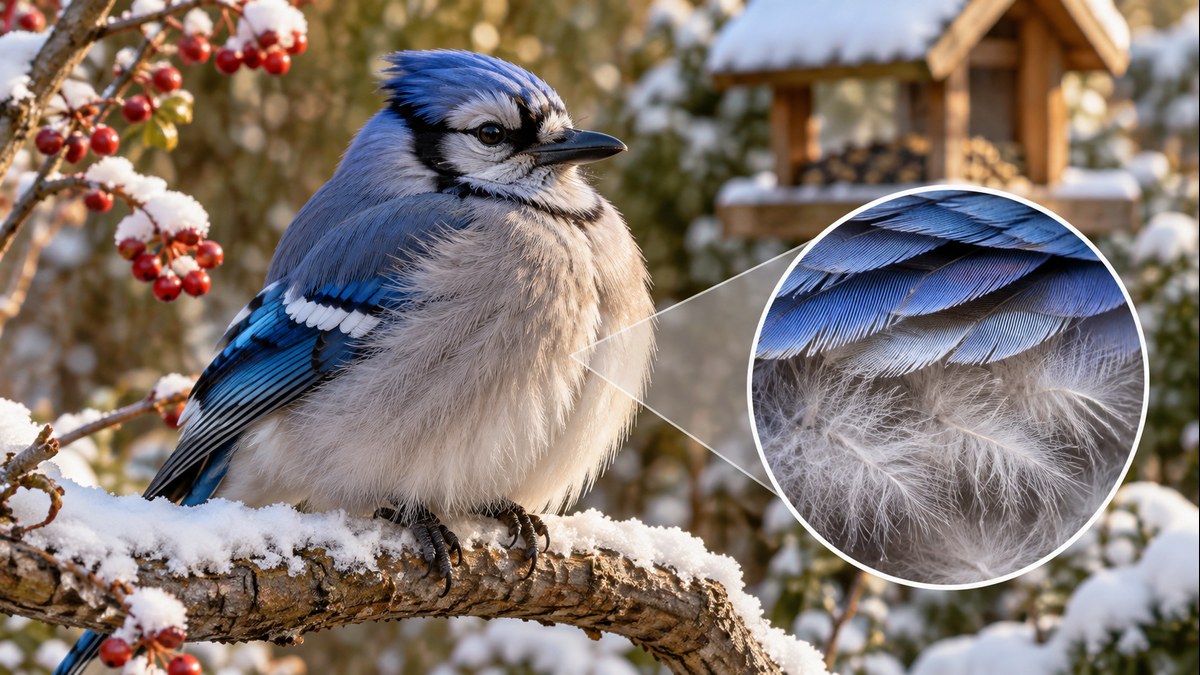
The structure of a contour feather is what makes it useful as insulation. The same study explains that a feather is built from many small branches. In its words, “The number of barbs and barbules, and the way they are attached to each other largely determines how much air they can trap, and thus the insulating properties of the feathers.” The study therefore treats the air trapped between the branches as the central variable, not the feather material on its own.
Trapped air and the skin layer
The dove study describes the thermal arrangement in plain terms. It says, “Heat retention is facilitated by trapping air between the skin and plumage, creating an insulating layer.” In this picture, the bird does not only insulate with the feather itself. The space between the skin and the feathers is part of the barrier, and the volume of that space matters.
The same source also notes that body surface and feather layer work together in a wider thermal system. It says, “Plumage is well known to play a key role in slowing the loss of heat produced by the body to the environment.” This is the central claim for the winter question. The feathers are therefore described as a barrier between the body and the environment.
The dove source also compares species from different climates. It states that “species in colder climates have longer, less dense barbs in the body (contour) feathers, allowing for increased volume of trapped air.” The point is that feather architecture can shift with climate, so a bird from a cold region may hold more air in its body plumage than a related bird from a milder region.
How birds change their insulation
Feathers do not work as a fixed shell. The dove study describes a behavioural lever: “A bird can increase the insulating layer volume, and thus insulative properties, by ptiloerection.” Ptiloerection is the raising or fluffing of the feathers. When the feathers stand away from the body, the trapped air layer gets thicker, and the bird’s insulation rises.
The source also notes that feathers can work in two directions. It says that “Feathers can manage both retaining and offloading heat in part because the feather layer is behaviourally controlled.” This means the feather layer is adjusted by the bird rather than fixed at all times.
Why feather structure can differ between populations
The great tit study compared birds from two places with different winters. It found that the two groups differed in feather structure. In its words, “Great tits from the northern population developed denser but shorter feathers, and with a lower proportion of plumulaceous barbs” when compared with birds from the south. The authors suggest these differences may be local adaptations to winter conditions.
The study is careful about the outcome, though. It says “it is hard to predict which of the two feather structures would provide the best thermal insulation.” Denser feathers do not automatically mean better insulation, because the length of the feathers and the mix of barb types also matter. This is a useful caution for anyone who wants a simple rule.
The same study points to a broader pattern in the literature. It notes that “Some studies have found that within species, populations differing in winter conditions vary in their thermal conductance.” The sentence supports the idea that winter conditions can be linked to differences in heat transfer, though the source does not quantify the effect for every species.
Feather growth and timing
Insulation is set when the feathers are grown. The great tit study explains that “Plumage characteristics are defined and fixed at the time of moulting, and subsequent modulations of the plumage insulation capacity are limited.” This is why the moult timing and the feather quality from that moult matter for the coming winter. A bird can adjust how its feathers are positioned, but it cannot easily rebuild a feather’s internal structure in the middle of the season.
The same study adds a constraint on what a bird can produce. It says, “Thus the number and structure of feathers sets an upper limit to insulation capacity.” This sets a ceiling on insulation, and that ceiling depends on the feathers grown during the moult.
Energy and time also limit the outcome. The study notes that “energy and time constraints may preclude the production of a plumage that is optimal with respect to insulation properties.” A bird may therefore end up with feathers that are good but not the best possible for the cold it faces.
Heat loss, body temperature and the wider picture
The dove study measured body temperature and skin-level temperature under several thermal conditions, including rest, flight, heating and wind. Its main finding was that “Modulations in heat dissipation areas contribute to thermoregulation in doves exposed to external thermal regimes and after flight exercise.” This shows that feathers are one part of a system that also includes bare skin areas that release heat.
The same study warns about measurement. It says “caution is warranted when inferring core temperature from skin-level or external measures.” For a reader trying to judge how warm a bird is, this matters, because the temperature of the feather surface is not the same as the body core temperature.
The study also reports that flight raised internal temperature. It says “Flight increased internal temperature by 0.6°C compared with resting, but the other treatments did not have significant effect.” That result concerns the dove study rather than winter cold, but it shows how activity can change the heat load that the plumage has to manage.
How we chose
The two sources were chosen because both are peer-reviewed research articles on the PMC archive that address the mechanism in the question directly. Each was opened and checked before any sentence was written. Neither is a retail page, and no product was considered for this explainer.
What we could not verify
The two sources explain the mechanism well, but they do not give a full answer for every bird. The great tit work is based on a specific species and two populations, and the dove work is based on experimental thermal conditions rather than a natural winter. Neither source gives a single table of insulation values for all birds that live through winter.
What the sources do not say
The sources do not say how much insulation each feather type adds in a wild winter, and they do not give a number for air volume in any particular winter bird. They also do not describe every bird group, so the mechanism here should not be read as a universal measurement for all species. For daily life in a garden, the sources do not say how much a bird’s winter feathers change with snow, wind, or long nights.
Frequently asked questions
Do bird feathers keep birds warm by trapping air?
Yes, according to the sources. The dove study says that “Heat retention is facilitated by trapping air between the skin and plumage, creating an insulating layer.” The air trapped in the feather layer is one of the main reasons the feathers insulate.
Why do birds fluff their feathers in cold weather?
Fluffing increases the insulating layer. The dove source says “A bird can increase the insulating layer volume, and thus insulative properties, by ptiloerection.” Raising the feathers makes the trapped air layer thicker.
Do all birds have the same feather structure?
No. The great tit study found that birds from two populations differed in feather structure. It describes denser but shorter feathers in the northern birds, which it suggests may be local adaptations.
Can a bird change its feathers during winter?
Only in limited ways. The great tit study says that “Plumage characteristics are defined and fixed at the time of moulting, and subsequent modulations of the plumage insulation capacity are limited.” Birds can adjust the feather layer, but the structure is largely set during moult.
Is dense plumage always better for insulation?
The sources do not say that density alone is enough. The great tit study says “it is hard to predict which of the two feather structures would provide the best thermal insulation.” Length and barb mix also matter.
For related reading on how a cold-season layer changes heat loss, see why snow insulates soil and why compost piles heat up.
Sources
- Interpopulation Variation in Contour Feather Structure Is Environmentally Determined in Great Tits, PMC, https://pmc.ncbi.nlm.nih.gov/articles/PMC3176289/ (opened 2026-10-28, HTTP 200)
- The role of plumage and heat dissipation areas in thermoregulation in doves, PMC, https://pmc.ncbi.nlm.nih.gov/articles/PMC12000677/ (opened 2026-10-28, HTTP 200)