How to Clean Algae From a Rain Barrel
As an Amazon Associate we earn from qualifying purchases.
If you want to know how to clean rain barrel algae, start with what feeds it. Algae grow where light, nutrients and warm water are present, and a rain barrel can supply all three. University extension guides agree on the basic routine: empty and rinse the barrel, scrub the inside, keep debris out, and keep the barrel shaded and covered. They differ on how often to clean, and on whether bleach has a place in the job, so this guide sets out each view.
Quick answer
- Empty and rinse the barrel at least once a year. Utah State says a full yearly rinse removes algal growth, debris and any stagnant water.
- Scrub the inside with a long-handled brush and rinse it well. Colorado State’s Pueblo guide describes a hose spray and a scrub for algae that have started to grow.
- Limit the light and the debris. Dark or opaque barrels, shade and clean gutters all help, according to the Nebraska guide.
- Keep the screens clean and avoid standing water. Wisconsin Extension says most problems are avoided if water does not stand in the barrel for more than five to seven days.
Why the water is worth protecting
Many barrels are used to water plants. Penn State Extension says: “Rain barrels are commonly used to water gardens, flowers, lawns, raised beds, and indoor plants”. Wisconsin Extension explains why the water is valued: “The primary purpose of a rain barrel is to provide homeowners and gardeners a source of soft, slightly acid water”. The guide describes that water as typically preferable to city or well water for irrigating ornamentals.
That makes the barrel part of your garden routine, so it is worth keeping clean. The steps below treat the barrel as a whole system. The screens and covers that keep out mosquitoes also keep out leaves and other debris, which is one of the routes by which nutrients reach the water.
What feeds algae in a rain barrel
The Nebraska guide gives the clearest list of causes. It says: “Algae growth is promoted mainly by nutrients, light, and warm water temperature”. Each factor has a practical control. Nutrients come mostly from debris, and the guide’s advice is to “Limit nutrient build-up in the barrel by reducing the amount of sediment and plant debris entering the barrel”. Those sediments carry the phosphorus and nitrogen that feed algae.
Light is the second factor. Wisconsin Extension says: “Growth of algae may also be a problem if rain barrels are placed in direct sunlight”. The Nebraska guide makes the barrel-color point directly: “Light colored barrels allow in sunlight which encourages algae growth”. Penn State Extension adds the roof-runoff angle: “Algae can occasionally become an issue when a barrel receives more sunlight or collects dirtier roof runoff”.
Warm water is the third factor. The Nebraska guide names temperature alongside light and nutrients, so a barrel in a hot, sunny spot has more of what algae need. The guides do not give a temperature threshold, so the controls you can apply directly are the sun and the debris.
How often to clean the barrel
The sources do not agree on frequency. Utah State says: “At least once a year you should completely empty and rinse out your rain barrel”. It adds that this “will remove algal growth, debris, or any stagnant water”. The Nebraska guide asks for the same yearly cleaning: “Clean the barrel at least once a year to remove sediment”.
Colorado State’s Pueblo guide asks for a faster routine: “the rain barrel should be completely emptied every month”. It ties that schedule to mosquito prevention, which is a different goal from algae control. The sources do not compare the two schedules directly. For a practical plan, once a year is the minimum that the guides name, and monthly emptying is the stricter option if algae or mosquitoes keep returning. The same Pueblo guide also adds a seasonal step: “You should always remove the rain barrel in the fall”.
The barrel is only one part of the system. If you are still deciding on a barrel, our guide to rain barrels for the garden covers that category, and once the barrel is clean and filled again, our guide to hose attachments for watering plants covers the fittings you may use to move that water to plants.
Clean the screens, gutters and inlet
The Nebraska guide makes the filters part of the routine. It says: “A filter or screen that is part of the barrel should be cleaned regularly, ideally after each rainfall”. It also recommends a periodic check: “Periodically check the entire rain barrel system for loose fittings, leaky connections, torn or clogged screens or filters, cracks, and build-up of sediment or other debris on the inside bottom of the barrel”.
The gutters feed the barrel, so they belong in the cleaning routine. Nebraska says: “Clean roof gutters at least annually”. If you need to hose out the gutters, take the barrel off first: “If hosing out the roof gutter, remove the rain barrel before cleaning”. The guide also suggests “gutter screens along with using screens/filters before the barrel inlet”, which keeps leaves and grit out of the barrel in the first place.
Step by step: empty, scrub and rinse
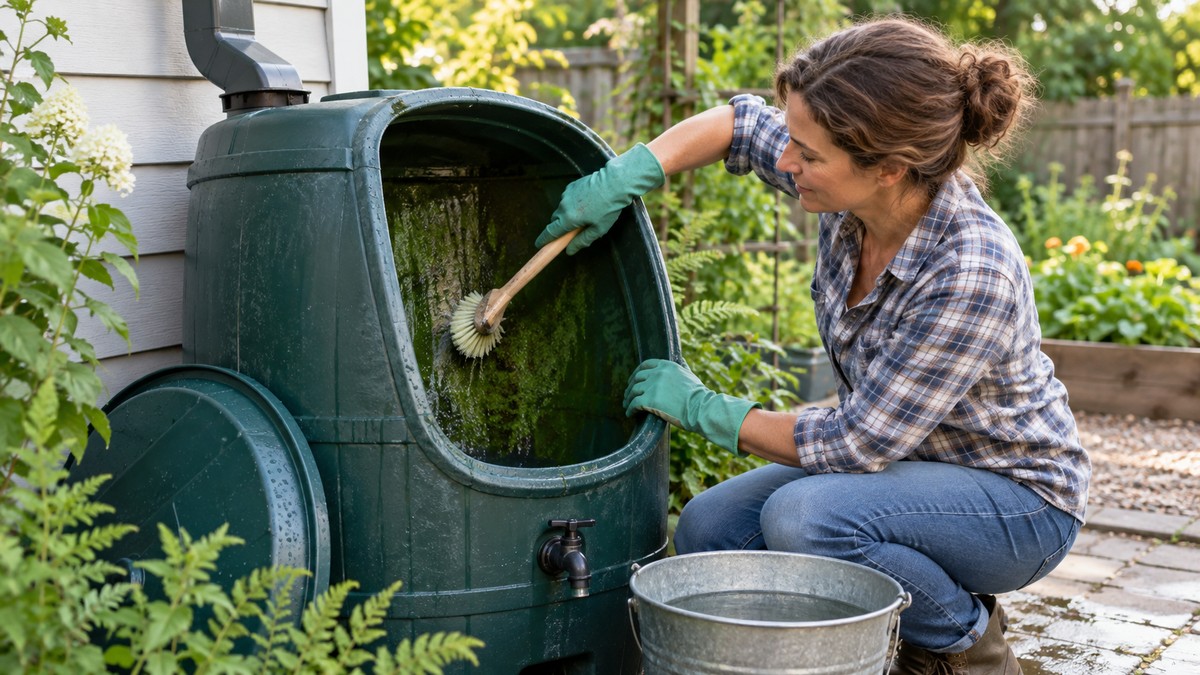
Start by emptying the barrel. Colorado State’s Pueblo guide gives a simple wash: “Take your garden hose and give the barrel a good spray around the inside to dislodge any algae that have started to grow”. Then add the scrub: “Give it a good scrub with a long-handled brush”.
Wisconsin Extension describes a stronger wash for when algae become a problem. It says: “If algae become a problem, empty the barrel and then wash the barrel with a dilute bleach solution”. It then gives the rinse and disposal step: “Rinse the barrel well after bleaching and dispose of the bleach water in a household drain”. This guide does not repeat a bleach ratio. Read the label of any cleaner you choose and follow its directions.
Whatever you use, finish with a thorough rinse. Nebraska’s list of checks includes “cracks” and “build-up of sediment” on the inside bottom of the barrel, so look there while the barrel is empty.
Emptying does not finish the job. Nebraska warns: “Be aware, though, that even after emptying a rain barrel, two to three inches of water can remain in the bottom which may allow mosquito development if they gain access to the barrel”. That leftover water is a reason to keep the lid and screen in good condition, as covered below, and it is a reason not to treat an emptied barrel as dry.
Keep algae from coming back
Dark, shaded barrels resist algae. The Nebraska guide says: “Rain barrel containers should be dark-colored or opaque”. It adds: “Place rain barrels in a shady location when possible”. The two rules work together, because light is one of the three drivers the guide names.
Debris is the other driver, and the gutters feed the barrel, which is why the guide ties them to cleaning. Keeping the roof clean and the inlet screened, as described above, reduces the nutrients that reach the water. Penn State’s point about dirtier roof runoff points the same way.
Color is a simple control. The Nebraska guide says: “If white or light colored barrels are used, paint them a darker color”. Covers do double duty, since the guide notes that “Covers (solid or screened) are needed to keep out mosquitoes, tree leaves, other debris, pets, and wildlife”. It also warns about children: “Secure covers are important to prevent children from crawling inside”.
Penn State’s maintenance list ties these habits together. It says routine maintenance “should include keeping the barrel covered, checking screens and fittings, directing overflow toward lawns or gardens, using the stored water regularly, cleaning the barrel periodically, and disconnecting or draining it before freezing weather”. Each item on that list reduces the time water sits and the amount of debris that enters.
Mosquitoes, screens and standing water
Algae and mosquitoes are separate problems, and the Nebraska guide links both to how the barrel is kept. It says: “Algae growth and mosquito breeding are issues that may arise with rain barrels. Both can be prevented”. On mosquitoes, it says: “Mosquito breeding is promoted by the use of open barrels and allowing collected water to become stagnant”. It gives the life-cycle timing: “Mosquitoes require 7 to 10 days of stagnant water to develop from egg to adult”. The same guide adds: “Using the rainwater within this time can prevent mosquito development”. Rutgers Cooperative Extension offers a shorter check: “If water remains after 72 hours, the rain barrel should be checked for mosquito larvae”.
The fix for mosquitoes is a closed top. Wisconsin says: “A fine mesh screen or filter fitted to the lid of your rain barrel will prevent adult mosquitoes from gaining access to the barrel and laying eggs”. Rutgers says the top “should be covered with window screening material that tightly fits to prevent access to the harvested rainwater”. Rutgers also advises an overflow hose: “A garden hose that is at least 8–10 foot long should always be attached to the overflow adaptor”. Utah State makes the general point: “All containers should be covered for safety and to prevent mosquitos”. Colorado State’s Pueblo guide notes a legal requirement in its state: “Rain barrels must have a sealable lid to conform to Colorado Water Law”. Local rules differ, so check yours before you set up or change a barrel.
Mistakes to avoid
- Leaving the barrel in direct sun. Wisconsin Extension says algae growth may be a problem in direct sunlight.
- Skipping the gutters. Nebraska advises cleaning roof gutters at least annually.
- Letting the screen clog. Nebraska says a filter or screen should be cleaned regularly, ideally after each rainfall.
- Letting water stand. Wisconsin says most problems are avoided if water does not stand in the barrel for more than five to seven days.
- Forgetting the rinse after a wash. Wisconsin says to rinse the barrel well after bleaching.
- Assuming an emptied barrel is dry. Nebraska says two to three inches of water can remain in the bottom after emptying.
How we chose
We opened six extension pages on rain barrels with curl on 2026-10-22: Nebraska, Utah State, Wisconsin, Colorado State’s Pueblo office, Rutgers and Penn State. The sections we kept describe algae, cleaning, screens, gutters and mosquito control, because those tasks share one routine. A University of Minnesota rain barrel page returned HTTP 403 and was left out. The guide recommends no products.
What we could not verify
The sources do not agree on how often to empty a barrel. Utah State and Nebraska say once a year, and Colorado State’s Pueblo guide says every month. None of the opened pages gives a schedule tied to sun exposure or to roof size. The sources describe a bleach wash, but they do not say how long a barrel should rest before its water is used on plants, and none addresses bleach residue on edible crops.
What the sources do not say
No opened page gives a cleaning schedule for a barrel in full shade, and none says how quickly algae return after a wash. They do not compare plastic and other barrel materials for algae. They do not say what barrel size suits a given roof, although Wisconsin gives a collection figure: about 600 gallons for every inch of rain that falls on 1,000 square feet of roof.
Frequently asked questions
How often should you clean a rain barrel?
At least once a year, according to Utah State and Nebraska. Colorado State’s Pueblo guide recommends emptying it every month, which it links to mosquito prevention. Those are the two schedules on record.
Does sunlight cause algae in a rain barrel?
Sunlight is one of the three drivers Nebraska names, along with nutrients and warm water. Wisconsin Extension says algae may be a problem in direct sunlight, and Penn State says a barrel that gets more sunlight can develop algae.
Can you use bleach to clean algae?
Wisconsin Extension describes a dilute bleach wash for algae that become a problem, followed by a thorough rinse and disposal of the bleach water down a household drain. Wisconsin’s page gives a dilution figure, which this guide does not repeat.
How do you keep mosquitoes out of a rain barrel?
Cover the barrel with fine mesh. Wisconsin says a fine mesh screen fitted to the lid prevents adult mosquitoes from laying eggs in the barrel. Rutgers suggests checking for larvae if water remains after 72 hours.
Should you store the barrel for winter?
Utah State says: “If you live in a cold climate then you should disconnect and store your rain barrel in the winter to prevent it from freezing solid”. That is the source’s advice for cold climates. The sources do not give a freezing temperature, so check your local conditions.
Sources
- https://extensionpublications.unl.edu/assets/html/g2220/build/g2220.htm (opened 2026-10-22)
- https://extension.usu.edu/sustainability/research/rain-barrels-in-utah (opened 2026-10-22)
- https://hort.extension.wisc.edu/articles/rain-barrels/ (opened 2026-10-22)
- https://pueblo.extension.colostate.edu/rain-barrels-and-rainwater-collection/ (opened 2026-10-22)
- https://njaes.rutgers.edu/fs1240/ (opened 2026-10-22)
- https://extension.psu.edu/rain-barrels-turn-rainwater-into-a-backyard-resource (opened 2026-10-22)