Should You Water in the Morning?
As an Amazon Associate we earn from qualifying purchases.
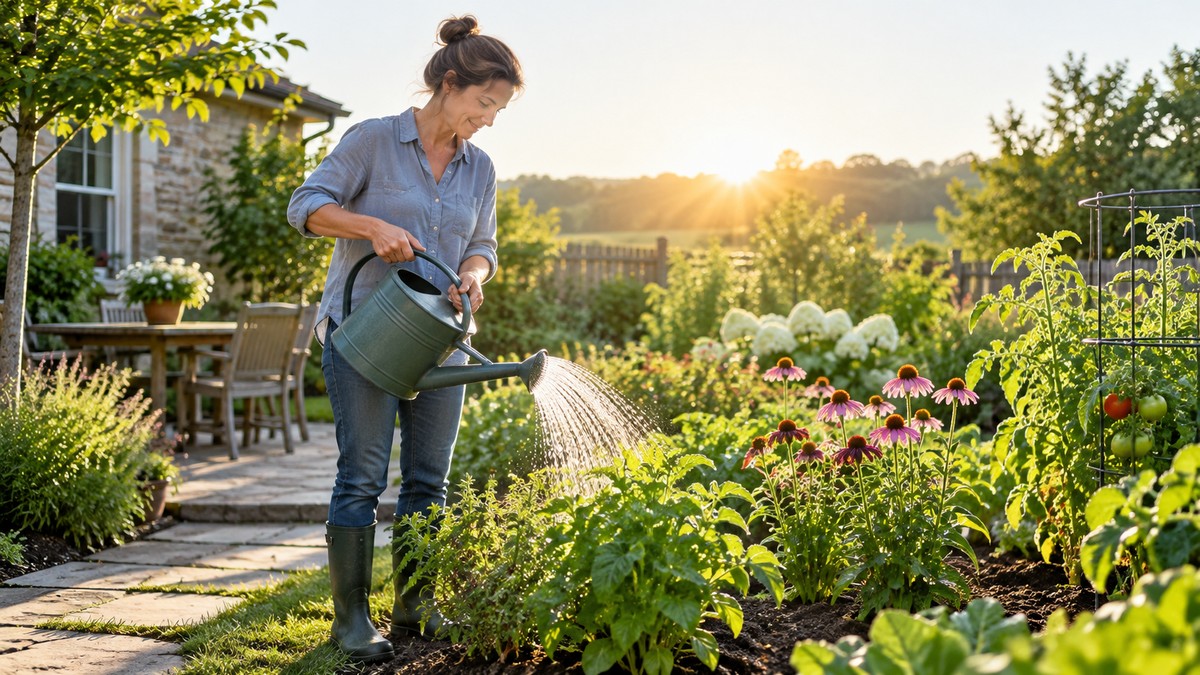
If you are wondering how water in the morning compares with watering at other hours, the short answer is that early morning is usually the best time. Extension guides from several universities give the same main reasons: less water is lost to evaporation, and leaves have time to dry before night. Evening and night watering can make sense in some cases. This guide explains where the sources draw that line, how much to apply, and what they do not settle.
Quick answer
- Water early in the morning, a few hours before or just after sunrise. Virginia Tech names that window as the time when evaporation and wind are lowest.
- Avoid the heat of the day. The University of Maryland guide says midday watering can raise evaporation losses by as much as 40 percent, by its own estimate.
- Evening watering is acceptable in some conditions. Night watering is discouraged by at least one guide unless it is the only time available.
- Water deeply and less often, and check the soil first. Colorado State says typical lawns should receive at least one inch of water per week.
Why early morning usually wins
The main reason is evaporation. Water that sits on the soil surface, or sprays into the air in the afternoon sun, may never reach the roots. The University of Maryland extension guide on trees and shrubs puts a number on the problem. It says: “Watering during the heat of the day increases the amount of water lost to evaporation by as much as 40%.” The guide does not explain how that figure was measured, so treat it as the guide’s estimate, not a rule to apply to your own yard.
Virginia Tech’s publication on turfgrass irrigation makes the same point and gives the clock window. It says: “Water is best applied early in the morning — a few hours before or just after sunrise — when evaporation loss and the impact of wind are lowest.” That publication is written for lawns, but the reasoning carries over to garden beds and containers, because heat and wind act on any water that is still on the surface or in the air.
Kansas State’s lawn watering sheet reaches the same conclusion in a single line: “Morning is the most efficient time to water.” Efficient here means that more of the water you apply is available to the plant. The sheet is a lawn guide, so read it as a general timing rule rather than a measured comparison for your garden.
Wet leaves overnight and plant disease
Timing also changes how long leaves stay wet, and that matters for disease. The Maryland guide warns about one habit in particular: “Late-day, overhead watering that gets the leaves wet increases the chances of some plants being infected by diseases.” South Dakota State’s garden guide makes the same trade-off for sprinklers. It says: “Running sprinklers in the evening, while reducing losses due to evaporation, could lead to the spread of foliar diseases due to prolonged leaf wetness.”
That second source shows the trade-off clearly. An evening sprinkler loses less water to evaporation, but it can leave foliage damp for hours. South Dakota State’s answer is to run sprinklers early in the morning, so the foliage dries as the day warms. Its figure caption for oscillating sprinklers gives the same instruction: “Oscillating sprinklers fan water across the soil surface and should be used early in the morning to minimize water losses by evapotranspiration.”
Virginia Tech is stricter for lawns. Its publication says night watering should be avoided unless it is the only time possible, because it keeps grass blades wet for hours and raises the chance of fungal disease. That warning is written for turf. Dense garden plantings such as tomatoes, squash or roses can also hold moisture on their leaves, but none of the opened sources covers those plants directly.
When evening or night watering makes sense
Not every source treats night watering as a problem. Colorado State University’s lawn guide says: “Finally, avoid watering during the heat of the day. Water early in the morning or in the evening.” It then ties night watering to climate: “If you have an automatic sprinkler system, water during the night; our climate is so dry that night watering doesn’t create problems unless you overdo it.”
That difference comes from where each guide is written. Colorado State ties its night-watering advice to a dry climate. Virginia Tech’s advice is written for a wetter setting and for turf, where leaves stay wet longer after water lands. The sources agree that the middle of the day is the worst time. They disagree about evening and night, mostly because of humidity and disease pressure. In a humid yard, the Virginia Tech warning about wet leaves is the more relevant one.
Containers follow a slightly different rule of thumb. Penn State Extension’s guide on watering in summer heat says: “Especially with containers, try to water around the same time each day.” The reason is practical. If you water in the morning one day and not until evening the next, the plants go two full days in sun and heat with only one watering. A steady daily time keeps the soil in a more even state.
How much to water and how deep
Timing matters less if the amount is wrong. Colorado State gives a baseline for lawns: “Typical lawns should receive at least one inch of water per week.” It also names a soil limit that changes how you apply the water: “Heavy clay soil can only absorb about one-quarter inch of water an hour.” Its advice follows from that. Clay soil should be watered more often with smaller amounts, such as two ten-minute runs rather than one twenty-minute run.
Virginia Tech makes a similar point about slow infiltration. It says: “Effectively applying 1 inch of water is likely impossible to do in a single watering given the slow infiltration rate of most Virginia soils.” Its suggested fix is to spread the total over several days, with smaller amounts applied every three to four days so that the water soaks in instead of running off.
Depth is the other half of the question. Kansas State’s lawn sheet says to soak the soil: “Soak soil to a depth of 6 to 8 inches.” Penn State advises slow watering so the moisture reaches further down: “Water slowly to allow moisture to go deeper into the ground.” Virginia Tech’s turf publication adds the reason for a deep, less frequent schedule: “Deep and infrequent watering that thoroughly soaks the rootzone to a 4-inch depth maintains a healthy root system”. Both sources push toward longer, less frequent soaking rather than a short daily sprinkle.
Check the soil before you water
A clock is only half of the plan. Several extension guides suggest checking the soil first. The University of Maryland guide says to check soil at about six inches down with a trowel, a hand shovel or a screwdriver. It says: “Water when the soil feels dry to the touch beneath the surface.” It also says that soil that is “moist or damp to the touch is fine.” Oklahoma State University offers a simpler check for lawns: “Use a screwdriver to check soil moisture before watering, if it goes in easily don’t water.”
Checking first also helps the morning schedule. If the soil is still moist from the day before, the morning slot can be skipped, which uses water better than watering on a fixed calendar. A soil moisture meter can make the check quicker. Our guide to soil moisture meters for the garden covers how that category is organized, without recommending any single model.
Hoses, timers and sprinklers
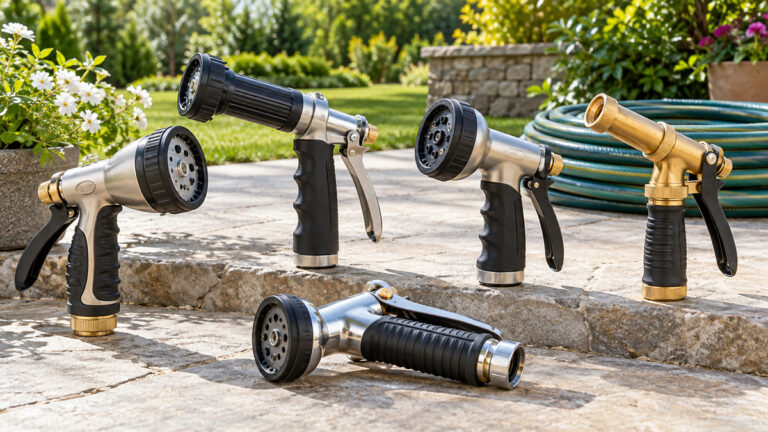
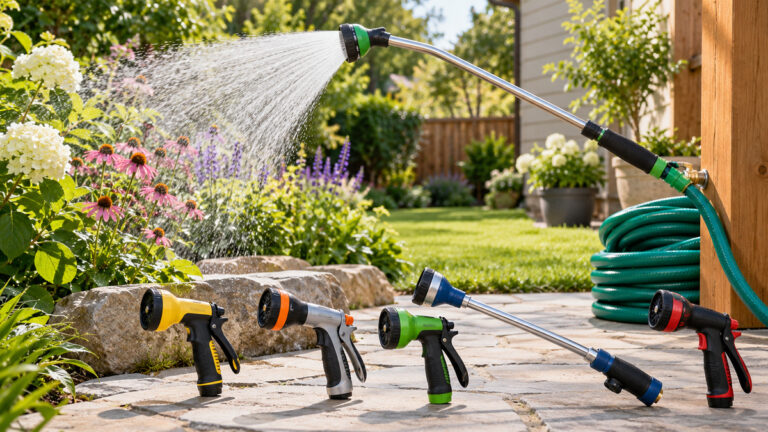
How you water changes how much reaches the roots. South Dakota State notes that drip and soaker systems lose little to the air: “Little water is lost to evaporation, because you are not sending it up in the air.” Their drawback is that water reaches only where the emitters sit, so the placement needs planning. For hand watering, Penn State says a hose with a long-handled wand and a shut-off valve lets you place the water: “a long-handled wand with a shut-off valve allows you to put the water where you want it”.
An early start is easy to miss. Virginia Tech notes that early morning watering is “fairly easy to accomplish with computerized, programmable timers”. and that cheaper timers attached to hoses can also do the job. If a timer would help you keep the morning habit, our guide to hose timers for the garden is a starting point for comparing the category.
Mistakes to avoid
- Watering on a fixed calendar and never checking. The Maryland guide advises: “Check soil moisture at least weekly during the hottest, driest part of summer and fall when plants have a higher demand for water.”
- Wetting the foliage. The same guide says: “Apply water to the roots, not the leaves of the plant.” That habit matters most in the evening, when the leaves have the least time to dry.
- Running sprinklers in the evening to save water. South Dakota State says that practice can spread foliar diseases because of prolonged leaf wetness, even though it cuts evaporation.
- Overwatering newly planted shrubs. The Maryland guide says: “Be careful not to overwater.” It adds that plants should never sit in a puddle of water for an extended period.
How we chose
We limited this guide to extension and university pages that address the time of day for watering. We opened each page with curl on 2026-10-22 and used it only when the HTTP status was 200 and the text could be read. Several extension pages returned HTTP 403 and were left out. Where a source is written for lawns, turf or trees, the text says so. The guide recommends no products.
What we could not verify
The sources do not agree on evening and night watering, and none of them gives one clock time that suits every garden. Most of the guidance is written for lawns, so the application to beds and containers is an extension of that advice rather than a finding from a garden study. The 40 percent figure comes from one university guide without a stated method. Keeping leaves dry is a sound goal, but none of the opened pages measures disease rates in home gardens.
What the sources do not say
None of the opened sources gives a start time in clock hours for your region. They do not say how much a morning schedule saves in your own yard, how much water a particular shrub or tomato plant needs, or how quickly a given soil will drain on your site. Colorado State’s dry-climate exception and Virginia Tech’s warning against night watering come from different settings, and the pages do not say which one fits your area.
Frequently asked questions
Is it better to water in the morning or at night?
Early morning is the timing most of the sources prefer. Virginia Tech says morning is best because evaporation and wind are lowest, and its turf publication warns against night watering unless it is the only option. Colorado State is more relaxed about night watering in a very dry climate, so the answer depends partly on humidity where you live.
Does watering in the morning really save water?
The University of Maryland guide says midday watering can increase water lost to evaporation by as much as 40 percent. That is the guide’s estimate, and it does not give the method behind the number. Morning watering avoids that midday loss, but it does not change how much water a plant needs over a week.
Can you water in the afternoon?
Virginia Tech says afternoon watering is acceptable, but it notes that “wind may affect uniformity, and evaporation loss is greater.” If afternoon is the only time you have, the sources do not say it will harm a plant. They do say it wastes more water than early morning.
How can you tell when the soil needs water?
Check the soil before you water. The Maryland guide suggests checking about six inches down, and it says soil that is “moist or damp to the touch is fine.” If the soil feels dry, water it thoroughly. Oklahoma State offers a screwdriver check for lawns: if the screwdriver goes in easily, do not water that day.
How much water should you apply each time?
The sources do not give one number for every garden. Kansas State says to soak the soil to a depth of 6 to 8 inches, and Colorado State says typical lawns need at least one inch of water per week. Clay soil takes in water slowly, so smaller amounts applied more often may be needed, as Colorado State and Virginia Tech both explain.
Sources
- https://extension.umd.edu/resource/watering-trees-and-shrubs (opened 2026-10-22)
- https://bookstore.ksre.ksu.edu/download/watering-your-lawn_MF2059 (opened 2026-10-22)
- https://www.pubs.ext.vt.edu/430/430-010/430-010.html (opened 2026-10-22)
- https://planttalk.colostate.edu/topics/lawns/1532-efficient-lawn-watering/ (opened 2026-10-22)
- https://extension.psu.edu/watering-to-beat-the-summer-heat (opened 2026-10-22)
- https://extension.sdstate.edu/options-watering-home-gardens-and-landscape-plantings (opened 2026-10-22)
- https://extension.okstate.edu/fact-sheets/lawn-watering-tips (opened 2026-10-22)