How to Water Potted Plants Automatically
As an Amazon Associate we earn from qualifying purchases.
Learning how to water potted plants automatically means choosing a system that delivers water on a schedule while the plants stay healthy. Extension guides from Illinois, North Carolina State, Nebraska, Alabama and Washington State describe the same main options: drip emitters on a timer, self-watering containers with a reservoir, and wicks. Several of them also say that a timer does not replace checking the soil.
The pages were written for different climates and container sizes. This article uses each figure only with its source, and it lists the points the pages leave open at the end.
Quick answer
- Drip emitters on a timer are the main automatic option the pages describe. North Carolina State lists convenience and less nutrient runoff as benefits, and upfront cost and routine maintenance as drawbacks.
- Self-watering containers draw water from a bottom reservoir, which suits balconies and short trips, but they can be expensive and heavy when filled.
- Check the soil anyway. Illinois says moisture meters are “no substitute for observing the plant”.
- Mulch and the right container slow drying, so the system needs to run less often.
Know how often containers need water
Containers dry faster than garden beds. Illinois Extension says “Plants grown in containers need frequent watering as the containers dry fast.” The University of Nebraska-Lincoln explains why: “Containers are exposed to greater soil temperature fluctuations and moisture level extremes than traditional in-ground gardens.” Its NebGuide adds that “a porous container will dry out more quickly than a nonporous container, resulting in a need for more observation of the moisture levels.”
Material and size matter as well. Illinois’ news release says “Potting mix in clay, fabric, and unglazed ceramic containers will dry faster than plastic or glazed pots.” Nebraska adds that “Small containers and metal containers will warm up, cool down, and dry out more quickly than containers made of other materials.”
The pages do not agree on how often to water. North Carolina State says that “most containers will need to be watered at least once a day when plants are mature.” Illinois says “There are no hard and fast rules when it comes to watering.” Washington State’s vacation guide is more cautious: “Don’t water on a set schedule. Rather, check the soil every few days to see if the area needs water.” An automatic system should be set by what the soil and the plant show, not by a calendar alone.
Drip emitters on a timer
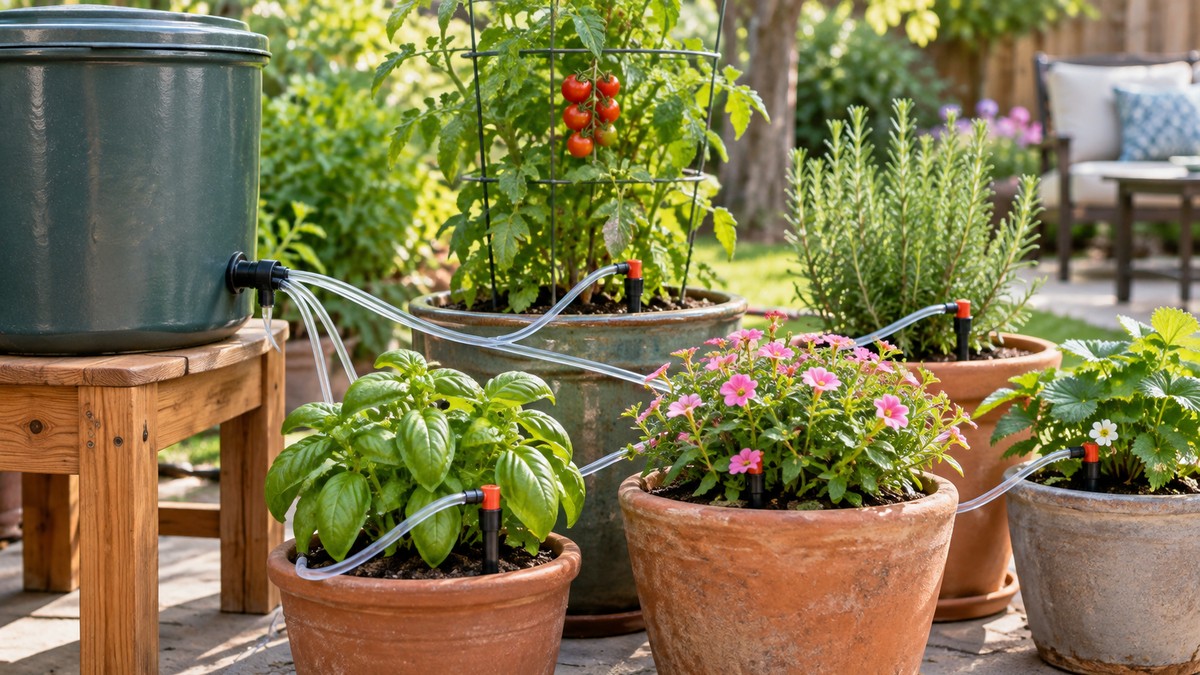
Drip is the option most of the pages describe. Alabama says “Watering time can be reduced by installing a drip irrigation system with an automated timer.” Nebraska explains the mechanics: “Small-scale drip irrigation systems can also be used to water container gardens. These systems emit water in a slow trickle to help ensure water absorption and reduce the loss of moisture and growing media.” It adds that drip “may also need to be automated, using a timer so watering will occur while out of town.”
North Carolina State’s table of watering methods gives the trade-offs. For drip, it lists the benefits as “Convenient and timesaving.” It notes that a timer can include a rain delay, “so that the system can be turned off when it rains.” The drawbacks are the “Initial cost of purchasing the system and the time to install it”, and the need for “routine maintenance to be sure all parts remain in good working order.”
Illinois’ watering page adds that drip irrigation “can be set up to make watering more convenient and less time consuming” when many containers sit in one area. Washington State notes that “Drip systems can be set up in pots or in gardens.”
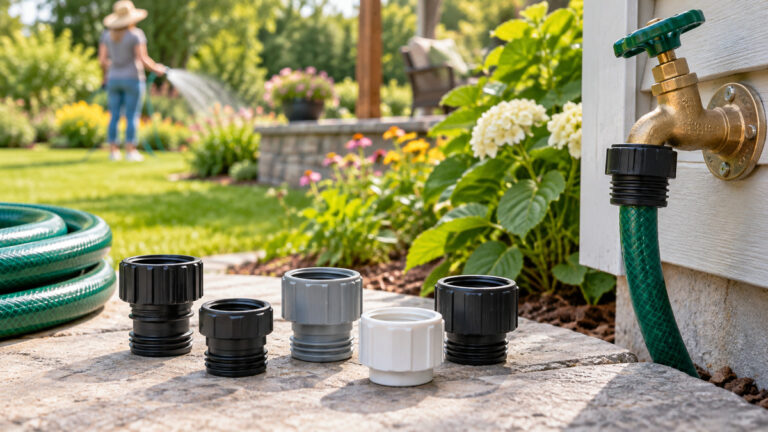
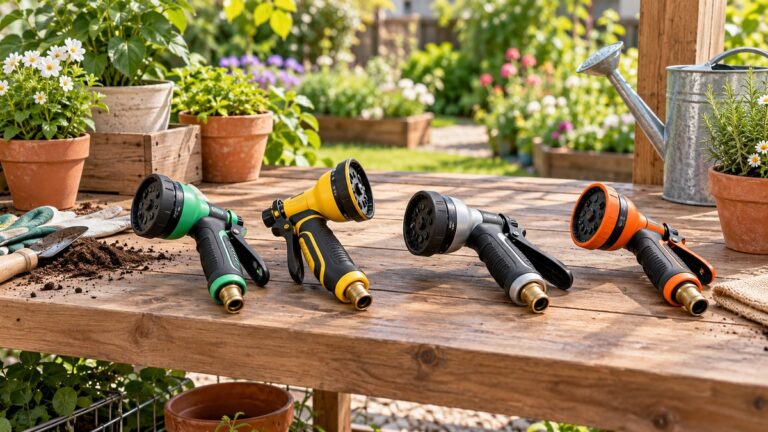
Nebraska also gives a warning about how the water arrives. Water “containers thoroughly using a light trickle and low speed to avoid washing out growing media and exposing plant roots.” A slow emitter suits that rule, and a fast spray does not. For the hose side of a drip setup, see our guide to hose attachments for watering plants, and for spray settings, see nozzles for watering plants.
Self-watering containers and wicks
Self-watering containers are the lowest-effort option. Illinois says “Self-watering containers can supply a reservoir of water to lessen the frequency of watering.” North Carolina State describes how they work: they draw water from a bottom reservoir into the soil by capillary action, through small soil columns or rope wicks, without making the soil too wet. It suggests them for “balcony gardening where draining water would be a problem,” and for summer trips.
The cost is the main drawback. North Carolina State warns that “Purchasing multiple containers at one time can be expensive. Containers are heavy when filled.” Alabama notes that “Some self-watering containers have been manufactured to improve drainage and also have built-in reservoirs for watering plants.”
A simple wick is another option. Washington State describes it: “This requires some sort of absorbent wicking material (strips of a cotton or t-shirt) and a container (bottle, bowl or pail) to hold water.” It also gives a warning: “Ensure that your wicking setup works correctly several weeks in advance so that you can make adjustments accordingly.”
Water-holding gels do not replace a schedule
Water-holding gels are often sold as a way to skip watering. Nebraska says they are a poor fit for that job: “Although water-holding gels may seem to be a great addition to containers to maintain constant moisture, this media is very difficult to rehydrate if it dries out.” It adds that “Growing media containing water-holding gels may need to be watered once, or even twice, a day.”
Illinois is just as direct. “These products do not eliminate the need for timely watering.” North Carolina State also says that water-holding polymers “are not recommended” for containers, so a gel does not replace a timer or a check.
Let the soil set the timing
Several pages advise checking the soil rather than watering by calendar. Illinois’ watering page says “When it comes to rules of thumb the best way to tell if a plant needs water is to feel the soil.” It gives the rule of thumb: “And if the first inch or so of the soil is dry, water.”
When you water, Illinois says to “Apply enough water each time so the whole soil ball becomes moist.” It describes the check: “This means using enough water each time so water starts to drip out of the drainage holes.” Nebraska offers a simple test: “Check moisture levels in containers by sticking a finger or a screwdriver a few inches into the growing media.”
Washington State’s advice is to “Water deeper and infrequently rather than a small amount more frequently.” That approach suits a timer, because one longer run wets the root zone better than frequent small doses.
Water early and keep foliage dry
Timing of the day matters too. Washington State says “Watering early in the morning is best. The evening is 2nd best, with midday being the worst time.” Illinois adds that “Avoid wetting the leaves when watering as this will encourage development of foliar disease.” North Carolina State warns that for a watering can, “If the foliage gets wet, it is more susceptible to sunscald as well as to disease.”
Illinois also advises on the water itself: “Use well water or naturally collected water source and not a source of water that has been softened.” That matters for an automatic system that draws from a home water line, because the source is set by the plumbing, not the grower.
Mulch and drainage slow the drying
Mulch cuts moisture loss. Nebraska says “Mulch can be placed on the surface of the container to reduce moisture loss”, and warns “Do not apply more than 1 inch of mulch on the top of the growing media and around the plant.” North Carolina State adds that the mulch should be “pulled back about 1 inch from the base of the plant to prevent moisture from building up next to the stem and causing disease.”
Illinois’ news release calls mulch “an effective tool for reducing evaporation, even in container plantings”. Drainage is the other half of the job. Illinois says “Proper drainage is just as important as the amount of water added to the container”. Nebraska notes that “All containers require drainage holes punched or drilled in the sides near the bottom of the container.”
Plan for a trip away
Washington State separates a weekend from a longer absence: “If, however, you are going to be gone for a 10-day vacation or longer, you need a more comprehensive strategy.” Its first step is to “Always soak everything well the day before you leave.”
Plan the timing early. The same guide advises “Don’t plant something new within the preceding 4-6 weeks before your departure date.” It also says a wick should be checked early, several weeks ahead, so there is time to adjust it.
Compare the methods
North Carolina State sums up the choice by saying that “Each method has benefits and drawbacks, and the choice of which method to use should be made based on the situation”. Its methods are a watering can, a garden hose, drip emitters on a timer, and self-watering containers. The watering can is the least expensive, while a hose “may be hot and can stunt root development” if it sits in the sun.
For many gardeners the decision comes down to the number of pots and how long they will be unattended. A few pots on a balcony may suit reservoir containers. A row of pots on a patio may suit a drip line, as Illinois notes for containers “located in the same general area”.
Mistakes to avoid
- Relying on a timer alone. Washington State says “Don’t water on a set schedule.”
- Counting on water-holding gels. Nebraska says gels can be “very difficult to rehydrate” once they dry.
- Overwatering. Illinois warns “Do not over water the plants as the container will be waterlogged and the roots will lack oxygen”.
- Ignoring drainage. Illinois says drainage matters as much as the amount of water.
- Watering without knowing the plant. Illinois says to “Water it based on its needs and not some general rule of thumb.”
How we chose
We drew on six extension pages, all opened with curl on 2026-10-22. They are Illinois Extension’s watering guide and its news release on watering container gardens, North Carolina State’s Extension Gardener Handbook chapter on containers, the University of Nebraska-Lincoln NebGuide on container vegetables, Washington State University Extension’s vacation watering guide, and the Alabama Cooperative Extension System’s container gardening article. We kept the methods each page describes and reported the benefits and drawbacks it gives. We did not recommend any brand, timer or self-watering pot, and we did not add timing figures that the pages do not give.
What we could not verify
The pages describe methods, not one automatic watering plan. None of them gives a timer setting, a run time, or a water volume per pot for an automated system, and none names a model. The pages also come from different regions, so their timing advice does not transfer directly to your yard.
What the sources do not say
- How long to run a drip line for a given pot size. Alabama says a timer reduces watering time, but no page gives a run time.
- Whether a timer or a self-watering pot can replace a daily check. Illinois and Washington State both advise checking, and North Carolina State says most mature containers need water at least once a day.
- How much water a reservoir holds in a self-watering pot. None of the pages gives a volume.
- How softened water affects container plants. Illinois advises against it, but no page explains the effect.
Frequently asked questions
Is a timer enough to water potted plants?
Not by itself. Illinois says moisture meters are “no substitute for observing the plant”, and Washington State advises checking the soil every few days to see whether the area needs water.
Are self-watering pots better than drip?
The pages describe both. North Carolina State says reservoir containers suit balconies and vacations, and that drip is “Convenient and timesaving.” Drip carries an upfront cost and needs routine maintenance, while reservoir containers are expensive to buy in quantity and heavy when filled.
How often do containers need water?
The pages differ. North Carolina State says most containers need water “at least once a day when plants are mature”, while Washington State advises watering “deeper and infrequently”. Check the soil before you decide on a schedule.
Do water-holding gels let me skip watering?
No. Nebraska says the media “is very difficult to rehydrate if it dries out”, and Illinois says “These products do not eliminate the need for timely watering.”
What should be set up before a long trip?
Washington State recommends soaking everything well the day before you leave, and it advises checking a wick setup several weeks in advance. For a trip of ten days or longer, it says you “need a more comprehensive strategy.”
Sources
- https://extension.illinois.edu/container-gardens/watering (opened 2026-10-22)
- https://content.ces.ncsu.edu/extension-gardener-handbook/18-plants-grown-in-containers (opened 2026-10-22)
- https://extensionpubs.unl.edu/publication/g2263/2015/pdf/view/g2263-2015.pdf (opened 2026-10-22)
- https://extension.illinois.edu/news-releases/6-tips-watering-container-gardens (opened 2026-10-22)
- https://wpcdn.web.wsu.edu/extension/uploads/sites/57/2019/09/Vacation-Time-Watering-Containers.pdf (opened 2026-10-22)
- https://www.aces.edu/blog/topics/landscaping/container-gardening/ (opened 2026-10-22)