How to Collect Rainwater Without Gutters
As an Amazon Associate we earn from qualifying purchases.
How to collect rainwater for plants without gutters is a question the sources we opened do not fully answer, so this guide starts with what they do cover. The three extension pages listed at the end describe rain barrels that sit under a downspout, and a downspout belongs to a gutter system. The sections that follow explain that setup, the arithmetic for sizing a barrel, and the limits the sources state for how the water can be used.
Quick answer
- The sources describe rain barrels fed by a gutter and downspout system. They do not describe a method for a roof with no gutters.
- The University of Nebraska guide says rainwater from rain barrels is not recommended for watering fruit and vegetable gardens.
- To estimate how much a roof can send, multiply the roof area by the rainfall in inches and by 0.623. A 300 square foot section gives about 187 gallons from a one-inch rain.
- Cover the barrel, carry the overflow away from the foundation, and disconnect the downspout before winter.
Start with the gutter and downspout setup
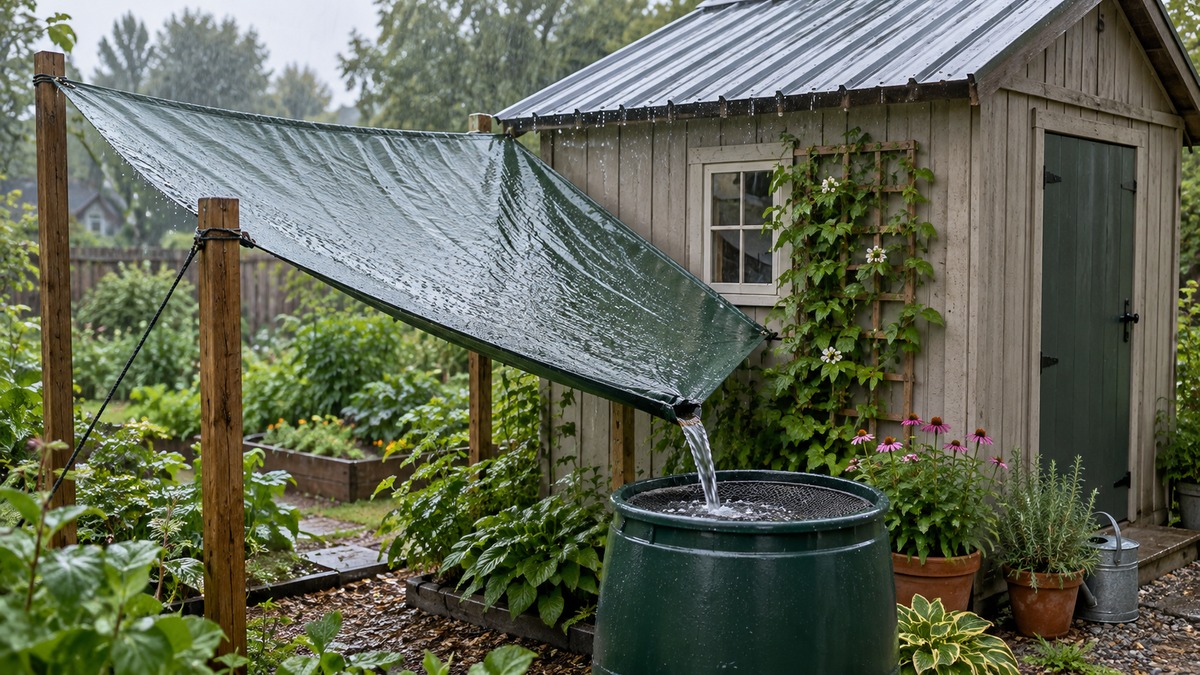
A rain barrel is a container that stores rain from a roof. The University of Nebraska NebGuide describes the basic system this way: rain barrels are “typically used to collect and temporarily store rainwater from rooftops using the gutter and downspout system”. It also notes that “Rain barrels, generally 50- to 100-gallon containers, are a traditional method of rainwater harvesting.” The guide’s figure captions show a barrel with a rain chain in place of a downspout, and that is the closest it comes to a different roof detail.
Location comes next. The North Carolina Cooperative Extension Brunswick County Center advises that you “Determine the location for your rain barrel, ideally under an existing downspout.” Because a full barrel is heavy, the same page says to “position your barrel on level ground to avoid it tipping over.” It also says that you “will need to elevate your rain barrel using cinder blocks, pavers, or other materials”, which helps you reach the faucet and gives the water a gravity assist.
The Utah State University guide puts the core idea this way: by attaching a rain barrel to the downspout, “the rain that falls on the roof is instead collected”. The page contrasts this with the usual pattern, in which roof water runs off to the ground, a ditch or the street.
This is where the no-gutter question gets hard. Every setup the sources describe starts with a downspout, and a downspout is fed by a gutter. The guides do not describe a barrel placed under a roof edge with no gutter, so there is no source for how much water such a barrel would catch or how to direct it.
Work out how much a roof can send
Roof size sets the ceiling on what a barrel can collect. The Nebraska guide gives the calculation as a single line: “Roof Collection Area (sq ft) × Rainfall (inches) × 0.623 = Volume (gallons)”. Its worked example uses one quarter of a typical 1,200 square foot roof, a 300 square foot section that drains to one downspout, and it says that “approximately 185 gallons of rainwater could potentially flow into a rain barrel connected to that downspout during a one-inch rain.”
The table below applies the same formula to five roof sections. These figures are our own arithmetic. The inputs are the areas and rainfall depths in the first two columns, and the 0.623 factor comes from the Nebraska formula.
| Roof area draining to one downspout (sq ft) | Rain (inches) | Gallons (area × rain × 0.623) | Barrels of 60 gallons needed (gallons ÷ 60) |
|---|---|---|---|
| 100 | 0.5 | 31 | 0.5 |
| 100 | 1 | 62 | 1.0 |
| 300 | 0.5 | 93 | 1.6 |
| 300 | 1 | 187 | 3.1 |
| 770 | 0.125 | 60 | 1.0 |
The 300 square foot row at one inch gives about 187 gallons, while the Nebraska example says approximately 185. The formula is the figure to use, and the gap is small. The Utah State page makes the same point from the other side: “Less than 1/8 inch of rainwater on a roof can fill a 60-gallon rain barrel.” The roof size behind that statement is not given, but the last row of the table shows the arithmetic: a 770 square foot section gives 60 gallons from one-eighth inch of rain.
Overflow starts quickly. A single 60-gallon barrel that starts empty and receives the 187 gallons from the 300 square foot row in a one-inch rain would overflow by about 127 gallons, if nothing is drawn from it during the storm. The Nebraska guide names the problem directly: “A limitation of rain barrels is their small size in comparison to the potential amount of rainfall that could be collected from even a portion of a rooftop.”
The guide’s answer is to choose the largest container you can fit and to link more barrels when one is not enough. It says to “select the largest container feasible” and to “link two or more containers together.” It also suggests that you “direct the overflow water to additional linked rain barrels” to increase the amount harvested and used.
Plan the overflow before you fill the barrel
Overflow matters as much as intake. The Nebraska guide states that “An overflow outlet is critical for carrying excess water away from the barrel to prevent water pooling near a building foundation.” The outlet is an opening near the top of the barrel, and a flexible hose or pipe connects to it. The guide also says that site choice depends on several factors: “When selecting a site, consider downspout location, how and where the collected water will be used, and how and where overflow water will be directed.”
The North Carolina guide gives a concrete destination: “Attach an appropriate length of hose to the overflow pipe to direct water to a vegetated area or rain garden.” The Nebraska limit on fruit and vegetable gardens covers rainwater from rain barrels, and overflow is the same water. For that reason, the sources point the overflow toward an ornamental bed or a rain garden, not a vegetable bed. If the hose work is the next step, our guide to soaker hoses covers the hose side of the same job.
Covers, mosquitoes and algae
A cover is the first defense against unwanted visitors. “Covers (solid or screened) are needed to keep out mosquitoes, tree leaves, other debris, pets, and wildlife.” The guide also asks for a filter or screen that is maintained. “A filter or screen that is part of the barrel should be cleaned regularly, ideally after each rainfall.”
Light is the second concern. “Rain barrel containers should be dark-colored or opaque.” The reason given is that “Light colored barrels allow in sunlight which encourages algae growth.” If you already own a light barrel, the guide’s advice is direct: “If white or light colored barrels are used, paint them a darker color.”
Mosquitoes are a question of standing water. “Mosquito breeding is promoted by the use of open barrels and allowing collected water to become stagnant.” The guide adds a timing detail: “Mosquitoes require 7 to 10 days of stagnant water to develop from egg to adult.” Our reading is that a tight cover and regular use of the stored water both matter, because the guide ties breeding to water that stays still. The sources do not say how often a barrel must be emptied to stop breeding, so no interval is given here.
Which uses the sources support
The Nebraska guide recommends rain barrel water for non-potable uses. Its definition is in the sentence itself: “Rainwater collected in rain barrels is recommended for non-potable (water that is not drinking water quality and is not safe for consumption) uses, such as watering ornamental plants.” Ornamental plants are the example the guide gives.
Vegetables are the clearest limit. The same guide says that “Rainwater from rain barrels is not recommended for watering fruit and vegetable gardens.” It gives the reason in a sentence that covers people and pets: “It is not suitable for humans or pets to consume”. The Utah State guide is just as direct: “Do not use the barrel to drink water or store drinking water.”
The Nebraska guide traces the main safety worry to the roof. “Concerns with rain barrel water safety stem primarily from bird droppings and animal waste deposited on rooftops.” It adds that “Bacteria and other disease-causing organisms could be picked up by rainwater flowing over rooftops.” For drinking uses, the guide says that “Specialized filtering and treatment are required”. It does not describe those steps, so this guide does not either.
Winter care
Winter is where the sources are most specific. The Nebraska guide says: “During winter, disconnect the downspout from the rain barrel to protect components from freezing water and to avoid water backing up into downspouts or overflowing around building foundations.” It also advises that you “Store the barrel in a shed or garage if possible”. The Utah State page gives the reason in plain words. Ice can split the plastic and cause leaks, so it asks you to store the barrel for winter wherever temperatures fall below freezing.
A checklist for a gutter-fed barrel
- Confirm there is a downspout to connect to. The sources do not describe a barrel without one.
- Measure the roof area that drains to that downspout, then use the formula to estimate the gallons from a one-inch rain.
- Choose the largest barrel you can fit, and plan a link to a second barrel if the estimate is above one barrel’s capacity.
- Set the barrel on level ground and raise it on blocks or pavers, so the faucet is within reach.
- Route the overflow hose to an ornamental bed or a rain garden, away from the foundation.
- Fit a solid or screened cover, keep the screen clean, and use a dark or opaque container.
- Disconnect the downspout and store the barrel for winter before freezing weather arrives.
For a list of barrel options that suit a garden, see the best rain barrel for a garden. For the hose that carries water from the barrel to a bed, see our soaker hose guide.
How we chose
We opened three extension pages on 2026-10-22. They are a University of Nebraska NebGuide on rain barrels, a Utah State University page on rain barrels in home and school gardens, and an N.C. Cooperative Extension page from the Brunswick County Center. We chose them because each is a university or cooperative extension source that describes rain barrels in its own words. We kept the statements that each page makes in plain words, and each quoted sentence was checked against the text of its page. Retail listings and blogs were left out, along with pages that returned 403, 404 or 429 errors.
What we could not verify
The three pages cover rain barrels that sit under a downspout. Several parts of the question as asked fall outside that scope, and the table is our own arithmetic rather than a measured result.
What the sources do not say
- How to collect water from a roof with no gutter. None of the three pages describes that setup.
- How much water a roof edge sheds without a gutter, or how to direct that water to a barrel.
- How long a barrel takes to fill in a real storm. The figures above come from roof area and rainfall, not from a measured fill.
- Which plants beyond ornamentals can take barrel water in every case. The guide names fruit and vegetable gardens as not recommended, and names ornamental plants as its example.
- Any treatment steps for water used at home. The guide says specialized treatment is required for drinking uses and does not describe it.
Frequently asked questions
Can you collect rainwater without gutters?
The sources do not describe a method for it. Every setup they describe uses a gutter and downspout. The University of Nebraska figure captioned “Figure 1. Rain barrel using a rain chain in place of a downspout.” shows a chain in that position, but the guide does not describe a roof edge without a gutter.
How big should a rain barrel be?
The Nebraska guide describes rain barrels as generally 50- to 100-gallon containers, and the Utah State page works with a 60-gallon barrel. Size the barrel against the roof area that drains to one downspout, using the table above. The guide advises selecting the largest container feasible and linking containers when one is not enough.
Can you water vegetables with rain barrel water?
The Nebraska guide does not recommend rain barrel water for fruit and vegetable gardens. It recommends that water for non-potable uses such as ornamental plants, so the sources give no approved vegetable use for it.
How do you keep mosquitoes out of a rain barrel?
The Nebraska guide ties the problem to open barrels and water that stays still, and it says covers are needed to keep out mosquitoes. A solid or screened cover is the first step. The guide notes that mosquitoes need seven to ten days of stagnant water to develop, but it does not say how often a barrel must be emptied, so the sources give no interval.
Should a rain barrel stay outside in winter?
The Nebraska guide says to disconnect the downspout in winter and to store the barrel in a shed or garage if possible. The Utah State page says to store the barrel for winter wherever temperatures fall below freezing, because ice can split the plastic and cause leaks.
Sources
- https://extensionpubs.unl.edu/publication/g2220/html/view (opened 2026-10-22)
- https://extension.usu.edu/utah4h/research/creating-sustainable-school-and-home-gardens-rain-barrels (opened 2026-10-22)
- https://brunswick.ces.ncsu.edu/rain-barrels/ (opened 2026-10-22)