How to Plant a Window Box for Beginners
As an Amazon Associate we earn from qualifying purchases.
How to plant a window box for beginners comes down to four jobs: pick a box that drains, fill it with a light potting mix, set the plants close together, and water by checking the soil rather than the calendar. The extension pages we opened agree on those basics. Clemson’s Home and Garden Information Center, NC State’s Gardener Handbook, Iowa State’s container care page and Oregon State’s container guide all cover them. Where the pages give different numbers, this guide says so.
Quick answer
- Choose a box with drainage holes, and do not put gravel in the bottom to improve drainage.
- Fill it with a light, soilless potting mix rather than heavy garden soil.
- Water when the mix is dry about an inch down, and keep watering until water runs out of the holes.
- Feed on a regular schedule. The pages give different intervals, so pick one and watch how the plants respond.
Start with a box that drains
Drainage comes first, and the sources are firm about it. Clemson’s window box guide says: “Be sure that your basket or window box has drainage holes.” It gives the reason plainly: “Drainage is essential so that the planting mix will not become water-logged.” NC State’s handbook makes the same point for every container, not only window boxes: “Drainage holes are necessary in all containers to prevent plant roots from standing in water and developing root rot.”
Gravel is the shortcut many gardeners reach for, and the sources reject it. NC State says: “Never put a layer of gravel or rocks in the bottom of a container beneath the potting mix in an effort to improve drainage.” The handbook explains why: “Doing so causes the water to collect in the potting mix just above the gravel.” Clemson agrees: “Do not place pebbles or other material at the bottom of the container.”
A decorative box with no holes needs a different approach. NC State says that a plant set in an attractive pot without drainage holes needs to be double-potted, and its concern is roots standing in water. Check for holes before you buy the mix.
Choose a box that suits the window
Size the box to the window first. Clemson advises: “Window boxes should extend the entire width of the window for best appearance.” Then plan for weight, because a box is heavier once it is wet. Clemson’s page states that “Window boxes and baskets call for a strong support system.” It adds: “Remember that the containers will be much heavier when watered.” The page gives no weight figure, so treat the support as a check to make before the first bag of mix goes in.
Color affects drying as well. NC State explains: “Dark-colored containers absorb more heat than light-colored ones, causing the potting media to dry out faster and the potting mix temperatures to rise.” A light-colored box on a sunny sill therefore warms less and dries more slowly, which is the handbook’s reasoning applied to a window. By the same logic, a dark box in full sun will dry out faster.
If a tray or saucer sits under the box, empty it after watering. Oregon State’s container guide says: “If you have a tray or saucer under your plant, be sure to empty it so the roots do not sit in excessive water.” That line matters more on a window sill, where the tray is easy to forget.
Fill the box with a light mix
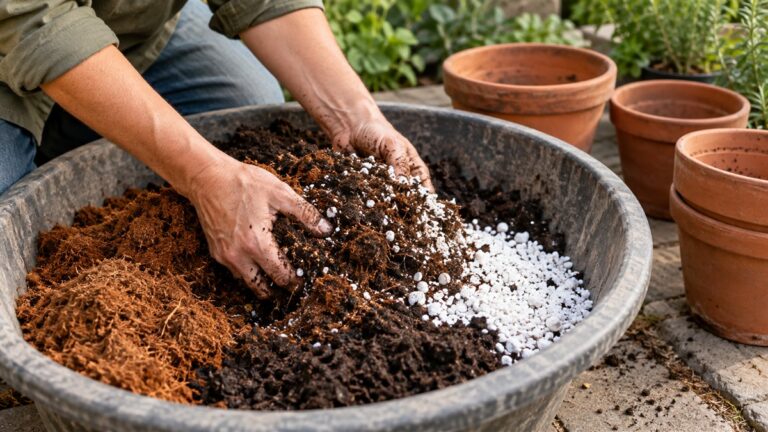
Garden soil is a poor choice for a box. Clemson’s window box page says: “A lightweight potting mix is needed for container gardening.” It explains the trade-off: “Soilless planting mixes provide excellent drainage, aeration and water-holding capacity that ordinary garden soil can not supply.” Oregon State gives the practical rule: “Always use an all-purpose potting soil that contains perlite or vermiculite, to allow for good drainage.”
Moisten the mix before you plant. Oregon State advises: “Moisten potting soil before planting.” Then water the box thoroughly once the plants are in. The same guide warns about empty space: “Containers that have a lot of unfilled space retain too much water and encourage root rot.”
For a box that you build yourself, the sources do not describe the wood or the fasteners, so this guide does not recommend any. If you want to compare the building options first, see our guide to DIY planter boxes for a deck railing.
Plant the box in order
Start with small plants. Clemson says: “Choose small, healthy young plants for planting.” The same page explains that these plants “will adapt to new surroundings much faster than older plants.” Water them well before they go in: “Water plants well before planting.”
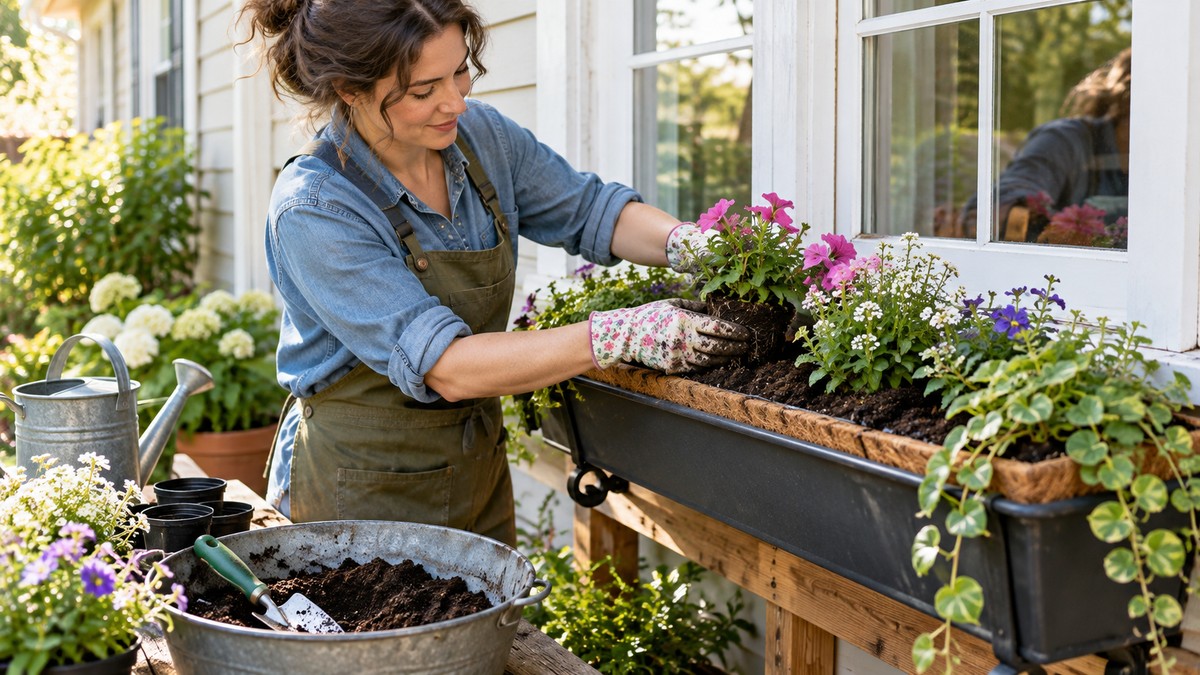
Spacing is closer than many beginners expect. Clemson says: “Plant much closer in a box or basket than you would in a flowerbed.” Put the trailing plants at the edges, and place the upright plants at the center or back. In Clemson’s words, “Trailing plants should be planted at the edges and bushy or upright plants will go at the center or back.”
Choose a mix of plants with some thought. Clemson says that “Many types of plants will grow in containers including annuals, vines, tropical plants, herbs and even some vegetables.” It also suggests including “a variety of colors, shapes and textures.” Once the plants are settled, pinch off early blooms on new transplants: “Pinch off flowers on new transplants to promote sturdy growth.”
Finish with a full watering. Oregon State says: “After planting, water thoroughly.” The water should run out of the holes, which shows the mix is saturated from top to bottom.
Water by feel, not by the calendar
A box dries out faster than a bed. Iowa State’s container care page says: “In general, containers need much more frequent watering than garden beds.” It advises checking often: “Plants growing in containers should be checked daily (especially in summer) to determine whether they need watering.” Clemson gives a simple test: “If the potting mix feels dry 1 inch below the surface, it is time to water.”
How often you water depends on the box and the day. Iowa State says: “Watering frequency may vary from once or twice a day (small container, hot, windy weather) to once or twice a week (large container, cool weather).” A small box on a hot, windy sill sits at the fast end of that range, and a large box in cool weather sits at the slow end. The finger test works in either case, so use it before each watering rather than a set day.
When you water, water all the way through. Iowa State says: “When watering plants in containers, continue applying water until water begins to flow from the drainage holes at the bottom of the container.” That step matters because a mix that is only wet on top will not reach the roots.
Do not let the box dry out completely. Iowa State says: “Do not allow the potting mix to dry out completely.” It also notes that “Potting mixes shrink and pull away from the sides of the containers when completely dry.” Once that happens, “Dry potting mixes are difficult to moisten” and water runs down the gap and out the bottom. Clemson’s answer is to soak the box: “If the pot dries out too much you should immerse it in water to resoak the soil mix.”
Feed the plants on a steady schedule
A box needs more feeding than a bed, because watering carries nutrients away. Clemson says: “Frequent watering flushes nutrients from the soil quickly, so frequent fertilizing is also necessary.” Its window box page then gives a schedule: “Feed baskets and boxes every two weeks from spring through summer with a complete liquid fertilizer diluted to half-strength.”
Iowa State sets a wider window. It says: “Apply water-soluble fertilizers every 1 to 3 weeks throughout the summer.” Many mixes already contain feed. Iowa State notes that “Many commercial potting mixes contain a slow-release fertilizer.” It adds: “slow-release fertilizers usually don’t last the entire growing season.” That means the feed in a mix can run out before the season does. Oregon State recommends a slow-release product for containers: “Use a slow-release fertilizer or worm castings and apply several times throughout the season.”
Avoid overdoing the nitrogen. Iowa State warns: “Fertilizers that are high in nitrogen should be avoided as they cause excessive vegetative growth at the expense of flowers.” A box full of leaves and few flowers fits the pattern that source describes.
Place the box in the right light
Choose plants that match the window. Clemson says: “Site selection is as important for baskets and boxes as it is for any other plant.” Its window box guide sorts plants into lists for sun and for part shade or shade, so start from the list that fits the window.
Hot weather changes the schedule. Clemson warns: “Containers will need frequent checking as the plants grow and temperatures become hotter.” Iowa State’s ranges show the same pattern: a small box in hot, windy weather may need water once or twice a day. Keep checking the mix, and let the feel of the soil decide.
Keep the box looking good through the season
Trim the box when it starts to sprawl. Clemson says: “Many plants are rejuvenated by a trim in late summer.” The same page gives a timing for planting in fall, so the box can carry color into winter where the plants allow it.
For a closer look at the soil choice for these boxes, see our guide to compost for window boxes.
Common mistakes to avoid
- Putting gravel in the bottom. NC State says it makes water collect in the mix above it.
- Leaving water in a saucer. Oregon State says to empty it so the roots do not sit in excessive water.
- Filling the box with garden soil. Clemson says soilless mixes handle drainage and aeration better.
- Letting the mix dry out completely. Iowa State says not to allow it.
- Using a high-nitrogen fertilizer. Iowa State says it promotes leaves at the expense of flowers.
What we could not verify
The pages we opened cover containers in general and one window box page in particular. They leave several practical questions open, and the list below names them plainly.
What the sources do not say
- No source gives a window box size, depth or plant count. Clemson says to plant “much closer” than in a flowerbed but gives no spacing figure.
- No source states a weight limit for a sill or bracket. Clemson says only that a box needs a strong support system.
- The fertilizer interval differs. Clemson says every two weeks for boxes, and Iowa State says every one to three weeks for a water-soluble product.
- None of the pages gives a number of sun hours for a window box. Clemson groups plants into sun and shade lists without giving hours.
- The pages do not cover winter care for a box that hangs outside a building.
How we chose
We limited this guide to extension and university pages about containers and window boxes. We opened four pages with curl on 2026-10-22, and each returned HTTP 200. We left out retail listings and commercial blog posts from the search results, because they are not extension sources. A University of Massachusetts Extension PDF that appeared in the search results was not opened, so it is not cited.
Where two pages gave different numbers, this guide shows both. We did not pick one silently.
Frequently asked questions
Does a window box need drainage holes?
Yes. Clemson’s window box page says to be sure the box has drainage holes, and NC State’s handbook says drainage holes are necessary in all containers to prevent root rot.
Can garden soil go in a window box?
The sources advise against it. Clemson says soilless mixes give better drainage and aeration than ordinary garden soil, and Oregon State recommends an all-purpose potting soil that contains perlite or vermiculite.
Should gravel go in the bottom for drainage?
No. NC State says gravel in the bottom makes water collect in the mix above it, and Clemson says not to add pebbles or other material at the bottom of the container.
How often should a window box be watered?
Check the mix rather than following a set day. Clemson says to water when the mix feels dry an inch below the surface, and Iowa State says frequency can range from once or twice a day to once or twice a week, depending on the box and the weather.
How often should window box plants be fed?
The sources do not agree on one number. Clemson says every two weeks with a half-strength liquid, and Iowa State says every one to three weeks for a water-soluble product. Choose one schedule, watch the plants, and avoid high-nitrogen products.
Sources
- Clemson Cooperative Extension, Home and Garden Information Center, Hanging Baskets and Window Boxes: https://hgic.clemson.edu/factsheet/hanging-baskets-window-boxes/ (opened 2026-10-22)
- NC State Extension, Gardener Handbook, Plants Grown in Containers: https://content.ces.ncsu.edu/extension-gardener-handbook/18-plants-grown-in-containers (opened 2026-10-22)
- Iowa State University Extension and Outreach, Care of Plants Growing in Containers: https://yardandgarden.extension.iastate.edu/how-to/care-plants-growing-containers (opened 2026-10-22)
- Oregon State University Extension, Container Gardening Basics: https://extension.oregonstate.edu/catalog/em-9544-container-gardening-basics (opened 2026-10-22)
As an Amazon Associate we earn from qualifying purchases.