How to Mulch a Raised Garden Bed
As an Amazon Associate we earn from qualifying purchases.
Knowing how to mulch a raised bed comes down to three choices: clear the weeds first, pick a material that suits a raised box, and spread it to a depth the sources support. Extension offices in several states agree on those basics, even though they differ on the details. Most organic mulches land between two and four inches deep, and the material you choose decides where in that range to stop.
Mulch does more than hold back weeds. Colorado State University Extension notes that it reduces evaporation from the soil surface. This guide covers the steps, the material trade-offs, and the points where the sources disagree.
Quick answer
- Clear established weeds before you add mulch. Mulch stops new seeds from sprouting, but perennial and grassy weeds grow up through it.
- Aim for two to four inches of most organic mulches, and about three to four inches of coarse wood chips in the paths between raised boxes.
- Keep mulch at least an inch from plant stems, and check it every year because it breaks down.
Clear the bed before you mulch
Start with a bed that is free of established weeds. Iowa State University Extension says mulches control weeds by keeping weed seeds from germinating, and it advises taking established weeds out before the mulch goes down. The King County Conservation District fact sheet makes the same point from the other direction: weed suppression is most effective when mulch is applied after weeding.
The University of Nebraska-Lincoln Extension tells gardeners to remove weeds and debris from the area where mulch will go. If you plan to use landscape fabric, lay it down before you apply the mulch. Fabric alone does not settle the matter, though. The King County fact sheet warns that plastic sheeting and fabric barriers are not always the quick fix they seem to be, because some perennial weeds poke through or go around the edges.
Timing matters in the fall, too. Washington State University Extension advises adding mulch to bare spots after weeding, which helps deter new weeds from establishing themselves. Its fall handout starts with a simple task list, and the first item is to clean up vegetable beds.
Choose a material that suits a raised box
Several materials work well, and they behave differently inside a bed. Each line below keeps the claim tied to the source that made it.
- Wood or bark chips: Colorado State says wood or bark chips make excellent mulch between raised boxes, and it recommends three to four inches to control weeds. Iowa State notes that bark comes in sizes from fine to large chunks.
- Weed-free straw: Colorado State calls weed-free straw excellent mulch for vegetables and advises buying certified weed-free products. Iowa State calls straw an excellent mulch for the vegetable garden. The King County fact sheet gives straw a thickness of one to two inches.
- Shredded leaves: Iowa State says to shred or compost leaves first, which prevents matting, reduces blowing, and speeds decomposition.
- Grass clippings: Colorado State says to use fresh clippings in thin layers, no more than a quarter inch thick, and to let each layer dry before adding another. Iowa State warns that fresh clippings may form a dense mat or produce an odor, and that clippings from weedy lawns carry weed seeds.
- Compost: The University of Nebraska-Lincoln page says straw or compost in vegetable gardens can be worked into the soil at the end of the season. The King County fact sheet says highly composted, finely textured material is less effective at weed suppression, so use it as a thin layer under coarse mulch.
Two cautions cut across the list. Colorado State warns against fine sawdust, because it could create a carbon to nitrogen imbalance and a barrier to water infiltration. Iowa State’s advice on fresh clippings points the same way. If you make your own compost for the top layer, our guide to making a compost pile covers the basics.
How deep to spread it
The depth figures in these sources are close but not identical. The University of Nebraska-Lincoln page says a depth of two to four inches is ideal for most organic mulches. Colorado State recommends three to four inches of wood chips to control weeds. The King County fact sheet calls coarse mulch at three to four inches deep optimal for most landscape beds.
The sources disagree on fresh grass clippings and other loose materials. Colorado State says to apply fresh clippings in layers no thicker than a quarter inch. Iowa State says to apply several inches of grass clippings, shredded leaves, coco hulls, or weed-free straw in early June, after the soil has warmed. Both figures come from the sources, and they do not match. The sources do not say which one fits your bed, so treat both as starting points.
If you are still filling the box, our guide on how much soil a raised bed needs covers the fill side of the job.
Step by step for a raised bed
Use this sequence for a bed that already holds plants or soil. Each step traces back to a source above.
- Pull or cut out established weeds, and remove loose debris from the surface.
- If you plan to use a biodegradable barrier such as cardboard or newspaper, lay it on level ground under the coarse mulch, and keep it moist.
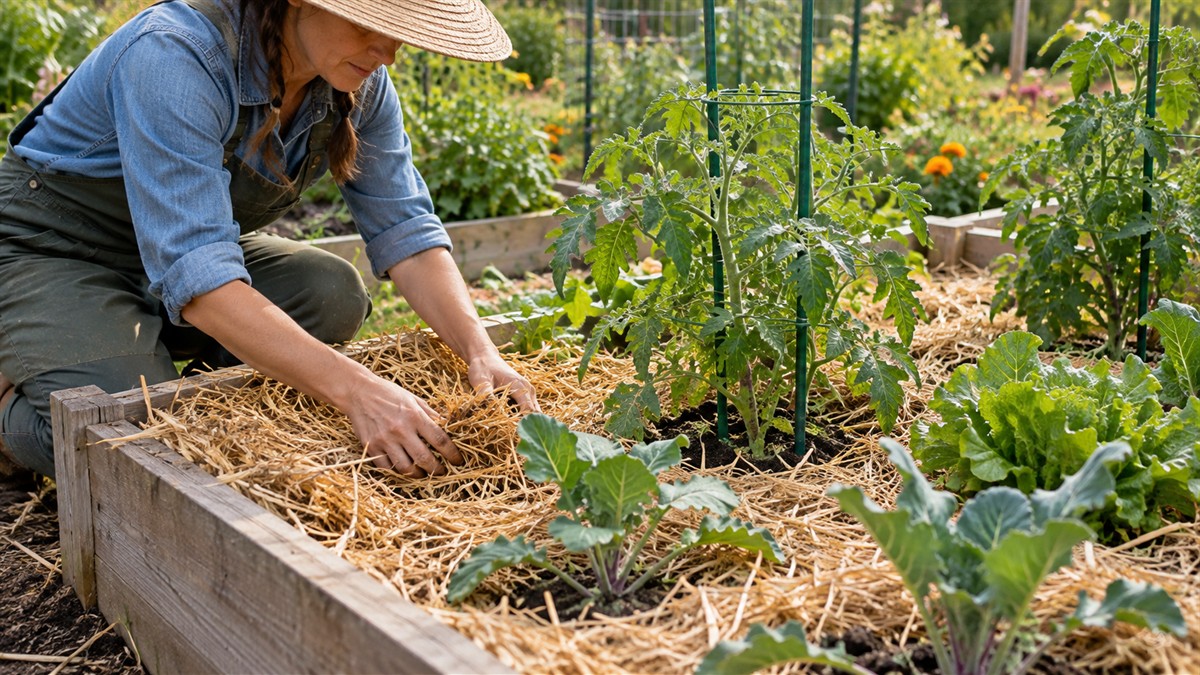
- Spread the mulch evenly to your target depth. Keep it at least an inch from plant stems. The University of Nebraska-Lincoln page suggests a few inches from the base of plants and tree trunks to prevent rot and pest problems.
- Check the edges of any barrier, because some perennial weeds get through or around them.
- Look over the mulch once a year and add more when it has broken down.
Mulch, moisture and timing
Colorado State says mulching reduces evaporation from the soil surface, and it puts the reduction in irrigation need at around 50 percent. The Utah State University fact sheet adds a raised-bed detail: raised-bed soil warms more quickly in spring, and higher soil temperatures increase evaporative moisture loss, which means more frequent irrigation during hot summer months. None of these pages measures how much mulch helps inside a raised box, so treat the 50 percent figure as Colorado State’s estimate for its own conditions.
Timing depends on the season. Iowa State advises applying those materials in early June, after the soil has warmed, and it warns that applying them while the soil is still cool in early spring can slow plant growth. For the cold months, N.C. Cooperative Extension calls mulching one of the simplest, most effective winterization steps. If you prefer not to plant a cover crop, mulch still gives strong winter soil protection.
For winter, our roundup on preparing raised beds for winter looks at covers, which is a different question from the mulch steps here.
Common mistakes to avoid
- Using fine sawdust. Colorado State warns that it could create a carbon to nitrogen imbalance and a barrier to water infiltration.
- Spreading fresh grass clippings too thick. Iowa State notes that fresh clippings may form a dense mat or produce an odor.
- Mulching over weeds that are already up. Covering perennial and grassy weeds will not suppress them, because they grow up through the mulch layer.
- Letting the layer thin out. The King County fact sheet says weed seed germination is likely to increase once the mulch breaks down to less than two inches.
- Trusting fabric alone. Plastic and fabric barriers are not always a quick fix, and perennial weeds can poke through or go around the edges.
- Piling mulch against stems. Keep it an inch or more away from them.
- Using clippings from a weedy lawn. Those clippings will carry weed seeds into the bed.
Keep it working through the year
Mulch does not last forever. The University of Nebraska-Lincoln page says organic mulch breaks down over time and needs replenishing, and it recommends checking levels annually and adding more to keep the desired depth. The King County fact sheet gives a practical marker: once the layer falls below two inches, weed seeds become more likely to germinate. Washington State’s fall handout pairs that habit with cleanup, so bare spots get mulch before new weeds take hold.
How we chose
The sources are university extension pages, a conservation district fact sheet, and a state university handout. Each one was fetched with curl on 2026-10-22, and its mulch, weed and winter sections were read before any sentence was used. Quoted sentences were checked word for word against the fetched text. Retail pages, blog posts and pages that returned errors were left out, and no product is named or recommended.
Dates matter. The Utah State fact sheet is from February 2012. The N.C. Cooperative Extension article is dated November 18, 2025. Check your local extension office for advice tuned to your climate.
What we could not verify
The sources agree on the basics but not on every number. Depth ranges differ by material, the grass clippings guidance conflicts, and none of the pages measures how these mulches perform in a particular raised bed.
What the sources do not say
The sources do not give a cost for any mulch, and they do not rank brands or name products. They do not say how long a given material lasts in a raised box in your climate, beyond the general note that organic mulch breaks down over time. They do not explain how mulch affects individual crops. The Utah State fact sheet is dated February 2012, so its soil and irrigation advice may need checking against current local guidance. None of the sources covers how mulch and drip irrigation work together, so plan the watering on your own after you read the local guidance.
Frequently asked questions
When is the best time to mulch a raised bed?
Iowa State advises applying several inches of grass clippings, shredded leaves, coco hulls, or weed-free straw in early June, after the soil has warmed. It warns that putting them down while the soil is still cool in early spring can slow plant growth. For the cold months, N.C. Cooperative Extension treats mulch as one of the simplest, most effective winterization steps.
How thick should mulch be in a raised bed?
For most organic mulches, the University of Nebraska-Lincoln page gives two to four inches. Colorado State recommends three to four inches of wood chips to control weeds, and the King County fact sheet describes coarse mulch at three to four inches as optimal for most landscape beds. Straw sits thinner, at one to two inches in the King County figure, so match the depth to the material.
Do grass clippings work as mulch in a raised bed?
Grass clippings can work, with conditions. Colorado State says to spread fresh clippings in thin layers, no more than a quarter inch thick, and to let each layer dry before adding more. Iowa State says to let lawn clippings dry first, because fresh ones may mat down or produce an odor. Clippings from a weedy lawn will carry weed seeds, so think twice before using them.
Is landscape fabric a good idea under mulch?
The sources treat it with caution. The University of Nebraska-Lincoln page says to lay landscape fabric down before the mulch goes on. The King County fact sheet warns that plastic and fabric barriers are not always the quick fix they seem to be, that some perennial weeds poke through or go around the edges, and that barriers do not stop seeds from growing on top of them. Its alternative is a biodegradable layer such as cardboard or newspaper under coarse mulch, kept moist and fully covered.
How often does mulch need topping up?
The University of Nebraska-Lincoln page says to check mulch levels annually and add more as needed to keep the desired depth. The King County fact sheet gives a marker to watch: once the layer falls below two inches, weed seed germination becomes more likely. For winter protection, N.C. Cooperative Extension recommends three to six inches, a separate figure from the summer depths above.
Sources
- https://extension.colostate.edu/resource/mulches-for-the-vegetable-garden/ (opened 2026-10-22)
- https://yardandgarden.extension.iastate.edu/how-to/using-mulch-garden (opened 2026-10-22)
- https://yardandgarden.extension.iastate.edu/faq/how-can-mulches-be-used-control-weeds (opened 2026-10-22)
- https://byf.unl.edu/mulch (opened 2026-10-22)
- https://cob.org/wp-content/uploads/Manage-Weeds-Naturally-Mulch-Booklet-Digital.pdf?pdftype=e (opened 2026-10-22)
- https://wpcdn.web.wsu.edu/wp-extension/uploads/sites/2056/2025/08/Fall-Composting-Handout.pdf (opened 2026-10-22)
- https://extension.usu.edu/yardandgarden/research/raised-bed-gardening.pdf (opened 2026-10-22)
- https://wilkes.ces.ncsu.edu/2025/11/winterizing-your-raised-garden-beds/ (opened 2026-10-22)