How to Keep Compost From Smelling Bad
As an Amazon Associate we earn from qualifying purchases.
Most compost that smells bad is telling you something specific. A pile that smells sour, foul or like rotten eggs is usually short of air, and a pile that smells sharp like ammonia usually has too much nitrogen-rich material. Work out which smell you have, then make the matching fix. This guide explains how to keep compost from smelling bad, using what the extension sources say about each cause.
The pages we opened cover the same handful of causes: air, the balance of materials, and moisture. The advice below sticks to what they state, and it names the publication behind each point.
Quick answer
- A sour or foul smell usually means the pile is short of air or too wet. Turn it, and add dry material if it is too wet.
- A sharp ammonia smell usually means too much nitrogen-rich material. Add carbon-rich material such as dried leaves, then turn the pile.
- Bury kitchen scraps in the pile, and keep meat, bones, fats and dairy out of it.
Match the smell to its cause
A smell is a clue rather than a diagnosis, but the sources tie each common smell to a short list of causes. Use the table as a first check, then look at the pile itself before you change anything.
| Smell | What the sources connect it to | First fix |
|---|---|---|
| Sour, foul or sewage-like | Too little oxygen. The Alabama guide says, “When a pile gets too little oxygen, it will become anaerobic, and offensive odors can result.” | Turn the pile, and add dry material if it is too wet. |
| Sharp, like ammonia | Too much nitrogen compared with carbon. The Alabama guide says the excess nitrogen is given off as ammonia gas. | Add dried leaves or other carbon-rich material, then turn the pile. |
| Rotten-egg or sulfur, in bagged leaves | Leaves that do not get enough air. The Ask Extension answer says, “If your leaf litter is not getting enough air it will have an anaerobic sulfur smell.” | Shred the leaves, moisten them, and poke holes in the bag for air. |
Why a pile goes sour
The Alabama guide starts from the basic biology: “Air Composting is an aerobic process, which means it occurs in the presence of oxygen.” The microbes that break down a pile use that oxygen, so a pile that is packed tight or cannot move air starts to go sour. The Virginia Cooperative Extension publication on making compost gives the three usual causes in one sentence: “If the pile smells bad, it may be too tightly packed for oxygen circulation, have too much nitrogen-containing material, or be too wet.”
Those causes often overlap. A wet pile with few air spaces can smell even when the green-to-brown mix looks right, so check all three before you decide which one to fix. The Illinois troubleshooting page names the air problem directly. Under a bad odor, its first problem is “Not enough air.” Its fix reads: “Turn it, add dry material if the pile is too wet.”
Build the pile so air can move
Airflow depends partly on how the pile is built. The Alabama guide suggests starting with a coarse base: “Begin with a 6-inch layer of coarse materials such as small twigs or branches (this adds air).” The Virginia guide puts down a 3-inch base of coarse material for the same reason, to get good aeration and drainage. A base like this lifts the first layers off the ground so air can reach them from underneath.
Chopping helps too. The Virginia guide says, “Chop or shred all plant materials before adding them to the pile for faster composting.” The reason is surface area. The Alabama guide makes the same point about chips: “Small chips give the microorganisms more surface area on which to feed.” Chopping does not stop a smell by itself, but it gives the microbes more to work on, and that makes the air and balance fixes easier to see.
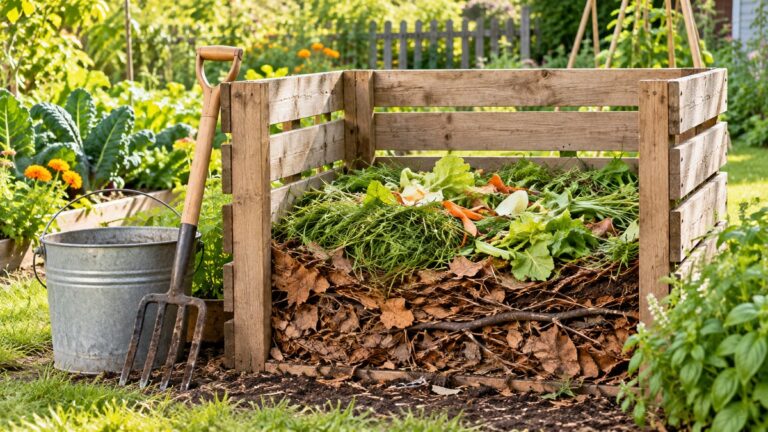
If you build your own bin, the Virginia guide asks for openings. It says to “leave spaces between blocks or planks for aeration because air is essential to the rapid composting of organic materials.” The same guide describes a bin that is easy to assemble and gives easy access for turning. Access matters because a pile you cannot reach is a pile you will not turn. For the setup steps, see our guide to starting a compost bin.
Balance the greens and browns
The sources call the two kinds of material greens and browns, and the balance between them sets how much nitrogen is available. The Virginia guide gives a target by volume: “The volume of the brown plant material should equal or be up to three times as much as the green plant material in the pile (C:N ratios of 1:1 to 3:1 by volume).” The Alabama guide expresses the same idea as a ratio: “The optimum C:N ratio is about 30:1.” Those are two ways of saying one thing, so pick the one that matches how you measure your materials.
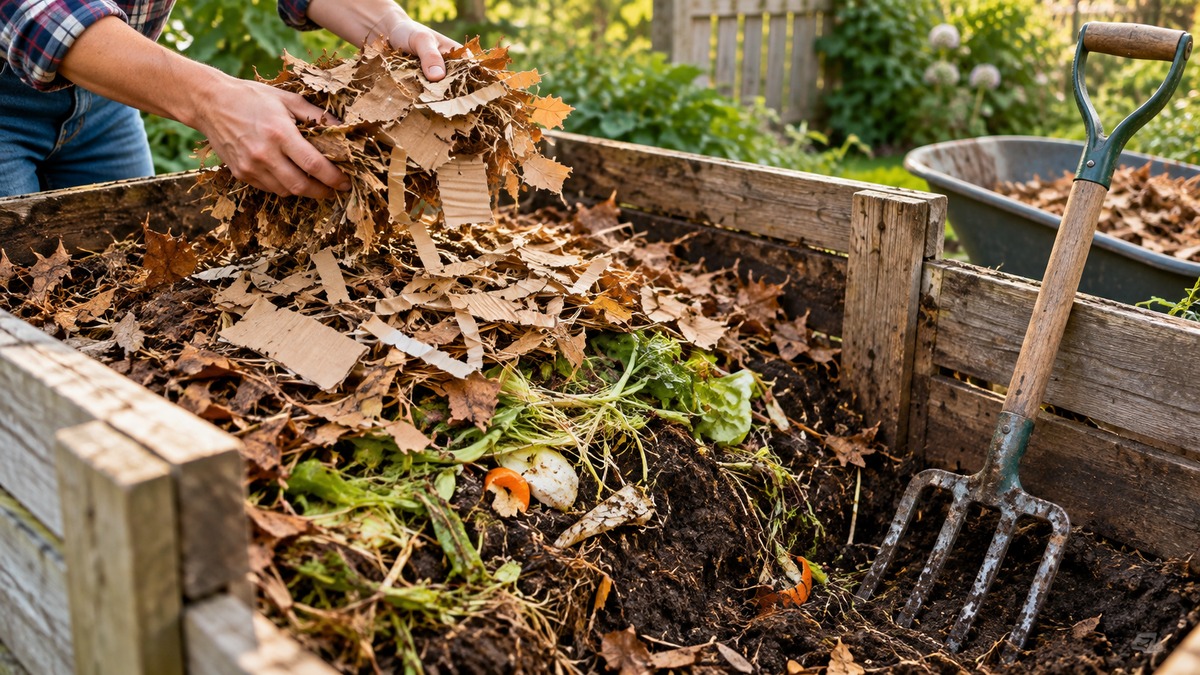
The Arizona handout sorts common materials into two lists. Its carbon-rich list includes newspaper and dried leaves. Its nitrogen-rich list includes grass clippings, vegetable scraps and fresh leaves. A pile that smells sharp usually has too much of the nitrogen-rich list, and the handout gives the fix in short form: “Add carbon if ammonia smell.” For a fuller setup of layers, see our guide to building a compost pile in layers.
Handle kitchen scraps without the smell
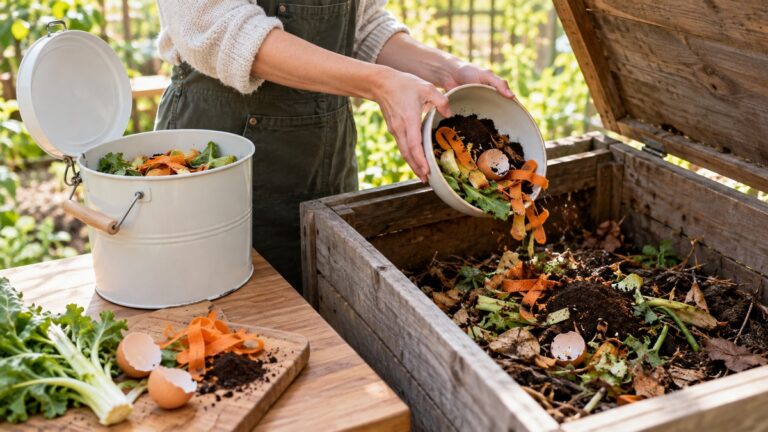
Kitchen scraps are a common nitrogen source in a backyard bin, and the Alabama guide gives a clear rule for them: “Kitchen scraps, such as vegetable and fruit scraps, egg shells, and coffee grounds, can be added to the pile, but make sure they are buried in the pile to avoid odor.” Burying each batch keeps the scraps inside the pile instead of on its surface, which is what the guide asks for.
The same guide treats most vegetable and fruit waste as a good fit, from apples and lettuce to tomatoes and turnips. It is more cautious about animal products. Its list of items to keep out includes fats, butter, bones, cheese, meat, milk and yogurt, and it gives the reason: “Do not add meat scraps, bones, or fats to the compost pile because they will attract unwanted animal and insect pests.”
The Virginia guide adds a condition on meat waste. It says to leave meat out unless the pile is big enough and hot enough throughout to handle it. For most backyard piles, that means keeping meat out altogether, and it is a simpler rule than trying to judge the heat of a pile by feel.
Turn the pile and keep it open
Turning is the fix that appears most often. The Arizona handout lists it as the step to “Turn to re-introduce oxygen,” and the Illinois page makes it the first solution for a bad odor. The Virginia guide explains why in one line: “Turning the pile adds oxygen, so the more you turn it, the faster it breaks down.” It also gives a schedule: “Once a month, turn the pile, moving the top and outside materials to the inside and vice versa.”
The Alabama guide adds a timing note. It suggests turning the pile once the middle has heated up, to mix it evenly and encourage even aeration, rather than on a fixed date. A pile that smells sour is a reason to turn it now, not to wait for the next scheduled turn.
Get the moisture right
Water is the second lever. The Alabama guide gives a range: “Ideally, the moisture content of the compost pile should be between 40 and 60 percent.” For a field check, it says: “The compost should be moist when squeezed but not dripping wet.” The Virginia guide uses a sponge image instead: “The pile should have the moisture of a wrung-out sponge.” The Arizona handout is close to that, with “Moist like a damp sponge.”
Wet and dry piles need different fixes. For a wet pile, the Arizona handout lists “Slimy or Waterlogged: turn the pile; reconsider drainage.” For a dry pile, the Virginia guide says to “Moisten the pile as you add leaves and other dry material.” The same guide offers a shape tip for dry weather: “Shape the pile so its center is lower than its sides to help water flow into the pile during dry weather.”
Check the pile after a fix
After you turn the pile or add dry material, give it a few days and check it. The Virginia guide says: “It should heat up within a few days.” If the pile does not heat, the same guide says it “may lack nitrogen or moisture or be too small.” The Arizona handout gives a short version of that check: “If pile is damp but won’t heat, add nitrogen.”
| What you see | What the sources point to | What they suggest |
|---|---|---|
| Slimy, waterlogged or wet | Too much water and poor drainage | Turn the pile and reconsider drainage (Arizona handout) |
| Damp, but will not heat | Not enough nitrogen (Arizona handout) | Add nitrogen (Arizona handout) |
| Dry center | Lack of nitrogen (Illinois page) | Mix in a nitrogen source such as fresh grass clippings, manure or fertilizer (Illinois page) |
The end point is a finished pile, and the sources describe it by look and smell. The Virginia guide says: “Finished compost is dark and has a pleasant smell.” The Arizona handout adds: “Should be dark, crumbly and have earthy odor.” A pile that still smells sharp or sour has not reached that stage.
Mistakes that keep a pile smelling
- Packing the pile so tightly that air cannot move through it. The Virginia guide names this as a cause.
- Adding a steady stream of nitrogen-rich scraps without enough dry material to balance them. The Virginia guide suggests adding old, dead plant material to balance excess fresh, green material.
- Letting the pile stay wet and never turning it. The Arizona handout puts turning first in its problem-solving list.
- Putting meat, bones, fats or dairy into the pile. The Alabama guide says they attract unwanted animal and insect pests.
- Leaving scraps on the surface. The Alabama guide says to bury them.
How we chose
This guide rests on statements that the extension pages we opened on 2026-10-22 make in plain words. We kept the causes that two or more of those pages support, and the fixes that a page states directly. We left out any figure whose text did not extract cleanly. The Alabama file, for example, has garbled degree signs, so this guide gives no temperatures. We also left out products, retail pages and hobby blogs. The table of smells is our arrangement of those statements, not a finding from a study.
What we could not verify
The pages we opened answer the basic questions: what causes a bad smell, and how turning and balance fix it. They say less about timing, pile size and climate, and this section sets out those gaps so you can plan around them.
What the sources do not say
The sources do not say how long a smell lasts after a fix, so this guide gives no number of days. They do not give a minimum pile size that prevents odor. The Virginia guide says a pile may be too small to heat, but it gives no size. The Alabama guide gives no figure for how much air a pile needs. The Ask Extension answer covers bagged leaves, not a kitchen-scrap pile, and this guide does not stretch its sulfur point to a pile. The pages also do not rank the causes. A pile that is wet and packed at the same time could smell for either reason, and the table is a first check, not a diagnosis.
Frequently asked questions
Why does my compost smell like ammonia?
The Alabama guide explains that too much nitrogen compared with carbon can release the excess as ammonia gas. The Arizona handout gives the short fix: “Add carbon if ammonia smell.” Dried leaves are on its carbon-rich list, so they are an easy choice for the carbon side.
Does a rotten-egg smell mean my compost is ruined?
The sources do not say that. The Ask Extension answer ties a sulfur smell to leaves that do not get enough air, and it describes a bag fix: shred the leaves, moisten them, and poke holes in the bag. That answer concerns leaf litter in bags, so it does not show what a kitchen-scrap pile needs. Turning the pile and checking its moisture is the sensible next step.
Does burying meat or dairy keep the smell down?
The Alabama guide says no to meat, bones and fats, and its list of items to keep out also includes butter, cheese, milk and yogurt. Burying does not change that advice in the guide. The Virginia guide gives a narrower rule for meat waste: include it only when size and heat can be kept up throughout the pile.
How often should a compost pile be turned?
The Virginia guide suggests once a month. The Arizona handout ties turning to finishing time: weekly turning finishes in one to two months. Turning to re-introduce oxygen is the same action that answers a sour smell, so a pile with odor problems usually needs turning first. The Illinois page is less specific and says to turn it when air is short.
What should finished compost smell like?
The Virginia guide says finished compost “is dark and has a pleasant smell.” The Arizona handout describes the same stage as “Should be dark, crumbly and have earthy odor.” A pile that still smells sharp or sour has not reached that point, so go back to the three causes above and check them one at a time.
Sources
- https://www.aces.edu/wp-content/uploads/2018/11/ANR-0638.REV_.pdf (opened 2026-10-22)
- https://www.pubs.ext.vt.edu/content/dam/pubs_ext_vt_edu/426/426-703/SPES-393.pdf (opened 2026-10-22)
- https://www.extension.arizona.edu/sites/default/files/attachment/BackyardCompostingHandout2021.pdf (opened 2026-10-22)
- https://extension.illinois.edu/composting/troubleshooting-composting-problems (opened 2026-10-22)
- https://ask.extension.org/kb/faq.php?id=235043 (opened 2026-10-22)