Best Bird Netting for Garden: Six Listings Compared by Mesh, Area and Wildlife Risk
As an Amazon Associate we earn from qualifying purchases. Details
The best bird netting for garden rows is a taut mesh that keeps birds off fruit and vegetables, with openings small enough that birds cannot get caught in it. A university extension sheet calls exclusion netting the most effective way to prevent bird damage. Government guidance from Victoria and South Australia covers the other side of the question: loose or wide netting can entangle birds and other wildlife. This guide compares six netting listings by size, stated mesh opening, coverage and bundled hardware, and it checks each stated mesh figure against the 5 mm figure those guides recommend.
Quick answer
- Mesh decides the wildlife risk first. South Australia recommends 5 mm x 5 mm or less at full stretch, and Victoria gives the same 5 mm x 5 mm figure. Four of the six listings state a mesh number, and all four are wider than that.
- Area is the second check. Length times width gives the ground a net covers, and the 25 by 100 foot OGORI roll covers the most ground of the six.
- Edges and sag matter as much as the mesh. The UMass Amherst sheet warns that determined birds will tunnel under netting that is not secured.
- Plan the removal date now. Victoria’s guidance says to take netting off once fruit is harvested or over-ripe, and to check the net daily while it is up.
Why netting works, and where it goes wrong
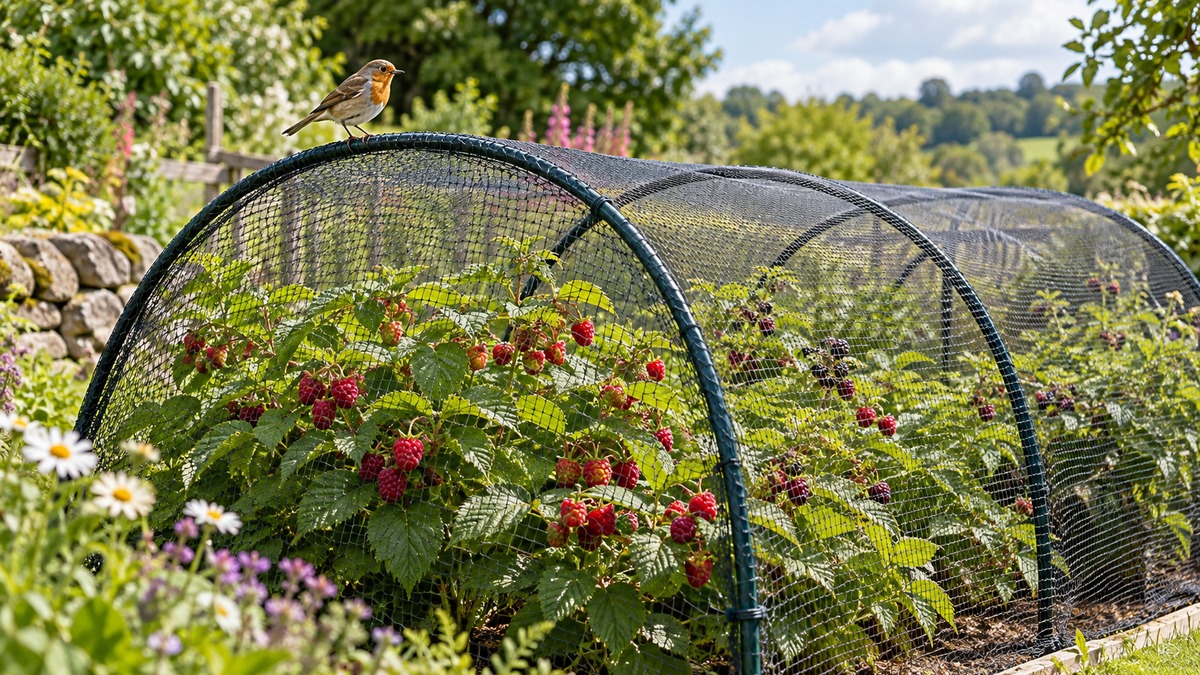
Netting protects fruit by standing between birds and the crop. The UMass Amherst sheet on blueberries and other fruit describes exclusion as the most effective approach, and it says that putting netting over mature plants is difficult. That is why the sheet describes building a frame first and laying the net over it.
The guidance that supports netting also describes how it fails. The South Australian guidance says inappropriate netting, or netting put up the wrong way, can entangle birds, flying foxes, possums, kangaroos, snakes and lizards. It explains that an entangled animal can become stressed, break bones and tear its wing membranes while it struggles. The Victorian guidance says many fruit netting types are the leading cause of flying fox injury and death.
Those guides name Australian animals and do not set US rules. The mechanism they describe is general, though. An animal that meets a loose or wide mesh can push into it, and the fixes they give apply to every animal on their lists. The South Australian guidance calls permanent netting a reliable way to protect horticultural crops and urban fruit trees, and the risk it describes comes from the mesh and the setup.
Three checks before you buy
Three features decide whether a net protects the crop without catching animals: the size of the openings, whether the net stays taut, and whether it comes down when the crop is finished. The sections below apply each check to the six listings. Where a listing does not state a figure, this guide says so and does not fill the gap with an assumed number.
Birds that come for water rather than fruit need a different answer, and our bird bath roundup covers that topic instead.
The mesh number that decides wildlife risk
The most useful number on a netting listing is the opening, meaning the gap between strands, not the roll length. The South Australian guidance recommends a mesh of 5 mm x 5 mm or less at full stretch, and it offers a simple check: netting that you cannot poke your finger through. The Victorian guidance uses the same 5 mm figure and says that if a finger fits through the holes, the net should not go on the trees.
Four of the six listings state a mesh figure in inches. Table 1 converts each one to millimeters, using 25.4 millimeters to the inch, and divides by 5 to show how far it sits above the guidance figure.
Table 1. Stated mesh opening against the 5 mm figure
| Listing | Mesh stated in the listing | Millimeters | Times the 5 mm figure |
|---|---|---|---|
| AlpineReach | 5/8 inch | 15.9 | 3.2 |
| Fetanten | 5/8 inch woven | 15.9 | 3.2 |
| OGORI | 3/4 inch | 19.05 | 3.8 |
| Avagiaforu | 0.8 x 0.8 inch | 20.3 | 4.1 |
| SATOCVAY | not stated | not stated | not stated |
| XMdeliverReach | not stated | not stated | not stated |
The formula is inches times 25.4, then divided by 5. For AlpineReach and Fetanten, 0.625 times 25.4 is 15.9, and 15.9 divided by 5 is 3.2. For OGORI, 0.75 times 25.4 is 19.05, and 19.05 divided by 5 is 3.8. For Avagiaforu, the widest stated opening, 0.8 times 25.4 is 20.3, and 20.3 divided by 5 is 4.1.
So every stated opening is at least three times the guidance figure, and the Avagiaforu opening is about four times it on each side.
Two listings give no number. SATOCVAY describes a fine mesh, and its bullets say the fine mesh lets air, water and sunlight through, but no opening is given. XMdeliverReach describes a tightly woven mesh with stated stretch, but the mesh size is not in the text we read, so this guide gives it no figure. Ask the seller for the opening in millimeters before you buy either one, and use the finger check on the net itself.
The guidance also describes the strands. The South Australian guidance prefers knitted or woven high-density polyethylene with strands at least 500 microns thick, and it warns against thin, lightweight nets that animals can pull out of shape. Fetanten and SATOCVAY name HDPE in their bullets. OGORI names nylon and Avagiaforu names PP. AlpineReach and XMdeliverReach do not name a polymer in the text we read, and none of the six gives a strand thickness, so the 500 micron figure cannot be checked from these listings.
The guidance also recommends white netting where possible, because it is easier for nocturnal animals to see at night. AlpineReach and XMdeliverReach both name black. The other four do not name a color in the text we read.
Coverage: how much ground each net covers
Coverage is length times width. Table 2 gives each listing’s size, the area that results, and how many example beds of 4 feet by 8 feet, which is 32 square feet, that area would cover. The bed count is a rough comparison. It ignores drape, overlap and the frame that holds the net up.
Table 2. Area and example bed count
| Listing | Size in the listing | Area (sq ft) | Example 4 x 8 ft beds |
|---|---|---|---|
| AlpineReach | 7.5 x 65 ft | 487.5 | 15.2 |
| Fetanten | 13 x 40 ft | 520 | 16.25 |
| OGORI | 25 x 100 ft | 2,500 | 78.1 |
| Avagiaforu | 13 x 32 ft | 416 | 13 |
| SATOCVAY | 10 x 10 ft, two bags | 200 | 6.25 |
| XMdeliverReach | 15 x 30 ft | 450 | 14.1 |
The calculations behind the table are short. 7.5 times 65 is 487.5, and 487.5 divided by 32 is 15.2. 13 times 40 is 520, and 520 divided by 32 is 16.25. 25 times 100 is 2,500, and 2,500 divided by 32 is 78.1. 13 times 32 is 416, and 416 divided by 32 is 13. For SATOCVAY, 10 times 10 is 100 per bag, 100 times 2 is 200, and 200 divided by 32 is 6.25. 15 times 30 is 450, and 450 divided by 32 is 14.1.
Area alone does not settle the choice. AlpineReach’s 7.5 foot width is the narrowest of the six listed widths, so it suits a long row or a fence line better than a wide bed. The 13 foot width of Fetanten and Avagiaforu fits a bed of about that width, before drape is allowed for. OGORI’s 2,500 square feet is about 78 example beds, which points to a long run, an orchard row or a fenced plot rather than a single bed.
Single trees and bags
SATOCVAY’s bags are built to slip over one tree. The bullets say to slip the bag over the tree and pull the drawstring, and that the zipper gives access for pruning, watering and harvest. The South Australian guidance says any door in a net should be gap-free and taut, so check that the zipper closes fully once the bag is on. A 10 by 10 foot bag suits a tree of modest size, but the bullets give no tree height, so measure the tree before you order.
Hardware and fixing the edges
OGORI includes 40 cable ties and 10 stakes. Going round the roll, 25 plus 100 is 125, and 125 times 2 is 250 feet of edge. 250 divided by 40 is 6.25, which gives one tie for every 6.25 feet of edge if every tie goes on the perimeter. The bullets do not say how many stakes a 100 foot run needs.
Avagiaforu includes 50 cable ties for its 13 by 32 foot net. 13 plus 32 is 45, and 45 times 2 is 90 feet of edge. 90 divided by 50 is 1.8, so there is one tie for every 1.8 feet, again if every tie goes on the perimeter. The bullets do not say how the ties should be spaced.
The other four listings name fixings without counts. Fetanten includes steel landscape staples and twist ties. AlpineReach includes zip tie accessories. SATOCVAY uses a drawstring and a zipper. XMdeliverReach says the net is easy to cut and install, without naming any ties.
Fixings matter for the same reason tautness does. The South Australian guidance asks that the net, including its base, be taut enough that it does not sink under an animal’s weight or form folds around it when the animal lands or crawls over it. It also asks for panels to be securely clipped or sewn together. A tie that is not tight leaves slack, and slack is what the guidance is trying to prevent.
Weight and handling
Fetanten’s bullets give a weight of 0.65 oz/yd2. It is the only weight in the set, so it is the only figure this guide can turn into a total. The 13 by 40 foot roll is 520 square feet. A square yard is 9 square feet, so 520 divided by 9 is 57.78 square yards. 57.78 times 0.65 is 37.56 ounces, and 37.56 divided by 16 is 2.35 pounds. That total assumes the weight figure applies to the whole sheet, which the bullet does not say in those words.
A light sheet is not a reassurance by itself. The South Australian guidance warns against thin, lightweight nets, so the weight is a reason to ask the seller about strand thickness, not a sign that the net is suitable. No other listing gives a weight, so no other total can be worked out from these listings.
None of the four listings that state a mesh opening comes near the 5 mm figure, so the product cards below describe fit, coverage and limits. They do not rank the nets as wildlife-safe.
1. AlpineReach Garden Netting 7.5 x 65 ft, Black Heavy Duty Bird Net (Long black heavy duty bird net, 7.5 by 65 feet)
Pros
- The listing says it helps keep birds, squirrels and rabbits off plants
- The bullets describe a weather-resistant knitted material
- Zip tie accessories are included for setup
Cons
- The listing states a 5/8 inch mesh, about 3.2 times the 5 mm figure
- The bullets do not name the polymer or give strand thickness
Best for: A long row of plants that needs a black mesh cover
Skip if: You need a mesh opening of 5 mm or less for wildlife safety
View on Amazon (affiliate link)
2. Bird Netting for Garden, Fetanten 13 x 40 FT Netting for Garden Protection (Woven HDPE garden netting kit, 13 by 40 feet, with staples and ties)
Pros
- The kit includes steel landscape staples and twist ties
- The bullets name vegetables, fruit trees and blueberries as uses
- The listing describes HDPE that it calls UV-proof and rot-resistant
Cons
- The listing says the tight weave prevents tangling, but its 5/8 inch mesh is about 3.2 times the 5 mm figure
- The bullets give a weight of 0.65 oz/yd2 and no strand thickness
Best for: A fruit tree or vegetable bed that needs a large sheet with its own staples
Skip if: You need a mesh of 5 mm or less for entanglement risk
View on Amazon (affiliate link)
3. OGORI 25 x 100 ft Bird Netting Heavy Duty Nylon 3/4 inch Mesh Garden Netting (Nylon bird netting roll, 25 by 100 feet, with cable ties and stakes)
Pros
- The bullets say the four corners are marked with bright strings
- The kit includes 40 cable ties and 10 stakes
- The listing names fruit, vegetation, chicken and berries as uses
Cons
- The bullets say the shape becomes irregular when one side is overstretched
- The 3/4 inch mesh is about 3.8 times the 5 mm figure
Best for: A long orchard row or fenced plot that needs one large sheet
Skip if: You want a net that stays square over a single small bed
View on Amazon (affiliate link)
4. 13x32FT Garden Bird Netting, Anti Bird Netting for Fruit Trees, 0.8 inch Mesh (PP garden netting, 13 by 32 feet, with 50 cable ties)
Pros
- The bullets say the PP material resists UV, rot and rust
- The kit includes 50 cable ties for fastening
- The listing says the net can wrap or drape a garden area
Cons
- The 0.8 inch opening is the widest stated mesh in this set, about 4.1 times the 5 mm figure
- The bullets do not say how thick the PP strands are
Best for: A raised bed or fruit tree owner who wants plenty of ties on hand
Skip if: Your main concern is a mesh opening that is wildlife-safe
View on Amazon (affiliate link)
5. Large Fruit Tree Netting 2 Pack 10×10 FT with Drawstring and Zipper, Reusable Garden Mesh Bag (Two drawstring and zipper tree bags, 10 by 10 feet each)
Pros
- The zipper gives access for pruning, watering and harvest
- The bags slip over a tree and close with a drawstring
- The bullets describe premium HDPE with an anti-UV treatment
Cons
- The listing does not state the mesh opening, so the 5 mm figure cannot be checked
- The bullets do not give a tree height for the bag size
Best for: An owner who wants a cover for one fruit tree
Skip if: You need a flat net over a bed or row
View on Amazon (affiliate link)
6. Garden Netting, 15ft x 30ft Black Bird Netting Heavy Duty, Animal Fencing for Fruit Tree (Black heavy duty garden netting, 15 by 30 feet, for fruit trees and vegetables)
Pros
- The listing calls the plant protection reliable and reusable
- The bullets describe a tightly woven mesh with stated stretch
- The bullets say the net is easy to cut and install
Cons
- The mesh opening is not stated, so no millimeter figure applies
- The listing names black netting, and the South Australian guidance recommends white where possible
Best for: A garden with fruit trees and vegetables that wants a long black sheet
Skip if: You need the mesh opening confirmed before you buy
View on Amazon (affiliate link)
Installing the net so it stays taut
A frame for taller plants
The UMass Amherst sheet builds its frame for blueberries, which it says frequently grow six feet tall or taller. It suggests 9 to 10 foot, 4 by 4 inch pressure treated posts, set at least 2 and a half feet into the ground, with 15 to 18 feet between posts. Wire runs post to post with a crossed wire in the middle, and the net is laid over the wires and allowed to drop down on all sides. Tops cut from two-liter plastic bottles go over each post, so the rough surface does not wear the netting. Bricks hung about a foot off the ground keep the wires taut.
Subtract the burial depth from the post height. For a 9 foot post set 2.5 feet deep, 9 minus 2.5 is 6.5 feet of clearance above ground, and a deeper set leaves less. That clears the six-foot blueberries, and the sheet notes that the net leaves room to walk under it while harvesting. The sheet also says the wires and bricks are part of the permanent structure, so the frame stays in place when the net comes off.
Rules for laying the net
The Victorian guidance says never to throw netting loosely over trees. It should be fixed tightly to branches or tied onto the trunk. The same guidance suggests netting selected branches only, rather than the entire tree.
The South Australian guidance adds a bounce check. An animal that lands on the net should almost bounce off it rather than sink in, so a net that sags under a hand fails that check. The guidance also asks that any drop-down door of net be taut, for example by weighing it down with a pipe weight.
Checking the net
The Victorian guidance says to check trees daily while netting is in use. The South Australian guidance asks for checks, preferably twice daily during the fruiting season, for trapped or entangled wildlife and for holes in the net. If you can keep the stricter schedule during the busy weeks, use it.
If an animal is caught, do not pull it free yourself. The South Australian guidance says entangled animals are likely to be highly stressed and potentially dangerous, so if you are not confident, leave them where they are, minimize disturbance and contact a licensed wildlife rescue group trained to handle and care for wildlife. The Victorian guidance points injured wildlife to a local rescue organization as well.
Taking the net down and disposing of it
Victoria says to remove netting from trees once fruit has been harvested or is over-ripe. A net left up after harvest protects nothing, yet it can still catch animals, so the removal date belongs in the plan before the net goes on.
The South Australian guidance says old netting should be stored or disposed of properly so that it does not become a further hazard to wildlife. If the disposal method is landfill, it recommends placing old netting into a bag.
Several listings call their nets reusable. The bullets for SATOCVAY, XMdeliverReach and Avagiaforu each use that word. The Victorian guidance is more specific about one reusable option: 30 percent block-out shade cloth, which it describes as wildlife-safe and reusable the following year. None of the sources we opened says how many seasons a polyethylene or nylon net lasts, so reuse remains a listing claim here.
How we chose
We searched Amazon.com in Chrome on 2026-10-21 for bird netting for garden and read the titles and bullets of the listings on the results page. Only listings whose product type matches the keyword were kept, so each net here is sold as garden netting for birds or plant protection. Accessories, unrelated items and second listings from a brand already in the set were left out. The set has one listing per brand: AlpineReach, Fetanten, OGORI, Avagiaforu, SATOCVAY and XMdeliverReach.
For each listing we recorded the size, stated mesh, material, color and fixings from the title and bullets, and we treated each claim as a listing claim. Calculations use only the numbers in those listings, the 25.4 millimeters to the inch conversion, and the 5 mm figure from the guidance. The guidance comes from three non-Amazon pages, listed in the sources, and each quoted sentence was checked against the copy of its page that we opened. This guide does not rank the six nets by overall quality.
What we could not verify
- The sources we opened do not give a real-world result for any of these six nets. None of them measures how well a given net keeps birds off a given crop, so this guide makes no such claim.
- Chrome gave us titles and bullets only. Most pages had no specification table, so sizes, mesh figures and materials come from title and bullet text.
- Any bullet cut off in capture was not used, and no figure here comes from a cut-off line.
- SATOCVAY and XMdeliverReach give no millimeter figure for the mesh in the text we read.
- No listing gives strand thickness, so the 500 micron figure in the guidance cannot be checked against any of them.
- Claims such as UV-proof, rot-resistant, tear-resistant, reusable and non-toxic are listing claims. The sources we opened do not check them.
- The two government guides are Australian and do not set US rules. The Victorian guide is dated 2017, the South Australian guide was published in March 2026, and the UMass Amherst sheet was last updated on November 12, 2020. None of the three covers US state or local netting rules.
FAQ
Does bird netting trap birds?
It can, and the South Australian guidance says so directly. Inappropriate netting, or netting put up the wrong way, can entangle birds and other wildlife. The risk grows when the mesh is wide, when the net is loose or sagging, and when it stays up after the crop is done. The guidance treats taut, fine netting as the lower-risk choice, and it asks for frequent checks. If you find a bird caught in a net, call a licensed wildlife rescue group rather than pulling the bird free yourself.
What mesh size should I buy?
The guidance figure is 5 mm x 5 mm or less, which South Australia measures at full stretch and is just under one-fifth of an inch. That is smaller than all four stated openings in this set, so it is the figure to compare with any listing before you buy. If the listing does not give the opening in millimeters, ask the seller for it, and run the finger check on the net before it goes up. Choose white netting where it is available, because the South Australian guidance recommends white where possible.
How long should netting stay up?
Only while the crop needs it. Victoria’s guidance says to remove netting from trees once fruit is harvested or over-ripe, and to check the trees daily while netting is in use. The South Australian guidance also asks for holes to be fixed promptly, and for old netting to be stored or disposed of properly, since it can stay a hazard to wildlife if it is not handled well.
How do I stop birds getting under the net?
Secure the edges and keep the surface tight. The UMass Amherst sheet warns that determined birds will tunnel under netting that is not secured, and its author holds the edges down with pieces of firewood. The South Australian guidance asks for the net and its base to be taut, and for any drop-down door of net to be taut too, for example by weighing it down with a pipe weight. Both sources point to the same two steps: fix the edge, and remove the sag.
Are there alternatives to netting?
Yes, and the UMass sheet describes two. It says a grape drink mix contains methyl anthranilate, which it describes as very distasteful to birds, and that the mix should be sprayed on fruit as it begins to color, with several applications possibly needed in a season. It also reports that research at Cornell University found a sucrose spray significantly reduced bird damage on blueberries. The sheet adds that combining deterrents with scare devices, such as terror eye balloons, is recommended when bird pressure is high. The sheet calls exclusion netting the most effective approach, so treat the sprays as a supplement. If the problem is a feeder rather than a crop, our guide to keeping squirrels off bird feeders covers that case.
Can shade cloth replace bird netting?
Victoria’s guidance lists 30 percent block-out shade cloth as a wildlife-safe option that will not stop fruit from ripening, and it says the cloth can be reused the following year. The guidance does not say how well the cloth keeps birds off fruit. The sources we opened therefore do not show that it matches fine netting for bird control, and the mesh rule above still applies to any netting you buy.
Bottom line
Buy a net only when its opening is stated in millimeters and is 5 mm or smaller, and otherwise use it only over plants you can check every day and take down after harvest.
Sources
- University of Massachusetts Amherst, CAFE Home Lawn and Garden, Bird Protection for Blueberries and Other Fruit: https://www.umass.edu/agriculture-food-environment/home-lawn-garden/fact-sheets/bird-protection-for-blueberries-other-fruit
- State of Victoria, Fruit tree netting and wildlife (2017): https://www.wildlife.vic.gov.au/__data/assets/pdf_file/0026/27395/Fruit-tree-netting-and-wildlife.pdf
- Government of South Australia, Wildlife friendly netting (published March 2026): https://cdn.environment.sa.gov.au/environment/docs/Wildlife-friendly-netting-2026.pdf