Best Hori Hori Knife: 6 Garden Knives Compared by Blade and Handle
As an Amazon Associate we earn from qualifying purchases. Details
The best hori hori knife for most gardeners is a 7-inch stainless steel model with a full tang, depth markings on the blade and a sheath, because those are the features the listings state most consistently. We compared six hori hori knives from six brands on Amazon, all listed as garden knives for digging, planting and weeding. The person typing best hori hori knife wants a tool that digs a planting hole, cuts a root, and marks the depth of a bulb or seed without a separate ruler. This guide compares the blade, steel, handle, depth markings and sheath that each listing states, and it says what the listings leave out.
Quick answer
- For a traditional wood handle with a hanging hole, PERWIN states a full-tang wood handle and a 7-inch stainless blade.
- For a Japanese-made blade with a stated hardness, TONMA lists AUS-8 stainless steel at HRC 58 plus or minus 1, with a 7.2-inch blade.
- For depth markings in both metric and inches, Attican and STRFOG both state dual markings.
- For a non-slip grip in wet soil, Grand Way lists a rubber-coated plastic handle.
What a hori hori knife has to do
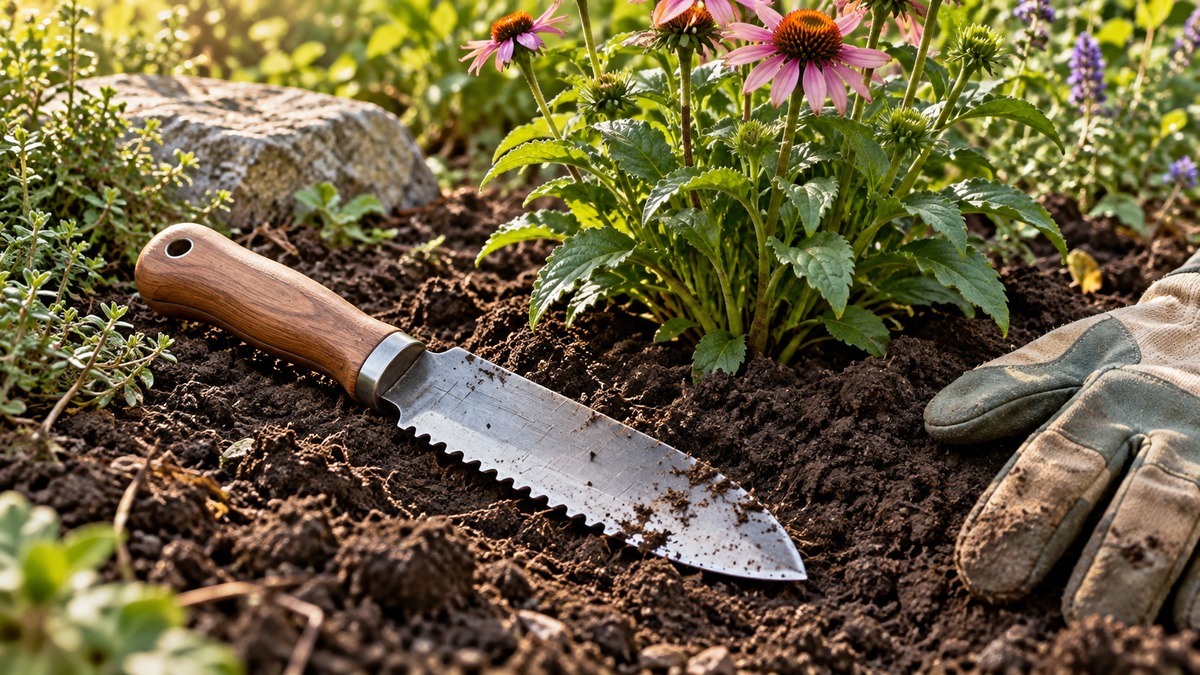
A hori hori is a digging knife with a straight edge on one side and a serrated edge on the other. The curved blade lifts soil, the straight edge slices through roots and sod, and the serrated edge saws through a tough root that a trowel cannot cut. Most gardeners use it for planting bulbs at the right depth, dividing perennials, and pulling weeds with their roots. The listings in this set describe those uses, along with cutting cord and measuring soil depth.
The three features that matter most are the blade, the handle and the depth markings. A blade that is too thin will bend under a root, and a blade that is too thick will not dig well. A handle that is too smooth slips when the soil is wet, and a handle that is too rough blisters the hand. Depth markings are useful only if they are placed where you can read them while you work.
The listings give a 7-inch blade in most cases, with two exceptions: TONMA lists a 7.2-inch blade and Nisaku lists a 7.25-inch blade. The planning difference between a 7-inch and a 7.25-inch blade is small. The difference is 7.25 – 7 = 0.25 inches, which is a quarter inch of extra cutting edge at the tip, not a change in how the knife feels in the hand.
Blade and steel
Stainless steel is named in most of the listings, though the grade is not always stated. The PERWIN bullets describe high-grade stainless steel with blades that extend into a full tang. The Attican bullets describe 100 percent stainless steel that the listing says is rust-resistant. The TONMA bullets name Japanese AUS-8 stainless steel with a hardness of HRC 58 plus or minus 1, and they describe a concave blade with one beveled sharp edge and one serrated edge. The Nisaku bullets name the finest stainless steel and a blade that is both serrated and straight-edged.
The Grand Way title names a heavy duty stainless steel blade with serrated and straight full-tang edges, but the bullets do not name a steel grade. The STRFOG title names a 7-inch stainless steel blade, and its bullets do not name a grade either. A hardness figure is the only steel detail that a buyer can compare directly, and only the TONMA listing gives one in the text we read.
The shape matters as much as the steel. A concave blade, as TONMA describes, scoops soil. A straight blade, as Grand Way describes on one edge, cuts cleanly through a root. A serrated edge, which most listings name, grips a root and saws through it. The best blade for you is the one whose edges match the jobs you do most often.
Handle
The handle decides grip and comfort. PERWIN names a full-tang wood handle with a hanging hole, and Nisaku names a 5.25-inch wooden handle that weighs the knife at 10 ounces. STRFOG describes an ergonomic wood handle. Wood is comfortable in dry soil, but it can soak up water, and the listings do not say how the wood is sealed.
Grand Way describes a rubber-coated plastic handle and says it will not crack, absorb moisture or become slippery like wood. That is a useful trade for wet or muddy work. The Attican listing describes a sturdy ergonomic handle without naming the material. The TONMA listing does not state a handle material in the bullets we read.
A full tang runs the blade’s steel through the handle. PERWIN and Grand Way both name a full-tang blade, which the listings say adds strength. The bullets do not give a test for how much load a tang will carry, so the phrase is a maker’s claim.
Depth markings
Depth markings help you plant bulbs and seeds at the right depth without a ruler. Five listings name them. Attican gives markings in millimeters and inches. STRFOG gives a dual scale in inches and millimeters. TONMA engraves inch markers on the blade. Nisaku gives inch markings on the stainless blade. PERWIN describes a depth measurement in inches. Grand Way describes measuring soil depth, but its bullets do not name the marking scale.
Check the scale before you buy. A listing that gives only inches suits a gardener who plants by the inch, and a listing with millimeters suits a buyer who follows metric seed packets. Both kinds of marking can be hard to read in dim light or on a dirty blade, so keep the blade clean when you measure.
A planning check on the handle
A hori hori’s overall length is the blade plus the handle. PERWIN lists an overall length of 12.1 inches and a 7-inch blade. For a planning estimate, the handle is about 12.1 – 7 = 5.1 inches. That figure is our planning estimate from the listed numbers, not a measurement, and the tang runs into the handle, so the actual grip length may differ. Use the estimate to judge whether the handle will fit your hand before you order.
The numbers side by side
The table gives each listing’s stated figures from its title and first bullets. A dash means the text we read did not state that figure.
| Brand (listing) | Blade | Steel | Handle | Depth markings | Sheath |
|---|---|---|---|---|---|
| PERWIN | 7 inch, sharp and serrated edges | high-grade stainless | full-tang wood, hanging hole | depth in inches | sheath (title) |
| Attican (Black Iron title) | 7 inch, beveled and serrated | 100% stainless | sturdy ergonomic handle | millimeters and inches | leather sheath, sharpening stone (title) |
| TONMA | 7.2 inch, concave, beveled and serrated | AUS-8 stainless, HRC 58 plus or minus 1 | – | engraved inch markers | – |
| Nisaku | 7.25 inch, serrated and straight | fine stainless | wood, 5.25 inch | inch markings | – |
| STRFOG | 7 inch stainless (title) | – | wood | dual inch and millimeter | sheath with belt loop |
| Grand Way | 7 inch, serrated and straight full-tang (title) | – | rubber-coated plastic | – | sheath (title) |
The table shows the main split in this group. Four listings give a sheath, three give a wood handle, and only one gives a hardness figure. Two listings name Japan as the place of manufacture.
Digging, cutting and lifting
Digging with a hori hori is a form of lifting, and the back is the part of the body that takes the strain. Penn State Extension says that “Shoveling can often be considered just a different form of lifting!” The same page advises that “When shoveling, keep your hands widely separated for good leverage.” A hori hori is a smaller tool than a shovel, but the same logic holds for a hand that stays close to the body and a back that does not twist.
Keep the blade in line with the cut. Push down with your legs rather than your back, and do not lever the blade through a root by rocking your wrist. A root that does not come out on the first try often needs a second, shallower cut.
Safety with a sharp edge
A hori hori has a sharp edge, and most of the listings describe the blade as sharp or serrated. The University of Florida hand tool guide says that “When working with knives, CS #23205 blades, or other tools with sharp edges consider wearing cut or puncture resistant gloves.” That advice fits this tool. Wear gloves when you cut roots, and keep the blade away from the other hand when you cut toward yourself.
Store the knife in its sheath when you are not using it. Several listings name a sheath, and a sheath keeps the edge from striking other tools in a bag. If the listing does not name a sheath, use a tool bag with a separate pocket for sharp tools. The listings do not describe a locking sheath or a blade guard, so check the product page for those details.
Choosing a hori hori for your work
Start with the soil. Dry, loose soil works well with a wood handle, which is light and comfortable. Wet or muddy soil favors a rubber-coated handle that will not slip. If you dig mostly clay, a thicker blade and a full tang give more confidence, though the listings do not state a blade thickness for every model. The TONMA listing describes a concave blade that scoops soil, which may suit clay.
Think about the markings next. If you plant by the inch, choose a model with inch markings. If you use metric seed packets, choose a dual-scale or millimeter model. Read the marking description in the bullets, because the listings do not all use the same scale.
Last, think about the sheath. A sheath protects the edge and makes the knife safer to carry on a belt. If you carry the knife in a bag with other tools, a sheath is a good idea. If you carry it on a belt, check that the sheath has a belt loop, which the STRFOG listing names.
Mistakes to avoid
Do not use a hori hori as a pry bar. The blade is meant for digging and cutting roots, and forcing it can bend the blade or loosen the handle.
Do not leave the knife in wet soil for days. Wood handles can swell and steel can rust where the edge is nicked. Clean and dry the blade after use, and keep the sheath dry.
Do not rely on the depth markings alone. Markings are a guide, and the soil depth you need depends on the plant and the seed packet.
Do not buy the knife by its title alone. The STRFOG title names stocking stuffers, while its bullets describe a working garden tool. Read the bullets for the tasks the listing states.
Care and storage
Rinse the blade after digging in clay, dry it with a cloth, and keep it out of wet storage. A dry sheath and a dry wood handle last longer than a wet set. Sharpen only with a stone or a tool made for the job, and note that the Attican listing names a sharpening stone in its title. Check the handle at the tang each season for looseness, because a handle that moves under load is harder to control.
Planting depth in practice
The inch markings make depth easy to read. For a bulb that the seed packet says to plant at 2 inches, push the blade in until the 2-inch mark meets the soil line, then drop the bulb and fill the hole. This is one practical use of the markings, not a rule, because each packet gives its own depth and the listings do not state a tolerance for their marks.
Picks
1. PERWIN Hori Hori Garden Knife, Garden Tools with Sheath for Weeding, Planting, Digging, 7″ (Full-tang wood handle with a hanging hole)
Pros
- The title names a full-tang wood handle with a hanging hole
- The bullets describe a sharp edge for slicing and a serrated edge for cutting tough roots
Cons
- The bullets name high-grade stainless steel without a grade
- The bullets give a 12.1 inch overall length, so check the sheath fit for your bag
Best for: A gardener who wants a wood handle and a hanging hole for storage
Skip if: You want a rubber or plastic grip for wet work
View on Amazon (affiliate link)
2. Black Iron Hori Hori Garden Knife [7 Inches, Japanese Stainless Steel] Durable Gardening Tool (Stainless blade with depth markings in millimeters and inches)
Pros
- The bullets give depth markings in millimeters and inches
- The title lists a leather sheath and a sharpening stone
Cons
- The bullets name 100 percent stainless steel but give no hardness figure
- The bullets do not name the handle material
Best for: A buyer who wants depth markings in both metric and inches
Skip if: You need the handle material stated before you buy
View on Amazon (affiliate link)
3. TONMA Hori Hori Garden Knife, Made in Japan, Garden Trowel, TGK-2 (Made-in-Japan AUS-8 blade with engraved inch markers)
Pros
- The bullets state AUS-8 stainless steel with a hardness of HRC 58 plus or minus 1
- The bullets describe a 7.2 inch concave blade with a beveled edge and a serrated edge
Cons
- The bullets do not name a handle material or a sheath
- The bullets describe inch markers only, not millimeters
Best for: A buyer who wants a stated hardness figure and a Japanese blade
Skip if: You want a sheath included with the knife
View on Amazon (affiliate link)
4. NISAKU NJP650 The Original Hori Hori Namibagata Stainless Steel Weeding Knife, 7.25-Inch Blade (Japanese weeding knife with a wood handle and dual edges)
Pros
- The bullets state a 7.25 inch blade and a 5.25 inch wood handle
- The bullets describe both serrated and straight edges on the blade
Cons
- The bullets do not describe a sheath
- The bullets mention a peg rack for storage rather than a carry case
Best for: A gardener who wants a wood handle and inch markings
Skip if: You want a non-slip handle for wet soil
View on Amazon (affiliate link)
5. Hori Hori Garden Knife, Stocking Stuffers for Men Women Kids, Garden Tools for Digging Planting (Dual-scale measuring knife with a belt sheath)
Pros
- The title names dual-scale inch and millimeter markings
- The bullets describe a protective sheath with a belt loop and a hanging hole
Cons
- The bullets describe the knife as a trowel, small spade and weed puller, so it covers more tasks with less focus
- The bullets do not give the blade steel grade
Best for: A gardener who wants a belt sheath and both metric and inch markings
Skip if: You need the steel grade or hardness stated before you buy
View on Amazon (affiliate link)
6. Hori Hori Garden Knife 7″ with Sheath – Heavy Duty Stainless Steel Multi-Purpose Tool for Weeding (Rubber-handled hori hori with serrated and straight edges)
Pros
- The title names a non-slip handle and a full-tang blade with serrated and straight edges
- The bullets describe a rubber-coated plastic handle that will not absorb moisture
Cons
- The bullets do not describe the blade steel
- The plastic handle may feel different in the hand from a wood grip
Best for: Wet or muddy soil where a non-slip grip matters
Skip if: You prefer a traditional wood handle
View on Amazon (affiliate link)
How we chose
We searched Amazon.com for hori hori knives on 2026-10-21 and read the first results page. We kept listings for a hori hori or a weeding knife with a straight edge and a serrated edge, and we dropped folding pocket knives, plain trowels and kits with several tools. We chose one listing per brand. The six picks are the set of listings that met those rules and came from six different brands.
This guide uses the title and first bullets of each listing. The figures above are the listing’s own numbers. It does not use customer reviews or seller ratings, and it leaves out purchase details. Each pick’s pros and cons come from the text the listing states, and the skip-if line names the buyer for whom the knife is the wrong choice.
What we could not verify
- How the blades hold an edge in soil or how the tangs handle a heavy root. The sources we opened cover gloves and lifting technique, not the performance of any knife.
- The hardness figure for TONMA. The number is in the listing, and we did not confirm it with the maker.
- The steel grade for Attican, PERWIN, STRFOG and Grand Way. The bullets name stainless steel without a grade.
- The rust resistance of any blade, including claims in the Attican bullets. These are the maker’s words.
- The handle material for TONMA and the sheath for Nisaku, which the bullets do not state.
- Whether the depth markings are accurate to the millimeter or inch. The listings give the marking scale, not a tolerance.
- Anything below the first bullets of each listing, including warranty and return terms.
FAQ
Is a hori hori better than a trowel?
For a planting hole and for cutting roots, a hori hori does more than a trowel. A trowel is better for scooping loose soil and moving potting mix, because its blade is wider and flatter. Many gardeners keep one of each.
What size blade should I buy?
Most listings here give a 7-inch blade, and that size suits most garden jobs. A longer blade of 7.25 inches adds a quarter inch of cutting edge. The difference is small, so choose by handle, steel and markings first.
Which handle is best for wet soil?
A rubber-coated plastic handle, as the Grand Way listing describes, will not absorb water or slip as easily as wood. A wood handle is comfortable in dry soil, and it can swell when wet, so keep it dry and clean.
Do I need a sheath?
If you carry the knife on a belt or in a bag with other tools, a sheath protects the edge and your hands. Several listings name a sheath, but the bullets for TONMA and Nisaku do not, so check the product page before you buy.
Are the depth markings accurate?
The listings state the markings, but they do not give a tolerance. Use the markings as a guide, and check the depth against the seed packet or the bulb label before you plant.
Bottom line
Choose the hori hori whose blade, handle and markings match your soil and your planting habits. For dry soil and a traditional grip, the PERWIN listing is the one to compare first. For a stated hardness figure, the TONMA listing gives the most detail. For wet soil and a non-slip grip, the Grand Way listing is the strongest choice in this set.
For related planting work, see our best planting carrots in raised beds guide and our best vegetables to plant in raised beds guide.
Sources
- University of Florida Facilities Services, hand tool safety guide (PDF): gloves when working with knives and other sharp-edged tools.
- Penn State Extension, Healthy Tips to Garden with Fewer Aches and Pains: shoveling as a form of lifting and hand spacing for leverage.
- Ohio State University Extension, AEX-790, Preventing Lifting Injuries: lifting, pulling and pushing heavy objects and back injuries.