Black Soldier Fly Bin DIY
As an Amazon Associate we earn from qualifying purchases. Details
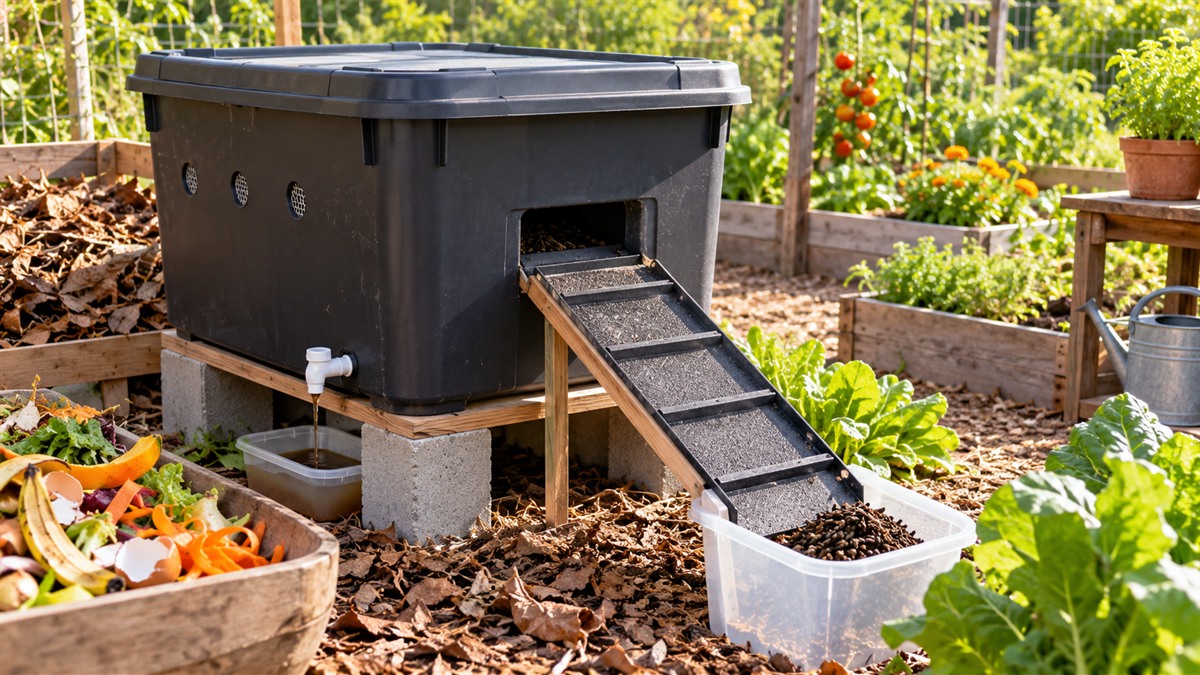
A DIY black soldier fly bin is a container with a lid, a set of exit holes or ramps so mature larvae can leave on their own, and a drain at the bottom. Purdue University Extension describes two builds you can make from common materials: an 18-gallon tote and a 55-gallon drum. The same guide says the larvae cannot survive winter in cold climates, so starter larvae are bought in early spring. This guide explains both builds, how to feed the bin, and when to harvest, using only what the Purdue guide states. Specs and figures were checked on 2026-10-17.
Quick answer
- Smallest build: an 18-gallon tote with a 1-inch ball valve drain, two 1-inch exit holes and two ramps.
- Larger build: a 55-gallon drum cut in half lengthwise and mounted in a lumber frame, with a hinged lid.
- Harvest: the compost can be harvested in as little as 21 days, and the bin contents can be dug out about every 20 days.
- Winter: buy larvae in early spring, and move the bin to a sheltered spot in cold months.
What a black soldier fly bin is for
The bin holds food scraps and a colony of larvae. The larvae eat the food and turn it into compost, and the adult flies lay eggs on the cardboard inside the lid. Purdue’s guide gives a full life cycle of about 38 days. Both builds include exit holes and ramps, which the guide’s steps describe as part of the bin.
Option 1: the 18-gallon tote
Purdue lists these materials:
- One 18-gallon tote
- 1-inch PVC fittings and a 5-ft pipe
- A 1-inch ball valve
- Waterproof caulk
The steps, as the guide describes them:
- Cut two 1-inch exit holes near the top of one short side.
- Cut one 1-inch drain hole low on the opposite side. The guide marks this hole as optional.
- Cut a 1-inch hole in the lid for the tee fitting.
- Build two ramps at about 35 degrees, and cut entry holes along them.
- Seal the wall openings with caulk.
- Hang corrugated cardboard inside the lid. The larvae use it as a place to lay eggs.
Option 2: the 55-gallon drum
The drum build uses more material. Purdue lists 60 ft of 2×4 lumber, 115 ft of 1×4 lumber, screws, hinges, 6 ft of chain, a 1-inch threaded tee and a 1-inch ball valve, plus the 55-gallon drum itself. The guide notes that lighter-colored drums work better in warm weather.
- Cut the drum in half lengthwise and mount each half in a lumber frame.
- Drill a 1/2-inch hole in the lid half for the tee fitting.
- Build two H-shaped legs and attach the bottom half to them.
- Add drain holes, then hinge the lid and support it with chain.
- Line the bottom edge with 1×4 boards, leaving a gap for an exit ramp, and add a ramp inside the bin.
How much to feed
Purdue gives feeding amounts in two places, and they do not match. The text recommends 4 lb of material per day for 10,000 larvae. Table 1 in the same guide lists 3.59 lb per day for that same count. The table’s figures are based on an average of 63 mg of food per larva per day. Use the table, since it shows how the number was reached, and check your own bin’s weight over the first week.
| Larvae | Food per day (Purdue Table 1) | Reference item in the guide |
|---|---|---|
| 250 | 0.09 lb | 1/2 cup of rice |
| 1,000 | 0.36 lb | 2 cups of rice |
| 5,000 | 1.79 lb | 1 pineapple |
| 10,000 | 3.59 lb | A standard bag of apples |
| 20,000 | 7.17 lb | Two bags of apples |
| 50,000 | 17.93 lb | About a peck of tomatoes |
Worked example: a 10,000-larva starter bin
Take the 3.59 lb per day from the table. Over one week that is 3.59 x 7, or about 25 lb of food. Over a 21-day harvest window, it is 3.59 x 21, or about 75 lb. These are our calculations from the table’s daily figure, not numbers the guide gives for a week or a harvest cycle. If your bin holds much less food than that, the larvae may run short. If it fills faster than you can feed it, slow down.
Harvest and the life cycle
Purdue says the compost can be harvested in as little as 21 days. The contents can be dug out roughly every 20 days, and the full life cycle takes about 38 days. When you dig out the bin, leave a small amount of feed and larvae in the base. That gives the next batch a start. The guide does not say how much to leave, so start with a small amount and adjust after one cycle.
Winter and timing
The Purdue guide is written for Indiana, and it says black soldier fly cannot survive winter there unless the bin is moved into a sheltered or protected area. It also says to buy larvae in early spring because they do not successfully overwinter. If you live in a cold climate, plan the first batch for spring, and bring the bin into a sheltered space before the cold sets in.
Mistakes to avoid
- Using the 4 lb figure without checking the table. The text and Table 1 disagree. Weigh your own food for a week before you settle on an amount.
- Buying larvae in the fall. The guide says they do not overwinter, so a fall start leaves the bin with no colony by spring.
- Leaving the bin empty of larvae after harvest. Keep some feed and larvae in the base to start the next cycle.
- Leaving out the exit holes and ramps. Both builds include them in the steps Purdue lists, so leaving them out departs from the plan.
Frequently asked questions
How long does a black soldier fly bin take to make compost?
Purdue says the compost can be harvested in as little as 21 days, and the bin contents can be dug out roughly every 20 days. The full life cycle is about 38 days.
Can black soldier fly larvae survive winter in a DIY bin?
Purdue says they cannot survive winter in Indiana’s climate unless the bin is moved into a sheltered or protected area. Buy larvae in early spring because they do not successfully overwinter.
How much food does a 10,000-larva bin need each day?
Table 1 in the Purdue guide lists 3.59 lb per day. The text gives 4 lb per day. The table is the figure the guide shows its working for.
Which build should I start with?
The 18-gallon tote is the smaller build, with a 1-inch ball valve drain and two 1-inch exit holes. The 55-gallon drum needs far more lumber and more cutting. Purdue describes both, and the choice depends on how much food you have to feed.
Where to go next
If you want a compost bin without the larvae, how to build a compost bin covers a simpler build. For a smaller container, see a DIY compost bin from a 5-gallon bucket, and for getting a pile started, how to start a compost bin walks through the first weeks.
Source opened
Purdue University Extension, Department of Entomology, Black Soldier Fly Composting Guide (E-276), published November 2022: extension.entm.purdue.edu/publications/E-276. Every build step, feeding figure, harvest timing and winter statement above comes from this guide unless we say otherwise.