THE Growing 43 Gal Compost Bin Tumbler Review: Specs and Limits
As an Amazon Associate we earn from qualifying purchases.
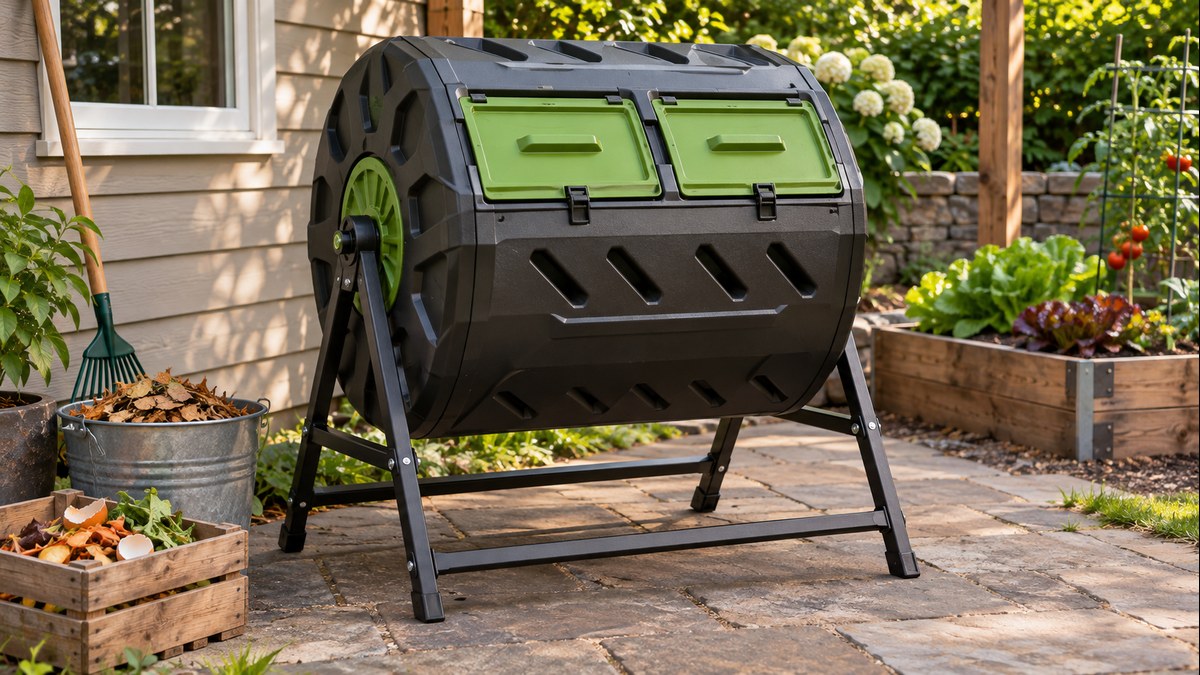
This THE Growing 43 gal compost tumbler review looks at the THE Growing 43 Gal Outdoor Compost Bin Tumbler for Backyard in orange. The unit is a hexagonal resin drum divided into twin 21.5 gallon chambers, with a combined listed capacity of 43 gallons. The listing says its panels use pre-embedded metal nuts for assembly and that the drum rotates on an iron support frame. This review sets out what the listing says, what federal and university guidance says about rotating bins, and which details the public record does not settle. Each product fact comes from the listing page or a cited source.
Quick answer
- The listing gives 43 gallons total, twin 21.5 gallon chambers, a hexagonal shape, and an item weight of 20.8 pounds.
- The main design claims are pre-embedded nuts for assembly, agitating fins inside the drum, and cross-ventilation slots. These are seller statements and are not measured here.
- The listing gives conflicting materials. The specification table says polypropylene, while the variant table says PVC.
- Extension guidance says a tumbler needs regular turning and a balanced mix of browns and greens. The listing gives no turning schedule.
What the listing says
The current listing is available at View on Amazon. The brand is listed as THE GROW’ING and the manufacturer with the same name. The specification table gives the color as orange, the capacity as 43 gallons, the product dimensions as 25 inches long, 26 inches wide and 33 inches high, and the shape as hexagonal. The item weight is 20.8 pounds and the number of items is one.
The material field reads Polypropylene (PP). The variant table on the same page lists the material as PVC for each color option. Those two entries disagree, and the listing does not say which is correct. A buyer who cares about the plastic should check the product details before ordering.
The bullets describe three design features. The first is pre-embedded metal nuts molded into the resin panels, which the listing says removes the need for loose washers when a single person assembles the bin. The second is a balanced rotating axis that lets the drum turn without heavy lifting. The third is deep agitating fins on the inner wall and cross-ventilation slots that the listing says guide airflow through the pile. The listing also describes the resin as UV-stabilized and impact-resistant. None of these claims was tested for this review.
The variant table lists four color options, orange, coffee, green and black, and shows the same 43 gallon capacity and hexagonal shape for each. The listing’s dimensions and weight are given for the orange version, and the listing does not say whether the other colors differ in size or weight. Buyers who want a particular color should confirm the dimensions on the color option they select.
The variant table also includes gloves and a built-in net as included features. The safety section advises wearing gloves, keeping the bin clean and well-ventilated, and keeping pests in mind. Those points match the general home composting advice in the sources below.
Twin chambers and the hexagonal drum
Twin chambers allow a gardener to run one side as active compost and keep the other side closed to cure. The listing describes this as a way to separate processing timelines, with one chamber left to let seasonal scraps cure while the active side takes daily vegetable peels and lawn clippings. That is a sound approach, and it matches the batch method that extension sources recommend for tumblers. A single full chamber left alone can slow down, so a second chamber lets a gardener keep adding material.
At 21.5 gallons per chamber, each side is a moderate volume. Large seasonal loads of leaves will fill a chamber quickly, and the listing does not say how much finished compost a chamber produces. The 43 gallon total is the figure to compare against other bins.
The hexagonal shape is common in this category. The listing does not explain why a hexagon was chosen, and it does not say whether the corners affect how the contents tumble. The mixing fins are the feature the listing relies on to break up dense material. Buyers who want to see the fins in use should look at the product photos and any video on the page before choosing this bin over a cylindrical one.
The dimensions of 25 by 26 by 33 inches give a moderate footprint. The listing says the bin can sit on a patio or in a raised bed corner. A base or tray under a rotating bin is a practical step, because a tumbler with ventilation holes can release liquid as the contents break down.
What the sources say about turning and loading
The U.S. Environmental Protection Agency’s home composting guidance describes turning as a way to speed decomposition. The page says that “Turning and mixing your pile from time to time will help speed up the decomposition process and aerate the pile.” It also lists barrels and tumblers among the enclosed bins a home composter may choose, which places this drum in the same group as other sealed composters.
The University of Arkansas Division of Agriculture publication on compost tumblers reports on a homemade drum. It says that “Once loaded, a tumbler produces usable compost in as little as two to three weeks.” It also says that “All you have to do is turn the tumbler once a day.” Those statements describe an extension model, not this product, and the timing depends on the material mix and how often the bin is turned. Still, they show the kind of result a loaded tumbler can give when it is managed.
Both sources point to the same working rules. Load the bin in batches, mix browns such as dry leaves and shredded paper with greens such as fruit scraps and grass clippings, and keep the material moist without making it soggy. The EPA guidance also says to keep meat, dairy and greasy foods out of a home bin, and that advice applies to a twin chamber tumbler like this one.
The twin layout helps only when the owner keeps the chambers separate in practice. If both sides are loaded at once with unlike material, the result is no different from one overloaded chamber.
Who this bin fits
The listing aims at a backyard gardener who wants to compost kitchen scraps and garden waste in a bin that turns, and who may assemble it alone. The pre-embedded nuts and the 20.8 pound weight suggest a unit that one adult can set up and move, although the listing does not say whether it can be moved when full.
The bin is probably a weaker choice for someone who needs a large volume at once, or who wants a pile that heats strongly. Extension guidance on tumblers says the volume of most tumblers is too small for hot composting. Buyers who want fast, hot compost for a large garden should look at a bigger open system.
Gardeners who compost in a pile and want a neater option, or who want two stages of compost without digging, are the clearest match. Anyone who prefers to leave a bin alone for long periods should consider a stationary bin, because a tumbler works best when it is turned regularly. The article on how to make garden compost quickly explains the material mix that applies to any bin of this type.
How we chose the sources
The listing was read on 2026-10-27 and its specification and bullet fields were copied into a research file without edits. Sources were limited to federal and university pages that opened directly, with the HTTP status recorded for each. Quotes were checked against fetched text before use. Pages that returned an error or a bot block were not used, and no source was chosen because it sells a product.
Frequently asked questions
How much capacity does each chamber have?
The listing gives twin 21.5 gallon chambers and 43 gallons total. It does not say how much finished compost each chamber yields.
Is the bin polypropylene or PVC?
The specification table says polypropylene and the variant table says PVC. The listing does not explain the difference, so check the product details before buying.
What we could not verify
The dimensions, weight and capacity here are the listing’s figures and have not been checked against a bin. The material conflict between PP and PVC is not resolved by any source reviewed. The listing does not give wall thickness, the size of the vents, the strength of the nut and panel joints, or the expected life of the resin.
The fin and airflow claims are design descriptions. Without a parts diagram or an independent measurement, the listing’s statement about how the fins lift dense material cannot be confirmed.
What the sources do not say
The EPA page does not discuss this product or any tumbler brand. The University of Arkansas publication describes a homemade drum built from a 55-gallon barrel, and it does not address a commercial resin unit with twin chambers. Neither source gives a turning frequency for this model, and neither says how a resin tumbler holds up through a hot summer or a freezing winter. No source reviewed gives the expected yield of finished compost from one chamber.
Related guides
Gardeners who want to make a compost tea from finished material can read how to make a compost tea. For a second approach to kitchen scraps, the guide on how to make earthworm castings covers worm-based processing.
Sources
- U.S. Environmental Protection Agency, “Composting at Home,” https://www.epa.gov/recycle/composting-home (opened 2026-10-27, HTTP 200). Used for: turning and mixing speeds decomposition; enclosed bins including barrels and tumblers.
- University of Arkansas Division of Agriculture, “Compost Tumblers,” FSA-6034, https://www.uaex.uada.edu/publications/PDF/FSA-6034.pdf (opened 2026-10-27, HTTP 200). Used for: tumbler batch timing and a homemade tumbler turning frequency, not this product.

